

Key takeaways
- Best all-in-one system: Hennessy Hammock Explorer Deluxe
- Best for frequent backpackers: Warbonnet Blackbird XLC with a dedicated rain tarp
- Best for a flatter, roomier lay: Haven Tent
- Best for occasional car camping: a double-layer gathered-end hammock tent with a larger tarp and simple webbing suspension
- Best for wet, exposed camps: an integrated bug-net hammock paired with a full-coverage tarp, preferably with doors
The best hammock tents for 2026 are the Hennessy Hammock Explorer Deluxe for integrated weather protection, the Warbonnet Blackbird XLC with a separate tarp for versatile three-season camping, and the Haven Tent for a flatter, wider sleeping platform.
A hammock tent is more than a fabric bed: the suspension determines setup and tree compatibility, the sleeping dimensions affect whether you can lie diagonally, and the tarp and insulation system decide whether it remains comfortable after sunset. Use the comparison below to match the design to your camping conditions rather than choosing by packed size alone.
Our top picks
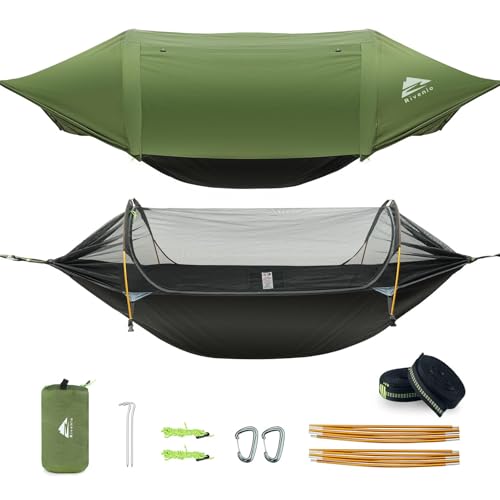


As an Amazon Associate we earn from qualifying purchases at no extra cost to you. Ratings are shown as listed on Amazon.
Best hammock tents by camping situation
- Best all-in-one system: Hennessy Hammock Explorer Deluxe
- Best for frequent backpackers: Warbonnet Blackbird XLC with a dedicated rain tarp
- Best for a flatter, roomier lay: Haven Tent
- Best for occasional car camping: a double-layer gathered-end hammock tent with a larger tarp and simple webbing suspension
- Best for wet, exposed camps: an integrated bug-net hammock paired with a full-coverage tarp, preferably with doors
Hammock tent comparison
| Model or system | Sleeping dimensions | Suspension approach | Rain protection | Insulation compatibility | Approx. packed weight |
|---|---|---|---|---|---|
| Hennessy Hammock Explorer Deluxe | About 100 x 52 in; asymmetrical lay | Tree straps and rope-based suspension, depending on package | Integrated bug net; included rainfly varies by package, generally diamond or larger asymmetrical coverage | Works with an underquilt; bottom-entry design limits some pad choices | About 3 lb 10 oz to 4 lb, depending on suspension and tarp |
| Warbonnet Blackbird XLC | About 120 x 63 in; asymmetrical lay with footbox | Webbing or whoopie-sling suspension, usually selected separately | Integrated bug net; separate tarp required for dependable rain protection | Excellent compatibility with gathered-end underquilts and hammock pads | About 2 lb 8 oz for the hammock body and net; complete system commonly 4–6 lb |
| Haven Tent | About 80 x 30 in floor; flatter bridge-style platform | Two tree anchors with webbing and carabiner-style connections | Integrated bug net; rainfly is supplied with the tent system | Uses a suspended sleeping pad; proprietary or compatible pad sizing matters | Roughly 5–6 lb for the complete kit, depending on version and accessories |
| Double gathered-end hammock tent system | Commonly 120 x 60–70 in | Two tree straps with buckles or whoopie slings | Bug net and tarp are usually separate | Most flexible: pad, underquilt, or both | About 3–6 lb complete, depending on tarp, insulation, and suspension |
Weights are useful planning figures rather than universal specifications. Fabric weight, suspension length, tarp size, insulation and packaging can change the final number. Confirm the current configuration before buying, especially when a manufacturer sells the hammock body, suspension and tarp separately.
Head-to-head: integrated hammock tent versus modular system
Hennessy Hammock Explorer Deluxe
The Explorer Deluxe makes sense for campers who want one coordinated shelter rather than a collection of compatible parts. Its integrated bug net, asymmetric shape and included weather components reduce shopping decisions. The bottom-entry design also keeps the net closed while you get in.
Its trade-off is flexibility. A bottom-entry hammock is less convenient for some sleeping pads, and the included suspension may be heavier or less adjustable than a modern whoopie-sling setup. The asymmetric body is comfortable for one person but does not provide the broad, open interior of a bridge-style hammock. Choose it for straightforward three-season trips, especially when you value a complete package over the lowest possible weight.
Warbonnet Blackbird XLC
The Blackbird XLC is a strong choice for experienced hammock campers who want generous length, a built-in footbox and a useful side shelf. Its 120-inch class body accommodates taller sleepers better than many compact hammock tents, while the modular suspension lets you choose lightweight whoopie slings or more foolproof adjustable webbing.
The important catch is that the hammock itself is not a complete rain shelter. Add a tarp, ridgeline, stakes and suitable insulation. A 12-foot-class tarp gives more end coverage than a minimal hex tarp, particularly in wind-driven rain. The complete system can therefore weigh more than the listing for the hammock body suggests, but it is easier to repair and upgrade piece by piece.
Haven Tent
The Haven Tent targets campers who dislike the curved, enveloping feel of a conventional gathered-end hammock. Its suspended pad creates a flatter platform and a more tent-like sleeping surface, which can be appealing when changing clothes or organizing small items inside the shelter.
That comfort comes with weight and packing complexity. The sleeping pad is part of the system’s structure, so replacing it with an arbitrary pad may affect fit and stability. It is better suited to short backpacking trips, motorcycle touring and car-supported camps than to minimalist long-distance hiking. Its complete-kit weight is also less attractive if every ounce matters.
How to choose the suspension system
- Adjustable webbing with buckles: easiest to learn and quick to reposition, but often heavier. Look for tree-friendly straps at least 1 inch wide.
- Whoopie slings: lighter and compact, with fine adjustment once you understand the system. They normally require separate tree straps or webbing.
- Rope or cord systems: common on traditional integrated designs, but more dependent on correct knots and tree protection.
- Bridge-hammock hardware: provides a flatter lay but can add spreader bars or more specialized components to pack and protect.
Never suspend from dead trees, cracked limbs or narrow branches. A useful starting point is a suspension angle of about 30 degrees from horizontal, with the hammock roughly chair height at its lowest point. Do not tighten the suspension into a nearly straight line: that increases forces on the fabric, anchors and trees. Stay within the manufacturer’s stated capacity, which may include the occupant and gear.
Rain protection and insulation: the specifications that matter
An integrated bug net does not equal rain protection. For unsettled weather, prioritize a tarp that extends beyond both ends of the hammock and can be pitched with side coverage. A tarp around 11–12 feet long is a practical starting point for many full-length gathered-end hammocks; doors or end panels are valuable in cold wind and prolonged rain.
Insulation must cover the underside as well as the top. A sleeping bag can compress beneath you and lose much of its warmth. An underquilt hangs outside the hammock, preserving loft, while a hammock-compatible sleeping pad provides a more familiar surface but can shift or feel narrow. Bridge hammocks often need a pad designed for their width and shape.
For a three-season kit, budget space and weight for an underquilt rated around the lowest temperature you realistically expect, plus a top quilt or sleeping bag. In damp climates, a tarp with adequate coverage is often more valuable than shaving a few ounces from the hammock body.
Decision matrix for different campers
| Your priority | Best direction | Why |
|---|---|---|
| First hammock trip, minimal research | Integrated Hennessy-style system | Bug net, suspension and weather components are designed to work together |
| Experienced user, frequent trips | Modular gathered-end system such as the Blackbird XLC | Parts can be replaced, tuned and upgraded independently |
| Tall sleeper | At least a 120-inch hammock body | Extra length improves diagonal positioning and reduces calf pressure |
| Broad sleeping position or dislike of cocooning | Bridge-style Haven-type design | Flatter platform, but more weight and pad dependence |
| Cold-weather camping | Double-layer hammock or underquilt-compatible system with full tarp | More reliable insulation placement and wind protection |
| Budget-conscious occasional use | Basic hammock body plus durable straps and a separate tarp | Spreads spending across essential components and avoids decorative extras |
Setup and ownership realities
Before a trip, hang the hammock in the backyard and practice three things: achieving a comfortable diagonal lay, pitching the tarp in both open and storm modes, and attaching the insulation without gaps. A five-minute setup at home can reveal that the tarp is too short or the pad is too narrow before weather makes the problem serious.
Inspect the fabric, stitching, carabiners, suspension and tarp tie-outs after every trip. The suspension and tie-out points usually show wear before the main bed fabric. Replace webbing that is frayed, chemically damaged or permanently creased. Keep tree straps clean and dry, and avoid storing a damp hammock compressed in its stuff sack; mildew and odor can develop quickly.
Wash according to the manufacturer’s instructions, normally with a mild detergent and no fabric softener. Dry completely out of harsh direct sunlight before long-term storage. Do not use ordinary narrow cords around trees: they can damage bark and may be prohibited in managed campsites.
Final recommendation
Choose the Hennessy Hammock Explorer Deluxe if you want the simplest complete hammock tent. Choose the Warbonnet Blackbird XLC if you are prepared to build a modular system and want better long-term tuning, length and repairability. Choose the Haven Tent if a flatter, more tent-like bed matters more than minimum packed weight. In every case, compare the complete shelter—including suspension, tarp and insulation—not just the hammock body’s advertised weight.




Write Your Review
No reviews yet. Be the first to share your experience!