

Key takeaways
- Compare five plasma cutters for home garages and farm repairs by clean-cut and severance ratings, dual voltage, duty cycle, pilot arc and air supply needs.
As an Amazon Associate we earn from qualifying purchases.
A plasma cutter earns its bench space in a home garage or farm shop when it does the jobs an angle grinder does slowly and an oxy-fuel torch does awkwardly: slicing a rusted exhaust section off a truck, trimming sheet steel for a trailer patch, cutting expanded metal for a gate, or parting a seized bracket. The five standalone machines below cover that work at different levels, from a 40-amp name-brand unit with a published rated cut to 50- and 60-amp dual-voltage inverters built around pilot arc starting.
Two numbers decide whether a cutter fits your work, and they are not the same number. The rated or clean-cut figure is the thickness the maker says the machine cuts with a usable edge at a reasonable travel speed. The severance or maximum figure is the thickest material the arc can separate at all, slowly, with a rougher edge and more cleanup. Listings often headline the larger number, so each pick below states the two figures separately, exactly as its maker publishes them. Where a maker publishes only a single maximum figure, that is stated plainly instead of being split into invented ratings.
Input power matters just as much. Most of these machines are dual voltage, but output drops on a household circuit, and the clean-cut rating falls with it. Duty cycle tells you how long the machine can cut at a stated output within a ten-minute period before it needs to cool. Finally, every machine here needs compressed air. None of the five has a built-in compressor, so an external compressor that can sustain the stated flow and pressure is part of the real setup, along with dry, filtered air to protect consumables.
Affiliate Disclosure: This article contains affiliate links. If you buy through a link on this page, we may earn a commission at no extra cost to you.
How to Choose a Plasma Cutter for Garage and Farm Work
Start with the thickest steel you cut regularly, not the thickest piece you might meet once. If most work is exhaust tubing, body panels, angle iron and plate up to 3/8 inch, a 40- or 50-amp machine running on 240 volts covers it with headroom. If you routinely part 1/2-inch plate or implement brackets, look at the 60-amp class and confirm your circuit and compressor can feed it.
Next, check the start type. A non-touch pilot arc starts without the tip touching the workpiece and keeps cutting across painted, rusty or perforated metal, which describes a large share of farm repair work. A high-frequency contact start needs a clean starting point and can struggle on coated surfaces. Blowback pilot arc designs start without high-frequency interference, a point that matters near vehicle electronics.
Then match the air supply. A small compressor that reaches the stated pressure but cannot sustain the flow will give short, deteriorating cuts and short consumable life. A moisture separator is close to mandatory in humid shops, because wet air erodes electrodes and nozzles quickly.
1. Hobart AirForce 40i (500576)

The AirForce 40i is the conservative, fully documented pick in this group. Hobart publishes a rated cut of 5/8 inch in mild steel and a maximum sever cut of 7/8 inch, and it separates the two figures clearly in its own specification sheet. On 120-volt input the output is automatically reduced, with rated outputs of 20 amps on a 15-amp circuit and 27 amps on a 20-amp circuit, so the full ratings belong to 240-volt operation through the included MVP adapters.
Its pilot arc controller keeps the arc established across expanded and perforated metal and across painted or coated surfaces without retriggering, which suits gate mesh, trailer decking and weathered implement steel. The XT40R torch uses a drag shield and widely stocked consumables. There is no built-in compressor: Hobart specifies an external air supply of 6.0 cfm at 90 to 120 psi, with a built-in filter and regulator on the machine itself.
Specs
- Output: up to 40 A
- Rated clean cut: 5/8 in mild steel
- Severance cut: 7/8 in mild steel
- Input voltage: 120/240 V with MVP adapters
- Duty cycle: 60 percent at 40 A on 240 V; 60 percent at 20 A and 35 percent at 27 A on 120 V
- Arc start: pilot arc controller
- Air supply: external compressor required, 6.0 cfm at 90-120 psi; built-in filter and regulator
- Torch: XT40R, 12 ft lead
- Weight: 21 lb
2. PrimeWeld CUT60

The CUT60 is the step up for garages that cut thicker plate on a regular basis. It delivers 20 to 30 amps on 120-volt input and 20 to 60 amps on 240-volt input, with a duty cycle of 60 percent at the full 60 amps and 100 percent at 46 amps on 240 volts. PrimeWeld publishes a maximum steel capacity of up to 7/8 inch; unlike Hobart and LOTOS, it does not headline a separate rated clean-cut figure for this model, and its manual cutting table works up to 20 mm at 240 volts, so treat 7/8 inch as an upper limit rather than an everyday clean-cut rating.
Starting is a non-high-frequency blowback pilot arc, so the torch starts without contact and without spraying high-frequency interference around shop electronics. The PT60 torch, a front-panel air gauge and an adjustable post-flow timer round out a machine aimed at sustained bench work. Air comes from an external compressor: the manual recommends an operating pressure of 55 to 75 psi, and the maker recommends a compressor delivering 5 cfm at 90 psi with a 20-gallon tank for sustained cutting.
Specs
- Output: 20-30 A on 120 V; 20-60 A on 240 V
- Published maximum cut: up to 7/8 in steel; manual cutting table up to 20 mm at 240 V
- Separate rated clean-cut figure: not published by the maker for this model
- Input voltage: 120/240 V dual voltage
- Duty cycle: 60 percent at 60 A on 240 V; 100 percent at 46 A on 240 V
- Arc start: non-high-frequency blowback pilot arc, non-touch
- Air supply: external compressor required, 55-75 psi operating pressure, 5 cfm at 90 psi recommended
- Torch: PT60
- Weight: 33.5 lb
3. LOTOS LT5000D
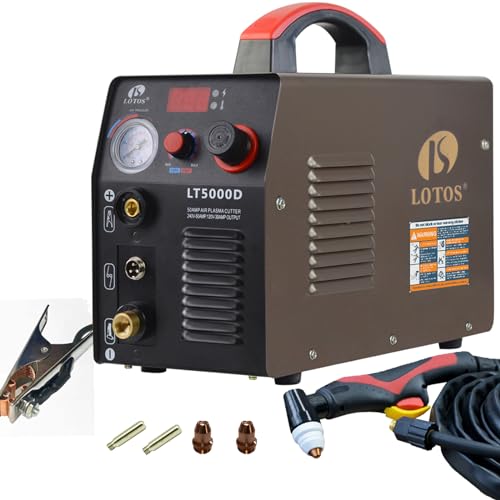
The LT5000D is a long-running 50-amp design that the maker has revised over the years, and the current listing states its capacities in the split format that matters: a 5/8-inch clean cut and a 3/4-inch severance cut. That clean-cut figure is at the strong end of the 50-amp class, so it is worth confirming the current listing revision before ordering, since this model name has covered several board and torch revisions.
The machine runs on 120 or 240 volts and uses a non-touch pilot arc, so it starts on rusty, painted and rough surfaces without dragging the tip across the work. Output adjusts from 10 to 50 amps, and the stated duty cycle is 60 percent at 50 amps on 220-volt input, which is enough for intermittent repair cutting with normal pauses for measuring and repositioning. It needs an external compressor; there is no built-in air supply, and the listing’s consumable sets are model-specific, so match spare tips and electrodes to the LT5000D by name.
Specs
- Output: 10-50 A
- Rated clean cut: 5/8 in (16 mm)
- Severance cut: 3/4 in (20 mm)
- Input voltage: 120/240 V dual voltage
- Duty cycle: 60 percent at 50 A on 220 V input
- Arc start: non-touch pilot arc
- Air supply: external compressor required; no built-in compressor
- Weight: about 22 lb
4. bestarc BTC500DP (9th Generation)

The BTC500DP builds its case on feedback: a large front display showing current, voltage and air pressure together, plus a built-in air sensor that flags supply problems before they ruin a cut. The maker rates it for a 1/2-inch clean cut, with a recommended maximum of 18 mm at 50 amps on 220 volts and 65 psi. On 110 volts the recommended maximum falls to 12 mm at 35 amps.
Its pilot arc is a high-frequency, non-touch design with an adjustable pilot arc time for mesh and expanded metal, and 2T/4T trigger modes for short and sustained cuts. A post-flow setting cools the torch after the trigger is released. Air supply is external: the maker specifies dry compressed air at 65 psi with a flow of 250 liters per minute, and states that the compressor is purchased separately. A built-in regulator and filter are fitted, with a quick-connect air fitting at the rear.
Specs
- Output: 10-35 A on 110 V; 10-50 A on 220 V
- Rated clean cut: 1/2 in
- Maximum cut: 18 mm at 50 A on 220 V, 65 psi; 12 mm at 35 A on 110 V, 50 psi
- Input voltage: 110/220 V automatic dual voltage
- Duty cycle: 60 percent at rated output, per maker listings for this model line
- Arc start: high-frequency non-touch pilot arc, adjustable pilot arc time
- Air supply: external compressor required, 65 psi and 250 L/min flow; built-in air sensor, regulator and filter
- Torch: AG60P pilot arc torch
- Modes: 2T/4T, adjustable post-flow
5. ARCCAPTAIN CUT50
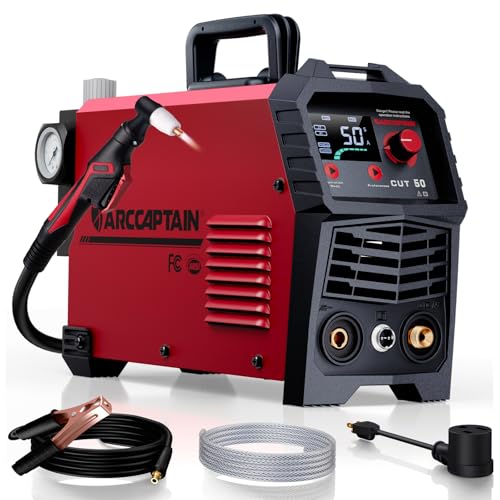
The CUT50 is the lightest machine here at 13 pounds, with a shoulder strap and a large LED display, aimed at garages that move the cutter to the work rather than the other way around. The maker rates it for a 1/2-inch clean cut, with a recommended maximum of 12 mm at 35 amps on 110 volts and 18 mm at 50 amps on 220 volts. Treat that 18 mm figure as the severance end of its range, not an everyday edge-quality rating.
One specification deserves a clear statement, because listings blur it: the maker’s own manual lists the arc ignition mode as high-frequency contact start, not a non-touch pilot arc. On clean, bare metal that is workable; on painted, rusty or perforated stock it is less forgiving than the pilot arc machines above. The manual rates the duty cycle at 60 percent, with output of 20 to 35 amps on 110 volts and 20 to 50 amps on 220 volts. Air is external, at a recommended 65 psi and 150 liters per minute (5.3 cfm), with a built-in regulator fitted.
Specs
- Output: 20-35 A on 110 V; 20-50 A on 220 V
- Rated clean cut: 1/2 in
- Maximum cut: 18 mm at 50 A on 220 V; 12 mm at 35 A on 110 V
- Input voltage: 110/220 V dual voltage
- Duty cycle: 60 percent at rated output
- Arc start: high-frequency contact start, per the maker manual
- Air supply: external compressor required, 65 psi and 150 L/min (5.3 cfm); built-in regulator
- Torch: PT31
- Weight: 13 lb
Safety and Setup Notes
Plasma cutting throws sparks, molten metal and ultraviolet light, often in buildings that store fuel, hay, tires and solvents. Clear the cutting area of combustibles, keep a fire extinguisher within reach, and watch the far side of the workpiece, where the spark stream lands. Wear shade-rated eye protection as the maker directs, leather gloves, and hearing protection for extended cutting.
Electrical setup is part of safety. Full output assumes a 240-volt circuit with the breaker size the maker specifies; running a 50- or 60-amp cutter at high output on an undersized circuit invites nuisance trips and overheated wiring. Ground the workpiece with the work clamp on clean metal close to the cut, and keep the air dry with a moisture trap between compressor and cutter.
A recall check was run for every model in this guide against the United States Consumer Product Safety Commission recall database before publication. No recall was found for any of the five models at the time of checking. Recall status can change, so a quick check of the model name before buying a used unit is worthwhile, especially for older revisions sold under the same model name.
Which One Fits Your Shop?
Choose the Hobart AirForce 40i if documented ratings, a wide consumables network and a genuine 5/8-inch rated cut matter most. Choose the PrimeWeld CUT60 if thicker plate is routine work and your circuit and compressor can support 60 amps. The LOTOS LT5000D suits buyers who want a 50-amp pilot arc machine with a strong stated clean-cut figure and a long track record under one model name. The bestarc BTC500DP is the pick for anyone who values live air-pressure and parameter feedback on the front panel. The ARCCAPTAIN CUT50 makes sense for clean-metal sheet and bracket work where its light weight and simple controls are the priority, with the understanding that its contact start is the compromise in the group.
Whichever machine you choose, budget attention for the unglamorous half of the system: a compressor that sustains the stated flow, dry air, the correct circuit, and a stock of the exact consumables your torch uses. The makers’ figures in this guide assume the air and power feeding the machine are right.
More from Amazon
Programs that pair well with the guide above. Offers and eligibility are set by Amazon and may change.
Free shipping on eligible items, Prime Video and more. Eligible new members can start with a free trial.
Start a Prime free trialA Prime membership for ages 18-24 with a trial period. Eligibility is set by Amazon.
See Prime for Young AdultsAudiobooks and podcasts to listen to on the go. Eligible new members can start with a free trial.
Try Audible freeAd-free music streaming. Eligible new subscribers can start with a free trial.
Try Music Unlimited freeAs an Amazon Associate we earn from qualifying purchases.
Write Your Review
No reviews yet. Be the first to share your experience!