

Key takeaways
- The best dent pullers for paintless dent repair at home, from glue-tab kits and bridge pullers to suction cups, with honest limits on what DIY PDR can fix.
As an Amazon Associate we earn from qualifying purchases.
Paintless dent repair (PDR) pulls a dent back out from the surface of a panel instead of filling, sanding and repainting it. The home kits in this roundup use three methods. Suction cups grip a smooth panel directly and pull. Glue-tab kits stick a plastic tab to the centre of the dent with hot-melt glue, then pull the tab with a squeeze lifter, a bridge puller that straddles the dent, or a small slide hammer. The bridge and lifter give slow, controlled force; the slide hammer gives a sharper tug for metal that will not move gently. Every kit below is a paintless tool: none of them drills, welds or touches the finish with anything harder than rubber feet and glue that releases with alcohol.
The limits matter more than the marketing. These tools work on shallow dents where the paint is intact and the metal has flexed rather than folded. A sharp crease, a dent on a panel edge or body line, stretched metal from a hard impact, and any dent where the paint has cracked or chipped are beyond what a home puller can fix. Glue pulling also carries a real risk on resprays and weakened paint: the tab can lift loose finish off the panel as it releases. Suction cups are gentler but narrower in scope, because they only work where the cup can seal on a flat-ish, smooth area. Aluminium panels add one more complication, since aluminium work-hardens as it moves and resists the repeated small corrections that steel tolerates. Expect technique and patience to decide the result. No kit makes a beginner’s first dent invisible; a good first repair is a dent that is clearly smaller and only visible when you look for it.
Affiliate Disclosure: This article contains affiliate links. If you buy through a link on this page, the site may earn a commission at no additional cost to you. Products were selected from manufacturer specifications and listing data, not from detailed research.
1. GLISTON 45-Piece Paintless Dent Repair Kit

The GLISTON 45-piece kit is the balanced starting point in this group: two pulling tools, a proper spread of tabs, and nothing essential left to buy separately. The golden squeeze lifter is the tool most repairs will use, and this revised version adjusts further than the earlier one, with about 0.39 in more height and 1.5 in more width, so it can centre itself over wider, shallower dents instead of rocking on the panel. The second tool is an arched bridge puller. The arch matters because the bridge feet stand clear of the dent and the pull stays vertical; a flat bar can drag its feet across the finish as the tab rises.
Tab coverage is where this kit earns its place. The lifter works with 16 tab sizes and the bridge with five more, and matching tab size to dent size is the single biggest factor in whether a glue pull holds or pops off early: a tab that is too small tears free, and one that is too large bridges over the low spot and pulls the wrong metal. The box also includes a glue gun, ten glue sticks in two formulations, a tap-down pen for the high spots pulling leaves behind, five trim pry tools, and a tool bag. GLISTON states plainly that the kit is not suitable for corners or creases.
Specs
- Piece count: 45 pieces
- Pulling tools: adjustable golden dent lifter, arched bridge puller
- Lifter adjustment: approx. 0.39 in extra height and 1.5 in extra width versus the previous version
- Tabs: 16 lifter tab sizes, 5 bridge tab sizes
- Glue: hot glue gun with 10 sticks (5 yellow, 5 black)
- Extras: tap-down pen, 5 pry tools, plastic shovels, alcohol bottle, cloth, tool bag
- Construction: aluminium alloy and stainless steel
- Kit weight: 2.79 lb
- Stated limitation: not suitable for corners or creases
2. VEVOR 117-Piece Car Dent Puller Kit
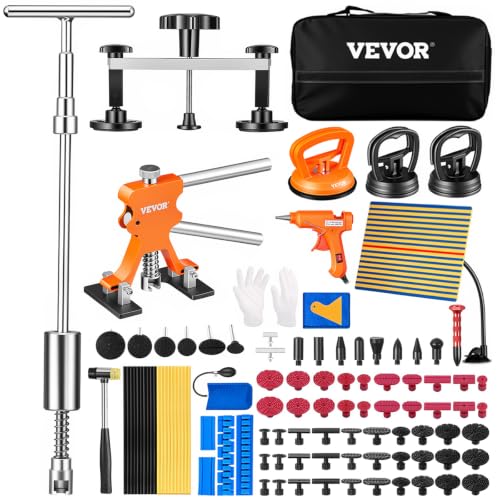
The VEVOR 117-piece kit is the wide-assortment option, built for owners who would rather have every pulling method in one bag than buy tools one dent at a time. It carries four ways to pull: an adjustable golden lifter for dents from 0.2 to 5.3 in, an adjustable bridge puller for dents from 0.2 to 3.54 in, a two-in-one stainless steel slide hammer that reconfigures between a short and a long puller, and three suction cups for the shallow, smooth dents that need no glue at all. When one method stalls on a dent, the next is already in the bag.
The tab supply matches the tool count: 50 puller tabs in varied shapes and sizes plus six bridge tabs, a glue gun and 20 glue sticks. Finishing tools are included as well, with eight tap-down pens, a rubber hammer and a reflector board, the striped board PDR technicians use to read a panel’s surface in reflected light. An air wedge pump rounds out the set for prising trim and gaining access behind panels. The honest trade-off is complexity: a first-time user has to learn which of four pullers suits a dent, and the tab assortment only helps if you match sizes instead of grabbing the nearest one. The stated adjustment ranges describe what the tools can span, not a promise that every dent inside those measurements will come out.
Specs
- Piece count: 117 pieces
- Pulling tools: golden dent lifter, bridge puller, 2-in-1 slide hammer, 3 suction cups
- Lifter range: dents from 0.2 to 5.3 in
- Bridge puller range: dents from 0.2 to 3.54 in
- Tabs: 50 puller tabs plus 6 bridge tabs
- Glue: hot glue gun with 20 glue sticks
- Extras: air wedge pump, 8 tap-down pens, rubber hammer, reflector board, gloves, tool bag
- Slide hammer: stainless steel, converts between short and long configurations
3. Manelord Auto Body Dent Repair Kit with Golden Dent Puller
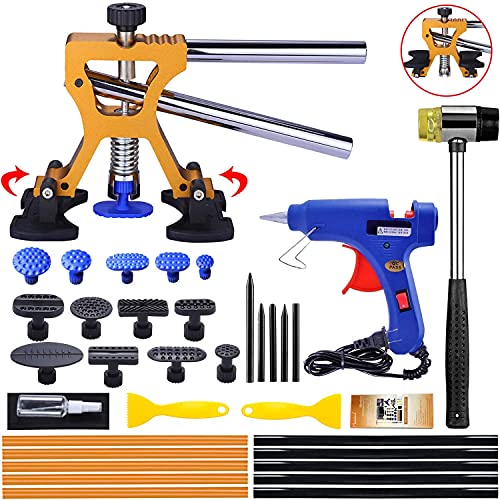
Manelord’s kit takes a focused approach: a golden dent lifter as the main tool, backed by a bridge puller, in a smaller box than the two kits above. The bridge works with 13 tab sizes, which is generous for a kit of this size and means the bridge is not limited to one or two small dings. The lifter-and-bridge pairing covers the two controlled pulling styles, leaving out the slide hammer entirely. For door dings and hail dents, that is a reasonable omission, because controlled pulls are what shallow dents respond to and a slide hammer’s sharper tug is easier to overdo.
The supporting pieces are complete for the method. The 20 W glue gun has a switch on the handle and needs five to eight minutes of preheating before the glue flows properly, a detail worth knowing because glue applied from a half-warm gun bonds weakly and lets go mid-pull. Thirteen glue tabs (eight black, five blue) and ten glue sticks in two colours are included, along with a rubber hammer, five tap-down pens for finishing high spots, two glue shovels for cleaning tabs, and an empty alcohol bottle for the release agent. What the kit does not include is any suction option, so a broad, smooth dent that a cup could have lifted in one pull still has to be worked with glue.
Specs
- Pulling tools: golden dent lifter, bridge puller
- Bridge tabs: 13 sizes
- Glue tabs: 13 total (8 black, 5 blue)
- Glue gun: 20 W, handle switch, 5 to 8 minutes preheat
- Glue sticks: 10 (5 yellow, 5 black)
- Extras: rubber hammer, 5 tap-down pens, 2 glue shovels, alcohol bottle, clean cloth
- Best suited to: door dings, minor dents and hail damage on flat panel areas
4. ARISD 32-Piece Paintless Dent Repair Kit

The ARISD 32-piece kit is the starter set in this roundup, and its smaller scope is a genuine advantage for a first repair. You get the two core controlled pullers, a golden dent lifter and a bridge puller, a mini hot-melt glue gun, and 16 glue tabs in assorted sizes. That is everything the basic glue-pull technique requires, without a slide hammer or a wall of accessories competing for attention while you learn. Several dent-repair roundups have picked this kit out for minor damage for exactly that reason: the learning curve is the technique itself, not the toolbox.
The remaining pieces support the workflow rather than pad the count: glue sticks in two colours, a tap-down pen, two scrapers for clearing glue off tabs and panels, an alcohol spray bottle for releasing tabs, a clean cloth and an instruction manual. The limits are the expected ones at this size. Sixteen tabs cover common ding sizes but leave gaps at the extremes, the mini glue gun recovers temperature more slowly between tabs than a full-size gun, and there is no suction cup or slide hammer to fall back on. As a first kit for door dings and shallow hail dents, though, the focus is the point.
Specs
- Piece count: 32 pieces
- Pulling tools: golden dent lifter, bridge puller
- Tabs: 16 glue tabs in assorted sizes
- Glue: mini hot-melt glue gun with yellow and black glue sticks
- Extras: tap-down pen, 2 scrapers, alcohol spray bottle, clean cloth, instruction manual
- Best suited to: first-time users, door dings and shallow hail dents
5. HORFUTY 3-Pack Suction Cup Dent Puller

The HORFUTY set is the simplest tool here: three suction cups and no glue, no tabs and no setup beyond cleaning the panel. One large 4.5 in cup does the heavy work, with a maker-stated maximum suction of 130 lb horizontally and 80 lb vertically, and two smaller 2.2 in cups handle tighter areas where the big cup cannot sit flat. The handles are solid ABS, the cups are natural rubber, and the core is metal, so the lever action that locks the vacuum down feels firm rather than flexy. The whole set weighs 9.1 oz and stores anywhere.
The trade-offs are the ones the method itself imposes. A suction cup can only pull a dent it can seal over: a broad, shallow dent on a smooth, gently curved panel. It cannot reach into a small ding, follow a strong curve, or do anything with a crease, and the stated suction figures describe the cup’s grip on an ideal surface, not the force your dent will need. What the cups do well is the quick, zero-consumable pull: one attempt takes seconds and leaves nothing to clean up. Treat it as the first thing to try on a suitable dent and a complement to a glue kit, not a replacement for one.
Specs
- Piece count: 3 suction cup pullers
- Cup sizes: 1 x 4.5 in, 2 x 2.2 in
- Stated maximum suction (large cup): 130 lb horizontal, 80 lb vertical
- Construction: ABS handle, natural rubber cup, metal core
- Weight: 9.1 oz total
- Also suited to: lifting glass, tile and smooth flat objects
- Method limit: requires a smooth surface the cup can seal against
How to Choose a Dent Puller
Start with the dent, not the kit. A broad, shallow dent on a flat door or bonnet with unbroken paint is the ideal home repair, and any kit here can attempt it. Small, tight dings need glue tabs, because a suction cup cannot seal over them. A dent with a crease, a fold on a body line, cracked paint or a location right at a panel edge belongs to a professional, and buying a bigger kit does not move it into DIY territory.
Match the puller to the force you need. Squeeze lifters and bridge pullers apply slow, adjustable pressure and are the easiest to control, which is why the GLISTON, Manelord and ARISD kits are built around them. A slide hammer, included in the VEVOR kit, delivers a sudden tug that can move stubborn shallow dents but can also over-pull and create a high spot that then needs tapping down. Suction cups sit at the gentle end: instant to try, limited to dents they can seal over.
Tabs and glue decide whether a glue pull works at all. A wide tab selection, like the GLISTON’s 21 tab sizes across two tools or the VEVOR’s 50-plus tabs, lets you match the tab to the dent so the pull lifts the low spot instead of tearing free. Kits include two glue formulations because bond strength varies with temperature and glue type; clean the panel with alcohol first and let the glue set fully before pulling. Plan on several gentle pulls with repositioned tabs rather than one hard pull.
Finally, set expectations before you start. Work in good light, ideally with a striped reflector or a window reflection across the panel so you can see the dent’s true shape. Practise on a refrigerator door or a less visible panel first. Pull a little, check, tap down any high spots, and repeat. A dent that ends up shallower and only visible in raking light is a successful home repair; chasing the last trace of a dent is how beginners stretch metal and turn a small job into a professional one. On aluminium panels, work even more gently, because the metal hardens as it moves and each correction makes the next one harder.
More from Amazon
Programs that pair well with the guide above. Offers and eligibility are set by Amazon and may change.
Free shipping on eligible items, Prime Video and more. Eligible new members can start with a free trial.
Start a Prime free trialA Prime membership for ages 18-24 with a trial period. Eligibility is set by Amazon.
See Prime for Young AdultsAudiobooks and podcasts to listen to on the go. Eligible new members can start with a free trial.
Try Audible freeAd-free music streaming. Eligible new subscribers can start with a free trial.
Try Music Unlimited freeAs an Amazon Associate we earn from qualifying purchases.










Write Your Review
No reviews yet. Be the first to share your experience!