

Key takeaways
- Compare knife-edge bearing separators by spread range, tapped-hole thread and puller fit, from compact splitter plates to complete 5-ton separator kits.
As an Amazon Associate we earn from qualifying purchases.
Some bearings refuse to give a puller anything to hold. A pinion bearing sits flush against the gear it was pressed beside, a transmission bearing hides behind a shoulder on the shaft, and an axle bearing leaves no lip for jaw tips to hook. A bearing separator exists for exactly that geometry. It is a pair of hardened steel plates with thin, tapered knife edges that are drawn together behind the bearing until the edges sit under the inner race and form a flat, full-width ledge. That ledge is what the pulling force acts on, so the load spreads across the back of the race instead of concentrating on two or three jaw tips.
One point needs stating plainly: a separator alone pulls nothing. The plates only create the gripping surface. The force has to come from a crossbar puller whose legs thread into the separator’s tapped holes, from a jaw puller gripping the outside of the clamped plates, or from a shop press pushing the shaft through while the plates rest on the press bed. A bare separator plate without one of those force sources is half a tool. This guide covers separator plates and separator sets built around them. It does not cover jaw gear pullers as a class, bearing press and driver kits meant for installation, or slide hammer extractors, which solve different problems.
Affiliate Disclosure: This article contains affiliate links. If you buy through these links, we may earn a commission at no additional cost to you.
How a Bearing Separator Works
The two plate halves sit on either side of the shaft, behind the bearing, with the bevelled knife edges facing the bearing. Studs draw the halves together, and the tapered edges wedge into the narrow gap between the bearing and whatever it sits against, working under the inner race until the flat outer faces of the plates form a solid ledge around the shaft.
From there, three force arrangements are common. The legs of a bar-type or push-puller thread into the tapped holes in the plates, and the puller’s forcing screw bears on the end of the shaft. Or the hooks of a jaw puller grip the outer edge of the clamped plates. Or the shaft goes into a hydraulic press with the plates supported on the press bed while the ram pushes the shaft through the bearing. All three load the inner race directly, which is why separators can move bearings that jaws pulling on the outer race or cage would destroy.
What to Check Before Buying
Spread range. The separator’s opening has to match the shaft and bearing diameter. Measure the bearing and the shaft it sits on, then choose a plate whose minimum-to-maximum spread brackets that size with room to spare. A plate that only just reaches the bearing sits at the very ends of its adjusting screws, the weakest way to run it.
Knife-edge condition. The edge does the work, so it has to be thin, straight, and free of chips. A rolled or nicked edge will not enter a tight gap and can skate off the race under load. On a new tool, check that both edges are ground evenly; on a used one, edge damage is the main reason to walk away.
Tapped holes and extension rod compatibility. Separator plates carry threaded holes that accept puller legs and extension rods, and threads are not universal across brands: OTC plates use specific thread sizes per model, and the generic 5-ton kits use their own leg threads. A separator only extends a puller collection if its holes match the legs and rods already on hand. Extension rods matter because deep-set bearings, such as carrier bearings inside a differential housing, often need longer legs to reach a crossbar positioned outside the housing.
Capacity. Complete separator kits carry a tonnage rating for the whole assembly. A separator plate used with a puller takes the rating of the weaker partner, and the plate is never an excuse to exceed the puller’s limit.
The Five Separators
1. OTC 1123 Bearing Splitter
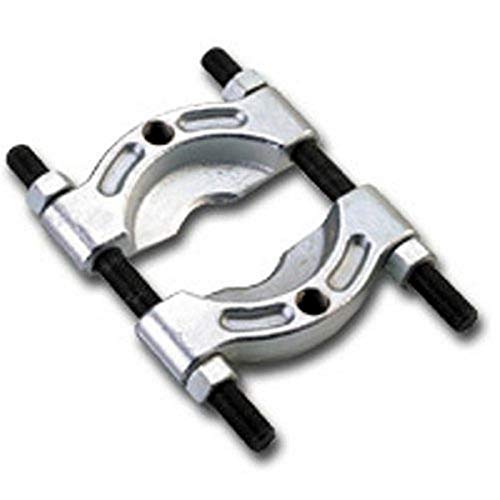
The OTC 1123 is the reference design for this tool class: a two-piece splitter plate from OTC’s long-running puller catalogue, sized for the middle of automotive work. Its spread runs from 1/2 inch to 4-5/8 inches, covering most pinion, carrier, and transmission shaft bearings in passenger vehicle and light truck axles. The knife-like edges are ground to enter the limited clearance behind a press-fit bearing, and the two tapped holes accept puller legs directly.
OTC rates the 1123 for use with its 1035, 1036, 1037, 1038, and 927 pullers, covering both Grip-O-Matic jaw pullers, which grip the outside of the clamped plates, and Push-Puller legs, which thread into the plate holes. With 1/2 inch cap screws fitted, the working spread extends from 2 inches to 7-3/4 inches, although those cap screws are not included. At 5 pounds the plate stays put while being positioned, and the 5/8-18 tapped holes are a standard OTC thread, which matters when matching extension legs from the same catalogue.
Specs
- Brand: OTC
- Model: 1123
- Spread range: 1/2 in minimum to 4-5/8 in maximum
- Extended spread: 2 in to 7-3/4 in with 1/2 in cap screws (not included)
- Tapped hole thread: 5/8 in-18
- Distance between adjusting screws: 4-3/8 in
- Weight: 5 lb
- Compatible pullers: OTC 1035, 1036, 1037, 1038, and 927
2. Sunex 57BS5 Bearing Separator

The Sunex 57BS5 is the large end of the separator plate range. Its opening runs from 1/2 inch to 9 inches, a spread aimed at bigger shaft bearings on heavier driveline and equipment work where mid-size plates cannot close around the shaft. Sunex forges the plate from alloy steel and grinds the edges at an angle so they can be driven between tightly assembled parts.
The splitter halves carry threaded holes for pushing and pulling attachments, so the plate works with a crossbar puller in the usual way, and it is equally at home on a press bed for bench shaft work. Sunex applies both zinc plating and a black oxide coating, a rust-resistant finish that suits a tool living in contact with gear oil and solvent. Note what the 9-inch capacity implies: this is a big plate for large bearings, oversized for small transmission work where a compact plate seats more precisely.
Specs
- Brand: Sunex Tools
- Model: 57BS5
- Spread range: 1/2 in to 9 in
- Construction: Forged alloy steel with angled knife edges
- Finish: Zinc plating and black oxide coating
- Attachment: Threaded holes for pushing or pulling attachments
- Item dimensions: 5.2 x 2.9 x 15.3 in
3. ABN Bearing Puller 6878

The ABN 6878 covers the same core spread as the mid-size professional plates, 1/2 inch to 4-5/8 inches, in a single separator plate aimed at wheel hub, gear pinion, and shaft bearing work. The tapered bevel edges are ground thin enough to sit behind a part where clearances are extremely limited, and ABN notes the splitter gets under the bearing far enough to pull against the race rather than damaging the bearing body.
The plate is heat-treated steel with a chrome-plated and black oxide finish. Its halves include SAE standard threaded holes that accept pushing or pulling attachments, which are not included, so this is a plate for a bench that already owns a compatible bar puller or press. At just under 6 pounds and about an inch and a quarter thick, it stores flat in a drawer, which the complete kits in this guide cannot claim.
Specs
- Brand: ABN
- Model: 6878
- Spread range: 1/2 in to 4-5/8 in
- Construction: Heat-treated steel, chrome-plated with black oxide finish
- Item weight: 5.74 lb
- Item dimensions: 9 x 7.5 x 1.25 in
- Attachment: SAE threaded holes for pushing or pulling attachments (not included)
4. KOOPOOL Bearing Puller and Splitter Kit

The KOOPOOL kit answers the problem raised at the top of this guide: it bundles the separators and the force source in one case. Two separator jaws, with maximum openings of 2 inches and 3 inches, pair with a 6-inch yoke, a 7-inch forcing screw, four hex push-pull legs in 4-inch and 5-inch lengths, and four matching hex extension legs. Assembled, the kit is a complete bar-type separator puller rated at 5 tons, ready for pinion bearings, wheel hub bearings, gears, and pulleys without borrowing parts from another set.
The extension legs are the detail that matters most in axle work. A carrier or pinion bearing often sits deep enough that a short-legged puller cannot bridge from the separator to a crossbar with the forcing screw centred on the shaft; the two leg lengths here cover shallow and deep setups. The components are heat-treated carbon steel with a black oxide finish. The honest limit is the 5-ton ceiling and the 3-inch maximum jaw opening: large carrier bearings on bigger axles can exceed both, which is where a plate like the Sunex above, paired with a heavier puller or a press, takes over.
Specs
- Brand: KOOPOOL
- Type: Bearing separator and puller set, 12 pieces
- Capacity: 5 tons
- Separator jaws: 2 in and 3 in maximum opening
- Forcing screw: 7 in
- Push-pull legs: 4 hex legs, 4 in and 5 in
- Extension legs: 4 hex legs, 4 in and 5 in
- Yoke: 6 in
- Material: Heat-treated carbon steel, black oxide finish
5. Orion Motor Tech Bearing Puller Set

Orion Motor Tech’s set follows the same complete-kit formula with its own component mix. Two separator jaws, 2-inch and 3-inch, work with a 6-inch yoke and a forcing screw, and the set adds both extension screws and L-type legs, which give the crossbar alternative anchor points on assemblies where straight legs cannot sit squarely. The rated capacity is 5 tons, for the same pinion, wheel hub, and axle bearing territory as the other kit in this guide.
The steel is heat-treated chrome-vanadium with a black oxide finish, and the full set weighs 11 pounds in its case. For a garage that owns no puller at all, a kit of this type is the shortest route to a working separator setup, because every threaded part in the box is made to fit the others. The same caution applies as with any house-brand kit: the rating belongs to the whole assembly, threads should be kept clean and lightly oiled so the forcing screw turns evenly, and a bearing that does not move under steady load should be soaked in penetrating oil and re-seated rather than forced harder.
Specs
- Brand: Orion Motor Tech
- Model: N014-BL
- Type: Bearing separator and puller set with case
- Capacity: 5 tons
- Separator jaws: 2 in and 3 in
- Yoke: 6 in
- Forcing screw: 7-1/5 in
- Extension screws: Four 4-1/3 in and four 5-1/3 in
- L-type legs: Two 5-3/5 in
- Material: Heat-treated chrome-vanadium steel, black oxide finish
- Item weight: 11 lb
Using a Separator Safely
Seat the plates evenly before any load is applied. The knife edges should contact the back of the inner race all the way around, not ride on the cage or the seal, and the gap between the plate halves should be roughly equal on both sides so the pull stays square to the shaft. Tighten the forcing screw in small increments and watch the bearing move; a bearing that tilts as it travels is binding and should be backed off, re-seated, and started again.
Keep threads clean and lightly oiled. A dry forcing screw jerks under load, which shocks the knife edges and can chip them. Eye protection is not optional: a press-fit bearing that releases suddenly, or a chipped edge under tonnage, can throw fragments. Never use an impact wrench on a forcing screw unless the tool maker explicitly allows it, and never substitute longer bolts of unknown grade in the plate halves.
Care and Storage
Wipe gear oil and debris off the plates after use, and inspect the knife edges before the tool goes away. Small nicks can be dressed with a fine stone, keeping the original bevel angle; a bent plate or deeply chipped edge is a retirement decision, not a repair job. Store plates flat and dry. Plated and black oxide finishes resist workshop humidity, but a separator stored under a leaking differential will still rust at the edge first, the one place rust cannot be tolerated.
Recall Check Note
The bearing separator, bearing splitter, and bearing puller classes were checked against the U.S. Consumer Product Safety Commission recall database at SaferProducts.gov during preparation of this guide. No recalls were returned for these classes, and none of the five products listed here is subject to a CPSC recall. That check covers the separator class itself; anyone combining a separator with an older puller or press should still confirm that equipment separately.
Frequently Asked Questions
Can a bearing separator be used without a puller?
Only in a press. The plates can rest on a press bed while the ram pushes the shaft through the bearing, but on their own the plates generate no force. Outside a press, a crossbar puller or jaw puller is required.
Will a separator damage the bearing it removes?
A correctly seated separator loads the inner race, the strongest path, and bearings removed this way often survive intact. Reuse still depends on condition and application; a bearing that was overheated, brinelled, or pulled at an angle should not go back into an axle or transmission regardless of how cleanly it came off.
What size separator is needed for differential carrier bearings?
Carrier bearings on common light-truck axles generally fall inside a 4-5/8 inch spread, which the mid-size plates here cover. Larger axles and heavy equipment bearings can exceed that, which is the case for a wide plate such as the 9-inch Sunex or for a press setup.
Why not just use a jaw puller?
Jaw pullers need a lip or gap behind the part for the jaw tips to hook. A bearing pressed flush against a gear or shoulder offers neither, and forcing jaw tips into the gap damages the race and shaft. The separator’s knife edge is made to enter that gap and build the ledge the puller then works against.
More from Amazon
Programs that pair well with the guide above. Offers and eligibility are set by Amazon and may change.
Free shipping on eligible items, Prime Video and more. Eligible new members can start with a free trial.
Start a Prime free trialA Prime membership for ages 18-24 with a trial period. Eligibility is set by Amazon.
See Prime for Young AdultsAudiobooks and podcasts to listen to on the go. Eligible new members can start with a free trial.
Try Audible freeAd-free music streaming. Eligible new subscribers can start with a free trial.
Try Music Unlimited freeAs an Amazon Associate we earn from qualifying purchases.







Write Your Review
No reviews yet. Be the first to share your experience!