

Key takeaways
- Compare the best spark plug gap tools for precise ignition tuning, from wire gauges safe for fine-wire plugs to ramp gauges with electrode adjusters.
As an Amazon Associate we earn from qualifying purchases.
A spark plug gap that is off by a few thousandths of an inch changes how an engine starts, idles and pulls under load. Too wide, and the ignition system has to work harder to jump the gap, which shows up as hard starting and misfires. Too narrow, and the spark is weak, combustion is incomplete and fuel economy suffers. The tool that settles the question is small and simple, but the style matters more than most people expect: a wire-loop gauge, a ramp or coin gauge and a blade-style set each measure differently, and the wrong technique can damage modern fine-wire plugs. This guide compares five spark plug gap tools by gauge type and range, and explains which style suits which plug before any bending happens.
Affiliate Disclosure: This article contains affiliate links. If you buy through a link on this page, we may earn a commission at no extra cost to you.
The Rule That Leads: Wire Gauges for Fine-Wire Plugs
One rule governs everything below. Fine-wire iridium and platinum plugs are checked with a wire gauge and never pried on. The precious-metal pad on the center electrode is tiny, and sliding a tapered ramp gauge through the gap — or worse, using the ramp to lever the gap open — can chip or tear that pad and ruin the plug. A round wire gauge passes through the gap without wedging, so it confirms the measurement without applying sideways force.
Adjustment follows the same logic. When a conventional copper plug needs correcting, only the ground (side) electrode is bent, using an adjuster hook or hole that pulls on the strap without pressing on the center electrode. And there is a second, equally important limit: many modern plugs are sold as do-not-gap parts. Several plug makers state that their fine-wire plugs leave the factory pre-gapped for the intended application and should not be adjusted at all — the correct move is to verify the gap with a wire gauge and, if it is out of specification, exchange the plug rather than bend it. Every pick below is framed around that discipline: measure accurately, adjust only where the plug maker allows it, and never pry on a fine-wire electrode.
1. OEMTOOLS 25442 9-Wire Spark Plug Gap Gauge — Wire Loops Done Right

The OEMTOOLS 25442 is the classic round wire gauge: nine precision wire loops arranged on a compact disc, each wire a fixed, go/no-go reference. The wire set spans the heart of the automotive gap range, from 0.025 inch up to 0.060 inch, with both inch and millimeter scales marked on the gauge. Because each wire is a full round section, it reads the true clearance between the electrode faces instead of the high spots, which is exactly why this format is the safe choice for checking iridium and platinum plugs.
This is a measuring tool only — it carries no electrode adjuster — and that is a deliberate virtue. It cannot tempt anyone into levering a gap open. The correct technique is to pass the wire through the gap with the plug held so the wire moves under its own light pressure: a slight drag means the gap matches, a wire that will not pass means the gap is tight, and a wire that falls through loosely means it is wide. For a workshop that services a generator, a mower, an outboard and a tow vehicle, the nine sizes cover the common specifications in one pocket-size tool.
Specs
- Gauge type: Wire-loop (round wire) gauge, 9 wires
- Range: 0.025 to 0.060 inch, dual-marked in inches and millimeters
- Function: Measurement only, no electrode adjuster
- Dimensions: 5.2 x 3.1 x 0.4 inches (packaged)
- Manufacturer: Great Neck Saw Mfg. Inc.
- Model: 25442
2. CTA Tools 3238 9-Wire Spark Plug Gap Gauge — The Wide-Spread Wire Set

CTA’s 3238 takes the same wire-loop format and spreads its nine sizes across the gaps that modern and older engines actually call for: 0.025, 0.030, 0.035, 0.040, 0.044, 0.045, 0.050, 0.055 and 0.060 inch. The inclusion of the less common 0.044 and 0.055 steps is the detail that matters — many engines specify gaps that sit between the round numbers, and a set that skips them forces a near-enough reading. With this spread, the specified size is almost always present as an exact wire.
The construction is all-steel and built for repeated shop use, and the maker’s manual walks through the same careful sequence this guide recommends: confirm the required gap from the service manual or the plug maker’s specification, select the matching wire, and slide it gently between the center and ground electrodes. Used that way, the 3238 is a verification instrument first — the tool that tells the truth about a plug before anyone decides whether adjustment is even permitted on that plug type.
Specs
- Gauge type: Wire-loop (round wire) gauge, 9 wires
- Wire sizes: 0.025, 0.030, 0.035, 0.040, 0.044, 0.045, 0.050, 0.055, 0.060 inch
- Construction: All-steel
- Dimensions: 2.25 x 2.75 x 6 inches (packaged)
- Weight: 1.44 ounces
- Model: 3238
3. CTA Tools 3235 Spark Plug Gapper — The Full-Range Ramp Gauge

The CTA 3235 is the other half of the CTA pairing: a coin-style ramp gauge whose tapered edge covers the widest range in this guide, from 0.020 inch to 0.100 inch (0.5 to 2.5 mm), with both metric and decimal markings. The plug is drawn along the graduated edge until it stops, and the reading is taken at that point. A hole in the body works as an electrode adjuster for opening or closing the ground strap on conventional plugs.
Two honest limits come with the format. First, the maker itself describes the 3235 as a quick-check reference tool rather than a calibration-grade instrument — it is the gauge for fast confirmation on copper plugs, small engines and older ignition systems, not the final word on a fine-wire plug. Second, the tapered edge must never be used to wedge a gap open, and it should not be slid through the gap of an iridium or platinum plug at all; that is the wire gauge’s job. Within those limits, the plated-steel 3235 is the broadest-range single tool here, and the one most likely to live on a key ring or in a glovebox.
Specs
- Gauge type: Ramp (coin-style) gauge with electrode adjuster hole
- Range: 0.020 to 0.100 inch (0.5 to 2.5 mm)
- Markings: SAE and metric
- Material: Plated alloy steel
- Function: Measure and adjust (conventional plugs)
- Model: 3235
4. GEARWRENCH 3293D SAE/Metric Spark Plug Gap Gauge — The Checkout-Counter Classic, Done Properly
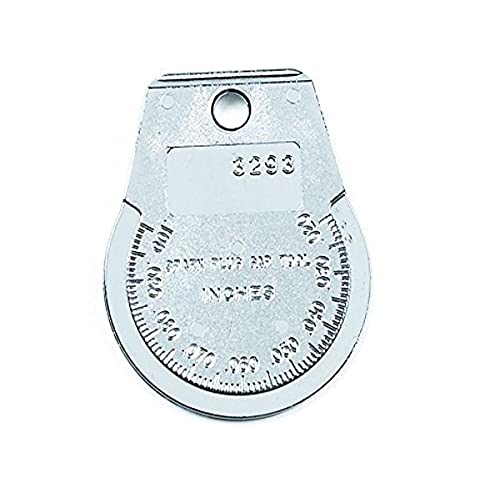
The GEARWRENCH 3293D is the familiar round ramp gauge found in toolboxes everywhere: a graduated disc that reads gaps from 0.020 to 0.100 inch, dual-marked in SAE and metric, with an adjuster opening for bending the ground electrode on conventional plugs. Its virtue is availability and simplicity — one flat disc, no moving parts, nothing to calibrate, and a scale that covers everything from a small two-stroke plug to the wide gaps of high-energy ignition systems.
The same cautions that apply to the CTA ramp apply here, and they are worth repeating because this is the tool most often misused. A ramp gauge measures by wedging, and wedging is precisely what fine-wire electrodes cannot tolerate. Use the 3293D to check and set copper and conventional plugs, use its adjuster only on the ground strap, and reach for a wire gauge when the plug has an iridium or platinum center electrode. Treated as a conventional-plug tool, it is accurate, durable and complete.
Specs
- Gauge type: Ramp (coin-style) gauge with electrode adjuster
- Range: 0.020 to 0.100 inch (0.5 to 2.5 mm)
- Markings: SAE and metric, dual scale
- Function: Measure and adjust (conventional plugs)
- Model: 3293D
5. OEMTOOLS 25352 Ramp Style Spark Plug Gap Gauge — The Pocket Backup

The second OEMTOOLS entry is the brand’s ramp-style gauge, model 25352: a small flat disc, roughly an inch across and about 0.6 ounces, stamped with SAE sizes on the front and metric on the back. It covers the same broad 0.020 to 0.100 inch band (0.50 to 2.5 mm) as the other ramps in this guide, and the hole at the top doubles as both a keychain attachment and an electrode adjuster that pulls the ground strap up to widen a gap or presses it down to narrow one.
This is the gauge that lives where the work happens unexpectedly — in the truck console that tows the camper, in the boat’s tool roll, in the shed with the mower and the pressure washer. Small engines overwhelmingly run conventional copper plugs, which is exactly the work a ramp gauge is suited to. It is not the tool for verifying a fine-wire automotive plug, and it does not pretend to be; as a quick, always-at-hand checker for conventional plugs, it earns its place as the fifth pick.
Specs
- Gauge type: Ramp-style gauge with electrode adjuster hole
- Range: 0.020 to 0.100 inch (0.50 to 2.5 mm)
- Markings: SAE on front, metric on back
- Dimensions: 1 x 1 x 1 inches
- Weight: About 0.6 ounces (17 g)
- Model: 25352
How to Choose the Right Gap Tool
Start with the plug, not the tool. If the engine runs iridium or platinum fine-wire plugs — most modern cars and trucks do — the only correct checker is a wire gauge such as the OEMTOOLS 25442 or the CTA 3238, and adjustment may be off the table entirely if the plug maker marks the plug do-not-gap. Verify, and replace a plug that reads out of specification.
Match the range to the fleet. Wire sets here span 0.025 to 0.060 inch, which covers the great majority of automotive and small-engine specifications. The ramp gauges extend from 0.020 to 0.100 inch, taking in very tight small-engine gaps and the wide gaps of older high-energy ignitions. A household that maintains both a modern truck and older equipment is best served by one of each style.
Respect the adjuster rule. Where adjustment is allowed, it is done to the ground electrode only, with a hook or adjuster hole that never presses on the center electrode. Any tool technique that pries between the electrodes is wrong, whatever the gauge style.
Keep the gauge honest. Wipe wires and ramps clean before use — a film of carbon or oil adds thickness and corrupts the reading — and store wire gauges flat so the loops are not bent, since a bent wire reads as a smaller gap than the plug actually has.
Final Verdict
For precise ignition tuning, the wire gauge is the professional answer: the OEMTOOLS 25442 for a clean nine-size spread, or the CTA 3238 where the in-between sizes such as 0.044 and 0.055 matter. The ramp gauges — CTA 3235, GEARWRENCH 3293D and OEMTOOLS 25352 — remain the fast, wide-range checkers for conventional copper plugs in small engines and older vehicles, provided they are used to measure and to bend ground straps only, never to pry on fine-wire electrodes. Choose by plug type first, range second, and every plug in the fleet can be verified against its specification with confidence.
More from Amazon
Programs that pair well with the guide above. Offers and eligibility are set by Amazon and may change.
Free shipping on eligible items, Prime Video and more. Eligible new members can start with a free trial.
Start a Prime free trialA Prime membership for ages 18-24 with a trial period. Eligibility is set by Amazon.
See Prime for Young AdultsAudiobooks and podcasts to listen to on the go. Eligible new members can start with a free trial.
Try Audible freeAd-free music streaming. Eligible new subscribers can start with a free trial.
Try Music Unlimited freeAs an Amazon Associate we earn from qualifying purchases.

Write Your Review
No reviews yet. Be the first to share your experience!