

Key takeaways
- Tow straps and kinetic recovery ropes compared by maker-rated breaking strength, stretch and length, plus the safety rules for towing and snatch pulls.
As an Amazon Associate we earn from qualifying purchases.
“Tow strap” is used as a catch-all label for two tools that behave in opposite ways, and mixing them up is how vehicles get damaged and bystanders get hurt. A flat tow strap is woven polyester webbing with almost no stretch. It is built for one job: a slow, steady pull, towing a disabled vehicle on a firm surface or dragging a load a short distance. A kinetic recovery rope or snatch strap is the opposite design. It is built to stretch — a snatch strap stretches up to about 20 percent, a kinetic rope up to about 30 percent — so a recovery vehicle can roll into the pull, store energy, and use that stored energy to ease a stuck vehicle out of mud, sand or snow.
That difference decides everything else. Yank on a stuck truck with a flat tow strap and the load arrives as a shock that can tear off a bumper or snap the strap. Try to flat-tow a car with a kinetic rope and the stretching and rebounding makes the towed car surge and wander. The five products below are labelled plainly as one type or the other, and every breaking strength figure is the maker’s own rating, stated as such.
Affiliate Disclosure: This article contains affiliate links. If you buy through them, we may earn a commission at no extra cost to you.
The safety rules that come before any strap
Three rules apply to every product in this class, whichever type is chosen. First, recovery work uses loop ends and rated shackles, not metal hooks. Cheap tow straps sold with open steel hooks are for light, steady towing only; under a snatch load a hook can straighten, detach, and become a projectile. For recovery, the strap or rope should have plain loop eyes, connected with rated bow shackles or soft shackles to proper rated recovery points on both vehicles.
Second, a strap or rope is never attached to a tow ball. A tow ball is not a rated recovery point; balls have sheared off under recovery loads and been launched through windscreens. Use the vehicle’s factory recovery points or a rated shackle mount that fits the receiver hitch.
Third, match the rating to the vehicle. The common guidance is a minimum breaking strength of at least two to three times the gross weight of the stuck vehicle. A strap that is far too strong is also a problem for kinetic work: an oversized snatch strap or rope barely stretches under a light vehicle, so it behaves like a static strap and delivers a shock load instead of a smooth pull. Size for the vehicle that will actually be recovered.
1. Rhino USA Recovery Tow Strap, 3 in x 30 ft — flat tow strap

This is the flat tow strap of the pair of Rhino USA products in this guide, and it is a towing tool, full stop. The 3-inch-wide, 30-foot polyester webbing has the minimal stretch that flat towing needs: the towed vehicle tracks predictably behind the tow vehicle instead of surging on an elastic connection. Rhino USA rates the breaking strength at 31,518 pounds, which covers full-size trucks and SUVs in a towing role with a wide margin.
The loop ends are triple reinforced, with protective sleeves that sit between the webbing and the shackle or recovery point to slow abrasion at the one place a strap always wears first. A drawstring storage bag is included, which matters more than it sounds: a strap that lives loose in a truck bed picks up grit and UV damage, and both shorten its life. For a disabled-vehicle tow on pavement or a hard-packed road, this is the straightforward, correctly specialised pick.
Specs
- Type: Flat tow strap — minimal stretch, towing only
- Dimensions: 3 in x 30 ft
- Material: Polyester webbing
- Maker-rated breaking strength: 31,518 lb
- Ends: Triple-reinforced loop ends with protective sleeves
- Included: Drawstring storage bag
- Warranty: Limited lifetime, per the maker
2. Smittybilt CC330 Tow Strap, 3 in x 30 ft — flat tow strap

The Smittybilt CC330 is the second flat tow strap here, from a long-established off-road accessory brand. It is also 3 inches wide and 30 feet long, with a maker-rated capacity of 30,000 pounds, double-stitched webbing and a double loop design at both ends. The bright yellow webbing is easy to see laid out on dark ground or in poor light, which is a small but real safety feature when a strap is stretched between two vehicles and someone might walk into it.
Like the Rhino USA strap above, this is a minimal-stretch polyester-style towing strap: it is the right tool for towing a rolling vehicle or making a slow, controlled drag, and the wrong tool for a running-start snatch recovery. Buyers choosing between the two flat straps are mostly choosing on brand preference and end-loop construction, since the size and rating class are nearly identical.
Specs
- Type: Flat tow strap — minimal stretch, towing only
- Dimensions: 3 in x 30 ft
- Maker-rated capacity: 30,000 lb
- Construction: Double-stitched webbing
- Ends: Double loop ends
- Colour: Yellow
3. ARB ARB705LB Snatch Strap — kinetic strap
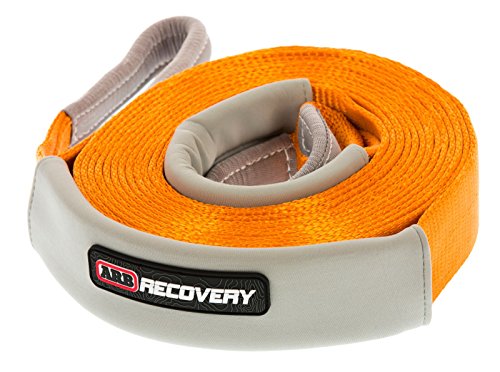
The ARB705LB is where this guide crosses from towing into recovery. It is a snatch strap: nylon webbing engineered to stretch up to 20 percent under load. In a snatch recovery the recovery vehicle drives forward with slack in the strap, the strap stretches and stores that energy, and the stored energy helps pull the stuck vehicle free with a smoother, building force instead of a single violent jerk. ARB rates the minimum breaking strength at 17,600 pounds (8,000 kg), and the strap’s ratings are verified in a NATA-approved laboratory, which is a level of independent testing most straps in this class do not carry.
At 30 feet long and 60 mm (about 2-3/8 inches) wide, it is sized for mid-size 4x4s, SUVs and lighter trucks. That rating deserves a second look rather than a shrug: 17,600 pounds is roughly two to three times the gross weight of a typical mid-size 4×4, which is exactly the window a snatch strap should sit in. A much stronger strap would not stretch properly behind a vehicle of that weight. The bright orange colour follows ARB’s colour-coding convention, so a snatch strap is never confused with a winch extension or tree trunk protector in the same kit bag.
Specs
- Type: Kinetic snatch strap — stretches, for recovery
- Dimensions: 30 ft x 2-3/8 in (60 mm)
- Material: Nylon webbing
- Maker-rated minimum breaking strength: 17,600 lb (8,000 kg)
- Stretch: Up to 20 percent
- Testing: NATA-approved laboratory, per the maker
- Colour: Orange
4. Bubba Rope Renegade, 3/4 in x 20 ft — kinetic rope

The Renegade is the smaller of Bubba Rope’s kinetic recovery ropes, built for cars, small SUVs and side-by-sides rather than full-size trucks. It is a double-braided nylon rope, 3/4 inch in diameter and 20 feet long, with a maker-rated breaking strength of 19,000 pounds. Kinetic ropes stretch more than snatch straps — up to about 30 percent — so the pull builds progressively and the peak load on both vehicles’ recovery points is lower than with a strap of similar rating.
The 20-foot length is the honest trade-off here. A shorter rope stores less energy and needs the recovery vehicle to work in a tighter space, which suits trail recoveries where 30 feet of run-up does not exist. For a lighter vehicle that is bellied out in sand or snow rather than buried to the axles in mud, that is usually enough. Owners of full-size trucks should step up to a 7/8-inch rope like the kit below rather than asking this diameter to do heavy work.
Specs
- Type: Kinetic recovery rope — stretches, for recovery
- Dimensions: 3/4 in x 20 ft
- Material: Double-braided nylon
- Maker-rated breaking strength: 19,000 lb
- Model: 176655BKG
- Ends: Spliced loop eyes
5. Rhino USA Kinetic Rope Recovery Kit, 7/8 in x 30 ft — kinetic rope

Rhino USA’s kinetic rope kit is the direct counterpart to its flat tow strap in pick one, and putting the two side by side shows the whole point of this guide: the same brand sells both because they do different jobs. The rope is 7/8 inch in diameter and 30 feet long, with a maker-rated maximum breaking strength of 30,580 pounds, sized for Jeeps, full-size trucks and SUVs. It is built to stretch under load — up to about 30 percent per the maker — so a stuck vehicle can be eased out of mud, sand or snow with stored energy rather than shock.
The kit format is the other half of its appeal. Two soft shackles are included, so the rope can be connected to rated recovery points without any metal-to-metal hardware at the vehicle ends, and soft shackles cannot become the kind of projectile a failed steel shackle can. Everything packs into a storage bag. For a driver who wants one box that covers a genuine stuck-vehicle recovery, this is the complete version of the kinetic side of the class.
Specs
- Type: Kinetic recovery rope — stretches, for recovery
- Dimensions: 7/8 in x 30 ft
- Material: Synthetic fibre double braid
- Maker-rated breaking strength: 30,580 lb
- Stretch: Up to 30 percent, per the maker
- Included: Two soft shackles and storage bag
- Model: RG-KRKIT
How to choose between the five
Start with the job, not the rating. If the vehicle still rolls and needs to be towed on a firm surface, choose a flat tow strap — one of the first two picks — and tow slowly with the strap kept taut. If the vehicle is stuck and needs to be pulled out of the surface it is sitting in, choose a kinetic product: the ARB snatch strap for a mid-size 4×4, the Bubba Rope Renegade for a lighter vehicle or a tight trail, and the Rhino USA kinetic rope kit for a full-size truck or SUV, or for anyone who wants soft shackles included.
Then check the rating against the vehicle. Take the gross weight of the vehicle that will be recovered and look for a minimum breaking strength around two to three times that figure. Below that window the gear is overworked; far above it, a kinetic strap or rope will not stretch as designed and the recovery turns harsh.
Length is the last variable. Thirty feet is the standard for a reason: it gives the recovery vehicle room to build momentum for a snatch pull and keeps the two vehicles safely apart during a tow. Twenty feet works where space is tight, but leaves less margin for either job.
Care and inspection
Every strap and rope here has the same enemies: sharp edges, grit, chemicals and sunlight. Inspect the full length before and after each use. A flat strap with cut or frayed webbing, damaged stitching at the eyes, or chemical stiffness should be retired, not saved for lighter jobs — a weakened strap fails at its weakest point under exactly the load it was bought for. Kinetic ropes and straps should be checked for abrasion on the outer braid and for eyes that have been pulled or distorted.
After a muddy recovery, rinse the strap or rope in clean water and let it dry out of direct sunlight before it goes back in its bag. Storing webbing wet and dirty grinds grit into the fibres with every fold. Kept clean, dry and shaded, quality recovery gear lasts for years.
Frequently asked questions
Can a tow strap be used for a snatch recovery? A flat tow strap should not be. It has almost no stretch, so a running pull turns into a shock load that can damage both vehicles or break the strap. Snatch recoveries call for a kinetic strap or rope that is designed to stretch.
Can a kinetic rope be used to tow a car on the road? It can physically connect two vehicles, but it is the wrong tool: the constant stretch and rebound makes the towed vehicle surge, and steering and braking control suffer. Use a flat tow strap for towing and keep the kinetic rope for recoveries.
What breaking strength is needed for a full-size truck? Working from the usual guidance of two to three times the vehicle’s gross weight, a truck in the 6,000 to 8,000 pound range points to gear rated between 18,000 and 24,000 pounds at minimum, and the 30,000-pound-class products above sit in that window. All figures here are maker ratings.
Are hooks or shackles better on a tow strap? For recovery, loop ends with rated shackles or soft shackles. Straps with fixed metal hooks are intended for light, steady towing only, and a hook is the part most likely to detach under a snatch load.
More from Amazon
Programs that pair well with the guide above. Offers and eligibility are set by Amazon and may change.
Free shipping on eligible items, Prime Video and more. Eligible new members can start with a free trial.
Start a Prime free trialA Prime membership for ages 18-24 with a trial period. Eligibility is set by Amazon.
See Prime for Young AdultsAudiobooks and podcasts to listen to on the go. Eligible new members can start with a free trial.
Try Audible freeAd-free music streaming. Eligible new subscribers can start with a free trial.
Try Music Unlimited freeAs an Amazon Associate we earn from qualifying purchases.
Write Your Review
No reviews yet. Be the first to share your experience!