

Key takeaways
- Standing drinks and conversation: allow approximately 6–8 square feet per person.
- Seated dining: allow approximately 10–12 square feet per person, including chair movement.
- Dining plus buffet or bar: allow approximately 12–15 square feet per person.
- Dining plus dancing: allow approximately 15–20 square feet per person, depending on the dance floor.
The best party tents are chosen by guest count first: use a 10 × 20 ft canopy for roughly 20–30 seated guests, a 20 × 20 ft frame tent for about 40–60 standing guests, and a 20 × 40 ft tent for larger gatherings or mixed dining and dancing areas.
Our top picks


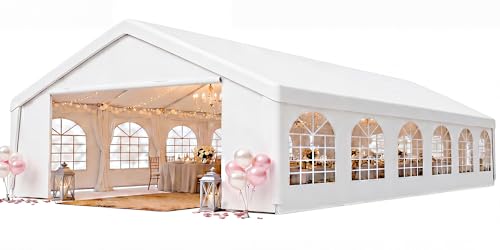
As an Amazon Associate we earn from qualifying purchases at no extra cost to you. Ratings are shown as listed on Amazon.
Best party tents by situation
| Situation | Best tent type | Practical size | Why it fits |
|---|---|---|---|
| Small backyard meal | Pop-up canopy | 10 × 10 or 10 × 20 ft | Fast setup and modest cost; suitable for food, shade, or a small table group |
| Family celebration with seating | Heavy-duty frame canopy | 20 × 20 ft | More usable interior space and better sidewall options than a basic pop-up |
| Wedding-style reception | Large frame or pole tent | 20 × 40 ft or larger | Allows tables, buffet service, circulation, and a dance or presentation area |
| Occasional events on a tight budget | Commercial-grade pop-up | 10 × 20 ft | Usually easier to store and reuse than a large rental-style tent |
| Wind-prone or changeable weather | Engineered frame tent with sidewalls | 20 × 20 ft or larger | Heavier frame, more anchoring points, and better control of rain and drafts |
How much tent space do guests need?
Size the canopy by usable floor area rather than its advertised footprint. A 10 × 10 ft tent has 100 square feet, but corner legs, guy lines, buffet tables, and entrances reduce the space people can comfortably occupy.
- Standing drinks and conversation: allow approximately 6–8 square feet per person.
- Seated dining: allow approximately 10–12 square feet per person, including chair movement.
- Dining plus buffet or bar: allow approximately 12–15 square feet per person.
- Dining plus dancing: allow approximately 15–20 square feet per person, depending on the dance floor.
For example, 40 seated guests at 12 square feet each require about 480 square feet. A 20 × 20 ft tent provides 400 square feet, so it will feel crowded once tables and a buffet are added. A 20 × 30 ft tent provides 600 square feet and is the more sensible choice.
Party tent types compared
Pop-up canopies
Pop-up canopies are the quickest option for small and medium gatherings. Two people can usually open a 10 × 10 or 10 × 20 ft model in roughly 5–15 minutes, though fitting sidewalls and securing the roof takes longer. They commonly use powder-coated steel or aluminum frames with polyester fabric roofs.
Their strengths are portability, simple storage, and relatively low market pricing—often about $150–$500 for a usable recreational or commercial-grade model, depending on size and materials. Their limitations are moderate headroom, less rigid frames, smaller anchoring footprints, and more exposed corner joints. They are best for calm-weather events unless the manufacturer supplies a substantial anchoring system.
Frame tents
Frame tents use a perimeter frame and do not need a center pole, which makes the interior easier to arrange. Many have eave heights around 6.5–8 ft and center clearances of 8–12 ft, giving guests more comfortable headroom than a basic pop-up. Setup commonly takes 30–90 minutes with two to four people.
These tents are the strongest general-purpose choice for a backyard party. They accept removable walls, windows, doors, and sometimes gutters that connect adjacent tents. Expect roughly $500–$2,000 for a medium-to-large owner-supplied frame system, with larger commercial structures costing considerably more. The trade-off is heavier transport, more pieces to label, and a longer drying and storage process.
Pole tents
Pole tents are supported by central and perimeter poles, creating a traditional peaked profile. They can provide attractive overhead height and good rain shedding, but the center poles consume floor space and require perimeter stakes or substantial ballast. They are often a better rental solution than a casual purchase because the installation requires more planning and tensioning.
Do not place a pole tent where buried utility lines, irrigation pipes, or hard paving prevent safe staking. A frame tent is usually more adaptable on patios, driveways, and compact lawns.
Head-to-head: what matters beyond the fabric
| Feature | Basic pop-up | Commercial pop-up | Frame tent |
|---|---|---|---|
| Typical setup time | 5–15 minutes | 10–25 minutes | 30–90 minutes |
| Typical 10 × 20 ft frame weight | 45–80 lb | 70–130 lb | 100–220 lb |
| Common peak height | 8–10 ft | 9–12 ft | 10–14 ft |
| Sidewall options | Partial or basic solid walls | Solid, window, mesh, and zippered options | Solid, window, mesh, door, and gutter options |
| Wind management | Limited; depends heavily on ballast | Better frame and staking options | Best potential, but only with correct anchoring |
| Typical replacement roof cost | $50–$180 | $100–$400 | $250–$1,000+ |
These are useful category ranges rather than guarantees. Frame geometry, fabric weight, included hardware, and local weather determine actual performance.
Sidewalls, ventilation, and weather protection
Sidewalls are valuable for wind-driven rain, low-angle sun, privacy, and cooler evenings, but enclosing every wall can make a tent hot and stuffy. For a summer party, choose at least one wall with mesh or large windows and keep opposing openings available for cross-ventilation. A roof vent or high-level gap helps warm air escape.
Solid walls protect better against rain than mesh, but they also increase wind load. Close them when rain is approaching, not automatically when the tent is erected. In warm weather, leave the leeward side open where possible and avoid placing cooking equipment inside the enclosed canopy.
Most recreational party tents are intended for temporary use. Take them down before thunderstorms, strong wind, heavy snow, or prolonged rain if the manufacturer does not explicitly rate them for those conditions. A waterproof roof is not the same as a structure designed for severe weather.
Anchoring is more important than buying a thicker roof
A large canopy can act like a sail. On grass or soil, use every supplied stake and guy line, drive stakes fully into sound ground, and place them at the recommended angle. On concrete or asphalt, use purpose-made ballast such as water or sand weights rated for the tent, rather than improvised objects that can roll or damage the frame.
As a planning guide, some 10 × 10 ft recreational canopies may need roughly 40–80 lb of ballast per leg in calm conditions, while larger or more exposed structures may require substantially more. The correct amount depends on the design and wind rating, so follow the manufacturer’s instructions instead of treating these figures as a universal safety rule. Never rely only on the tent’s feet sitting on the ground.
Setup checklist that prevents common failures
- Inspect the site. Choose level ground, check overhead branches, and confirm that stakes will not hit buried services.
- Lay out the frame. Keep roof fabric off abrasive ground and identify each leg, connector, and wall panel before lifting.
- Raise gradually. Extend opposite corners together so the frame does not twist. Stop if a joint binds; forcing it can bend a truss.
- Attach the roof evenly. Do not tension one corner completely before fitting the others, or the fabric may pull the frame out of square.
- Add walls after anchoring. Walls increase wind resistance. Secure the canopy first, then attach panels and guy lines.
- Check water paths. Keep the roof taut and remove low spots where rain can pool. A few gallons of pooled water can add significant weight.
Ownership costs and durability
The first parts to wear are usually roof fabric at folded creases, hook-and-loop strips, plastic foot caps, guy-line tensioners, and frame connectors—not the main steel tubes. Repeatedly packing a wet tent encourages mildew and can stain the coating. Let every component dry fully before storage, even if that means opening the tent again the following day.
Clean fabric with mild soap, cool water, and a soft brush. Avoid bleach, pressure washing, abrasive scrubbers, and household solvents that can weaken coatings. Store poles in a dry bag or labeled case, and keep replacement stakes, ropes, pins, and foot caps with the tent. A replacement roof can cost less than replacing the entire frame, so confirm that spare fabric is available before buying.
For occasional use, a $300 canopy used ten times costs about $30 per event before replacement parts. A $1,200 frame tent used 30 times costs about $40 per event, but it may become the better value if it provides safer anchoring, sturdier walls, and fewer failed setups. Frequent hosts should prioritize replacement-part availability and packed weight over the lowest initial price.
Final buying recommendation
Choose a 10 × 20 ft commercial pop-up for small parties where speed and storage matter. Choose a 20 × 20 ft frame tent when 30–50 people need comfortable seating and you want useful sidewalls. Choose a 20 × 40 ft or larger frame or professionally installed pole tent for receptions, buffet service, and dancing. In every case, leave capacity for furniture and circulation, select ventilation before appearance, and treat anchoring and weather limits as essential specifications rather than accessories.






Write Your Review
No reviews yet. Be the first to share your experience!