

Key takeaways
- Compare the best proofing baskets for sourdough boules and batards, from classic rattan bannetons to stackable pulp and washable silicone picks.
As an Amazon Associate we earn from qualifying purchases.
A proofing basket, also called a banneton or brotform, does one job: it holds shaped dough steady during its final rise so the loaf bakes up instead of spreading out. The coiled walls support the dough, wick a little moisture from the surface, and leave the spiral pattern that marks a rustic boule or batard. The five baskets below cover the main formats a home baker actually needs — a single premium rattan round, a two-basket rattan set, an oval pair for batards, a stackable pulp design, and a washable silicone option for small kitchens.
Affiliate Disclosure: This article contains affiliate links. If you buy through a link on this page, the site may earn a commission at no extra cost to you. Product details are taken from manufacturer and retailer listings at the time of writing.
Two honesty points before the picks. First, basket sizes are dough-weight dependent, not absolute: a basket sold as 9 inch suits roughly 500 g to 1 kg of dough depending on the recipe, and a high-hydration 1 kg loaf will climb over the rim of a 9-inch basket long before it finishes proofing. Match the basket to the dough weight you bake most, not to the biggest loaf you might bake once. Second, care rules differ sharply by material. Rattan baskets are never washed or soaked in water — they are dried thoroughly and brushed out with a stiff brush, because trapped moisture in the cane is what grows mold. The pulp and silicone picks below follow different rules, and each section states them plainly.
1. Saint Germain Bakery Premium Round Banneton, 9 Inch — Best Single Rattan Basket
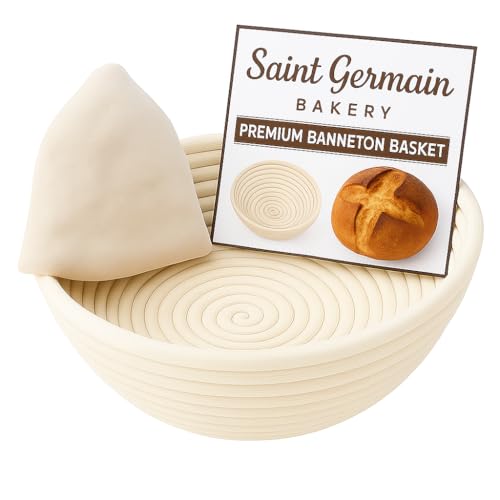
Saint Germain Bakery built its name on tightly woven rattan baskets with a smooth, splinter-free interior, and this single 9-inch round is the straightforward version: one basket, one liner, no bundle padding. The cane is handwoven without dyes or chemical finishes, and the coil spacing is even enough that the flour rings transfer cleanly to the crust. The included liner is a heavier cloth than the thin liners bundled with budget sets, which matters if you proof wet doughs without flouring heavily.
This is the right format for a baker who proofs one boule at a time and wants the basket itself, rather than a pile of accessories, to be the quality part of the purchase. The trade-off is obvious: one basket means one loaf per proofing session, so batch bakers should look at the two-basket sets below instead.
Specs
- Size: 9 inch round
- Dough weight: about 1.5 to 2 lb (roughly 680 to 900 g) per maker and retailer guidance
- Material: Natural rattan cane, unfinished, no dyes
- Liner: Cloth liner included
- Finish notes: Smooth, splinter-free interior weave
- Care: Dry fully after use and brush out; never soak or wash the rattan
2. Kook Banneton Proofing Baskets, Set of 2, 9 Inch Round — Best for Two Boules at Once
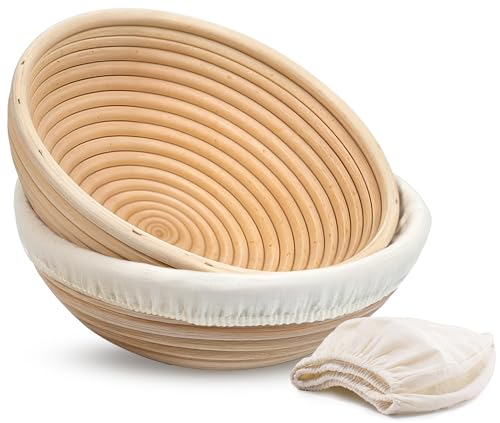
Kook’s set pairs two identical 9-inch round rattan baskets with two cloth liners, which solves the most common banneton frustration: a second loaf with nowhere to proof while the first one occupies the only basket. Each basket measures 9 inches across and 3.4 inches deep, and the maker rates each one for up to 2 lb of dough, so a doubled standard recipe proofs side by side without one loaf waiting in a mixing bowl and over-proofing.
The rattan is handwoven with a brushed finish, and the liners are washable cloth — the liners go in the laundry, the baskets themselves stay dry and get brushed, as rattan requires. At just over a pound for the set, the baskets are light, which also means they reward a gentle hand when turning dough out; a heavy ceramic bowl they are not.
Specs
- Size: 9 inch round, each basket 9 x 9 x 3.4 in
- Dough weight: Up to 2 lb (about 900 g) per basket
- Material: Handwoven rattan
- Liner: Two washable cloth liners included, one per basket
- Set weight: 1.14 lb for the pair
- Care: Brush baskets dry and air fully; liners are washable
3. Saint Germain Bakery Oval Banneton Baskets, 10 Inch, Set of 2 — Best for Batards
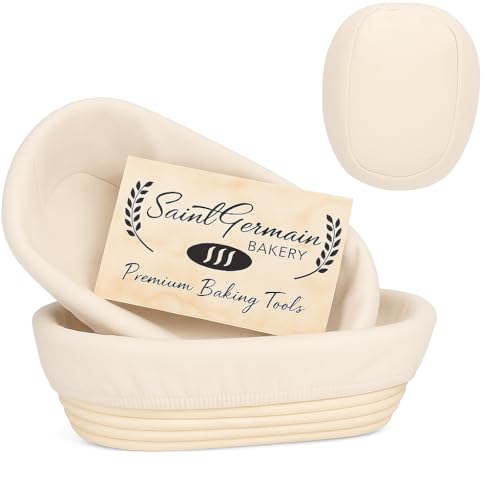
Round baskets shape boules; oval baskets shape batards, the elongated loaves that slice evenly for sandwiches and fit a standard loaf pan’s footprint on a baking stone. This Saint Germain set includes two 10-inch oval rattan baskets with liners, so a pair of batards can proof together and bake in the same session. The 10-inch length refers to the outer rim, and the working capacity is roughly 2 lb of dough per basket — scale a recipe up to a full kilogram only if it is a firm, lower-hydration dough, because a wet dough will crest the shallow oval walls.
The construction matches the brand’s round baskets: natural rattan, unfinished, with the same smooth interior weave, and the liners are cut for the oval shape rather than being round liners folded to fit. Oval baskets also double as the better choice for oblong country loaves proofed seam-up before a final shaping.
Specs
- Size: 10 inch oval, set of 2 baskets
- Dough weight: Roughly 2 lb (about 900 g) per basket
- Material: Natural rattan cane, unfinished
- Liner: Two liners included, shaped for the oval baskets
- Set weight: 15.5 oz
- Care: Dry fully and brush out after use; never soak the rattan
4. Brod & Taylor Banneton Boule, 8.5 Inch, 2-Pack — Best Stackable Pulp Design

Brod & Taylor rethought the banneton in molded pulp instead of cane. These 8.5-inch round baskets are made from upcycled sugarcane pulp and renewable bamboo, pressed into a rigid, ridged form that supports dough the way coiled rattan does, but nests and stacks for storage — two baskets take the shelf space of one rattan basket. The textured interior releases dough with a light flour dusting, and the material wicks surface moisture to help form the thin skin that scores cleanly and springs well in the oven.
The 8.5-inch size suits a 1.5 lb boule, slightly smaller than a standard 9-inch basket, so size your regular recipe accordingly. Liners are optional and sold separately; the surface is designed to work without one. Care is the pulp version of the rattan rule: brush off flour after each use and let the basket dry completely — do not soak it. Bakers whose rattan baskets have developed odors or mold in humid kitchens are the natural audience for this format.
Specs
- Size: 8.5 inch round, 2-pack
- Dough weight: About 1.5 lb (roughly 680 g) per basket
- Material: Upcycled sugarcane pulp and renewable bamboo
- Liner: Not included; designed to release without one, liner optional
- Design: Rigid molded form, nests and stacks for storage
- Care: Brush clean and dry fully after use; do not soak
5. Spmarkt Collapsible Silicone Proofing Basket, 9 Inch Round — Best Washable Option

The Spmarkt basket replaces cane and pulp with food-grade silicone over a steel wire frame, and that changes the care rules completely: this one is dishwasher safe, can be rinsed without a thought about mold, and collapses flat for drawer storage. The silicone wall is about 6 mm thick, flexible enough to fold yet firm enough on its frame to hold a shaped dough through its final proof, and the interior carries the ridged texture that leaves rings on the crust.
The listing also rates the basket oven safe to 450 degrees Fahrenheit, so it can double as a bake vessel in a pinch, though its natural role is proofing. There is no liner and none is needed; the nonstick surface releases with a light flouring. What you give up is the breathability of rattan — silicone does not wick moisture, so very wet doughs proof a little softer here, and the crust finish is less rustic than a cane basket’s. For small kitchens, campers, and anyone who has lost a rattan basket to mold, that is a fair trade.
Specs
- Size: 9 inch round, collapsible
- Dough weight: Suited to standard 500 g to 1 kg boules by size class
- Material: Food-grade silicone with steel wire frame, about 6 mm wall
- Liner: None; nonstick surface
- Heat rating: Oven safe to 450 degrees Fahrenheit per the listing
- Care: Dishwasher safe; folds flat for storage
How to Choose a Proofing Basket
Start with dough weight, not diameter. Basket names describe the rim, but capacity is set by depth and wall angle. As a working guide, an 8.5 to 9 inch round suits 500 g to 1 kg of dough, with the top of that range reserved for firm doughs. A high-hydration dough at 1 kg belongs in a 10 inch round or it will proof over the rim. When in doubt, size up for wet doughs and down for stiff ones.
Match the shape to the loaf. Round baskets make boules for Dutch ovens and round stones. Oval baskets make batards that slice evenly and fit rectangular bakers. Buying one of each shape covers nearly every rustic recipe; buying two of the same shape covers batch baking of one recipe.
Pick a material by your kitchen, not by tradition alone. Rattan breathes, wicks moisture, and gives the classic ringed crust, but it demands dry storage and brush-only cleaning, and it molds if put away damp. Molded pulp keeps most of the breathability, stacks neatly, and resists the odor problem, with the same no-soaking rule. Silicone gives up the wicking in exchange for full washability and flat storage.
Decide on liners honestly. A liner gives a smooth loaf surface and easier release for very wet doughs; no liner gives the deep spiral pattern. Most bakers end up using the liner for high-hydration dough and skipping it for firm dough. A basket that includes a liner lets you choose per bake, which is why four of the five picks above include or support one.
Season and store any natural basket correctly. Before first use, mist a rattan basket lightly, dust it well with rice flour or a wheat and rice flour blend, and let it dry. After every bake, brush out loose flour, let the basket air until completely dry, and store it somewhere ventilated — never sealed in a plastic bag and never washed. A basket stored dry lasts for years; a basket stored damp is compost.
Frequently Asked Questions
Can a proofing basket go in the oven? Rattan and pulp baskets cannot — they are proofing tools only, and the dough is turned out onto a stone, steel, or Dutch oven for baking. The silicone pick above is the exception, with an oven rating stated in its listing.
What flour keeps dough from sticking? Rice flour, or a half-and-half blend of rice and wheat flour, dusted generously into the coils. Rice flour absorbs moisture without turning gummy, which is why it outperforms plain wheat flour in the basket.
How long should dough proof in the basket? Only the final proof happens in the basket, after shaping — typically until the dough springs back slowly when poked, leaving a slight dent. Bulk fermentation happens earlier, in a bowl, not in the banneton.
Why did a loaf stick even with a liner? Usually the liner was under-floured or the dough was wetter than the basket’s practical capacity. Flour the liner itself, not just the basket, and let a new liner build up a seasoned flour layer over its first few bakes.
More from Amazon
Programs that pair well with the guide above. Offers and eligibility are set by Amazon and may change.
Free shipping on eligible items, Prime Video and more. Eligible new members can start with a free trial.
Start a Prime free trialA Prime membership for ages 18-24 with a trial period. Eligibility is set by Amazon.
See Prime for Young AdultsAudiobooks and podcasts to listen to on the go. Eligible new members can start with a free trial.
Try Audible freeAd-free music streaming. Eligible new subscribers can start with a free trial.
Try Music Unlimited freeAs an Amazon Associate we earn from qualifying purchases.




Write Your Review
No reviews yet. Be the first to share your experience!