

Key takeaways
- Compare the best aquarium rocks for aquascaping: dragon stone, seiryu, slate, lava rock and river stone, with honest notes on pH, prep and weight.
As an Amazon Associate we earn from qualifying purchases.
Rock is the skeleton of an aquascape. It decides the silhouette of the layout, gives plants and moss something to grip, and creates the caves and ledges that fish actually use. But aquarium rocks are not just decoration, because stone is geology, and geology interacts with water. Pick the wrong rock and your water chemistry drifts in a direction your fish never asked for. This guide compares five widely available natural rocks — dragon stone, seiryu stone, slate, lava rock and river stone — with the chemistry stated plainly for each one, so you can match the stone to the tank instead of fighting it later.
Affiliate Disclosure: This article contains affiliate links. If you buy through a link on this page, we may earn a commission at no extra cost to you.
Start With Water Chemistry, Not Looks
The single most important fact about any aquarium rock is whether it changes your water. Rocks fall into two camps. Carbonate-bearing stones, including most seiryu stone sold today, slowly dissolve in aquarium water and push pH, KH and GH upward. That is genuinely useful in an African cichlid tank, a hard-water livebearer setup, or a shrimp tank stocked with species that need minerals. It is the wrong direction for soft-water fish such as many tetras, discus and crystal shrimp, and in a CO2-injected planted tank it means your parameters creep up between water changes while you chase a moving target.
Inert rocks — lava rock, slate, and most dragon stone — leave your water essentially as it comes out of the tap. Neither camp is better. The mistake is buying a carbonate rock for a soft-water scape, or an inert rock when your livestock actually needs the buffering. Every pick below states which camp it belongs to.
A rough screening tool is the vinegar test: put a drop of household vinegar on a dry piece of rock and watch closely. Fizzing or bubbling suggests carbonate content, which means the stone will tend to raise pH and hardness. Treat it as a rough screen, not a guarantee — a stone can fail to fizz on the surface and still leach slowly, and the only reliable confirmation is soaking a sample in a bucket of your tank water for a week and comparing pH and KH before and after.
The Five Rocks Compared
1. Unocho Dragon Stone (Ohko Stone) — 5 lb, 2–4 Inches

Dragon stone, also called ohko stone, is the textured, honeycombed rock behind a large share of planted aquascapes. It is a hardened clay-based stone, which gives it two defining traits: it is lighter than dense rock of the same size, and its pits and channels are packed with clay and silt when it arrives. Those holes are exactly what make it beautiful, and exactly why prep matters — an unrinsed piece can cloud a tank for days. Work a stiff brush and a jet of water into the holes until the runoff runs clear. Never use soap or detergent on any aquarium rock; residues are far harder to remove than clay dust.
Chemically, dragon stone is generally treated as inert to near-neutral: it is not a carbonate rock and does not push pH upward the way seiryu does. Its edges can be crumbly rather than sharp, and pieces can be broken or scored to fit a layout, which makes it forgiving for building height. This Unocho bag is a nano-to-mid-size option at 5 lb with pieces listed at 2–4 inches — enough for a small scape or for detail work around larger feature stones.
Specs
- Rock type: Dragon stone (ohko stone), clay-based
- Pack weight: 5 lb
- Piece size: 2–4 inches, as listed
- pH effect: Effectively neutral; not a carbonate rock, no meaningful pH/KH rise
- Edge notes: Crumbly, textured surface; pits hold clay and need thorough rinsing
2. Unocho Natural Seiryu Stone — 20 lb, 3–10 Inches

Seiryu stone is the blue-grey, white-veined rock of classic iwagumi layouts, and this 20 lb Unocho bag with pieces listed at 3–10 inches is sized for a main-stone arrangement in a mid-size tank rather than nano detail work. The jagged ridges and pale calcite veins are the look people buy it for, and the stone darkens considerably when wet, which is worth knowing when you are judging dry pieces under room light.
Here is the honesty point that has to lead with seiryu: most stone sold as seiryu today is a carbonate-bearing rock, and it will raise pH, KH and GH over time. In a hard-water tank that is a feature. In a soft-water planted tank it is a slow, persistent drift you will be correcting at every water change. If you want the seiryu look in soft water, budget for the buffering fight or choose an inert lookalike instead. Also inspect pieces before they go near glass or fish: seiryu ridges can be genuinely sharp, and a minute with wet-and-dry sandpaper on the worst points protects long-finned and soft-bellied fish.
Specs
- Rock type: Seiryu stone, carbonate-bearing
- Pack weight: 20 lb
- Piece size: 3–10 inches, as listed
- pH effect: Raises pH, KH and GH over time; suits hard-water setups, wrong for soft-water species
- Edge notes: Ridged and can be sharp; sand down exposed points before adding delicate fish
3. Small World Slate & Stone Natural Slate — 3–5 Inches, 12 lb

Slate is the builder’s rock. It splits into flat plates, so instead of arranging boulders you are stacking architecture: caves, terraces, retaining walls for substrate slopes, and overhangs that plecos and loaches claim immediately. This Small World Slate & Stone pack is USA-sourced, washed and packaged by the seller, with pieces listed at 3–5 inches and a total weight of 12 lb.
Slate is effectively inert — it does not raise pH or hardness, which makes it a safe structural material under or behind more decorative stone. Two cautions apply. First, split slate edges can be knife-sharp straight from the bag; run a thumb along any edge that will face open water and sand the ones that catch. Second, stacked slate must be stacked like masonry, flat and stable, ideally seated on the substrate or glass before substrate is piled around it — a toppled slate plate is heavy enough to do real damage. Dry-stacking the structure outside the tank first is time well spent.
Specs
- Rock type: Natural slate, flat layered plates
- Pack weight: 12 lb
- Piece size: 3–5 inches, as listed
- pH effect: Inert; no meaningful effect on pH or hardness
- Edge notes: Split edges can be very sharp; sand exposed edges, stack flat and stable
4. BCQLI Red Lava Rock — About 30 Pieces, 1–1.2 Inches
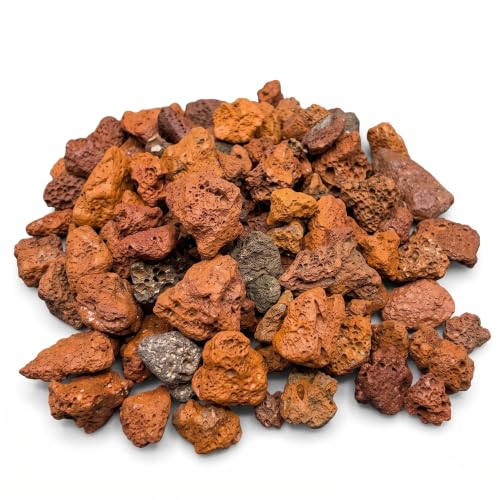
Lava rock is solidified volcanic foam: full of pores, far lighter than it looks, and chemically inert. That porosity is functional, not just visual — the internal surface area hosts nitrifying bacteria, which is why small lava pieces double as filter media and why epiphyte plants and moss anchor to it so readily. The trade-off is texture: raw lava can be abrasive, so keep it out of the direct path of soft-bellied bottom dwellers and long-finned fish, or knock the worst points down with a file.
This BCQLI pack is the small end of the lava market: roughly 30 pieces at 1–1.2 inches, about 14 ounces in total, in the red-brown colour lava is known for. That is nano-tank and shrimp-tank scale — accent pieces, plant anchors, or a filter bag’s worth of bio-media — not main-stone material for a large scape. The seller states the stone has been cleaned, but rinse it anyway until the water runs clear; lava’s pores hold dust that only shows itself once the rock is submerged.
Specs
- Rock type: Red lava rock (volcanic pumice-type stone)
- Pack: About 30 pieces, unit count listed at 14 oz
- Piece size: 1–1.2 inches, as listed
- pH effect: Inert; no meaningful effect on pH or hardness
- Edge notes: Porous and abrasive; file down sharp points for delicate fish, rinse dust from pores
5. Pulovin Natural River Rocks — 20 lb, 2–3 Inches

River stone is what water itself shapes: tumbled smooth over years, with rounded edges that are the safest of any rock in this guide for delicate fish, and a natural look that suits biotopes and low-contrast scapes. This Pulovin bag holds 20 lb of stones listed at 2–3 inches, described by the seller as natural rocks suitable for aquariums and fish tanks, with no dyes or fillers.
The chemistry note for river rock is “usually inert, verify anyway.” River stone is a mixed geology product — most pieces are hard siliceous stone that will never affect your water, but a mixed bag can include a carbonate piece, which is precisely what the vinegar test and a bucket soak are for. One more warning that matters: buy river rock sold for aquarium or decorative use like this, and avoid polished or waxed pebble products, whose coatings do not belong in a tank. Smoothness also means river stones stack poorly and roll — bed them into the substrate rather than piling them.
Specs
- Rock type: Natural river stone, tumbled smooth
- Pack weight: 20 lb
- Piece size: 2–3 inches, as listed
- pH effect: Generally inert; mixed geology means a stray carbonate piece is possible — vinegar-test suspect pieces
- Edge notes: Rounded and fish-safe; stacks poorly, bed pieces into substrate
What the Photos Will Not Tell You
Every rock in this guide is a natural product, and natural stone varies. Listing photographs show selected pieces arranged by someone with a whole pile to choose from. Your bag is a random draw within the stated size range: shapes, veining and colour will differ from the picture, and a 20 lb bag of 3–10 inch stone might contain two large pieces and several small ones, or the reverse. Plan layouts around a size range, not a photograph, and order more weight than the scape strictly needs so you have pieces to reject — experienced aquascapers treat a spare third as normal, not wasteful.
Weight deserves its own planning step. Rock is sold by the pound because it is genuinely heavy: a hardscaped tank can carry a substantial load concentrated on a few contact points. Spread that load. A sheet of egg-crate light diffuser or foam under the substrate distributes the weight of heavy feature stones and protects the glass if a piece shifts. Seat the largest stones first, directly on that support layer, then add substrate around them — stone placed on top of deep substrate can settle, slide and bury a fish or crack against glass.
Prep Rules That Apply to Every Rock Here
Rinse everything. Dragon stone needs its clay flushed out hole by hole; lava rock sheds pore dust; slate and river stone arrive with quarry and handling dust. Use plain water and a stiff brush. Never use soap, detergent or bleach on rock destined for a stocked tank, and if you are tempted to collect your own stone instead, understand the risks you are accepting: wild-collected rock can carry pesticides, fertiliser residue and road runoff, its geology is unknown, and some attractive stones are simply unsuitable — soft crumbling rock, ore-bearing stone with metallic veins, and anything from a treated or industrial site should stay out of the tank. The vinegar test screens for carbonate; it says nothing about contamination.
Which Rock Fits Which Tank
For a soft-water planted scape, dragon stone and lava rock give you texture without chemistry. For hard-water fish, cichlids, or mineral-loving shrimp, seiryu turns its buffering from a flaw into the point. For structure — caves, terraces, walls — slate is unmatched, and for a gentle, natural floor-level scape with fish that bruise easily, river stone is the kind option. Match the stone to the water you intend to keep, prep it patiently, support its weight properly, and the rock will outlast every other decision in the tank.
More from Amazon
Programs that pair well with the guide above. Offers and eligibility are set by Amazon and may change.
Free shipping on eligible items, Prime Video and more. Eligible new members can start with a free trial.
Start a Prime free trialA Prime membership for ages 18-24 with a trial period. Eligibility is set by Amazon.
See Prime for Young AdultsAudiobooks and podcasts to listen to on the go. Eligible new members can start with a free trial.
Try Audible freeAd-free music streaming. Eligible new subscribers can start with a free trial.
Try Music Unlimited freeAs an Amazon Associate we earn from qualifying purchases.










Write Your Review
No reviews yet. Be the first to share your experience!