

Key takeaways
- Five aquarium wavemakers compared on maker flow figures, wattage, control and mounting, from gyre and cross-flow pumps to a compact nano powerhead.
As an Amazon Associate we earn from qualifying purchases.
A wavemaker has one job: keep the water in an aquarium moving. That movement carries oxygen to the livestock, sweeps uneaten food and waste toward the filter instead of letting them rot in dead corners, and stops corals from sitting in their own waste. In a reef tank it also flexes coral polyps back and forth the way a natural reef current does, which is a big part of why corals extend, feed, and grow instead of slowly receding.
Three pump shapes dominate the category. Propeller powerheads push a cone of water from a single point and are the easiest to aim. Gyre pumps stretch that idea into a long cage that rolls a sheet of water across the whole tank. Cross-flow pumps work on the same sheet principle, usually with fewer refinements. On top of the shapes sits a control split: DC pumps with controllers or apps that pulse, ramp, and randomise the flow, and simple AC pumps that run at one speed until something external switches them.
The five wavemakers below cover that whole spread, from a flagship gyre for large reefs down to a palm-sized pump for a nano tank. Each entry lists the maker’s own flow figure, wattage, control options, mounting method, maximum glass thickness, and the tank band the maker states, so the numbers can be compared like for like.
Affiliate Disclosure: This article contains affiliate links. If you buy through a link on this page, the site may earn a commission at no extra cost to you.
How to Choose a Wavemaker
Read the flow figure as a ceiling, not a promise. Every GPH number in this guide is the maker’s maximum, measured in open water with nothing restricting the outlet. Rockwork, a guard mesh, a dirty impeller, and the simple fact that the water has to push against the tank all trim real output well below the headline figure. Treat the number as a way to compare pumps against each other, not as the flow a tank will actually see, and size up rather than down when a tank sits between two models.
Match the flow pattern to the livestock. A broad, gentle sheet from a gyre or cross-flow pump suits LPS corals and mixed reefs that dislike being blasted. A focused propeller jet can reach a stubborn dead spot but will strip tissue off a fleshy coral placed directly in front of it. Fish matter too: strong swimmers from high-energy reef zones shrug off heavy flow, while seahorses, small gobies, and long-finned fish struggle in it. More flow is not always better; the right flow is flow the inhabitants can live in all day.
Guard the intake. An unguarded propeller intake is a genuine hazard. Sea anemones that wander the glass can be pulled in and shredded, and small or weak fish can be pinned against an intake screen. Pumps that ship with a mesh or foam guard should be run with it fitted, and any pump positioned where an anemone roams needs the same protection added. This is the single most common way a wavemaker kills livestock, and it is entirely preventable.
Check the glass before the flow. Every magnetic mount has a maximum glass or acrylic thickness, and exceeding it means a weak hold and a pump that can slide or drop. Measure the pane, including on larger tanks where the back and side panels are often thicker than expected, and compare it with the figure in the Specs block before ordering.
Decide how much control is worth having. Pulse and random modes do real work: they lift settled detritus out of rockwork, alternate the direction corals are pushed, and stop any one spot from being hammered continuously. Feed modes that pause the pump keep food in front of the fish instead of in the filter. A constant-speed pump with sensible placement still moves water well, but it cannot do any of that on its own.
1. Maxspect XF350 Gyre Pump and Controller Package

The XF350 is the flagship of Maxspect’s Gyre line and the pump that defined the category. Instead of a propeller, it spins two long rotors inside a cage that runs most of the pump’s 12.8-inch length, drawing water in along the whole body and pushing it out as a wide, even sheet. Mounted at one end of a long tank, that sheet rolls across the full length, bounces off the far wall, and returns along the bottom, which is the gyre circulation pattern the design is named for. Dead spots are hard to sustain in a tank set up this way.
The package pairs the pump with Maxspect’s dedicated controller, which runs constant, pulse, and alternating gyre modes plus a feed pause, and the pump can also be driven directly by a HYDROS WaveEngine controller for keepers already in that ecosystem. CoralVue, the maker-side source for the US market, rates the XF350 for aquariums from 80 to 800-plus gallons, and the magnetic mount holds glass or acrylic up to three quarters of an inch thick. It is a large-tank pump in every sense: on a small aquarium even its lowest settings are a great deal of moving water.
Specs
- Type: Gyre cross-flow pump with dedicated controller
- Max flow: 5,280 GPH (maker figure, open-water maximum)
- Power consumption: 5 to 52 W
- Control: Controller with constant, pulse, alternating gyre and feed modes; HYDROS WaveEngine direct-drive compatible
- Mounting: Magnetic mount
- Max glass thickness: 0.75 in (19 mm), glass or acrylic
- Maker tank rating: 80 to 800+ gallons
- Dimensions: 12.8 x 3 x 1.5 in
2. hygger HG042 Strong Wave Maker

The HG042 is hygger’s large-tank inverter wavemaker, a compact propeller pump driven by an external LED display controller. The headline numbers are strong for the class: a maker-stated maximum of 3,400 GPH from an 18-watt DC motor, in a pump body small enough to hide behind rockwork. The controller offers six wave modes with twenty flow levels and ninety-nine frequency steps, so the pattern can be tuned from a gentle sway to a hard pulse without touching the pump.
Two details lift it above basic budget powerheads. The controllers pair wirelessly in lead and follow arrangements, so two pumps can be synchronised or run against each other from one set of controls, and a light sensor enables a night mode that drops the pump to its lowest flow level when the room goes dark. A ten-minute feed mode pauses output and restarts it automatically. The magnetic base holds glass up to 15 mm, and the pump ships with a protective net cover for the intake, which addresses the anemone and small-fish hazard described above. hygger’s manual rates the pump for 75 to 200 gallons overall, split as 75 to 120 gallons in saltwater and 100 to 220 in freshwater.
Specs
- Type: DC propeller wavemaker with LED display controller
- Max flow: 3,400 GPH (maker figure, open-water maximum)
- Power consumption: 18 W, DC 24 V
- Control: 6 wave modes, 20 flow levels, 99 frequency steps, feed mode, light-sensor night mode, wireless lead/follow pairing
- Mounting: Magnetic base, protective intake net included
- Max glass thickness: 15 mm
- Maker tank rating: 75 to 200 gallons (75 to 120 saltwater, 100 to 220 freshwater)
3. Jebao SCP-120M WiFi Sine Cross Flow Pump

Jebao’s SCP series takes the gyre idea and rebuilds it at a budget position. The SCP-120M is the WiFi version of the 120 size: a 295 mm cross-flow bar that mounts horizontally on the end wall of the tank and pushes a sheet of water across it, using the same twin-rotor layout as the premium gyre pumps. Jebao sizes this model by tank length rather than gallons, recommending it for aquariums up to 120 cm long, and the magnetic mount is specified for glass up to 15 mm thick.
Control is the reason to choose the M version. Alongside the physical controller, the pump connects over WiFi to Jebao’s app, which unlocks scheduled programming across the day: classic wave, sine, constant, and reef-style random patterns at set times, plus a feed pause, with master and slave synchronisation when more than one pump is fitted. One honest gap in the paperwork: Jebao’s SCP manual does not print a flow figure for this model, and the approximately 4,300 to 4,600 GPH figure in the Specs below is the maker’s published number for the same 120-size cross-flow platform. Treat it as a platform figure rather than a measurement of this exact unit.
Specs
- Type: Cross-flow (gyre-style) pump, WiFi model
- Max flow: Approximately 4,300 to 4,600 GPH (maker figure for the 120-size cross-flow platform)
- Power consumption: 45 W, DC 24 V
- Control: WiFi app plus controller; constant, classic wave, sine and random reef modes, feed mode, master/slave sync
- Mounting: Magnetic base
- Max glass thickness: 15 mm
- Maker sizing: Tanks up to 120 cm in length
- Dimensions: 295 x 72 x 45 mm
4. Jebao SLW-10 Sine Wave Wavemaker

The SLW-10 is the small end of Jebao’s sine-wave line, built for nano and compact reef tanks. Its disc-shaped outlet spreads flow across a wide cross-section instead of concentrating it into a jet, which is exactly what a small tank needs: a 1,065 GPH maximum sounds modest next to the pumps above, but in a 40-litre cube an unspread jet at that rate would sandblast anything in front of it. The pump head rotates on its mount, so the wide output can be angled across the front glass or down the length of the scape.
The external controller runs the sine-wave modes the line is named for, ramping power smoothly up and down rather than switching abruptly, and SLW units support wireless master and slave control so a pair can be coordinated in a slightly larger tank. Jebao’s manual recommends the SLW-10 for tanks under 600 mm in length. The one figure to check carefully is the magnet: the maker’s manual lists the SLW-10’s magnetic base for glass up to 6 mm, the thinnest limit in this guide, so it suits the thin panes of nano aquariums and should not be forced onto a thicker-walled tank.
Specs
- Type: Compact sine-wave propeller wavemaker
- Max flow: 4,000 L/h (1,065 GPH), maker figure
- Power consumption: 10 W, DC 24 V
- Control: External controller with sine-wave modes and speed steps; wireless master/slave sync; 3D adjustable outlet angle
- Mounting: Magnetic base
- Max glass thickness: 6 mm (maker manual figure)
- Maker sizing: Tanks under 600 mm in length
5. Sicce XStream 3500
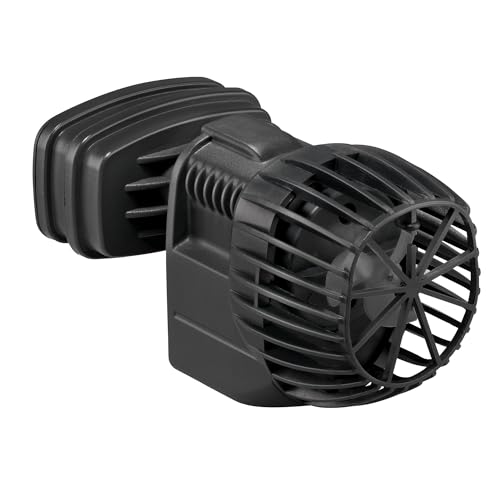
The XStream 3500 is the deliberate opposite of the app-controlled pumps above. Sicce, an Italian maker with a long history in aquarium pumps, builds it as a constant-flow AC stream pump: plug it in and it runs, at one speed, until it is unplugged or an external timer switches it. There are no modes, no app, and no controller to fail, which is a legitimate design choice for a freshwater planted tank or a marine setup that simply needs dependable background circulation.
What it offers instead is build detail. The impeller runs on pure ceramic bearings with a stainless steel shaft, a combination aimed at quiet running and long service life, and the pump draws a maker-stated 4 watts while moving up to 925 GPH. The magnetic mount rotates through a full 360 degrees so the outlet can be pointed anywhere, includes an anti-vibration case, and is specified for glass up to three quarters of an inch thick, the joint strongest hold in this guide. Sicce does not publish a gallon band for this model, so judge the fit on the flow figure: 925 GPH is nano-to-mid-size circulation, or one targeted zone in a larger tank, not whole-tank flow for a big reef.
Specs
- Type: AC stream propeller pump, constant flow
- Max flow: 925 GPH (3,500 L/h), maker figure
- Power consumption: 4 W, AC mains
- Control: None built in; runs continuously, can be paired with an external wave timer; 360-degree directional adjustment
- Mounting: Magnetic mount with anti-vibration case
- Max glass thickness: 0.75 in (19 mm)
- Maker tank rating: No gallon band published for this model
Keeping a Wavemaker Running Well
Flow fades slowly, and because it fades slowly it goes unnoticed. Algae film, coralline growth, and calcium deposits narrow the intake and drag on the impeller month by month, until a pump moves a fraction of the water it moved when new. A soak in a mild citric acid or vinegar solution every few months, with a soft brush worked around the impeller and cage, restores most of it. Gyre and cross-flow pumps need their rotors and cages stripped and cleaned on the same schedule.
Position matters as much as maintenance. A pump aimed so its output crosses the return flow from the filter creates turbulence that reaches everywhere; a pump aimed along a wall mostly stirs one lane. When corals close up, fish camp in one corner, or detritus settles in the same patch every week, the fix is usually angle and placement, not more power.
Frequently Asked Questions
How much flow does a reef tank actually need? Common guidance is total turnover of roughly twenty to forty times the tank volume per hour for a mixed reef, and more for SPS-dominant systems, split across all pumps rather than demanded from one. Soft coral and fish-only tanks sit happily far below that. These are planning ranges, not rules, and the livestock’s behaviour is the final check.
Is one big pump or two smaller pumps better? Two smaller pumps on opposite walls, run in alternating or anti-sync modes, usually produce healthier flow than one large pump: the direction keeps changing, dead spots get swept from both sides, and the tank still has circulation if one pump stops. One pump is simpler and perfectly workable in smaller aquariums.
Can a wavemaker run on a timer instead of a controller? Only pumps designed for it. DC controller pumps should be switched through their own controller or app, not by cutting power. Simple AC pumps like the Sicce in this guide tolerate external timers and wave timers well, which is one of their remaining advantages.
Why did the fish or anemone get stuck to the pump? Because the intake guard was missing, removed for cleaning and not refitted, or never supplied. Fit the guard, keep it fitted, and position pumps away from the rockwork an anemone is most likely to cross.
The Bottom Line
For a large reef, the Maxspect XF350 remains the reference gyre pump, with the flow, the controller, and the glass capacity to anchor a big system. The hygger HG042 covers the same large-tank territory in a propeller format with genuinely useful control features. Jebao’s SCP-120M brings the cross-flow sheet to long tanks with app scheduling, while the SLW-10 is the natural fit for nano aquariums with thin glass. The Sicce XStream 3500 asks for nothing and does one thing indefinitely. Match the pattern to the livestock, respect the glass limit, guard the intake, and any of the five will keep a tank healthier than still water ever could.
More from Amazon
Programs that pair well with the guide above. Offers and eligibility are set by Amazon and may change.
Free shipping on eligible items, Prime Video and more. Eligible new members can start with a free trial.
Start a Prime free trialA Prime membership for ages 18-24 with a trial period. Eligibility is set by Amazon.
See Prime for Young AdultsAudiobooks and podcasts to listen to on the go. Eligible new members can start with a free trial.
Try Audible freeAd-free music streaming. Eligible new subscribers can start with a free trial.
Try Music Unlimited freeAs an Amazon Associate we earn from qualifying purchases.

Write Your Review
No reviews yet. Be the first to share your experience!