

Key takeaways
- Compare five kitten milk replacers for orphaned and newborn kittens, with exact mixing ratios, feeding schedules and hygiene rules that keep neonates safe.
As an Amazon Associate we earn from qualifying purchases.
Affiliate Disclosure: This article contains affiliate links. If you buy through a link on this page, we may earn a commission at no extra cost to you.
A newborn kitten that has lost its mother has one immediate need: a milk replacer formulated for kittens, warmed to body temperature and fed around the clock. Two shortcuts cause real harm and are worth ruling out before any product comparison. Cow’s milk is not a substitute. It carries far more lactose than a kitten’s gut can handle, far less protein and fat than a growing kitten needs, and it commonly triggers diarrhoea that dehydrates a neonate within hours. Homemade emergency recipes circulating online are, at best, a stopgap for a single night while real replacer is on its way; they are unbalanced in calcium, taurine and vitamins, and no kitten should be raised on one as a plan.
Commercial kitten milk replacers exist precisely because queen’s milk is unusually rich: roughly twice the protein of cow’s milk, with taurine and arginine a kitten cannot synthesise in sufficient amounts. The five products below are the established options, spanning powders and a ready-to-feed liquid. One safety note before the list: in August 2026, Revival Animal Health voluntarily recalled its Breeder’s Edge Foster Care Feline and Shelter’s Choice feline milk replacers after testing found potassium, copper, folic acid, choline and vitamin B6 below intended levels in specific lots. Those products are not recommended here. Whatever brand you buy, check the lot and best-by date against current FDA recall notices, because a replacer is a sole-source diet and a deficient batch leaves a kitten with nothing else to grow on.
Powder or Ready-to-Feed Liquid
Powder is the default for a litter being raised over several weeks. It stores well unopened, mixes fresh for each day, and one can covers many feedings. Its risk is human error: a scoop mixed too weak starves the kitten slowly, and one mixed too strong can cause constipation and dehydration. Ready-to-feed liquid removes the measuring step entirely, which matters at 3 a.m. with a fading neonate, and it is sterile until opened. The trade-off is that an opened can must be refrigerated and used within about 72 hours, so it suits the first critical days, single kittens, and emergencies rather than a six-week foster assignment. Many experienced foster carers keep one can of liquid for the first night and a can of powder for everything after.
1. PetAg KMR Kitten Milk Replacer Powder, 12 oz
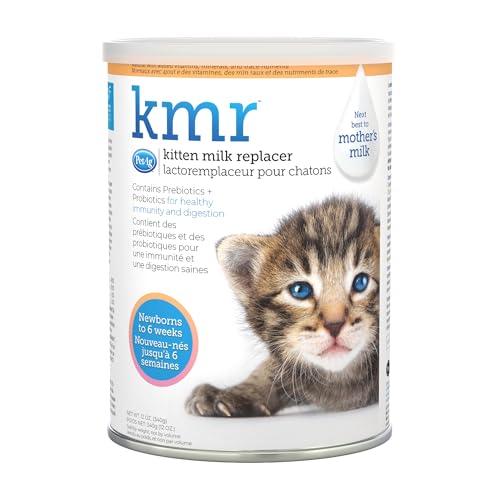
KMR is the reference product in this category and the formula most veterinary clinics and shelters reach for first. It is labelled as a complete diet for kittens from newborn to six weeks old, built on casein and dried skimmed milk with added taurine, arginine and a probiotic blend, and its guaranteed analysis sits at the top of the range for a mainstream powder. The mixing ratio is one part powder whisked into two parts warm water, and the label is explicit that you should not use a blender and should not mix more than the kitten will consume in 24 hours. Feeding rate is two tablespoons (30 mL) of reconstituted formula per 4 ounces (115 g) of body weight per day, divided across the day’s feeds. A 12 oz can makes roughly 60 oz of liquid at the standard ratio, which is why this size is the practical choice for a single kitten or a small litter.
Specs
- Form: Powder
- Size as listed: 12 oz can
- Crude protein: min 40.0 percent
- Crude fat: min 28.0 percent
- Crude fibre: max 0.6 percent; moisture: max 5.0 percent
- Mixing ratio: 1 part powder to 2 parts warm water
- Feeding rate: 2 tablespoons (30 mL) per 4 oz body weight daily
- Labelled for: Kittens newborn to six weeks; also as a supplement for nursing mothers
2. PetAg KMR Kitten Milk Replacer Liquid, 11 oz, Pack of 4

This is the same KMR nutrition in a ready-to-feed can, intended for the situations where mixing is the weak point: the first night with a chilled, weak neonate, a single tiny kitten, or a carer who cannot measure reliably at every feed. There is nothing to dilute and no ratio to get wrong; you shake the can, warm the portion, and feed. Because it is mostly water, its guaranteed analysis reads very differently from the powder’s, and that is expected rather than a shortcoming. The discipline with liquid is storage: refrigerate the can as soon as it is opened and discard or freeze what is left within three days, as the maker’s directions state. The four-can pack suits a foster home that wants sterile, zero-prep formula on hand for intakes without committing to liquid for the whole rearing period.
Specs
- Form: Ready-to-feed liquid
- Size as listed: 11 fl oz cans, pack of 4
- Crude protein: min 7.0 percent (as fed)
- Crude fat: min 4.5 percent (as fed)
- Crude fibre: max 0.8 percent; moisture: max 85.0 percent
- Mixing ratio: None; shake and serve
- Feeding rate: 2 tablespoons (30 mL) per 4 oz body weight daily
- Storage after opening: Refrigerate; discard or freeze within 3 days
- Labelled for: Kittens newborn to six weeks
3. Fox Valley Day-One Kitten Formula, 1 lb

Fox Valley Animal Nutrition supplies much of the wildlife rehabilitation world, and its Day-One kitten formula is the specialist’s pick among these five. The maker states it is produced from human-grade ingredients, and its guaranteed analysis is the most concentrated here: 40 percent minimum protein with a moderate 25 percent minimum fat, no crude fibre, and added taurine, arginine and methionine. It mixes at one part powder to two parts warm water at about 100 degrees Fahrenheit, and the maker’s feeding guidance is two to three teaspoons per 4 ounces of body weight per day, divided into four to six feedings. That smaller, more frequent pattern suits very young or weak kittens whose stomach capacity is the limiting factor. The 1 lb pouch is the sensible entry size; larger buckets exist for shelters raising litter after litter.
Specs
- Form: Powder
- Size as listed: 1 lb pouch
- Crude protein: min 40 percent
- Crude fat: min 25 percent
- Crude fibre: max 0 percent; ash: max 9 percent; moisture: max 5 percent
- Mixing ratio: 1 part powder to 2 parts warm water
- Feeding rate: 2 to 3 teaspoons per 4 oz body weight daily, in 4 to 6 feedings
- Labelled for: Growing kittens from birth; also queens and convalescent cats
4. Nutri-Vet Milk Replacer for Kittens, 12 oz

Nutri-Vet’s powder is built around gut support, which is where orphaned kittens most often fail. Its Opti-Gut blend supplies live micro-flora intended to stabilise digestion during the highest-risk weeks, and published veterinary comparisons list its guaranteed analysis at 30 percent minimum protein and 40 percent minimum fat, a higher-fat, energy-dense profile than the other powders here. Mixing is one tablespoon of powder to two tablespoons of water warmed to roughly 100 to 105 degrees Fahrenheit, fed at two tablespoons of solution per 4 ounces of body weight per day. One honest label note: Nutri-Vet positions this product for newborn kittens whose mother’s milk is unavailable or insufficient, and its own materials also describe supplemental use for pregnant, nursing and senior cats, so read the current can’s feeding statement and involve a veterinarian if a kitten will be raised on it as the sole diet for the full six weeks.
Specs
- Form: Powder
- Size as listed: 12 oz can
- Crude protein: min 30 percent
- Crude fat: min 40 percent
- Mixing ratio: 1 tablespoon powder to 2 tablespoons warm water
- Feeding rate: 2 tablespoons (1 oz) solution per 4 oz body weight daily
- Notable addition: Opti-Gut live micro-flora blend
- Labelled for: Newborn kittens; also pregnant, nursing and senior cats
5. Hartz Powdered Kitten Milk Replacer Formula, 11 oz

Hartz’s powdered replacer is the widely stocked grocery and general-store option, and for a kitten found on a Sunday night that availability is a genuine virtue. It is made with real milk protein and fortified for the jobs kitten formula has to do: calcium for bone development, taurine for heart and eye development, and lysine for respiratory health. The label directs mixing one part powder with two parts room-temperature water until lumps dissolve completely, and rates the powder at 5,000 kcal of metabolisable energy per kilogram. It is labelled for orphaned, small or weak kittens from birth to six weeks, and doubles as a supplement for a pregnant or nursing mother or a convalescing cat. One transparency point: Hartz’s published label summary leads with calorie content rather than a protein and fat percentage, so check the guaranteed analysis panel on the can itself when comparing it against the powders above.
Specs
- Form: Powder
- Size as listed: 11 oz (312 g) can
- Calorie content: 5,000 kcal ME per kg of powder (11 kcal per teaspoon)
- Mixing ratio: 1 part powder to 2 parts room-temperature water
- Fortified with: Calcium, taurine, lysine, linoleic acid
- Protein and fat percentages: Printed on the can’s guaranteed analysis panel
- Labelled for: Kittens from birth to six weeks; supplement for nursing mothers
Feeding Schedule and Neonatal Care Essentials
Formula choice is only half the job. For the first week of life, kittens feed every two to three hours, around the clock; by week two the interval stretches to roughly every three to four hours, and by week three to four, every four to six hours, always adjusted against the label’s daily volume for the kitten’s weight. Serve formula warm, near body temperature, never hot, and never microwave it, since hot spots can scald a mouth and throat; warm the bottle in a cup of warm water instead. Feed the kitten belly-down in a natural nursing posture, never on its back like a human baby, which invites aspiration.
Kittens under about three weeks cannot urinate or defecate on their own. After every feed, stimulate the genital area gently with a warm, damp cloth or cotton ball until the kitten eliminates, and finish with a gentle burp by holding the kitten upright against your shoulder and patting its back. Weigh each kitten daily on a gram scale; steady daily gain is the clearest sign the formula, ratio and schedule are right, and a flat or falling weight curve is the earliest warning to call a veterinarian.
Hygiene is not optional at this age. Wash hands before handling, sterilise bottles and nipples between feeds, mix powder with measured precision rather than by eye, refrigerate mixed formula immediately, and discard reconstituted powder after 24 hours and opened liquid within the window on its label. Formula left sitting in a bottle at room temperature should never be reoffered. If this is your first orphaned litter, pair this guide with a veterinarian or an experienced foster mentor from a local rescue; the schedule above keeps a kitten alive tonight, and a mentor catches the problems a label cannot.
Weaning: The Exit From the Bottle
At around four weeks, teeth erupt, kittens start lapping, and the bottle’s job begins to end. Offer a shallow dish of warm replacer, then a gruel of replacer mixed with wet kitten food, thickening the mixture over one to two weeks until the kitten eats solid kitten food on its own, usually by six to eight weeks. Stage-2 weaning foods, sold as gruel-style transition powders for the four-to-eight-week window, exist for kittens that stall at this step. Keep fresh water available from the first gruel onward, and keep offering a bottle top-up to any kitten whose weight gain falters during the transition rather than forcing the schedule.
The Bottom Line
For most foster situations, the KMR powder is the dependable default: complete labelling, a clear 1-to-2 mixing ratio, and a can size matched to a litter’s first weeks. Keep the KMR liquid four-pack for intake night and fragile neonates, choose Fox Valley Day-One for specialist-level concentration in small, frequent feeds, consider Nutri-Vet when digestive stability is the battle, and treat the Hartz can as the respectable emergency buy that keeps a found kitten fed tonight. Whichever can you open, measure exactly, feed on schedule, stimulate after every meal, and weigh daily; in neonatal care, routine is the treatment.
More from Amazon
Programs that pair well with the guide above. Offers and eligibility are set by Amazon and may change.
Free shipping on eligible items, Prime Video and more. Eligible new members can start with a free trial.
Start a Prime free trialA Prime membership for ages 18-24 with a trial period. Eligibility is set by Amazon.
See Prime for Young AdultsAudiobooks and podcasts to listen to on the go. Eligible new members can start with a free trial.
Try Audible freeAd-free music streaming. Eligible new subscribers can start with a free trial.
Try Music Unlimited freeAs an Amazon Associate we earn from qualifying purchases.










Write Your Review
No reviews yet. Be the first to share your experience!