

Key takeaways
- Compare the best power steering pulley tools for pulling and pressing pump pulleys: five kits compared by hub size, pump fitment and included hardware.
As an Amazon Associate we earn from qualifying purchases.
Start with the warning, because it is the whole reason this tool category exists: never pull a power steering pulley with a jaw puller. A power steering pulley is pressed onto the pump shaft with an interference fit, and its hub has a raised flange designed for one specific job — being gripped by a split collar while a forcing screw pushes against the end of the shaft. Hook two or three jaws over the rim of the pulley and start tightening, and the force lands on the thin outer disc instead of the hub. The usual results are a bent pulley that wobbles and eats belts, a cracked plastic pulley on newer cars, or a pulley that comes off at an angle and scores the shaft on the way. Every kit in this guide works the same correct way: a collar or jaw halves close around the hub flange, the center screw bears on the shaft, and the pulley walks straight off. Installation is the reverse — a threaded installer screws into the shaft and presses the pulley on squarely to its seated depth.
Affiliate Disclosure: This article contains affiliate links. If you buy through these links, we may earn a commission at no additional cost to you. This helps support our work and allows us to continue providing detailed tool guides.
What to Look for in a Power Steering Pulley Tool
Hub diameter is the first fitment check. Most domestic press-fit pump pulleys use one of four hub sizes: 1-1/8, 1-1/4, 1-5/16, or 1-3/8 inches. The collar halves in the kit have to close on the hub you actually have, so measure the hub or look it up by pump before ordering. A kit that covers all four sizes handles the overwhelming majority of Ford, GM, and Chrysler pumps you are likely to meet.
Pump type matters as much as size. The common pump families named in these kits are Saginaw, Thompson, and the Ford C111 and C2 pumps. The forcing screws in a kit are threaded to suit those pumps’ shafts — typical threads are 3/8″-16 and 5/16″-18, with some kits adding an M8 x 1.25 installer for later applications. If the screw threads do not match the shaft, the tool cannot install the pulley no matter how well the collar fits.
Removal-only tools are half a kit. Pulling the old pulley off is the dramatic part, but the new pulley still has to go back on to the correct depth, flush with the end of the shaft or to the maker’s specified position, without hammering. Hammer blows travel straight through the pulley into the pump’s internal thrust surfaces. Every pick here both removes and installs, which is the minimum a pump-pulley tool should do.
Lubricate the forcing screw. This is the instruction experienced users repeat and first-time users skip. A dry fine-thread screw under pulling load galls, binds, and can snap or strip. A coat of oil or anti-seize on the threads before each use is what separates a kit that lasts years from one that dies on its second seized pulley.
Plastic pulleys need a gentler grip. Many late-model pumps carry molded plastic pulleys that crack under the concentrated load a narrow metal collar can apply. Kits with wider half-moon shells or a retaining ring spread the load around the hub. If your fleet is mostly newer vehicles, weigh that design point heavily.
The 5 Best Power Steering Pulley Tools
1. OTC 4530 Power Steering Pump Pulley Service Set

The OTC 4530 is the reference design in this category: a complete removal and installation set built around the four standard hub diameters, with adapters matched to a named list of domestic applications rather than a vague universal claim. OTC lists the set for GM 3.1L, 3100, 3400, and 3800 V6 engines, the GM 2.3L Quad 4 four-cylinder, and Ford 4.6L, 5.4L, and 5.8L modular V8 engines — which makes fitment checking straightforward if you work on those engines regularly. The puller collar grips the hub flange while the forcing screw pushes on the shaft, and the installer hardware presses the replacement pulley on to depth.
Everything stores in a blow-molded case, which matters more than it sounds: these kits are collections of small threaded pieces, and a lost installer screw turns the whole set into a removal-only tool. For a shop or serious home garage that services domestic trucks and cars, the 4530 is the benchmark the rest of this list is measured against.
Specs
- Function: Removes and installs power steering pump pulleys
- Hub sizes: 1-1/8, 1-1/4, 1-5/16, and 1-3/8 in
- Named applications: GM 3.1L, 3100, 3400, 3800 V6; GM 2.3L Quad 4; Ford 4.6L, 5.4L, 5.8L modular V8
- Storage: Blow-molded case
2. OEMTOOLS 27031 Power Steering Pulley Puller and Installer Kit

The OEMTOOLS 27031 covers the same four hub diameters as the OTC set and names its pump coverage explicitly: Saginaw, Thompson, and Ford C111 and C2 pumps, across Ford, GM, Chrysler, and VW applications. The kit’s two screws handle the shaft threads used on those pumps. Beyond the steering pump itself, OEMTOOLS also rates the set for pulling GM belt-driven vacuum pump pulleys and pressed-on water pump pulleys on GM V6 engines — genuinely useful overlap, since those pulleys share the same press-fit hub design and fail the same way when attacked with a jaw puller.
The steel pulley clamp and removal screws come in a molded carrying case, and at just over two pounds the kit is easy to keep in a service cart rather than a cabinet. If your work is mostly the classic domestic pump families, this is a complete, honestly specified kit.
Specs
- Function: Removes and installs power steering pump pulleys
- Hub sizes: 1-1/8, 1-1/4, 1-5/16, and 1-3/8 in
- Pump coverage: Saginaw, Thompson, Ford C111 and C2 pumps (Ford, GM, Chrysler, VW)
- Also rated for: GM belt-driven vacuum pump pulleys, pressed-on GM V6 water pump pulleys
- Construction: Steel clamp and removal screws
- Weight: 2.04 lb; case dimensions 9.5 x 7.3 x 2.3 in
3. DPTOOL Power Steering Pulley Puller and Installer
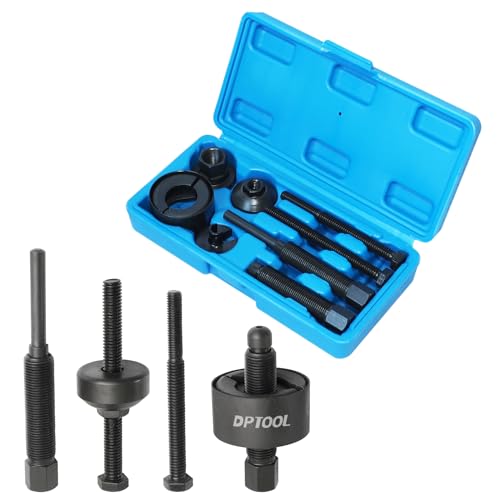
The DPTOOL kit follows the same proven layout — collar halves, pressure flange and ring, a pressure bearing to cut friction under load, and a set of forcing screws — but specifies its material more precisely than most: structural-grade AISI 1045 medium carbon steel, heat-treated. That matters on the forcing screw, which is the part that takes the full pulling load on its threads. DPTOOL fits the same four hub sizes and names GM 3.1L V6 and 2.3L Quad 4 engines, Ford 4.6L, 5.4L, and 5.8L V8s, Chrysler systems, and most VW power steering pumps, again covering Saginaw, Thompson, and Ford C111 and C2 pumps.
One practical difference: DPTOOL states the tool can be driven with an air tool or impact, or worked with a simple wrench and socket. If you do use power, go gently and keep the threads oiled — the maker’s own instructions stress lubrication, warning that dry threads damage the tool. The set arrives in a portable case with an instruction manual.
Specs
- Function: Removes and installs power steering pump pulleys
- Hub sizes: 1-1/8, 1-1/4, 1-5/16, and 1-3/8 in
- Material: AISI 1045 medium carbon steel, heat-treated
- Hardware: Extended pressure screw, 3/8″-16 and 5/16″-18 bolts, pressure flange, pressure ring, pressure bearing, collar halves and retaining ring
- Pump coverage: Saginaw, Thompson, Ford C111 and C2 (GM, Ford, Chrysler, VW applications)
- Drive: Hand tools, air tool, or impact per maker instructions
- Storage: Portable case with instruction manual
4. Orion Motor Tech Power Steering Pulley Puller/Installer Tool Set (SP0400)

Orion Motor Tech’s seven-piece set is the compact option here. It includes the pulley remover, a pulley installer, two forcing screws, a sleeve, two puller jaws, and a power steering line disconnect tool, all in a small blow-molded case. The remover works on the 5/8″-18 thread form, and the installer covers 3/8″-16 or M8 x 1.25 shaft threads — that metric installer thread is worth noting, because it extends the kit to later pumps the older domestic-only sets do not address. The tools are 1045 steel with a matte black finish, heat-treated and blackened for corrosion resistance.
Coverage spans the same 1-1/8 to 1-3/8 inch hub range for Ford, GM, and Chrysler vehicles, with the forcing screws also suiting some Volkswagen pumps. At about two pounds in a case roughly nine inches long, this is the kit most likely to live in a road toolbox rather than on a shelf.
Specs
- Function: Removes and installs power steering pump pulleys
- Pieces: 7 (remover, installer, 2 forcing screws, sleeve, 2 puller jaws, disconnect tool)
- Threads: 5/8″-18 remover; 3/8″-16 or M8 x 1.25 installer
- Hub sizes: 1-1/8 to 1-3/8 in
- Material: 1045 steel, heat-treated, matte black finish
- Vehicle coverage: Ford, GM, Chrysler; some VW pumps via forcing screws
- Case: Blow-molded, 9.1 x 7.5 x 2.5 in; weight about 2 lb
5. GAOLAOSY Power Steering Pump Pulley Removal Tool

The GAOLAOSY kit is a straightforward carbon steel puller and installer set aimed at the same press-fit pulley job, and it casts its application net a little wider: the maker lists it for power steering pump pulleys as well as water pump and vacuum pump pulleys, which suits a generalist garage that meets all three. Construction is high-strength carbon steel with a corrosion-resistant finish. There is less published detail on hub-size breakdown than the name-brand sets provide, so confirm your hub diameter against the listing before ordering — but the tool follows the correct hub-gripping, shaft-pushing pattern rather than a jaw design, which is the non-negotiable point.
Specs
- Function: Removes and installs press-fit pump pulleys
- Applications per maker: Power steering, water pump, and vacuum pump pulleys
- Material: Carbon steel, corrosion-resistant finish
- Model: Power Steering Pump Pulley Removal Tool
- Manufacturer part number: GAOLAOSY-GLA-393
Using a Pulley Service Set Without Damaging the Pump
The technique is the same across all five kits. Clean the hub flange and shaft end first — grit under the collar halves lets them slip. Seat the collar or jaw halves fully around the hub flange and close the retaining sleeve or ring over them so the halves cannot spread under load. Oil the forcing screw threads. Then turn the screw while holding the collar from rotating, and watch the pulley: it should move straight and evenly. If it cocks to one side, back off, reseat the collar, and start again — a pulley pulled at an angle can gall the shaft, and a scored shaft will never hold the new pulley properly.
On installation, thread the installer into the shaft by hand first to confirm the threads match, then draw the pulley down evenly until it seats. The pulley face should end up at the maker’s specified position relative to the shaft end; a pulley pressed too far or left short will throw the belt out of line with the rest of the accessory drive, and the belt will tell you about it within a few hundred miles. Spin the pulley by hand before refitting the belt: any wobble means the pulley went on crooked or was already bent.
Frequently Asked Questions
Can I use a three-jaw puller if I am careful? No. Care does not change where the force lands. Jaw pullers load the pulley rim, and press-fit steering pulleys are not built to be pulled by the rim. Bent and cracked pulleys are the predictable result, which is why the hub-collar design exists.
How do I know which hub size my pump has? Measure the hub diameter with a caliper, or match the pump and engine against the application lists the kit makers publish. The four sizes covered here — 1-1/8 through 1-3/8 inches — account for most domestic pumps.
Will these kits fit my alternator pulley? Not by default. This guide is about power steering pump pulleys, which use threaded shaft installers. Alternator decoupler pulleys use a completely different tool family with spline and hex bits; that is a separate article and a separate purchase.
Does the pulley have to come off to change the pump? Usually, yes. Most replacement pumps ship without a pulley, and the pulley blocks access to mounting bolts on many applications anyway. Budget for the pulley swap as part of any pump replacement.
The Bottom Line
Every kit here does the one thing that matters: it pulls on the hub and pushes on the shaft, keeping force where the pulley was designed to take it. The OTC 4530 is the benchmark set with the clearest application list. The OEMTOOLS 27031 matches it on hub coverage and adds vacuum and water pump pulley work. The DPTOOL kit stands out for its specified heat-treated 1045 steel and impact-rated drive. The Orion Motor Tech SP0400 is the compact pick with a useful metric installer thread, and the GAOLAOSY covers steering, water, and vacuum pump pulleys in one generalist set. Measure your hub, match your pump family, oil the threads — and leave the jaw puller in the drawer.
More from Amazon
Programs that pair well with the guide above. Offers and eligibility are set by Amazon and may change.
Free shipping on eligible items, Prime Video and more. Eligible new members can start with a free trial.
Start a Prime free trialA Prime membership for ages 18-24 with a trial period. Eligibility is set by Amazon.
See Prime for Young AdultsAudiobooks and podcasts to listen to on the go. Eligible new members can start with a free trial.
Try Audible freeAd-free music streaming. Eligible new subscribers can start with a free trial.
Try Music Unlimited freeAs an Amazon Associate we earn from qualifying purchases.
Write Your Review
No reviews yet. Be the first to share your experience!