

Key takeaways
- Pole tents: Usually economical and visually appealing, but interior poles and perimeter ropes constrain tables, stages, and dance floors. They require suitable staking or engineered ballast.
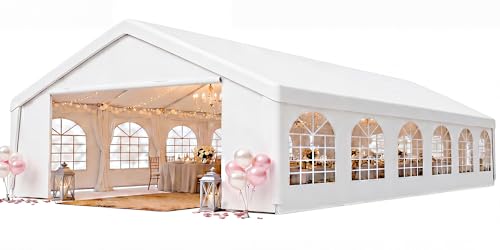
- Frame tents: Use an aluminum or steel framework around the roof and walls, leaving the interior open. They work well on asphalt, concrete, lawns, and compact spaces, although ballast can become substantial.
- Clearspan structures: Commercial modular systems use rigid frames and often taller walls. They are the strongest choice for large festivals, repeated rental work, lighting grids, and complex layouts, but transport and installation usually require a professional crew.
- High-peak tents: A useful middle ground for weddings, with an elevated roof profile and relatively efficient setup. Their center supports can still affect the layout.
The best event tents are commercial-frame or tension-frame structures matched to guest count, ground conditions, weather exposure, and how often the tent will be assembled—not simply the largest canopy within budget.
Our top picks



As an Amazon Associate we earn from qualifying purchases at no extra cost to you. Ratings are shown as listed on Amazon.
Quick picks by event situation
| Event situation | Best tent type | Practical size | Typical seated capacity | Why it fits |
|---|---|---|---|---|
| Private wedding, 40–80 guests | Small pole or frame tent | 20 × 40 ft to 30 × 40 ft | 50–100 | Efficient footprint and manageable installation |
| Wedding reception, 100–200 guests | Commercial frame or clearspan tent | 40 × 60 ft to 40 × 100 ft | 120–250 | Flexible floor plan with no center poles |
| Festival or community event | Large clearspan or modular frame system | 40 × 100 ft and larger | 250–600+ | Expandable bays, stronger circulation, service access |
| Frequent rental use | Commercial aluminum-frame system | Modular 10- or 20-ft bays | Varies by configuration | Repeatable setup, replaceable parts, professional anchoring |
| Small budget and occasional use | High-peak or basic frame tent | 20 × 20 ft to 20 × 40 ft | 25–80 | Lower purchase cost, but less margin for severe weather |
Capacity figures assume banquet seating with tables and chairs, not a standing crowd. Add space for a buffet, bar, dance floor, stage, gifts, catering access, and exits before ordering.
What separates the best event tents
Guest capacity and usable floor area
A tent’s advertised dimensions describe its outside footprint. Poles, guy lines, ballast, sidewalls, and clearance around the perimeter reduce usable space. For a seated dinner, allow roughly 12–15 square feet per guest when the tent includes tables and chairs. A dance floor, stage, or buffet may raise the requirement to 18–25 square feet per guest.
For example, a 40 × 80 ft tent provides 3,200 square feet. At 15 square feet per guest, the theoretical capacity is about 213 people. If a 20 × 20 ft dance floor, 160 square feet of catering space, and circulation areas consume approximately 650 square feet, the remaining 2,550 square feet supports closer to 170 guests. This calculation prevents an attractive floor plan from becoming cramped.
Floor plans: center poles versus clearspan space
- Pole tents: Usually economical and visually appealing, but interior poles and perimeter ropes constrain tables, stages, and dance floors. They require suitable staking or engineered ballast.
- Frame tents: Use an aluminum or steel framework around the roof and walls, leaving the interior open. They work well on asphalt, concrete, lawns, and compact spaces, although ballast can become substantial.
- Clearspan structures: Commercial modular systems use rigid frames and often taller walls. They are the strongest choice for large festivals, repeated rental work, lighting grids, and complex layouts, but transport and installation usually require a professional crew.
- High-peak tents: A useful middle ground for weddings, with an elevated roof profile and relatively efficient setup. Their center supports can still affect the layout.
For a wedding with a central dance floor, head table, and unobstructed guest sightlines, a frame or clearspan design is usually easier to plan than a pole tent. For a relaxed cocktail event on a lawn, the lower cost and traditional appearance of a pole tent may be more important.
Weather protection: fabric is only part of the answer
Event tents commonly use coated polyester, vinyl, or PVC-coated polyester. Lightweight polyester can reduce handling weight, while commercial vinyl and PVC-coated fabrics generally offer better abrasion resistance, cleanability, and long-term water resistance. Look for details such as heat-welded seams, reinforced attachment points, UV-resistant coating, flame-retardant certification appropriate to the event location, and sidewalls that seal continuously at the roof and ground.
Waterproof fabric does not make a tent safe in every storm. Wind resistance depends on the entire system: frame engineering, roof geometry, sidewall configuration, anchors, ballast, and installation quality. Fully enclosed sidewalls can substantially increase wind loading. Ask the supplier for a documented wind rating and the conditions under which it applies rather than relying on a vague “all-weather” claim.
For rain, raised flooring is often more valuable than a thicker roof alone. Interlocking plastic flooring, plywood subfloors, or temporary deck systems can keep guests above mud and standing water. For heat, prioritize high roof volume, removable sidewalls, ridge ventilation, and correctly sized fans. Never use unapproved fuel-burning heaters inside an enclosed tent; heating equipment should be selected and operated according to local fire rules.
Frame durability, anchoring, and installation crews
Aluminum frames are lighter and resist corrosion, making them practical for frequent assembly. Steel frames can provide high strength but add considerable transport weight and may need more attention to finish damage and corrosion. The parts most likely to wear first are roof connectors, ratchets, webbing, zippers, sidewall clips, stakes, and fabric edges—not usually the main frame tubes.
Anchoring is a design decision, not an accessory to improvise at the venue. On soil, commercial stakes or screw anchors may be appropriate after confirming underground utilities. On asphalt or concrete, engineered ballast blocks or water ballast may be required. A 40 × 80 ft frame tent can need several thousand pounds of ballast in exposed conditions; the exact requirement depends on the manufacturer’s engineering and local wind rules. Household sandbags are rarely an adequate substitute.
For a small 20 × 20 ft canopy, an experienced event team may complete installation in a few hours. A 40 × 100 ft structure can require a trained crew, lifting equipment, and a full day or more, especially with flooring, lighting, sidewalls, and ballast. Large clearspan systems should normally be installed by the supplier or a qualified commercial crew. Include delivery, setup, teardown, site inspection, and weather monitoring in the quote.
Decision matrix for choosing the right system
| Your priority | Recommended choice | Trade-off |
|---|---|---|
| Lowest purchase cost | Basic pole or high-peak tent | More layout limits and greater dependence on staking |
| Hard surface or tight urban site | Frame tent with engineered ballast | Ballast can be expensive and consume exterior space |
| Maximum interior flexibility | Clearspan structure | Higher transport, labor, and engineering costs |
| Occasional one-day celebration | Rental-grade frame tent | Renting may cost less than storage and maintenance |
| Monthly or weekly event use | Modular commercial aluminum system | Requires inventory management and trained installers |
| High heat or humid climate | Ventilated roof with removable sidewalls | Less enclosure during wind-driven rain |
Accessories that change the event experience
- Flooring: Essential for wet ground, formal footwear, accessibility, and dance areas.
- Sidewalls: Choose solid, clear, windowed, or mesh panels according to privacy, airflow, and weather needs.
- Doors and ramps: Zippered entries may suit small events; framed doors and ramps improve access for large crowds and equipment.
- Lighting: Use distributed LED fixtures or suspended event lighting with protected cables and suitable load calculations.
- Gutters: Joining gutters between adjacent tents helps prevent runoff from pouring into walkways.
- Heating and cooling: Specify equipment with the tent supplier so ventilation, fire clearances, and electrical demand are compatible.
- Ballast covers and cable ramps: These reduce trip hazards and make a professional installation safer for guests.
Ownership costs and maintenance realities
Purchase prices vary widely, but a small recreational-quality canopy may cost a few hundred dollars, a rental-grade wedding tent several thousand dollars, and a large commercial clearspan installation tens of thousands of dollars or more before flooring and labor. Compare ownership with rental using cost per use:
Cost per use = purchase price + storage + maintenance + average setup labor, divided by expected events.
A $6,000 frame system used for 12 events, with $1,200 in total maintenance and $150 of setup labor per event, costs about $750 per use before transport and anchoring. If a comparable rental costs $900 per event and includes installation, ownership may be worthwhile only if the owner can store, inspect, and safely install the tent.
Dry fabric completely before storage, even if it appears clean. Brush off grit, wash according to the manufacturer’s instructions, and avoid harsh solvents that can damage coatings. Inspect every seam, buckle, connector, and strap before the next event. Do not drag wet or loaded fabric across rough ground, and do not pack a tent with leaves or soil trapped inside.
Final buying checklist
- Calculate seating, service areas, exits, and circulation rather than using guest count alone.
- Confirm the floor plan works without blocking doors, fire lanes, or accessible routes.
- Obtain the manufacturer’s anchoring and wind requirements for the exact size.
- Measure the site, including overhead obstructions, vehicle access, and ground type.
- Ask who installs the tent and whether the crew is trained for the selected system.
- Budget for flooring, ballast, sidewalls, lighting, delivery, and teardown.
- Check local permits, fire-retardancy documentation, occupancy limits, and weather cancellation rules.
For most weddings, a rental-grade frame tent offers the best balance of open floor planning and manageable weather protection. For festivals or repeated commercial use, a modular clearspan structure is the stronger long-term choice. The best event tents are the ones whose capacity, anchoring plan, installation crew, and accessories are specified before the first table is delivered.





Write Your Review
No reviews yet. Be the first to share your experience!