

Key takeaways
- Is the wind rating stated for the roof only, or for the roof with sidewalls installed?
- What anchor type and spacing are required?
- Can the system be installed on pavement or decking?
- Who checks underground utilities before staking?
- What is the evacuation or takedown threshold in the weather plan?
The best commercial party tents for large events are modular, fire-rated frame tents with replaceable parts, engineered anchoring, and a wind rating that matches the site—not simply the largest canopy you can afford.
For most weddings and corporate events, a 30 × 60-foot or 40 × 80-foot commercial frame tent is the most useful starting point. Festival operators usually need larger clearspan structures, such as 40 × 100 feet or modular 50 × 100-foot systems, while occasional users may be better served by a professionally installed high-peak or pole tent.
Our top picks


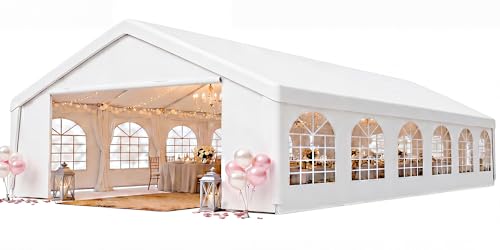
As an Amazon Associate we earn from qualifying purchases at no extra cost to you. Ratings are shown as listed on Amazon.
Best commercial party tents by event type
| Best for | Recommended tent type | Useful starting size | Typical seated capacity | Why it fits |
|---|---|---|---|---|
| Formal wedding reception | High-peak or frame tent | 30 × 60 ft | 120–150 guests | Attractive roofline, flexible doors, flooring and climate-control options |
| Corporate dinner or product event | Clearspan frame tent | 40 × 80 ft | 200–260 guests | No center poles; easier staging, branding and AV placement |
| Festival or public market | Modular clearspan structure | 40 × 100 ft or larger | 300–450 guests | Expandable footprint and better control of entrances, vendors and egress routes |
| Repeated rental use | Commercial frame tent system | 20 × 40 ft modules | 50–100 guests per module | Replaceable roofs, sidewalls and fittings reduce long-term downtime |
| Small budget event | Heavy-duty pole tent | 30 × 45 ft | 75–110 guests | Lower purchase cost, but requires suitable ground and center poles |
Capacity estimates assume banquet seating with tables, chairs and circulation space. A standing reception can fit more people, while a stage, dance floor, buffet, bar or exhibition booths can reduce capacity substantially.
Frame tent versus pole tent versus clearspan
Frame tents: the versatile commercial choice
Frame tents use an aluminum or galvanized-steel framework that supports the roof independently of the fabric. They can be installed on grass, asphalt, concrete or decking when the anchoring plan permits it. Since there are no center poles, the interior works well for dining layouts, stages, dance floors and trade-show displays.
Aluminum frames are lighter and easier for crews to handle. Commercial aluminum systems commonly use extrusions around 2 to 3 inches wide, with thicker or reinforced components for larger spans. Galvanized steel frames are heavier but can offer excellent rigidity and lower initial cost. The trade-off is transport weight, corrosion management and more demanding manual handling.
Pole tents: attractive, economical and site-dependent
Pole tents are supported by perimeter and center poles, tensioned ropes and stakes. Their peaked profile is appealing for weddings and private celebrations, and they generally cost less than comparable frame systems. They need a larger perimeter because guy lines extend beyond the fabric, and they are poorly suited to hard surfaces unless a specialist anchoring system is available.
Center poles also create layout restrictions. A 30 × 60-foot pole tent may need its dance floor, buffet or seating arranged around multiple interior poles. This is manageable for a dinner but inconvenient for product demonstrations or unobstructed staging.
Clearspan structures: best for large public events
Clearspan tents use stronger engineered frames and often have higher sidewalls, wide gable ends and modular connectors. They are the best choice when trucks, stages, large displays or crowds need an uninterrupted interior. They also provide better separation between guest areas, catering zones and backstage operations.
Their advantages come with higher transport, labor and anchoring requirements. For a one-day event, hiring an installer is usually more practical than purchasing a large clearspan system.
Compare the specifications that matter
| Specification | Occasional commercial use | Frequent rental or venue use | Large public event |
|---|---|---|---|
| Common footprint | 20 × 40 to 30 × 60 ft | 30 × 60 to 40 × 80 ft | 40 × 100 ft and modular systems |
| Primary frame | Aluminum frame or steel pole system | Commercial aluminum frame | Engineered aluminum or steel clearspan |
| Typical packed weight | 250–550 lb | 500–1,200 lb | 1,000–3,000 lb or more |
| Roof fabric | 14–18 oz coated polyester or vinyl | 16–20 oz commercial vinyl | 18–22 oz engineered vinyl |
| Sidewall height | 7–8 ft | 7–8 ft, with high-sidewall options | 8–12 ft or more |
| Indicative operating wind range | 25–40 mph, only when rated and anchored | 35–50 mph, subject to engineering and ballast | 50 mph or higher for selected engineered systems |
| Setup crew | 4–6 people | 6–10 people | Professional installation crew |
These are useful comparison ranges, not universal guarantees. Wind performance depends on footprint, roof shape, sidewalls, surface, anchor spacing, ballast, exposure and local rules. A seller should provide a written wind rating and anchoring schedule for the exact model and configuration. Never treat a generic “heavy duty” label as an engineering certification.
Anchoring is more important than extra fabric weight
On grass or soil, commercial tents are commonly secured with stakes, driven anchors or screw anchors. A 30 × 60-foot tent may require dozens of perimeter anchor points, with the exact number determined by the frame manufacturer and local wind calculations. Larger structures may need deeper anchors or engineered ground screws.
On asphalt or concrete, water barrels are rarely an adequate substitute for a proper ballast plan. Ballast may consist of concrete blocks, ballast plates, water weights or engineered systems connected directly to the frame. The required total weight can range from several thousand pounds to tens of thousands of pounds on large or exposed structures.
Ask these questions before signing a rental or purchase agreement:
- Is the wind rating stated for the roof only, or for the roof with sidewalls installed?
- What anchor type and spacing are required?
- Can the system be installed on pavement or decking?
- Who checks underground utilities before staking?
- What is the evacuation or takedown threshold in the weather plan?
Choose a layout before choosing the footprint
For a wedding, allow approximately 10 to 12 square feet per guest for banquet seating, excluding substantial catering, restroom and backstage areas. A 30 × 60-foot tent provides 1,800 square feet. At 12 square feet per guest, that is about 150 guests before subtracting a large dance floor, buffet or bar.
For example, suppose a reception needs seating for 120 people, a 20 × 20-foot dance floor, a 12 × 20-foot buffet area and a 10 × 20-foot bar. The basic areas total:
- Guest seating: 120 × 10 square feet = 1,200 square feet
- Dance floor: 400 square feet
- Buffet: 240 square feet
- Bar: 200 square feet
- Subtotal: 2,040 square feet
After adding circulation and service space, a 30 × 60-foot tent is likely tight. A 40 × 60-foot tent, a 40 × 80-foot tent, or separate catering and guest structures would provide a more workable plan.
Corporate events often benefit from a clearspan layout divided into registration, presentation, seating, refreshments and sponsor areas. Festivals need wider aisles, emergency exits, queue space and separation between cooking, power and public zones. Draw the floor plan with tables and equipment at scale; a tent that fits the guest count can still fail operationally.
Setup, maintenance and ownership realities
Large commercial tents are not usually a one-person setup. A frame tent involves unloading, sorting components, assembling the roof frame, attaching fabric, raising the structure, tensioning the perimeter, installing sidewalls and completing anchors. A 30 × 60-foot system may take four to six trained workers several hours, while a large clearspan structure can require a full crew and lifting equipment.
Keep fabric dry before storage. Moisture trapped in folded vinyl can cause mildew, staining and unpleasant odors. Sweep off dirt, wash with mild soap and water, and avoid harsh solvents that can damage coatings or printed graphics. Inspect roof seams, webbing, buckles, zippers and pole connectors after every event.
The parts that commonly wear first are stake loops, ratchet straps, sidewall zippers, hook-and-loop closures, connector pins and fabric edges exposed to abrasion. Buy a system with individually replaceable roof panels and sidewalls rather than one-piece components that force a major replacement after localized damage.
Budget for transport, labor, storage racks, cleaning, repairs, ballast and permits. A commercial tent may cost roughly $3,000–$10,000 for a smaller frame system and $10,000–$50,000 or more for large engineered structures, before installation and accessories. Rental rates vary widely by region and may make professional hire more economical for events held only a few times each year.
Decision matrix: which tent should you buy?
| Your situation | Best direction | Reason |
|---|---|---|
| Limited budget, grassy venue, infrequent use | Commercial pole tent or rental | Lower purchase cost, but accept center poles and guy lines |
| Frequent weddings and mixed venues | Modular aluminum frame tent | Reusable on more surfaces and easier to configure |
| Hard-surface site with branding and AV | Clearspan frame system | No interior poles and better wall, door and lighting options |
| Wind-exposed waterfront or open field | Engineered structure with certified anchoring | Higher safety margin and documented installation requirements |
| Festival operator expanding over time | Modular 20- or 30-foot bays | Add capacity without replacing the complete structure |
Bottom line
Choose a commercial aluminum frame tent for the best all-purpose balance of layout freedom, portability and repeat use. Choose a pole tent when appearance and initial cost matter more than unobstructed space. Choose an engineered clearspan structure for festivals, large corporate productions and any event where stages, vehicles, branding or crowd flow demand a completely open interior. In every case, verify the exact wind rating, fire documentation, anchoring plan and replacement-part availability before comparing prices.




Write Your Review
No reviews yet. Be the first to share your experience!