

Key takeaways
- Compare five sump return pumps with verified specs: max flow, real head height, wattage and controller features for quiet, controllable turnover.
As an Amazon Associate we earn from qualifying purchases.
The return pump is the one piece of aquarium equipment that never gets a day off. It lifts every drop of filtered water from the sump back to the display, around the clock, and everything else in the system — the skimmer, the heater, the refugium — only works because that loop keeps turning. Pick one that is too weak and the sump equipment starves. Pick one that is too strong and you get gurgling overflows, microbubbles and a pump that has to be throttled back with a valve for its entire working life.
This guide compares five return pumps that cover most sump setups: a mid-size DC workhorse, a proven AC pump with no electronics to fail, two compact controllable pumps for smaller sumps, and a high-head DC model for tall stands and big displays. Every specification below comes from the manufacturer’s own documentation, and the sizing advice focuses on the number that actually matters — flow at your real head height, not the headline figure on the box.
Affiliate Disclosure: This article contains affiliate links. If you buy through a link on this page, we may earn a commission at no additional cost to you. Product specifications are taken from manufacturer documentation at the time of writing.
How to Choose a Return Pump
Ignore the headline flow, size by head height
The maximum flow printed on every pump box is measured at zero head height — the pump pushing water straight out of its outlet with no lift at all. Your sump pump works against gravity the whole time. A typical setup asks the pump to lift water four to five feet from the sump waterline to the display waterline, and every elbow, union and length of pipe adds friction on top of that. By the time water reaches the tank, many pumps deliver half their headline flow, and some deliver far less.
The honest way to size a pump is to measure the vertical distance from your sump’s water surface to the display’s water surface, add roughly a foot of head for plumbing friction, and then read the manufacturer’s flow-versus-head chart at that height. Aim for three to five times the display volume per hour after those losses for most reef and freshwater sump systems. If a maker does not publish a head chart, treat the pump as a gamble no matter how impressive the box number looks.
DC versus AC
DC pumps run on low-voltage power through an external controller. That controller is the real advantage: instead of choking the pump down with a ball valve, you dial the speed up or down electronically, which is quieter, wastes less energy as heat, and lets you match flow to what your overflow can actually handle. Most DC controllers also add a feed hold that pauses the pump for several minutes, and many restore your last setting automatically after a power cut.
AC pumps are simpler — a synchronous motor that runs at full speed whenever it is powered, with flow adjusted by a built-in dial or an external valve. There is no controller to fail, no power brick to keep dry, and the best AC pumps have earned a reputation for running for years with nothing more than an occasional impeller cleaning. The trade-off is coarser control and, usually, a higher power draw for the same delivered flow.
The single point of failure
When a return pump stops, two things happen at once: the display stops being filtered and heated, and the water in the return line drains back into the sump until the level equalises. Your sump needs enough empty volume above its normal waterline to hold that drain-down water without flooding the floor. A siphon-break hole drilled just below the display waterline limits how much water can come back down. Plan for the stoppage before it happens.
The 5 Best Aquarium Return Pumps
1. Jebao DCP-5000 Sine Wave DC Return Pump

The DCP-5000 sits in the middle of Jebao’s long-running DCP line and covers the most common sump sizes. It is a 24-volt DC pump driven by a sine wave controller, which keeps the motor smooth and quiet. Jebao’s manual lists maximum flow at 5,000 litres per hour, and the listing data for this model states a maximum lifting height of 13 feet, matching the 4.0-metre maximum head in the manual’s performance table.
Control is handled on the wired controller: speed adjusts in steps between 30 and 100 percent, a feed button holds the pump for ten minutes, and a memory function restores your previous setting after a power interruption instead of restarting at full blast. The pump ships with multi-size connectors so it can be plumbed with flexible hose or hard pipe, and the manual covers both submerged and inline installation, noting that inline setups must be gravity-fed because the pump is not self-priming. For a mid-size reef or freshwater sump, this is the flexible, quiet default.
Specs
- Maximum flow: 1,321 GPH (5,000 L/h)
- Maximum head height: 13.1 ft (4.0 m)
- Power consumption: 40 W
- Voltage: 24 V DC
- Outlet: multi-size connectors for soft hose or hard pipe
- Controller: sine wave drive, speed adjustable 30–100%, 10-minute feed hold, power-outage memory
- Dimensions: approx. 6.4 x 4.1 x 5.1 in
- Use: submersible or inline (gravity-fed)
2. Sicce Syncra Silent 5.0
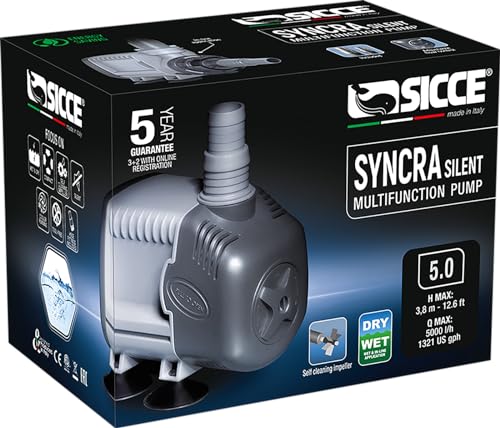
The Syncra Silent 5.0 is the AC counterargument. There is no controller, no app and no power brick — just a synchronous motor, a flow-adjustment dial on the pump body, and a long track record in both reef sumps and skimmer duty. Sicce specifies 1,321 GPH of maximum flow and a maximum head of 12.6 feet, which puts it in the same working class as the DCP-5000, although it draws considerably more power to get there.
What you get in exchange is simplicity and build quality. The pump runs submerged or inline, the shaft and bearings are stainless steel, and flow is trimmed mechanically rather than electronically. For keepers who would rather have a pump with nothing electronic to fail, the Syncra 5.0 remains the benchmark AC return pump in this size range.
Specs
- Maximum flow: 1,321 GPH
- Maximum head height: 12.6 ft
- Power consumption: 105 W
- Voltage: 120 V AC
- Inlet / outlet: 1–1.2 in inlet, 0.8–1 in outlet (threaded, hose adapters included)
- Controller: none — built-in mechanical flow adjustment
- Dimensions: 6.8 x 3.9 x 4.6 in
- Use: submersible or inline
3. Current USA eFlux DC Flow Pump 6009

Current USA’s eFlux 6009 is a compact DC return pump for smaller sumps, and it earns its place here for one reason: Current publishes an honest performance table. The headline figure is 1,050 GPH, but the manufacturer’s own chart shows roughly 500 GPH delivered at five feet of head — exactly the kind of number you need for real sizing, and a useful reminder of how far zero-head ratings drift from reality.
The pump adjusts from 210 to 1,050 GPH through its dial controller, runs on 24-volt DC at a maximum of 30 watts, and can be installed submerged or externally. Hose barbs for both 3/4-inch and 1-inch tubing are included, along with an inlet strainer for submerged use. The controller also works with Current’s LOOP hub system, so the return pump can share an interface with compatible lights and wave pumps. In a body roughly five inches long, it is a tidy fit for the tight return chambers of all-in-one conversions and small custom sumps.
Specs
- Maximum flow: 1,050 GPH (adjustable range 210–1,050 GPH)
- Flow at 5 ft head: approx. 500 GPH (manufacturer chart)
- Maximum head height: 10.5 ft (3.2 m)
- Power consumption: 6–30 W
- Voltage: 24 V DC
- Outlet: 3/4 in and 1 in hose barbs
- Controller: dial speed control, feed mode, LOOP hub compatible
- Use: submersible or external
4. hygger 24V DC Aquarium Water Pump, 925 GPH

hygger’s DC return pump is aimed at small-to-medium sumps where a full-size pump body will not fit or would be hard to tame. It is specified at 925 GPH maximum flow with a maximum head of 11.5 feet, drawing up to 35 watts on 24-volt DC power. The LED controller offers finer adjustment than most pumps in this class, with 71 speed steps between 30 and 100 percent, plus four flow modes — constant, classic, sine and random — and a feed button that pauses the pump for ten minutes.
One practical detail sets it apart for shallow sumps: the U-shaped intake shell lets the pump keep drawing water at low levels, suiting the shallow return chambers where evaporation shows up first. Three nozzle adapters are included for the outlet. In return duty the fine speed steps matter more than the wave modes — what counts is creeping the flow up until it exactly matches the overflow without overshooting.
Specs
- Maximum flow: 925 GPH
- Maximum head height: 11.5 ft
- Power consumption: 35 W
- Voltage: 24 V DC
- Outlet: three nozzle adapters included
- Controller: LED display, 71 speed steps (30–100%), four flow modes, 10-minute feed pause
- Use: submersible; low-water U-shaped intake shell
5. Jebao DCP-10000 Sine Wave DC Return Pump

For large displays, basement sumps and tall stands, the DCP-10000 doubles down on the DCP formula. Jebao specifies 10,000 litres per hour of maximum flow and a maximum head of 6.0 metres — just under 20 feet — which keeps useful pressure available even when the sump sits well below the tank. At full power it draws 80 watts on 24-volt DC, still modest for the class of pump that can push water up a full storey of plumbing.
The controller works like the smaller DCP models: stepped speed adjustment, a ten-minute feed hold, and memory that restores your setting after an outage. That adjustability matters at this size, because an oversized pump fighting a smaller overflow is loud and wasteful. Dialled down to the flow the system actually needs, a big DC pump like this runs cool and quiet with headroom in reserve.
Specs
- Maximum flow: 2,642 GPH (10,000 L/h)
- Maximum head height: 19.7 ft (6.0 m)
- Power consumption: 80 W
- Voltage: 24 V DC
- Outlet: multi-size connectors for soft hose or hard pipe
- Controller: sine wave drive, speed adjustable, 10-minute feed hold, power-outage memory
- Use: submersible or inline (gravity-fed)
Keeping the Loop Alive
Whichever pump you choose, a few habits protect the system around it. Leave enough freeboard in the sump to catch the full drain-down volume with the pump off, and test it by actually switching the pump off and watching where the water settles. Clean the impeller and intake every few months — calcium and algae growth quietly steal flow long before a pump fails outright. And if the tank holds valuable livestock, a spare pump on the shelf is insurance against the one failure that cannot wait for a delivery.
Frequently Asked Questions
How much flow does a sump return pump actually need?
A common target is three to five times the display volume per hour, measured after head losses. Work out your head height first, then read the flow chart — the pump that looks perfect at zero head may deliver half that at five feet.
Is a DC pump always better than an AC pump?
Not always. DC pumps offer electronic speed control, feed modes and lower power draw, but they add a controller and power supply that can fail. A quality AC pump like the Syncra has fewer parts and a long service record. Choose based on whether you value adjustability or simplicity more.
Can a return pump be too strong?
Yes. An oversized pump can overwhelm the overflow, raise the display waterline, and send microbubbles through the system. With a DC pump, turn the speed down. With an AC pump, use the built-in adjustment or a valve on the outlet side — never restrict the intake.
Should the return pump also power reactors and other equipment?
It can, through a manifold, but every branch steals flow from the return and complicates balancing. Many keepers run reactors from a small separate pump so the main loop stays simple.
Conclusion
Size by head height, not by the box. For most mid-size sumps, the Jebao DCP-5000 gives quiet, adjustable DC performance with room to spare. The Sicce Syncra Silent 5.0 is the pick when proven AC simplicity matters more than electronic control. Smaller sumps are well served by the Current USA eFlux 6009 or hygger’s fine-stepping DC pump, and the DCP-10000 covers tall stands and large systems where head pressure is the whole problem. Match the pump to your plumbing, leave room in the sump for the day it stops, and the loop will take care of everything else.
More from Amazon
Programs that pair well with the guide above. Offers and eligibility are set by Amazon and may change.
Free shipping on eligible items, Prime Video and more. Eligible new members can start with a free trial.
Start a Prime free trialA Prime membership for ages 18-24 with a trial period. Eligibility is set by Amazon.
See Prime for Young AdultsAudiobooks and podcasts to listen to on the go. Eligible new members can start with a free trial.
Try Audible freeAd-free music streaming. Eligible new subscribers can start with a free trial.
Try Music Unlimited freeAs an Amazon Associate we earn from qualifying purchases.






Write Your Review
No reviews yet. Be the first to share your experience!