

Key takeaways
- Compare five ferret foods by protein, fat and first ingredients, from starch-free kibble to freeze-dried raw, and learn what an obligate carnivore needs.
As an Amazon Associate we earn from qualifying purchases.
A ferret is not a small cat and it is definitely not a rodent. It is an obligate carnivore with a short, simple digestive tract, no cecum, and a gut transit time of only a few hours. That biology sets the rules for every bag in this guide: the protein has to be high, it has to come from animals rather than plants, the fat has to be generous, and the carbohydrate load has to stay low because a ferret has almost no ability to digest starch and fiber. The five foods below are all sold as ferret diets, and they are compared the way a ferret keeper should compare them: by the guaranteed analysis and by what actually sits at the top of the ingredient list.
Affiliate Disclosure: This article contains affiliate links. If you buy through a link on this page, we may earn a commission at no extra cost to you. We do not accept payment for placement, and every product below is included because it fits the feeding role described.
What a ferret diet has to deliver
Most ferret nutrition guidance converges on the same label targets: at least 35 percent crude protein, roughly 15 to 20 percent or more crude fat for young and active animals, and crude fiber kept low. Protein percentage alone is not enough, though. Ferrets cannot use plant protein efficiently, and pea- and legume-heavy formulas are widely discouraged in ferret keeping because pea protein has been linked to cystine bladder stones in this species. A bag that reaches its protein number with soy, peas, or potato protein is not equivalent to a bag that reaches it with chicken, egg, and organ meat.
Taurine matters too. Ferrets need dietary taurine for heart and eye health, and the stronger labels state a guaranteed minimum rather than leaving you to guess. Finally, remember imprinting. Kits learn what counts as food by smell in their first months of life, and an adult ferret may refuse an unfamiliar food so stubbornly that it barely eats. Every switch in this guide should be a gradual mix over one to two weeks, never an overnight swap.
1. Wysong Ferret Epigen 90 Digestive Support
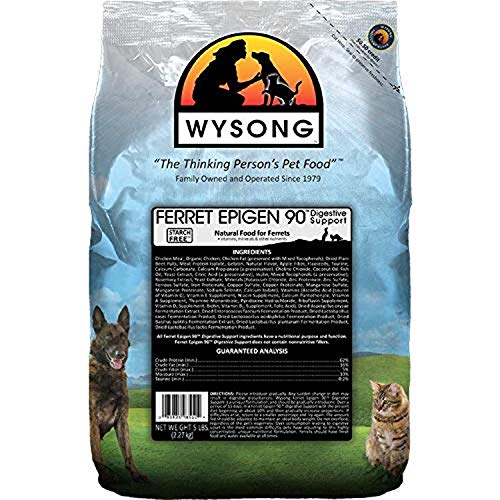
This is the most concentrated kibble sold for ferrets, and it is built on a simple idea: remove the starch. Wysong’s Ferret Epigen 90 line is marketed as starch free, which means the kibble holds together without the grain or potato binders most extruded foods rely on. The guaranteed analysis is in a class of its own, with protein roughly half again as high as the other kibbles in this guide. The Digestive Support version softens that intensity slightly with soluble fiber sources, a prebiotic effect, and a long list of probiotic fermentation products and digestive enzymes, which makes it the sensible entry point to the line.
The ingredient panel is meat from top to bottom: chicken meal and organic chicken lead, followed by chicken fat, beet pulp, and a meat protein isolate. There are no grains and no legumes to dilute the animal protein. The honest caution is that concentration cuts both ways. Wysong itself directs a slow introduction over about fifteen days, and a ferret moved onto this food too fast is a ferret with loose stools. Portions also go further than the scoop size suggests, because there is simply more nutrition in every cup.
Specs
- Format: Dry kibble, starch free
- Bag size: 5 lb
- Crude protein (min): 62%
- Crude fat (min): 16%
- Crude fiber (max): 5%
- Taurine (min): 0.2%
- First ingredients: Chicken Meal, Organic Chicken, Chicken Fat, Dried Plain Beet Pulp, Meat Protein Isolate, Gelatin
2. Oxbow Essentials Ferret Food

Oxbow built its name on small-herbivore nutrition, and its ferret food is a more recent, deliberately label-driven entry. The headline numbers are strong without being extreme: protein in the low forties, fat at twenty percent, and the highest guaranteed taurine level in this guide at half a percent, which is a genuine point in its favor for heart health. Fish oil and flaxseed supply omega-3 and omega-6 fatty acids with stated minimums, which is where the coat support in this formula comes from.
The first five ingredients are all animal based: chicken meal, chicken, chicken fat, egg product, and gelatin. The maker also states the food is made without corn, peas, or potatoes, which keeps it clear of the legume-protein concern described above. Rice flour and cassava root flour appear further down as the binders, so the formula is not starch free, but the starch sits behind a solid wall of meat rather than in front of it. It is positioned for all life stages, so the same bag covers kits and adults.
Specs
- Format: Dry kibble
- Bag size: 4 lb
- Crude protein (min): 42%
- Crude fat (min): 20%
- Crude fiber (max): 3%
- Taurine (min): 0.50%
- First ingredients: Chicken Meal, Chicken, Chicken Fat, Egg Product, Gelatin, Rice Flour
3. Wysong Ferret Archetype Chicken Formula

Archetype is the freeze-dried raw option, and it is a different kind of food from the four kibbles around it. Wysong states the product is never heated above 118 degrees Fahrenheit, so what arrives is raw chicken, chicken organs, and ground chicken bone in dry form, with very little else between the meat and the bowl. The guaranteed analysis reflects that: moderate protein by the standards of this guide, but by far the highest fat, and almost no fiber or moisture. It can be fed dry or soaked in water for ten to fifteen minutes until it rehydrates.
Two practical notes belong with any raw diet. First, handling discipline is real: the maker prints safe-handling instructions because the bag contains raw meat, so hands, bowls, and surfaces need washing, and rehydrated food that is not eaten should be refrigerated or discarded rather than left in the cage. Second, the bag is small at seven and a half ounces. For a single ferret fed in rotation with a kibble, that is manageable; as the only food for a multi-ferret household it becomes a lot of bags. Many keepers use it exactly that way, as the raw component alongside a staple kibble.
Specs
- Format: Freeze-dried raw, feed dry or rehydrated
- Bag size: 7.5 oz
- Crude protein (min): 44%
- Crude fat (min): 36%
- Crude fiber (max): 0.5%
- Moisture (max): 4%
- First ingredients: Chicken, Chicken Organs, Ground Chicken Bone, Natural Flavor, Taurine
4. Marshall Premium Ferret Diet

Marshall is the largest ferret breeder in the United States, and this is the food its kits are started on, which gives it one practical advantage no other bag here can match: a huge share of pet ferrets in North America already recognize it as food. For a newly adopted ferret, and especially for a rescue whose history is unknown, that imprinting head start can matter more than a few points of protein. The formula is built on fresh chicken inputs, including organ by-products, and Marshall describes a slow-cook, vacuum-drying process intended to protect the nutrients in that meat.
The label tradeoffs should be stated plainly. Corn meal sits fourth on the ingredient list, so this is not a grain-free food, and its protein and fat numbers are good rather than exceptional. The protein is animal based and the by-products named are organs only, which are nutrient-dense tissues a wild carnivore would eat anyway. Read it as the continuity pick: the food most likely to be eaten on day one, and a reasonable base to mix a richer kibble into over time.
Specs
- Format: Dry kibble (pellet)
- Bag size: 4 lb
- Crude protein (min): 38%
- Crude fat (min): 18%
- Crude fiber (max): 3.5%
- First ingredients: Chicken By-Products (Organs Only), Chicken, Chicken By-Product Meal, Corn Meal, Dried Beet Pulp, Brewers Dried Yeast
5. Kaytee Forti-Diet Pro Health Ferret Food

Kaytee’s ferret entry is the modest bag of the group, and it earns its place on accessibility rather than on headline numbers. It still clears the basic ferret thresholds: protein at the thirty-five percent floor and fat at twenty percent, with probiotics for digestive support and omega-3 fatty acids included for skin and coat. For a keeper whose local shelves carry exactly one ferret food, it is frequently this one, and a ferret that eats it willingly is better off than a ferret refusing a theoretically superior bag.
The compromises are visible on the label and should not be hidden. Dehulled soybean meal appears in the first five ingredients, which means a share of that protein is plant based, the exact pattern the buying guide below tells you to limit. Brewers rice and ground wheat also sit high in the panel. And the bag is the smallest here at three pounds, so a busy household will cycle through it quickly. Treat it as a workable everyday food and a useful mixing partner, not the nutritional ceiling of this list.
Specs
- Format: Dry kibble
- Bag size: 3 lb
- Crude protein (min): 35%
- Crude fat (min): 20%
- Added features: Probiotics and omega-3 fatty acids per the maker
- First ingredients: Poultry Meal, Poultry By-Product Meal, Brewers Rice, Poultry Fat, Dehulled Soybean Meal, Ground Wheat
How to choose and switch
Read the guaranteed analysis first and the marketing second. You want protein at or above thirty-five percent with the first ingredients naming animals: chicken, chicken meal, egg, organ meats. Then scan for the plant-protein pattern. Peas, pea protein, lentils, chickpeas, and soy high on the list are a reason to put a bag back, both because ferrets use that protein poorly and because of the bladder-stone link reported with pea-based diets. A stated taurine minimum is a good sign. Fat in the high teens or better suits young and active ferrets; a genuinely old, slow ferret is the one case where the richest foods may be more than the animal needs.
Switching deserves as much care as choosing. Because of food imprinting, mix the new food into the old in small steps over one to two weeks, and keep a reserve of the previous food until the new one is fully accepted. A common keeper strategy is to feed a mix of two kibbles permanently, so a reformulation or a stock shortage never forces a cold-turkey change on an animal that would rather skip meals than try something new. Whichever food you land on, keep fresh water available at all times; kibble-fed ferrets drink a lot, and a heavy crock is harder to tip than a bottle is to drain.
One last warning about what is not on this list. Sugary ferret treats, including the yogurt-style drops sold for ferrets, work against everything above: they load a sugar-sensitive carnivore with exactly the carbohydrate rush its pancreas handles worst, in a species already prone to insulinoma. If you want a treat or a training reward, a small piece of plain cooked meat or a freeze-dried meat treat fits the diet a ferret was built for. The staple food does the nutritional work; treats should never be asked to.
More from Amazon
Programs that pair well with the guide above. Offers and eligibility are set by Amazon and may change.
Free shipping on eligible items, Prime Video and more. Eligible new members can start with a free trial.
Start a Prime free trialA Prime membership for ages 18-24 with a trial period. Eligibility is set by Amazon.
See Prime for Young AdultsAudiobooks and podcasts to listen to on the go. Eligible new members can start with a free trial.
Try Audible freeAd-free music streaming. Eligible new subscribers can start with a free trial.
Try Music Unlimited freeAs an Amazon Associate we earn from qualifying purchases.










Write Your Review
No reviews yet. Be the first to share your experience!