

Key takeaways
- Five plain rabbit food pellets compared by base hay, fibre, protein and calcium, with ration sizes, transition steps and the muesli mixes to avoid.
As an Amazon Associate we earn from qualifying purchases.
A rabbit’s gut only works when it keeps moving, and it keeps moving on fibre. Long-stem hay does most of that work, but the daily pellet ration is where the measured nutrition lives: the vitamins, minerals and protein balance that hay alone cannot guarantee. The five foods below are all uniform pellets — every piece in the bag carries the same nutrition, so a rabbit cannot pick out the tasty parts and leave the rest behind.
That word “uniform” matters more than any brand name. The alternative on the shelf is the muesli-style mix: a bright blend of flakes, seeds, corn pieces and coloured puffs. Rabbits feed selectively from those mixes, eating the starchy and sugary pieces first and leaving the fortified pellets — the part that actually carries the nutrition — sitting in the bowl. Selective feeding is a direct route to obesity, soft droppings and uneven tooth wear. If a bag shows loose seeds, corn or dried fruit chunks, it is a treat mix wearing a staple food’s label, and none of the picks here are built that way.
One more piece of honesty before the picks: pellets are a measured supplement, not the diet itself. The standard guidance is roughly an egg-cup of pellets per kilogram of rabbit per day, alongside unlimited grass hay and a daily handful of leafy greens. A rabbit that fills up on pellets eats less hay, and it is the hay — the chewing, the long fibre, the constant gut movement — that keeps digestion and teeth in shape.
How to Choose a Rabbit Pellet
Match the base hay to the life stage. Adult rabbits do best on timothy-based pellets: high fibre, moderate protein, modest calcium. Young, growing, pregnant and nursing rabbits need more of everything, and that is what alfalfa-based pellets deliver. The same alfalfa formula fed to a healthy adult adds calcium the animal does not need, and rabbits handle calcium unusually — they excrete the excess through the kidneys, so a chronically rich diet is linked to bladder sludge and urinary stones.
Read the fibre number first. For an adult maintenance pellet, crude fibre of 20 percent or more is the shape to look for, with protein around 12 to 14 percent and fat kept low. Breeder-style alfalfa feeds run hotter — 16 percent protein and higher calcium — because they were formulated for growth and lactation, not for a neutered house rabbit on the sofa.
Check the calcium range. A maintenance pellet should sit roughly between 0.35 and 0.9 percent calcium. Young formulas legitimately run higher. What matters is matching the number to the animal in front of you, especially for rabbits with any history of sludgy urine.
Transition gradually and watch the litter box. Mix the new pellet into the old food over one to two weeks. A rabbit’s gut bacteria are tuned to its current diet, and a sudden swap shows up fast: smaller, softer or fewer droppings are the first signal to slow the transition down. Droppings return to normal, round and plentiful when the change suits the rabbit.
Store pellets like food, not gravel. Heat, air and sunlight degrade the vitamins in a fortified pellet. Reseal the bag, keep it cool and dry, and buy the size your rabbit will finish in a few weeks rather than a bulk sack that sits open for months.
The Five Pellets
1. Oxbow Essentials Adult Rabbit Food, 10 lb
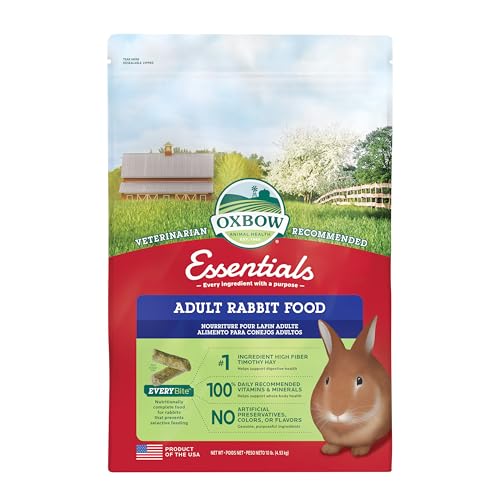
The reference point for adult rabbit pellets, and the formula most rescue and veterinary feeding guides are built around. Timothy grass meal is the first ingredient, the pellets are uniform from the first piece to the last, and Oxbow states plainly that the food is not intended for growing, pregnant or nursing rabbits — it is a maintenance diet, and it does not pretend otherwise.
The analysis suits that job exactly: fibre with a 25 percent floor, moderate protein, and calcium held in a modest band for an adult animal. The maker’s feeding chart scales the ration by weight, from an eighth of a cup for small rabbits up to three quarters of a cup for the largest, always alongside unlimited grass hay. The 10 lb bag is the middle size in the range and the practical one for a single rabbit or a bonded pair.
Specs
- Base hay: Timothy grass meal (first ingredient)
- Crude fibre: min 25%, max 29%
- Crude protein: min 14%
- Crude fat: min 2%
- Calcium: min 0.35%, max 0.75%
- Life stage: Adult maintenance (not for growing, pregnant or nursing rabbits)
- Feeding guide: 1/8 to 3/4 cup daily by body weight, plus unlimited grass hay
- Bag weight: 10 lb
2. Sherwood Pet Health Adult Rabbit Food, Free-Choice Timothy, 10 lb

Sherwood takes the most stripped-down approach on this list: a timothy hay pellet with no grain and no soy anywhere in the formula. Instead of soybean meal and hull fillers, the ingredient list runs on timothy hay, safflower meal and whole flax seed, with chelated minerals. It is the highest-fibre analysis here, and the lowest protein — a deliberate profile for adult rabbits whose real diet is hay and whose pellets are only topping up the gaps.
The “free-choice” name describes the feeding style: Sherwood formulates this pellet to be fed flexibly, from a measured minimum of about a tablespoon per pound of body weight up to free access, because the low calorie density makes overfeeding harder than with richer pellets. That flexibility suits confident hay eaters. Rabbits that ignore hay and gorge on pellets still need the ration measured, whatever the bag permits.
Specs
- Base hay: Timothy hay (first ingredient)
- Formula notes: Grain-free and soy-free; safflower meal and whole flax seed, no hull fillers
- Crude fibre: min 28%, max 33%
- Crude protein: min 11%
- Crude fat: min 4%
- Calcium: min 0.40%, max 0.90%
- Life stage: Adult maintenance
- Feeding guide: Flexible, from about 1 tablespoon per pound of body weight upward
- Bag weight: 10 lb
3. Kaytee Timothy Complete Rabbit Food, 4.5 lb

Kaytee’s long-running timothy pellet is the mainstream option: sun-cured timothy grass hay leads the ingredient list, followed by soybean hulls and dehulled soybean meal as the fibre and protein support. The analysis lands in the middle of this list on almost every line — fibre in the low-to-mid twenties, protein a touch under the Oxbow, calcium in a moderate band.
That middle-of-the-road profile is precisely its role. It is a sound adult maintenance pellet for keepers who want a widely stocked, consistent formula, and the 4.5 lb bag is a sensible size for a single rabbit: small enough to stay fresh, large enough to last a few weeks at an egg-cup a day. As with every timothy pellet here, it is built for adults; Kaytee directs growing and breeding animals to richer formulas.
Specs
- Base hay: Sun-cured timothy grass hay (first ingredient)
- Crude fibre: min 22%, max 27%
- Crude protein: min 13%
- Crude fat: min 1.5%
- Calcium: min 0.25%, max 0.75%
- Life stage: Adult maintenance
- Feeding guide: Daily measured ration alongside unlimited hay and fresh greens
- Bag weight: 4.5 lb
4. Sherwood Baby Rabbit Food, 4.5 lb

The young-rabbit entry, and the clearest illustration of why life stage matters. Sherwood builds this one on alfalfa hay instead of timothy, keeping the same grain-free, soy-free discipline as its adult food — whole oil seeds including flax provide the fat, and there is no corn, wheat or molasses. Growing rabbits need the extra protein for tissue, the extra calcium for bone, and the extra energy density for a body that is still being built.
The mirror-image warning applies in both directions: this is the wrong food for a healthy adult. Fed past the growth stage, its calcium and protein stop being building materials and become a burden on the kidneys and waistline. Plan the switch to an adult timothy pellet as growth levels off, at around seven to twelve months depending on breed size, and make that switch gradually like any other.
Specs
- Base hay: Alfalfa hay (first ingredient)
- Formula notes: Grain-free and soy-free; whole flax and oil seeds, no corn or molasses
- Crude protein: min 15%
- Crude fibre: min 19%, max 24%
- Calcium: min 0.8%, max 1.3%
- Life stage: Young and growing rabbits
- Feeding guide: Measured daily ration with unlimited alfalfa or grass hay for youngsters
- Bag weight: 4.5 lb
5. Small World Rabbit Food, Manna Pro, 10 lb
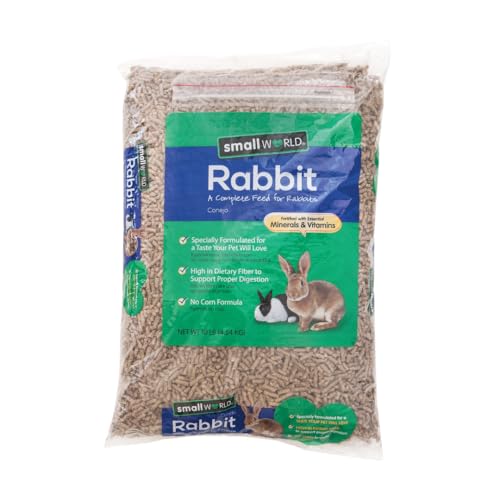
The breeder-style complete feed of the group, from Manna Pro’s Small World line. This is a traditional alfalfa-based pellet of the kind rabbitries have used for decades: dehydrated alfalfa meal and wheat middlings lead the label, protein runs at 16 percent, and the pellets are firm and uniform so there is nothing to selectively pick through. Yucca extract is included, a common addition in feeds aimed at reducing waste odour.
Read it for what it is. Sixteen percent protein and calcium up to 1.25 percent is a growth-and-condition specification, richer than a neutered adult house rabbit needs as a lifetime ration, and its fibre floor is the lowest here. For young, breeding or underweight rabbits, or as a budget staple in a multi-rabbit household with good hay intake, it does its job honestly. For a sedentary adult, the timothy pellets above are the better long-term fit.
Specs
- Base: Alfalfa-forward complete feed (dehydrated alfalfa meal, wheat middlings)
- Crude protein: min 16%
- Crude fat: min 2.5%
- Crude fibre: min 15%, max 20%
- Calcium: min 0.75%, max 1.25%
- Life stage: Adult and all-class complete feed (breeder-style formulation)
- Feeding guide: Measured daily ration; provide hay alongside for house rabbits
- Bag weight: 10 lb
Feeding Pellets Without Causing Trouble
Keep the ration measured. An egg-cup per kilogram of body weight per day is the working rule for adult timothy pellets, split morning and evening if that suits the routine. A bowl that is always full of pellets trains a rabbit to skip hay, and the consequences — a sluggish gut, overgrown teeth, weight gain — arrive slowly and present late.
Make every change gradually. Blend the new pellet into the old over one to two weeks, increasing the share every few days, and read the litter box as you go: droppings should stay round, dry and plentiful. Soft, small or scarce droppings mean slow down. This applies to the life-stage switch too — alfalfa-based young food out, timothy adult food in, over the same patient fortnight.
Finally, respect the alfalfa line in both directions. Young, pregnant and nursing rabbits genuinely need the richer pellet. Healthy adults genuinely do not, and for them the extra calcium in an alfalfa formula is the one ingredient with a plausible downside. Match the bag to the rabbit’s age, and the rest of the diet — hay first, greens daily, pellets measured — falls into place.
FAQ
How many pellets should an adult rabbit eat each day?
Roughly an egg-cup (about 25 g) per kilogram of body weight, alongside unlimited grass hay and a handful of leafy greens. Richer alfalfa-based feeds should be measured more tightly for adults.
Are muesli mixes really that bad for rabbits?
Yes, for a mechanical reason: rabbits pick out the starchy, sugary pieces and leave the fortified pellets behind, so the diet they actually eat is unbalanced even if the bag’s analysis looks fine. Uniform pellets remove the choice.
When should a young rabbit move from alfalfa to timothy pellets?
As growth levels off, typically between seven and twelve months depending on breed size. Transition gradually over one to two weeks and watch that droppings stay round and plentiful.
Can pellets replace hay if the pellets are high in fibre?
No. Even the highest-fibre pellet here is ground fibre; it does not reproduce the long chewing action and gut stimulation of long-stem hay, which should remain the bulk of the diet and be available at all times.
Affiliate Disclosure
This article contains affiliate links. If you buy through them, the site may earn a commission at no extra cost to you. Products were selected on their published specifications and ingredient lists — check the label on the bag you receive, and ask a veterinarian about diet changes for pregnant, nursing or unwell rabbits.
More from Amazon
Programs that pair well with the guide above. Offers and eligibility are set by Amazon and may change.
Free shipping on eligible items, Prime Video and more. Eligible new members can start with a free trial.
Start a Prime free trialA Prime membership for ages 18-24 with a trial period. Eligibility is set by Amazon.
See Prime for Young AdultsAudiobooks and podcasts to listen to on the go. Eligible new members can start with a free trial.
Try Audible freeAd-free music streaming. Eligible new subscribers can start with a free trial.
Try Music Unlimited freeAs an Amazon Associate we earn from qualifying purchases.










Write Your Review
No reviews yet. Be the first to share your experience!