

Key takeaways
- Five cat hairball remedies compared: two lubricant gels and three fibre chews that help swallowed hair pass through, with label doses and warning signs.
As an Amazon Associate we earn from qualifying purchases.
Every cat grooms, and every grooming cat swallows hair. Most of that hair travels through the digestive tract and out the far end without incident. A hairball forms when swallowed hair collects in the stomach faster than it can move on, until the cat brings the wad back up. The occasional hairball in a long-haired or heavy-shedding cat is a normal by-product of grooming. A shelf of remedies exists to help the rest of that hair keep moving in the right direction.
Those remedies work in two fundamentally different ways, and the distinction decides which one belongs in your cupboard. Lubricant gels coat the hair and the gut lining with petrolatum and oils so a forming mass slides through instead of compacting. Fibre-based tablets and chews take the other route: psyllium, pumpkin, and plant fibres add bulk and water-holding capacity to the stool, carrying swallowed hair along with it. Gels are the traditional tool for a cat that is actively struggling with a hairball now. Fibre products are built for daily prevention in cats that produce hairballs on a schedule.
One point needs to be stated before any product names. Remedies are the second line of defence, not the first. Regular brushing removes loose hair before the cat ever swallows it, and a few minutes with a brush several times a week prevents more hairballs than any gel or chew can move after the fact. Hairball-control diets and cat grass play supporting roles for the same reason. The five products below are what you reach for when grooming alone is not keeping up.
Affiliate Disclosure: This article contains affiliate links. If you buy through a link on this page, we may earn a commission at no extra cost to you. Products are chosen on formulation, label transparency, and suitability for the jobs described, not on commission.
When a “Hairball” Is Not a Hairball
Frequent vomiting is not normal, and it should never be managed indefinitely with a stronger gel. A cat that vomits weekly or more, retches repeatedly without producing anything, coughs in a crouched position with the neck extended, loses interest in food, or becomes lethargic may not have a hairball problem at all. Unproductive retching and coughing are classic presentations of feline asthma. Recurrent vomiting also fits inflammatory bowel disease, food intolerance, and skin disease that drives over-grooming. At the serious end, a hair mass or foreign body that obstructs the intestine is an emergency, and its early signs look like an ordinary bad hairball day.
The working rule is simple. An otherwise bright cat that produces a hairball every few weeks and eats normally afterwards is a candidate for the remedies below. A cat whose episodes are getting more frequent, who retches without result, or who goes off food needs a veterinarian first and a remedy second, if at all.
How to Choose a Cat Hairball Remedy
Match the format to the problem. Choose a lubricant gel when a cat is actively working on a hairball or produces them in clusters during shedding season; the label schedules below are written as short courses followed by maintenance. Choose a fibre tablet or chew when the pattern is steady and predictable, because those formulas are designed to be fed every day.
Read the active ingredients, not the front of the tube. Gels in this category are honest products, but they work by coating, not chemistry: petrolatum is not absorbed and does not dissolve hair, it lubricates it. Fibre products should name their fibre sources — psyllium husk, pumpkin, apple pomace — rather than hiding behind a proprietary blend, and the better ones on this page do.
Plan for the cat you actually have. A gel only works if the cat will lick it. Makers design for this — most cats take flavoured gel from a finger, and the fallback on every gel label is to smear a small amount on a front paw so the cat grooms it off. Cats that refuse all handling do better on a chew or tablet disguised as a treat. Note that the PetHonesty chew below is dosed by body weight, which adds up quickly in a multi-cat household.
Respect the label schedule. More gel than the label states does not move hair faster; it produces loose stools and can interfere with absorption of fat-soluble vitamins if overused for long stretches. Fibre chews fed freely become a calorie problem. Follow the printed directions and reassess after a few weeks.
1. Vetoquinol Laxatone Hairball Gel for Cats, Tuna Flavor, 4.25 oz
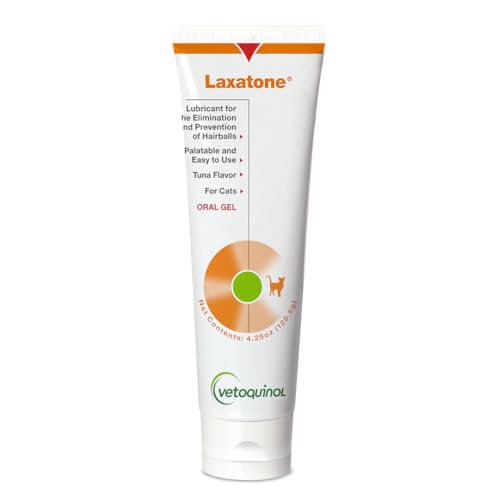
Laxatone is the reference product in this category — the name is close to generic for hairball gel — and the current listing is sold under the Vetoquinol brand, the company behind Tomlyn. The formula is a straightforward oral lubricant: white petrolatum does the coating, supported by light mineral oil and soybean oil, in a tuna-flavoured gel most cats will lick from a finger or a paw.
The label schedule is a two-stage course rather than a daily supplement. For the first two to three days the dose is a half to one teaspoon daily to help an existing hairball pass; after that it drops to a quarter to a half teaspoon two or three times a week for prevention. That schedule makes it the right pick for episodic hairballs and shedding-season flare-ups rather than a year-round daily habit. At maintenance doses the tube lasts a long time.
Specs
- Format: Oral lubricant gel in a squeeze tube
- Active approach: Petrolatum and oil lubricant coating; per teaspoon (6 g): white petrolatum USP 1285 mg, light mineral oil NF 203 mg, soybean oil 237 mg
- Dose: 1/2 to 1 teaspoon daily for 2 to 3 days, then 1/4 to 1/2 teaspoon 2 to 3 times per week
- Flavor: Tuna
- Size: 4.25 oz tube
- Suited to: Cats and kittens, per the maker
2. Cat Lax Hairball Elimination and Prevention Gel, 2 oz

Cat Lax is the other long-established veterinary gel, made by Dechra, and it takes a slightly different formulation route to the same job. White petrolatum again provides the lubrication, but it is carried in barley malt syrup with cod liver oil, which gives the paste a sweet malt character that many cats accept more readily than fish-flavoured gels. Per gram, the label declares 0.474 g of white petrolatum and 0.474 g of barley malt syrup, so the petrolatum share is comparable to the Laxatone formula.
The dosing is measured in ribbon length instead of spoonfuls. For hairball removal, the label directs about one inch squeezed from the tube, once daily, for an average adult cat, adjusted down for smaller cats. For prevention, the same amount two or three times per week. The flip-top laminate tube is only 2 oz, the smallest package in this roundup, which makes it a sensible first purchase for a cat whose taste preferences you do not yet know — but heavy users will go through it quickly.
Specs
- Format: Oral lubricant paste in a flip-top tube
- Active approach: Petrolatum lubricant in a malt base; per gram: white petrolatum 0.474 g, barley malt syrup 0.474 g, cod liver oil 0.02 g, with vitamin E as antioxidant
- Dose: Approximately 1 inch from the tube once daily for removal; 2 to 3 times per week for prevention
- Flavor: Malt and caramel
- Size: 2 oz tube
- Maker: Dechra Veterinary Products
3. Vet’s Best Cat Hairball Relief Digestive Aid, 60 Chewable Tablets

Vet’s Best is the petroleum-free option for owners who would rather not feed a petrolatum gel every week. These chewable tablets are built on a plant fibre and botanical blend — psyllium seed, marshmallow root, slippery elm bark, and papaya — intended to support normal gut movement so hair passes with the stool instead of accumulating. Slippery elm and marshmallow root are demulcents that coat the digestive tract, which makes this formula part fibre supplement, part soothing digestive aid.
The tablets are chicken flavoured and can be given as a treat or crumbled over food, which suits cats that accept hand-fed tablets but fight a tube. The 60-count bottle is framed by the maker as a 30-day supply, which works out to two tablets daily — a genuine daily-prevention rhythm rather than an occasional intervention. Vet’s Best is veterinarian formulated and carries the NASC quality seal.
Specs
- Format: Chewable tablets
- Active approach: Petroleum-free plant blend; psyllium seed, marshmallow root, slippery elm bark, and papaya to add fibre and support gut motility
- Dose: Daily tablets per the label; the 60-count bottle is a 30-day supply
- Flavor: Classic chicken
- Size: 60 chewable tablets
- Quality mark: NASC seal, per the maker
4. PetHonesty Cat Hairball Support Chews, Chicken, 30-Day Supply

PetHonesty’s entry is a dual-texture chew — a crunchy outer shell around a creamy centre — built on psyllium husk fibre with citrus pulp and apple pomace, plus omega-3s from fish oil and lecithin and zinc methionine for the skin and coat side of the equation. The logic is sound: fibre moves the hair that has been swallowed, while the omega and zinc support aims at the shedding that starts the problem.
The dosing is the detail to read before buying. PetHonesty directs one chew daily per pound of body weight — five chews for a five-pound cat, ten for a ten-pound cat, half dose for kittens under six months. That is a lot of chews compared with the two-tablet rhythm of the Vet’s Best routine, and it is why the tub is sold by supply duration rather than count. The maker also prints an unusually frank caution list, including use with care in hyperthyroid cats and administration during or after a meal to reduce stomach upset. For a cat that loves treats and an owner who will actually keep up the daily handful, it is the most treat-like routine here.
Specs
- Format: Dual-texture crunchy and creamy chews
- Active approach: Psyllium husk fibre with citrus pulp and apple pomace; omega-3s (fish oil, lecithin) and zinc methionine for skin and coat support
- Dose: 1 chew daily per 1 lb of body weight; half dose for kittens under 6 months; give during or after a meal, per the maker
- Flavor: Chicken
- Size: 30-day supply tub, 10.5 oz
- Cautions: Maker advises care with hyperthyroid cats and against use with blood thinners
5. NaturVet Hairball Aid Plus Pumpkin Soft Chews, 60 Count

NaturVet’s soft chews pair the category’s standard fibre, psyllium husk, with pumpkin powder — a combination aimed squarely at daily digestive regularity. Pumpkin is a familiar, gentle fibre source in feline diets, and in a soft chew format it reaches cats that will not touch a tablet and owners who will not wrestle with a gel tube. The formula is veterinarian formulated and wheat-free, which is worth noting for cats on grain-sensitive diets.
The chews are made for cats over twelve weeks old and are intended as an everyday supplement to help eliminate and prevent hairballs, rather than a short course during a flare-up. At 60 soft chews in a 3.1 oz cup, this is the most compact daily option in the roundup, and the salmon and bacon flavouring is pitched at picky eaters. NaturVet is a long-running supplement maker and the product carries the NASC seal. If your cat’s hairballs arrive on a predictable weekly rhythm tied to shedding, this daily fibre routine is the natural fit.
Specs
- Format: Soft chews
- Active approach: Psyllium husk and pumpkin powder providing natural fibre to support a healthy digestive system
- Dose: Daily soft chews per the maker’s label directions
- Flavor: Salmon and bacon
- Size: 60 soft chews, 3.1 oz cup
- Suited to: Cats over 12 weeks old; wheat-free formula; NASC seal, per the maker
Putting a Routine Together
For most households the pattern that works is layered. Brush the cat several times a week — more during the spring and autumn coat changes — because hair removed by a brush never reaches the stomach. Keep a lubricant gel on hand for the clusters of hairballs that arrive anyway, dosed on its short label course. If hairballs still show up on a regular rhythm after a month of consistent grooming, move to a daily fibre product from the list above and give it several weeks before judging it.
Track what you see. A simple note of dates on the calendar turns guesswork into evidence: if episodes space out from weekly to monthly, the routine is working. If they do not — or if the pattern changes to unproductive retching, coughing, or appetite loss — stop escalating home remedies and book the vet visit. No product on this page dissolves hair, cures a blockage, or substitutes for that diagnosis, and the honest limit of every remedy here is that it helps normal hair move through a healthy cat.
More from Amazon
Programs that pair well with the guide above. Offers and eligibility are set by Amazon and may change.
Free shipping on eligible items, Prime Video and more. Eligible new members can start with a free trial.
Start a Prime free trialA Prime membership for ages 18-24 with a trial period. Eligibility is set by Amazon.
See Prime for Young AdultsAudiobooks and podcasts to listen to on the go. Eligible new members can start with a free trial.
Try Audible freeAd-free music streaming. Eligible new subscribers can start with a free trial.
Try Music Unlimited freeAs an Amazon Associate we earn from qualifying purchases.










Write Your Review
No reviews yet. Be the first to share your experience!