

Key takeaways
- Compare bird seed blocks and suet cakes for backyard birds: no-melt suet dough, insect suet, pressed seed cylinders and bells, with honest filler notes.
As an Amazon Associate we earn from qualifying purchases.
Loose seed is easy to scatter and just as easy to waste. A large share of what goes into a tube feeder ends up on the ground, where it sprouts, molds, or feeds rodents instead of birds. Solid bird seed blocks and suet cakes solve that problem by pressing seed, nuts, fruit, and fat into a single firm piece that birds have to work at. A good block lasts far longer than the same weight of loose mix, makes almost no mess under the feeder, and lets clinging birds such as woodpeckers, nuthatches, and wrens feed in the position they prefer.
The catch is that “block” covers several different foods. Suet cakes are mostly rendered beef fat with seed mixed in. No-melt suet doughs use a pressed cornmeal base so they survive summer heat. Seed cylinders and bells are held together with gelatin and contain little or no fat. Each format behaves differently in heat and rain, fits a different feeder, and attracts a slightly different crowd. This guide compares five solid options across those formats, with the ingredient lists stated the way the makers state them, and with the weak points of each format named plainly.
How to Choose a Seed Block or Suet Cake
Start with the season. Standard suet is a cold-weather food. Rendered fat softens as temperatures climb, and in summer heat a plain suet cake can melt, drip through the cage, and turn rancid. Rancid fat is not just wasted food; it can coat feathers and should be thrown away. No-melt doughs and gelatin-bound seed cylinders exist specifically for warm months, so match the format to your climate before anything else.
Next, read the ingredient list instead of the front label. Blocks are sold by weight, and cheap weight often means filler. Milo and red millet are the classic fillers: most backyard birds ignore them, so a heavy block built on them delivers less food than a lighter block built on sunflower hearts, peanuts, and tree nuts. Cracked corn is eaten by some ground birds but also swells and molds quickly when wet. A short ingredient list led by sunflower, peanuts, or suet is a better sign than a long one led by grains.
Finally, match the shape to the feeder you own. Flat suet cakes fit the standard wire suet cage. Cylinders need a cylinder feeder with a center rod. Bells hang from a hook, usually inside a mesh bell holder. Every block should sit up off the ground in a feeder or on a raised platform, because a block lying on wet soil or a soaked deck will wick up moisture and mold from the bottom.
1. C&S Peanut Delight No Melt Suet Dough — Best No-Melt Suet Cake
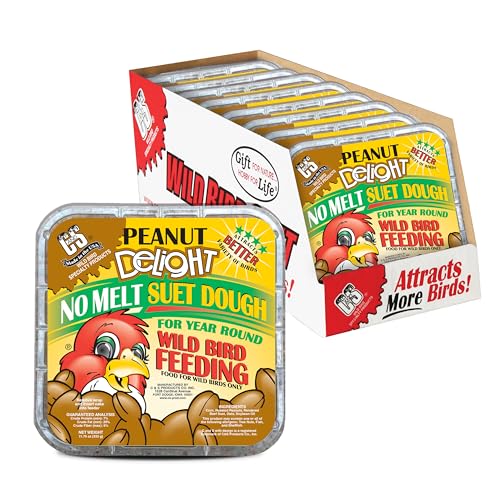
C&S built its Delight line around the biggest weakness of suet: melting. Instead of pouring melted fat into a tray, the maker blends rendered beef suet with a corn meal base and roasted peanuts, then presses the mixture into a firm dough cake. The result holds its shape in heat that turns standard suet greasy, which makes this the suet format to choose for year-round feeding and warm climates. Peanuts are the lead attraction here, and peanut suet is a reliable draw for woodpeckers, jays, nuthatches, chickadees, and wrens.
The listed variant is an 8-pack of 11.75-ounce cakes, so one purchase stocks a suet cage for a long stretch. The dough texture is softer than a poured cake, and birds peck pieces from it easily. It still contains real beef fat, so it delivers the concentrated energy that makes suet valuable in cold snaps and nesting season, without the summer dripping problem.
Specs
- Format: Pressed no-melt suet dough cake
- Weight: 11.75 oz per cake, 8 cakes per pack
- Main ingredients: Rendered beef suet, corn meal, roasted peanuts
- Feeder type: Standard wire suet cage or cake feeder
- Melt behaviour: No-melt dough; holds shape in summer heat instead of dripping
2. C&S Insect Treat Suet — Best Standard Suet Cake

This is the traditional format done the traditional way: high-quality beef fat is melted, blended with seeds and insects, poured into a tray, and left to harden. The insects are the point. Insect-eating birds that ignore plain seed — bluebirds, wrens, woodpeckers, and robins in winter — key in on suet with insect content, and this cake is aimed squarely at them. It is a single 11.75-ounce cake in the standard tray size that fits any basic suet cage.
Be clear about the trade-off. A poured standard suet cake like this one is a winter food in most of the country. In sustained heat it softens, can drip, and goes rancid faster than no-melt dough, so hang it in shade, check it often in warm spells, and replace it if it smells off or looks melted. In cold weather, though, its soft fat is easy for small birds to eat when they need calories most, and it remains one of the simplest ways to bring insect eaters to a yard.
Specs
- Format: Poured standard suet cake
- Weight: 11.75 oz single cake
- Main ingredients: Rendered beef fat, seeds, and insects
- Feeder type: Standard wire suet cage
- Melt behaviour: Standard suet; softens and can turn rancid in summer heat, best for cold weather
3. Mr. Bird Bugs, Nuts & Fruit Large Cylinder — Best Big Seed Cylinder

Mr. Bird’s large cylinders are pressed seed blocks on a bigger scale: each one weighs 4 pounds 2 ounces, and this listing is a 4-pack. The recipe is built for insect and nut eaters — mealworms, tree nuts, peanuts, sunflower hearts, raisins, and cranberries, bound with gelatin rather than fat. That ingredient list is why these cylinders pull in bluebirds, woodpeckers, nuthatches, and wrens that walk past a sunflower-only block. There is no milo and no grain filler padding the weight.
Because the binder is gelatin and there is no fat base, the cylinder does not melt in the sun the way suet does. Prolonged rain will soften the outer layer over time, so a cylinder feeder with a roof is the right home for it. The size is the other advantage: a large cylinder simply lasts, which suits feeding stations at cabins, camps, and second homes that are not refilled every few days. You will need a cylinder feeder with a center rod sized for large cylinders.
Specs
- Format: Pressed seed cylinder, gelatin bound
- Weight: 4 lb 2 oz per cylinder, 4 cylinders per pack
- Main ingredients: Mealworms, tree nuts, peanuts, sunflower hearts, raisins, cranberries, gelatin
- Feeder type: Large cylinder feeder with center rod, roofed feeder preferred
- Melt behaviour: No fat base, so it does not melt; prolonged rain softens the surface
4. Mr. Bird Flaming Hot Feast Small Cylinder — Best for Squirrel Pressure

The Flaming Hot Feast takes a sunflower heart, peanut, golden safflower, and mealworm cylinder and infuses it with hot pepper. Birds cannot taste capsaicin, so they feed normally. Squirrels can taste it, and most learn to leave the cylinder alone after a sample. For yards where squirrels empty every feeder within a day, a hot pepper block is one of the few formats that keeps food in front of birds without baffles or specialty feeders. This listing is a 2-pack of 19-ounce small cylinders.
Honesty matters here. Hot pepper deters most squirrels, not all of them, and determined individuals in some yards eat it anyway. Raccoons and deer are also not reliably put off. Treat the pepper as a strong advantage rather than a guarantee, and keep normal feeder placement sense — a cylinder hanging within jumping range of a fence will still be tested. The small size fits standard small cylinder feeders and suits trying the formula before committing to large cylinders.
Specs
- Format: Pressed seed cylinder with hot pepper, gelatin bound
- Weight: 19 oz per cylinder, 2 cylinders per pack
- Main ingredients: Sunflower hearts, peanuts, golden safflower, mealworms, hot pepper oil
- Feeder type: Small cylinder feeder with center rod
- Melt behaviour: No fat base, so it does not melt in heat; keep dry for longest life
5. Pine Tree Farms Fruit Berry Nut Seed Bell — Best Hanging Seed Bell

A seed bell is the simplest block format of all: seed pressed into a bell shape that hangs from a hook, with no cage or rod required. Pine Tree Farms’ Fruit Berry Nut bell weighs 16 ounces and follows the maker’s Fruit Berry Nut recipe — black oil sunflower seed, peanuts, mixed feed nuts, blueberries, cranberries, and raisins. The fruit content makes it a good pick for birds that come for berries as much as seed, and the bell shape lets clinging birds feed from any side.
Two honest notes. First, the full Fruit Berry Nut recipe also includes white millet and red millet, which many birds pick around; the fruit, nuts, and sunflower carry this bell, and the millet is part of why it costs less than the premium cylinders above. Second, a bell has no fat and a gelatin-style binder, so it will not melt, but it is exposed on all sides and weathers faster than a block inside a cage. Hang it under an eave or inside a mesh bell holder, off the ground and out of the worst rain.
Specs
- Format: Pressed seed bell with hanging loop
- Weight: 16 oz single bell
- Main ingredients: Black oil sunflower seed, peanuts, mixed feed nuts, blueberries, cranberries, raisins (recipe also includes white and red millet)
- Feeder type: Hangs from a hook; mesh seed bell holder recommended
- Melt behaviour: No fat base, so it does not melt; rain and humidity soften it over time
Feeding Blocks Well
Whichever format you choose, placement decides how long it lasts. Hang blocks where they get some shade, especially suet, and keep them off the ground in a feeder, cage, or holder rather than resting on a deck rail or platform where rainwater pools. A block sitting in water molds from the bottom up, and moldy food should be discarded, not left for birds to pick through.
Rotate formats with the seasons. Standard suet earns its place from late autumn through early spring, when fat is safe and birds need the energy. As temperatures rise, switch the same cage to a no-melt dough, and lean on gelatin-bound cylinders and bells through summer. Check any block after storms, trim away softened or discolored portions, and replace food that smells rancid. Done that way, a solid block gives you the longest-lasting, least wasteful feeding station in the yard.
Affiliate Disclosure: This article contains affiliate links. If you buy through a link on this page, we may earn a commission at no extra cost to you.
More from Amazon
Programs that pair well with the guide above. Offers and eligibility are set by Amazon and may change.
Free shipping on eligible items, Prime Video and more. Eligible new members can start with a free trial.
Start a Prime free trialA Prime membership for ages 18-24 with a trial period. Eligibility is set by Amazon.
See Prime for Young AdultsAudiobooks and podcasts to listen to on the go. Eligible new members can start with a free trial.
Try Audible freeAd-free music streaming. Eligible new subscribers can start with a free trial.
Try Music Unlimited freeAs an Amazon Associate we earn from qualifying purchases.










Write Your Review
No reviews yet. Be the first to share your experience!