

Key takeaways
- Five suet feeders compared: a simple cage, a tail-prop model for big woodpeckers, a guarded double, a window mount and a log feeder, with starling notes.
As an Amazon Associate we earn from qualifying purchases.
Suet — rendered fat blended with seed, nuts or fruit — is the highest-energy food most backyard birders can offer, and it pulls in a different crowd than a seed tube. Woodpeckers, nuthatches, chickadees, titmice, wrens and creepers all cling and peck at a suet cake, and in a garden yard or at a cabin it is often the fastest way to bring those clinging birds into regular view. The hardware that holds the cake matters more than it looks: the right feeder decides which birds can reach the food, how long a cake lasts, and how much of it ends up feeding starlings and squirrels instead.
This guide covers dedicated suet feeders only — cages, tail-prop boards, a guarded double cage, a window mount and a log feeder — in standard cake sizes. Seed hoppers and tube feeders that happen to have a suet cage bolted on are a different class of feeder and are covered elsewhere.
Affiliate Disclosure: This article contains affiliate links. If you buy through a link on this page, the site may earn a commission at no extra cost to you. Product picks are based on specifications and listing details, not on commissions.
Suet Is a Cool-Season Food, and That Shapes the Hardware
One honest limit applies to every feeder below: suet is fat, and fat softens. In sustained heat — roughly above 90°F — raw suet turns soft, drips, and can go rancid, and rancid fat is bad for birds and unpleasant for everyone else. Commercial rendered cakes hold up better than raw suet, and “no-melt” dough formulations are made for warm weather, but the classic suet season is autumn through spring. Hang any of these feeders in shade rather than full afternoon sun, and in a hot spell take cakes in rather than leaving them to spoil. A feeder with a roof helps shed rain and slows the softening, but no roof changes the basic rule: heat is suet’s enemy.
The other constant is competition. Starlings and grackles love suet and travel in groups that can strip a cake in a morning. Squirrels treat every design as a puzzle. The feeder styles below manage those pressures in different ways — by orientation, by cage spacing, by tail-prop ergonomics that favor woodpeckers — and each product section states plainly what its design does and does not stop.
The Main Suet Feeder Designs
Cage feeders. The original design: a wire box sized for one standard cake (about 4.5 inches square), hung from a chain or hook. Birds cling to the grid and peck through it from either face. Simple, cheap to replace, and open to everything — including starlings and squirrels.
Tail-prop feeders. A vertical frame with an extended panel below the cake. Woodpeckers feed by bracing their stiff tails against a surface while their feet grip, exactly as they do on a tree trunk. A prop sized for the bird — longer for pileateds, shorter for downies — lets big woodpeckers feed comfortably instead of dangling. These are open-face designs, so they do not exclude starlings; their job is bird comfort, not crowd control.
Upside-down feeders. A roofed box where the cake is reachable only from underneath. Woodpeckers, nuthatches and chickadees hang inverted without thinking about it; starlings and grackles, built to feed upright, mostly cannot sustain the position and give up. It is the single most effective passive starling deterrent in suet feeding — but, stated plainly, it does nothing about squirrels, which hang upside down happily. Orientation manages birds; baffles and placement manage squirrels.
Guarded (caged) feeders. A suet holder inside a larger wire cage whose openings admit small clinging birds and keep squirrels and large bully birds from reaching the cake itself. The trade-off is that larger woodpeckers are also kept at beak’s length, so guarded feeders suit chickadee-and-downy yards better than pileated yards.
Log feeders. A section of log drilled with holes sized for suet plugs. The most natural presentation — birds work it like a dead snag — but it takes plugs or cake cut into pieces rather than a whole standard cake, and untreated wood weathers over seasons.
Window feeders. A small cage on suction cups, stuck to glass. The food is ordinary; the point is the view, with clinging birds feeding inches away.
What to Check Before Buying
- Cake fit. Nearly all feeders are built around the standard commercial suet cake, roughly 4.5 inches square and an inch thick. Check capacity in cakes: one, two, or plug-format.
- Tail-prop length. If pileated or red-bellied woodpeckers are the goal, look for a long prop — around 9 inches or more of bracing panel below the cake. Short or absent props suit small birds only.
- Material. Powder-coated steel cages shrug off weather and chewing. Recycled poly lumber never rots, splits or needs paint, and scrubs clean. Cedar looks the part and resists rot but can be chewed. Natural log feeders are consumable over a few seasons.
- Cleaning access. Suet residue builds up in grids. Doors that open fully and grids that lift out make the hot, soapy scrub these feeders need far more likely to actually happen.
- Mounting. Most suet feeders hang. Window models need clean, smooth glass and cups that get re-seated now and then. Any hanging feeder in squirrel country wants a baffle above it or a pole position squirrels cannot jump to — no cage design fully substitutes for placement.
1. More Birds Suet Cage Bird Feeder
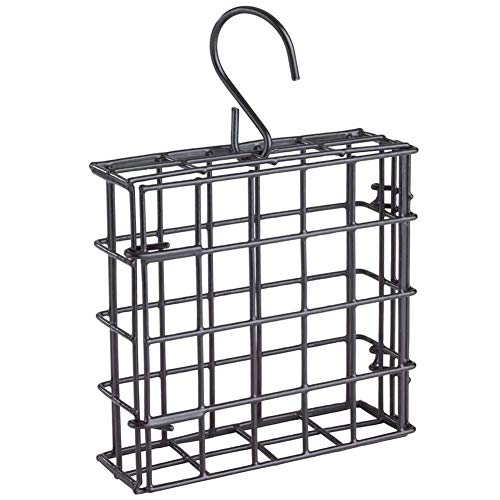
The More Birds suet cage is the baseline design done properly: a black steel wire cage sized for a single standard suet cake, hung from a hook, with an easy-open door that uses a double-locking closure. That closure is the detail that matters — plain spring-clip cages get flipped open by raccoons and dropped by squirrels, and the double lock slows casual theft, though it should be said plainly that no latch makes a hanging cage raccoon-proof. Birds cling to the grid and feed from both faces, and the cage also accepts seed cakes and fruit, which makes it a flexible first suet feeder for a garden yard. There is no tail prop and no roof, so big woodpeckers dangle rather than brace, and the cake weathers directly. As a simple, honest cage, it is the reference point the other designs improve on.
Specs
- Type: Hanging wire cage feeder
- Capacity: 1 standard suet cake (also suits seed cakes and fruit)
- Material: Steel wire cage, black finish
- Tail prop: No
- Mounting: Hanging, hook included
- Closure: Easy-open door with double-locking closure
2. Birds Choice Pileated Suet Feeder with Tail Prop

The Birds Choice Pileated feeder is built around one idea: give the biggest woodpeckers a proper brace. The recycled poly lumber frame stands 22.5 inches tall and holds two standard suet cakes stacked in a vinyl-coated grid, and the panel below the cakes extends into a long tail prop — about 9.5 inches of bracing surface — so pileated and red-bellied woodpeckers can press their stiff tails against it and feed in the same posture they use on a trunk. Smaller woodpeckers and nuthatches use it just as readily. The poly lumber body will not rot, split or fade the way a wooden feeder does, the grid hardware is stainless steel, and the whole feeder scrubs clean, which matters with fatty residue. Stated plainly: this is an open-face feeder, so starlings can feed from it too, and the long prop gives squirrels a seat — pair it with a baffle. Its job is woodpecker comfort at capacity, and it does that job better than any flat cage.
Specs
- Type: Tail-prop suet feeder
- Capacity: 2 standard suet cakes
- Material: Recycled poly lumber (taupe with green roof), vinyl-coated steel grid, stainless steel screws
- Tail prop: Yes, extended lower panel, about 9.5 in of bracing surface
- Dimensions: 8 x 3 x 22.5 in
- Mounting: Hanging
3. More Birds Squirrel-X Double Suet Feeder

The Squirrel-X takes the opposite approach to the tail-prop: instead of inviting big birds in comfort, it locks the food down. Two standard suet cakes sit in an inner holder, and around that holder is a powder-coated steel outer cage whose openings are sized for small clinging birds — chickadees, titmice, nuthatches, downy woodpeckers — while squirrels and larger bully birds cannot reach the cakes themselves. That spacing is the entire mechanism, and its limits should be stated plainly: determined squirrels can still worry at whatever presses against the cage, and larger woodpeckers are kept at the same distance as the pests, so this is a feeder for yards whose regulars are small birds. The steel lid and cage weather well outdoors, the double capacity stretches the time between refills, and it hangs like any other cage feeder — ideally under a baffle, since a cage slows squirrels down rather than defeating a feeder they can sit on top of.
Specs
- Type: Guarded (caged) double suet feeder
- Capacity: 2 standard suet cakes
- Material: Powder-coated steel cage and lid
- Tail prop: No
- Mounting: Hanging
- Deterrent: Outer cage openings sized for small clinging birds; keeps squirrels and larger birds off the cakes
4. Kettle Moraine Window Mount Single Suet Cake Feeder

Kettle Moraine’s window feeder trades yard placement for proximity. A steel suet cage holding one standard cake sits on a recycled plastic base, and two suction cups hold the unit flat against a windowpane, so downy woodpeckers, nuthatches and chickadees feed literally inches from the glass — a genuinely different experience for a kitchen window over a garden, and a good way to show kids a woodpecker’s tongue and feet at work. The practical notes are simple and worth stating: suction cups hold on clean, smooth glass and should be pressed back on now and then, especially across freeze-thaw swings; and a feeder this close to the house only works in yards where birds already come near the building. Mounted within a few feet of the glass, it also sits in the safest zone for window strikes, since birds leaving it cannot build up speed. There is no tail prop, so visitors are the smaller clingers — which, at that distance, is exactly the show most people want.
Specs
- Type: Window-mount suet cage feeder
- Capacity: 1 standard suet cake
- Material: Steel suet cage with recycled plastic base
- Tail prop: No
- Mounting: Window glass, 2 suction cups
- Dimensions: 1.75 x 6.25 x 5 in (as listed)
5. ONWRD Natural Wood Log Feeder

The ONWRD log feeder is the most natural presentation in this roundup: a 16-inch section of real wood, drilled with three holes of 1.5 inches diameter that pass through the log, hung outdoors like a piece of snag. Suet plugs press into the holes, and woodpeckers, nuthatches, titmice and chickadees work the log the way they would a dead tree, bracing against the bark and trunk surface itself — no artificial prop needed. Two honest limits come with the format. First, it does not take a standard suet cake whole: it runs on plugs, suet balls, or a cake cut into thirds and packed into the holes, so it suits people happy to buy or make plugs. Second, untreated wood is a consumable — it will weather, check and eventually split over seasons of rain and freeze, which many birders accept as the cost of the natural look. Hang it at least five feet up, in shade, and it is the feeder in this list most likely to be mistaken for part of the tree.
Specs
- Type: Log feeder (suet plug feeder)
- Capacity: 3 suet plugs, one per hole; a standard cake can be cut into thirds and pressed in
- Material: Natural wood log
- Holes: Three, 1.5 in diameter, drilled through
- Length: 16 in
- Tail prop: No — birds brace against the log itself
- Mounting: Hanging
Placement and Care
Hang suet in shade, ideally where birds have a nearby shrub or tree to stage from, and at least five feet off the ground. In squirrel country, mount on a pole with a baffle or hang where squirrels cannot launch from a trunk or roofline — as the product sections note, cage spacing and latches slow squirrels but placement is what actually beats them. If starlings dominate a standard cage, switch one feeder to an upside-down design rather than giving up on suet entirely; the clinging birds you want will adjust within days, and the starlings mostly will not.
Clean suet feeders regularly with hot, soapy water and a stiff brush, rinse well, and let them dry before refilling — fat residue goes rancid on the feeder as surely as in the cake. Replace cakes that smell off, look melted, or have been hanging untouched through a warm spell. In summer, either pause suet feeding or switch to no-melt doughs, and bring the feeders in for a proper scrub either way.
FAQ
Will an upside-down feeder really stop starlings?
Mostly, yes. Starlings and grackles feed upright and cannot hold an inverted position long enough to eat, while woodpeckers, nuthatches and chickadees are built to cling underneath. A few athletic starlings learn to flutter-grab, so expect a large reduction rather than a total ban — and remember the design does nothing about squirrels.
How long should a tail prop be?
Match it to the bird. Downy woodpeckers do fine on short props or none. Hairy and red-bellied woodpeckers want several inches of bracing panel, and pileateds need a long prop — the Birds Choice above offers about 9.5 inches — because the tail is a load-bearing part of how they feed.
Can I feed suet in summer?
With care. Rendered commercial cakes and no-melt doughs are formulated for warm weather, but raw suet softens, drips and spoils in heat. Keep feeders in shade, offer smaller amounts, and retire anything that smells rancid.
Do suet cakes fit every feeder here?
Four of the five take standard commercial cakes directly — the cage, the tail-prop and the guarded double take them whole, and the window feeder takes one. The log feeder is the exception: it uses suet plugs, or a cake cut into pieces and pressed into its holes.
More from Amazon
Programs that pair well with the guide above. Offers and eligibility are set by Amazon and may change.
Free shipping on eligible items, Prime Video and more. Eligible new members can start with a free trial.
Start a Prime free trialA Prime membership for ages 18-24 with a trial period. Eligibility is set by Amazon.
See Prime for Young AdultsAudiobooks and podcasts to listen to on the go. Eligible new members can start with a free trial.
Try Audible freeAd-free music streaming. Eligible new subscribers can start with a free trial.
Try Music Unlimited freeAs an Amazon Associate we earn from qualifying purchases.










Write Your Review
No reviews yet. Be the first to share your experience!