

Key takeaways
- The best digging forks for gardens, beds and camp plots compared: forged, stainless and fiberglass builds, tine shapes, grips, weights and care tips.
As an Amazon Associate we earn from qualifying purchases.
A digging fork does the work a spade does badly. Where a spade slices through roots and worms and glances off stony ground, four stout tines slip between obstructions, loosen a full slab of soil, and lever it up without turning the bed into a trench. It is the tool for turning vegetable beds in spring, lifting perennials and root crops without spearing them, working compost into a pile, and clearing rough ground on a camp plot where a rototiller will never go. It is not a pitchfork — those have thinner, rounder tines made for moving hay and mulch — and it is not a hand fork, which is a short kneeling tool for weeding around plants. A digging fork is a full-size, long-handled lever, and almost everything about how long it lasts comes down to how the head is built and what the handle is made of.
Affiliate Disclosure: This article contains affiliate links. If you buy a digging fork through a link on this page, the site may earn a commission at no additional cost to you. Products are selected on specifications and construction, and no maker pays for placement.
What Actually Matters in a Digging Fork
Head construction decides lifespan. The strongest heads are forged from a single piece of steel, so the tines, shoulder, and socket flow from one billet with no joint to fail. The weak point on cheaper forks is the welded socket: the head is welded to a tube or tang, and that weld is exactly where the bending load concentrates when a tine hooks a buried rock and the handle becomes a four-foot pry bar. Welds crack there first, and handles snap there second. A welded all-steel fork is not automatically a bad tool — the weld removes every wood-rot failure mode — but the joint deserves a close look before buying and a regular look in use, because it is the part that will go.
Tine shape should match the job. Square-section tines are the digging pattern: the edges bite into compacted soil, resist twisting, and shrug off stones. Flat tines are the lifting pattern: they slide under root balls, potato hills, and manure with less damage to what is being lifted, but they flex more in hard ground. Many general-purpose forks split the difference with tines that are flat across the front and rounded at the back.
Handle material is a genuine trade-off. Ash and other hardwoods absorb shock, so a day of digging jars the hands and shoulders less, and a split wishbone grip carved from the same piece of wood is comfortable in a way moulded plastic rarely is. The cost is weather: wood left in a damp shed or out at a camp plot swells, checks, and eventually rots at the socket. Fiberglass shrugs off rain, frost, and neglect, and it is the better choice for a tool that lives outdoors — but it transmits more shock and can splinter under a hard sideways blow. Steel handles are the heaviest option and the least forgiving on the joints, yet there is simply nothing in them to rot, snap, or delaminate.
Grip and length matter more than brand. A D-grip suits most hands and gives a firm purchase for the push-down stroke. A Y-grip or traditional wishbone spreads the load across the palm. Overall lengths run from about 40 to 48 inches; taller gardeners should look at the long end of that range, because a short fork forces a stoop on every stroke.
The Five Forks
Fiskars Ergonomic Garden Fork (1001413) — the long, joint-friendly pick

Fiskars builds this fork around a boron steel head and shaft, which removes the two classic failure points in one move: there is no wood to rot at the socket and no separate handle to loosen. Boron steel is the same family of hardened steel Fiskars uses across its digging line, chosen for edge retention on the tine points and resistance to bending when a tine tip meets a stone. At 122 cm — roughly 48 inches — it is the longest fork in this group, and that length is the real feature: taller users, or anyone who digs standing beds for hours, get leverage without bending as far on each stroke. The oversized ergonomic D-handle is shaped to keep the wrist in a neutral position during the push-and-lever cycle, which is where most fork fatigue actually comes from. The trade-offs are weight distribution and feel. A steel shaft transmits more ground shock than ash, and at 2.08 kg it is not the lightest tool here. For a camp plot or allotment where the fork may live in an unheated shed through winter, though, an all-steel tool with no timber anywhere in it is a rational kind of insurance.
Specs
- Tines: 4 prongs
- Head: Boron steel, steel shaft construction
- Handle: Steel, 122 cm (48 in) overall length
- Grip: Ergonomic D-handle
- Weight: 2.08 kg (about 4.6 lb)
TABOR TOOLS J59A Digging Fork — the heavy-duty all-steel option
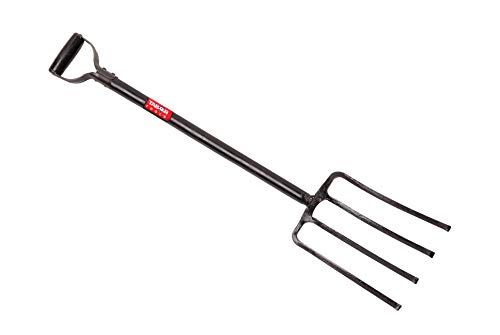
The J59A is the bruiser of this group: an all-steel spading fork with a big head — about 12 inches long and 8 inches wide — and four tines that are flat across the front and rounded at the back, with chisel-style points. That tine profile is a deliberate compromise. The flat face lifts root crops and compost without slicing them, the rounded back keeps some of the stiffness of a square tine, and the points start into compacted soil more willingly than a blunt spade pattern. At 5.5 pounds it is heavy, and that mass works for the user when breaking new ground: momentum does part of the pushing. The honest caveat belongs to the construction. The steel shaft is welded to the head rather than forged in one piece, and as noted above, that weld is the joint to watch on any fork built this way — it is also the joint that carries the load when the fork is used as a pry bar against buried roots. In exchange, there is no wooden handle to crack in dry heat or rot in a wet corner, and the 40-inch overall length keeps the tool handy in raised beds where a longer shaft gets in the way. Tall users should note that 40 inches is at the short end of the range and can mean stooping.
Specs
- Tines: 4, flat front with rounded back, chisel points
- Head: Steel, about 12 x 8 in, welded steel shaft construction
- Handle: Steel shaft, 40 in overall length
- Grip: D-handle
- Weight: 5.5 lb
Bully Tools 92370 Spading Fork — the fiberglass weather survivor

Bully Tools takes the opposite route from the traditional makers: a steel head on a fiberglass handle with a poly D-grip. Fiberglass is the handle material that best matches how these tools are actually stored — leaning in a damp garage corner, riding in a truck bed, or standing in a holder at a camp plot through a wet season. It does not rot, swell, or check, and it tolerates the freeze-thaw cycles that slowly work a wooden shaft loose in its socket. The head is a compact spading pattern, 6-3/4 inches wide, which concentrates the push of a boot onto a smaller area than a wide fork — useful in stony or clay-heavy soil where a broad head skates. Four tines at 44 inches overall put it in the middle of the group for length, suiting average-height users for bed turning and compost work. The compromises are the familiar fiberglass ones: more shock reaches the hands than with ash, and the material dislikes being struck or crushed sideways. Within normal digging and levering loads, though, this is the fork most likely to be indifferent to a decade of bad storage, which for a plot or campsite tool is a specification that matters as much as tine shape.
Specs
- Tines: 4
- Head: Steel, 6.75 in wide spading pattern
- Handle: Fiberglass, 44 in overall length
- Grip: Poly D-grip
- Weight: Not reliably published for the tool alone; packaged weight is listed at 2.57 kg
Spear & Jackson 4550DF Traditional Stainless Steel Digging Fork — the traditional bed fork

This is the classic English pattern, built the way it has been built for generations: a mirror-polished stainless steel head on a one-piece hardwood shaft that is split at the top to form a wishbone handle and riveted in two places. Stainless steel is the practical choice for anyone who digs in wet soil and puts tools away damp — it resists rust, and the polished finish sheds sticky clay instead of carrying it. The wishbone grip, being continuous with the shaft, has no moulded joint to work loose, and the hardwood absorbs shock the way fiberglass and steel cannot. The head has treaded shoulders for a boot. Credit is due to the maker for stating the limit plainly: this fork is intended for digging and turning loose and prepared soil, and it is not built for prying out rocks, stumps, or heavy roots — stainless is somewhat softer than hardened carbon steel, and the traditional pattern assumes the user will reach for a bar or mattock when the ground fights back. Used within that honest envelope, it is the lightest full-size fork here at 4.3 pounds and the one best suited to long sessions in beds and borders. It is covered by a 10-year guarantee.
Specs
- Tines: 4
- Head: Mirror-polished stainless steel, treaded shoulders
- Handle: One-piece weatherproofed hardwood shaft, split wishbone grip, riveted in two places
- Overall length: 39.76 in
- Grip: Wishbone (YD) handle
- Weight: 4.3 lb
VNIMTI Garden Fork — the long Y-grip compost and lifting fork

The VNIMTI fork pairs a steel four-tine head with a wooden handle and a steel Y-grip, at 45 inches overall — near the long end of this group. The Y-grip is the detail that defines it: the open wishbone shape lets the top hand push down with the palm centred over the shaft, which suits the two jobs this fork is aimed at, turning compost and lifting. Compost work is mostly vertical stabbing and stirring rather than hard levering, and a Y-grip stays comfortable through hundreds of repetitions where a narrow D can start to bite into the palm. The wooden handle keeps shock absorption on the traditional side of the ledger, with the usual condition that it should be stored dry and given an occasional coat of oil if it starts to look grey and thirsty. Four steel tines in a general spading pattern handle bed turning and root-crop lifting as well as pile work. Buyers should go in with clear expectations about class: this is a value-tier Amazon-native tool rather than a heritage brand, the listing data is thinner than the big makers publish, and the head-to-handle joint deserves the same inspection advised for any socketed fork. For a second fork dedicated to the compost heap, or a long spare for the plot, the format makes sense.
Specs
- Tines: 4
- Head: Steel
- Handle: Wood, 45 in overall length
- Grip: Steel Y-grip
- Weight: Not reliably published in the listing data
Which Fork for Which Job
For breaking new or compacted ground, weight and tine stiffness lead: the TABOR TOOLS J59A puts the most steel in the ground per stroke, and the Fiskars answers with boron steel and extra length for taller users. For a tool that will live outdoors or in a damp shed, the Bully Tools fiberglass handle and the Fiskars all-steel build are the two that ignore weather entirely. For long, pleasant hours in prepared beds — the work most gardeners actually do most often — the Spear & Jackson’s light weight, shock-absorbing hardwood, and rust-proof head are the comfortable combination, provided its stated limits are respected. The VNIMTI earns its place as the compost-pile and lifting fork, where the Y-grip and 45-inch reach matter more than brute digging strength. Camp plot owners clearing rough ground should weight the decision toward forged or all-steel construction and treat any fork as a lever with limits: when a tine hooks something that will not move, the right move is to dig around it, not to bounce on the handle.
Care That Doubles a Fork’s Life
Three habits cover most of it. Knock the soil off and wipe the tines before storage; caked clay holds moisture against steel all winter, and even stainless appreciates being put away clean. Keep wooden handles fed — a light coat of linseed oil once or twice a year stops the checking that starts at the socket — and store any fork out of standing water, ideally hanging or standing head-up in a dry corner. Finally, inspect the head joint each spring: a hairline crack at a weld, a socket that has begun to rock on the shaft, or a tine that has taken a slight bend are all cheap problems when caught early and tool-ending problems when ignored. Straighten a bent tine cold, with leverage along its length, never by hammering it sideways against a stone.
A digging fork is a simple tool with nowhere to hide a shortcut, which is why the honest differences — forged against welded, ash against fiberglass, square tines against flat — are worth more than any badge on the handle. Match the construction to the ground and the storage it will actually get, and any of these five will still be working long after the beds they dug have changed hands.
More from Amazon
Programs that pair well with the guide above. Offers and eligibility are set by Amazon and may change.
Free shipping on eligible items, Prime Video and more. Eligible new members can start with a free trial.
Start a Prime free trialA Prime membership for ages 18-24 with a trial period. Eligibility is set by Amazon.
See Prime for Young AdultsAudiobooks and podcasts to listen to on the go. Eligible new members can start with a free trial.
Try Audible freeAd-free music streaming. Eligible new subscribers can start with a free trial.
Try Music Unlimited freeAs an Amazon Associate we earn from qualifying purchases.










Write Your Review
No reviews yet. Be the first to share your experience!