

Key takeaways
- Hanging mesh herb dryers compared for garden, kitchen and camp harvests, with zippered layers, honest capacity notes and mold-free air-drying guidance.
As an Amazon Associate we earn from qualifying purchases.
A hanging herb dryer is a simple thing: a stack of mesh shelves suspended from a hook, giving cut herbs a flat, ventilated place to lose their moisture. The five racks in this guide are all variations on that idea, and they share the same hard limit, which is worth stating before any product names. Air drying only works when the air itself is dry and moving. In a humid kitchen, a damp coastal campsite or a rainy harvest week, herbs can mold before they dry no matter which rack holds them, because the rack does not dry the air — it only organises the herbs. A shaded spot with a genuine breeze, or a small fan in the room, does more for the result than any extra layer count.
The second trade-off runs through every pick below. All five are enclosed designs: each layer is a mesh chamber with a zipper, which keeps insects, dust and curious birds off the harvest. That protection costs airflow. An enclosed chamber is a pocket of stiller air than an open tray or a bundle hung from a beam, so enclosed racks dry more slowly than open ones in the same room. For most garden and camp harvests the protection is worth the extra day or two, but buyers should know the exchange is real. Finally, capacity: every rack here spaces its layers roughly eight inches apart, and leafy herbs dry properly in a single loose layer. A four-layer rack holds four layers of herbs spread thin — not four layers of herbs piled deep. Piling traps moisture in the middle of the pile, and that is where mold starts.
Affiliate Disclosure: This article contains affiliate links. If you buy a product through one of these links, the site may earn a commission at no extra cost to you. Products are selected on specifications and suitability for the job, and the limitations of each design are stated openly below.
1. iPower Herb Drying Rack, 4-Layer, 2-Feet
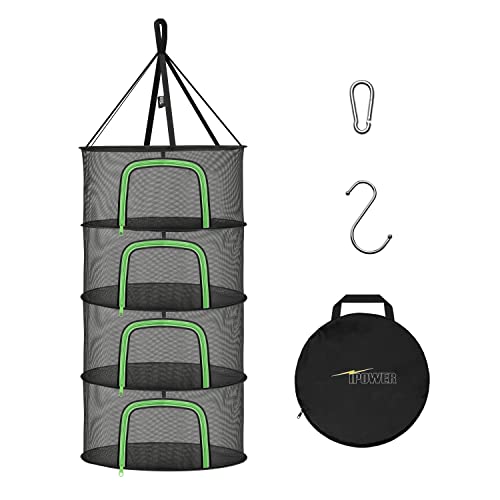
The iPower is the reference design in this category: four round nylon mesh chambers, each just under two feet across, hung from a ceiling mount with a pothook and carabiner included in the box. Its distinguishing detail is the U-shaped zipper on each layer. A U opening lets the whole front of a chamber fold down, so herbs can be laid out or lifted off with both hands instead of being fished through a narrow slot — a small thing that matters when the material is dry and crumbly and every handling sheds leaf.
The frame is a spring wire ring, and iPower warns plainly that the rack is bouncy when it comes out of its storage pouch and can spring open unexpectedly. Open it away from your face, ideally outdoors or over a table. Folded back down it returns to a flat disc that fits the included pouch, which makes it one of the easier racks to store in a camp kit or a kitchen drawer between harvests. The listed weight limit is modest, which is honest rather than a flaw: a two-foot layer of loose herbs weighs very little, and the limit only bites if someone loads it with dense fruit or wet produce, which is not what this tool is for.
Specs
Layers: 4
Layer diameter: 23.6 in (2 ft)
Mesh material: Nylon
Design: Enclosed, U-shaped zipper opening on each layer
Hanging method: Ceiling mount with pothook and carabiner
Folded size: Collapses flat into the included storage pouch
Item weight: 1.34 lb
ASIN: B09NLKN98P
Source: https://www.amazon.com/dp/B09NLKN98P
2. AC Infinity Herb Drying Rack, 4-Layer, 18-Inch

AC Infinity’s rack is the compact option, and the one most clearly built for indoor growers. At eighteen inches across it fits inside a grow tent, a closet or a narrow pantry corner where a two-foot rack would foul the walls, and its four zippered chambers hang about thirty-one inches in total. The frame is a steel wireframe rather than a plain spring ring, which helps the shelves stay level and resist sagging when a layer carries unevenly distributed material.
The mesh is polyester, the chambers collapse flat, and a carrying bag and hanging hook are included. The honest limitation is surface area: an eighteen-inch layer holds noticeably less than a two-foot layer, so a big basil or mint harvest means more batches through the rack, not a faster single batch. For apartment kitchens, tent growers and campers drying small quantities of herbs, seeds or flower heads, that trade is usually the right one.
Specs
Layers: 4
Layer diameter: 18 in
Hanging length: 31 in
Mesh material: Polyester
Frame: Steel wireframe
Design: Enclosed, zippered chamber on each layer
Hanging method: Hanging hook, included
Folded size: Collapses flat, carrying bag included
Item weight: About 0.97 lb
ASIN: B099BMHDS1
Source: https://www.amazon.com/dp/B099BMHDS1
3. Mars Hydro Herb Drying Rack, 2 ft, 4 Layers

Mars Hydro’s entry matches the iPower on footprint — four layers, two feet in diameter — but hangs a little shorter at thirty-two inches overall and uses a carbon steel frame with polyester mesh. Its maker-stated weight limit is the highest of the four-layer racks in this guide, which suits gardeners who also dry heavier material such as sliced fruit, peppers or seed heads alongside herbs. The same caution applies as with any rack, though: a high frame limit does not change the airflow rule, and heavy wet slices dry slowly in an enclosed chamber wherever they are hung.
Each layer opens with a zipper, the whole unit folds for storage, and the mounting is a simple hanging strap for a hook, rail or tent pole. Against the iPower, the practical differences are the zipper shape — a standard opening rather than the full U flap — and the frame rating.
Specs
Layers: 4
Layer diameter: 24 in
Hanging height: 32 in
Mesh material: Polyester
Frame: Carbon steel
Design: Enclosed, zipper opening on each layer
Hanging method: Hanging mount strap for hook or rail
Folded size: Folds flat for storage
Item weight: 1.68 lb
Maker-stated weight limit: 8.8 lb
ASIN: B0BG7QDPM3
Source: https://www.amazon.com/dp/B0BG7QDPM3
4. MEKOLIFE Herb Drying Rack, 6 Layers

Six layers is the middle ground of this category, and the MEKOLIFE is a typical, well-specified example: two-foot nylon and polyester mesh chambers on a carbon steel wire ring, each closed by a green zipper, with a solid waterproof top panel that sheds drips and dust settling from above. At roughly forty-seven inches of hanging height it needs a proper ceiling hook, a garage beam or a tall tent — measure the drop before ordering, because a six-layer rack that has to be folded in half to fit has lost its point.
The kit includes pruning shears and a hanging hook, which makes it a reasonable single purchase for a first herb garden harvest. The maker-stated weight limit is low, and that should be read as a real constraint: this is a rack for herbs, flowers and light produce, loaded in thin layers. The spring frame pops open on unpacking, as with the iPower, and the bottom layers are naturally the least convenient to load and check. Rotating material between layers every day or two evens out drying, since the top of any hanging rack sits in warmer, drier air than the bottom.
Specs
Layers: 6
Layer diameter: 23.6 in
Hanging height: About 47 in
Mesh material: Nylon and polyester
Frame: Carbon steel wire ring
Design: Enclosed, zipper closure on each layer, waterproof top panel
Hanging method: Ceiling mount, hanging hook included
Folded size: About 10.2 x 8.6 x 1.5 in packed
Item weight: 1.92 lb
Maker-stated weight limit: 3.3 lb
Extras: Pruning shears included
ASIN: B0CHPKKDR4
Source: https://www.amazon.com/dp/B0CHPKKDR4
5. Desy & Feeci Herb Drying Rack, 8 Layers

The Desy & Feeci is the tall one: eight two-foot layers hanging sixty-three inches from hook to base, the most separated drying surface in this guide. That capacity is genuine but narrow in scope. Eight layers suit a harvest of many small, distinct batches — several herb varieties kept apart, seed heads from different plants, flowers for tea — far better than they suit one large wet mass, because each layer still only dries what is spread thinly across it. Anyone hanging this rack needs real vertical clearance: a barn beam, a stairwell or a high garage ceiling, not a standard closet rail.
Construction is polyester mesh in a collapsible pop-open frame, hung by an S-hook buckle strap and supplied with a storage bag. The maker warns that the net springs out when the package is opened, and at eight layers that spring is energetic — open it somewhere with room. Layer spacing works out to roughly eight inches, the same as the rest of this guide, so tall material such as dill heads or long stems still needs to be cut down to fit between shelves. For the gardener whose September problem is sheer variety and volume of small batches, this is the rack that solves it; for everyone else it is more rack than the harvest justifies.
Specs
Layers: 8
Layer diameter: 23.6 in (60 cm)
Hanging height: 63 in
Mesh material: Polyester
Design: Enclosed collapsible mesh chambers with zipper openings
Hanging method: S-hook buckle strap
Folded size: Collapses into the included storage bag
ASIN: B07HQGZT6H
Source: https://www.amazon.com/dp/B07HQGZT6H
How to Choose, and How to Actually Dry Herbs in One
Size first. Count the harvest honestly: a couple of herb plants and a kitchen garden’s worth of trimmings fit the eighteen-inch AC Infinity or a two-foot four-layer rack. A market-garden row or a whole bed of one herb wants the six or eight-layer racks — not because they dry faster, but because thin single layers are non-negotiable and surface area is the only way to get them. Measure the hanging drop as carefully as the diameter; every rack in this guide needs its full listed height plus room to work the lowest zipper.
Where the rack hangs decides the result more than which rack it is. Choose shade with moving air: a covered porch out of direct sun, a garage with the door cracked, a spare room with a window open or a small fan running. Direct sun bleaches colour and drives off the aromatic oils that are the point of drying herbs at all. At camp, hang the rack under a tarp or tree canopy, off the ground and away from the fire — smoke taints dried herbs permanently — and bring it inside the tent or vehicle at night, because dew will re-wet a nearly dry batch in a few hours.
Technique is short and strict. Harvest late in the morning once dew has dried. Shake off soil and insects rather than washing, since added water is added drying time and added mold risk. Strip damaged or blackened leaves before loading. Spread everything in a single layer with air gaps, keep varieties in separate chambers, and check daily: turn the material, break up any clumps, and remove anything showing white or grey fuzz immediately, before it spreads. Herbs are done when leaves crumble cleanly and stems snap rather than bend — typically several days to two weeks depending on the herb and the weather. Store the finished batch in airtight jars in the dark, and check the jars after a week for condensation, which means the batch went in too early.
One last honest note on scope. These racks are air dryers, nothing more. For humid climates, late-season harvests in wet weather, or material that must dry fast and completely — thick fruit slices, mushrooms for storage, anything prone to spoilage — a powered dehydrator is the correct tool and no mesh rack substitutes for it. Within their proper job, the five racks above cover the range from a windowsill herb garden to a full autumn harvest.
Frequently Asked Questions
Can these racks be used outdoors at a campsite?
Yes, with conditions. Hang the rack in shade with airflow, under a tarp or canopy if rain threatens, and bring it in at night to keep dew off the load. Keep it well away from campfire smoke, which dried herbs absorb readily.
Why did herbs mold in a rack that was hung indoors?
Almost always the room air was too humid or too still, or the layer was loaded too thickly. Move the rack somewhere with moving air, spread the load thinner, and remove moldy pieces as soon as they appear so spores do not spread to the rest of the batch.
How long does air drying take in a mesh rack?
Leafy herbs in dry, moving air are typically ready in several days to about two weeks. Thick or fleshy material takes longer, and humid weather stretches every estimate. Judge by touch — crumbling leaves and snapping stems — not by the calendar.
Do the zippered layers slow drying down?
Slightly, yes. An enclosed chamber moves less air than an open tray, in exchange for keeping insects, dust and birds off the harvest. In most garden and camp settings that protection is worth the modest extra time.
More from Amazon
Programs that pair well with the guide above. Offers and eligibility are set by Amazon and may change.
Free shipping on eligible items, Prime Video and more. Eligible new members can start with a free trial.
Start a Prime free trialA Prime membership for ages 18-24 with a trial period. Eligibility is set by Amazon.
See Prime for Young AdultsAudiobooks and podcasts to listen to on the go. Eligible new members can start with a free trial.
Try Audible freeAd-free music streaming. Eligible new subscribers can start with a free trial.
Try Music Unlimited freeAs an Amazon Associate we earn from qualifying purchases.










Write Your Review
No reviews yet. Be the first to share your experience!