

Key takeaways
- The best landscape staples for fabric, drip lines and netting, with gauge, length, coating and pack-count picks for loose, firm and rocky soil.
As an Amazon Associate we earn from qualifying purchases.
Landscape staples are the cheapest-looking part of a fabric or drip irrigation job, and the part that decides whether the job stays put. A U-shaped pin of bent wire has one task: hold material flat against the ground through wind, foot traffic, watering and frost heave. When staples fail, they fail quietly — an edge lifts, fabric creeps, a drip line wanders off the row — and the fix is always more work than pinning it properly the first time.
Affiliate Disclosure: This article contains affiliate links. If you buy through them, we may earn a commission at no extra cost to you.
Treat staples as consumables, because that is what they are. Some get pulled and reused, some bend on the first rock they meet, and some stay buried for the life of the fabric. The buying decision is therefore not about finding a perfect staple. It is about matching four things to your ground: wire gauge, leg length, coating, and how many pins a pack actually gives you. This guide explains those four factors plainly, then covers five widely available 6-inch, 11-gauge options that differ in top width, coating type, point shape and pack count.
What actually matters in a landscape staple
Gauge decides holding power and bend resistance. Wire gauge runs backwards: the lower the number, the thicker the wire. Most garden staples are 11 gauge (about 3 mm), which is stiff enough to drive into firm soil and thick enough to grip. Thinner 12- or 14-gauge pins are easier to push in by hand but pull out of loose soil and fold over in hard ground. For rocky or compacted soil, 11 gauge is the sensible floor, and the thicker wire also survives being levered back out.
Length decides how deep the anchor sits. Six inches is the standard for a reason: it puts the legs below the loose surface layer in most garden soil. In sandy or freshly tilled ground, even 6 inches can creep, and spacing pins closer matters more than hunting for longer pins. In hard clay, a 6-inch staple driven fully home holds extremely well — the challenge there is getting it in without bending it.
Coating decides rust life. Bare or lightly finished steel rusts quickly in wet soil. Galvanized staples carry a zinc coating that slows that rust, and hot-dip galvanizing lays down a thicker zinc layer than a thin electro-galvanized finish, so hot-dip pins are the better pick for permanent installations that will stay buried under fabric for years. For a temporary job — pinning netting for one season, holding a drip line you plan to move — standard galvanized is plenty, and pulled pins can go back in the box for the next job.
Point shape decides how they drive. Chisel points and beveled tips slice into soil with less force and are less likely to skate sideways off a stone. Blunt or square-cut ends need a firmer mallet hit and bend more often in stony ground.
Top width decides what the staple straddles. A 1-inch top suits fabric edges, netting and standard drip tubing. Wider tops, around 1.5 inches, sit over fatter lines, foam insulation board edges and bundled material, and spread the clamping area a little more.
How many staples does a job actually need?
Pack counts look generous until you do the spacing math. A common pinning pattern for landscape fabric is one staple every 12 inches along seams and edges, with closer spacing on slopes and corners. A 3-by-50-foot roll of fabric has about 106 linear feet of edge and seam to pin, which works out to well over 100 staples before you add a single drip line. Pin a few drip runs as well and a 200-count pack stops looking like overkill. Small 50-count packs make sense for repairs, a single raised bed, or a short drip run — and for little else. Count your linear feet first, then choose the pack.
1. Sandbaggy 6-Inch Landscape Staples, 200 Count

Sandbaggy is the contractor-facing name in this category, and this 200-count pack is its standard fabric staple: 6-inch legs of 11-gauge low-carbon steel with a square top and chisel points. The square top sits flat on fabric instead of rocking on it, which keeps woven weed barrier from creeping under the pin, and the chisel points are genuinely easier to start in firm ground than square-cut ends. The galvanized finish suits multi-season installs, and the brand sells the same staple pattern in larger trade quantities, which tells you who the core buyer is. For a full yard of fabric plus drip lines, this is the pack sized to the job rather than to a single flower bed.
Specs
- Length: 6 inches
- Gauge: 11 gauge low-carbon steel
- Material/coating: galvanized steel
- Top width: 1 inch, square top
- Ends: chisel points
- Count per pack: 200
- ASIN: B012C1T21W
- Source: https://www.amazon.com/dp/B012C1T21W
2. Ashman Galvanized Garden Stakes, 200 Pack

Ashman’s 200-pack covers the same ground as the Sandbaggy with a slightly wider top — the listing dimensions are 6 inches long by 1.15 inches wide — and a hot-dipped zinc galvanized coating. That wider bridge is a small but real advantage over drip tubing and emitter lines, because the pin clears the line with a bit more room and presses on a broader strip of fabric at seams. Ashman sells the same staple in counts from small garden packs up to bulk boxes, so matching pack size to the job is easy within the one product line. The 200-count box weighs about 6.75 pounds, which gives a fair sense of the wire you are getting: these are full-weight 11-gauge pins, not skimmed-down versions.
Specs
- Length: 6 inches
- Gauge: 11 gauge
- Material/coating: hot-dipped zinc galvanized steel
- Top width: 1.15 inches
- Ends: pointed U-pin ends
- Count per pack: 200
- ASIN: B01EWH0VWS
- Source: https://www.amazon.com/dp/B01EWH0VWS
3. HOOPLE 6-Inch Galvanized Landscape Staples, 100 Pack

HOOPLE’s 100-pack is the mid-size option: 6-inch legs, a 1-inch top, and 11-gauge galvanized alloy steel with beveled sharp tips. The beveled ends are the selling point here — they start into compacted soil with noticeably less persuasion than blunt ends, and the listing notes the U width can be squeezed or spread slightly to clamp different material thicknesses, which is handy when one pin has to hold both fabric and a drip line. A 100-count pack suits a single fabric roll, a couple of raised beds, or a modest drip layout, and the pack weight of roughly 3.65 pounds is in line with honest 11-gauge wire.
Specs
- Length: 6 inches
- Gauge: 11 gauge
- Material/coating: galvanized alloy steel
- Top width: 1 inch
- Ends: beveled sharp tips
- Count per pack: 100
- ASIN: B07G3J6GRL
- Source: https://www.amazon.com/dp/B07G3J6GRL
4. FEED GARDEN 6-Inch Hot-Dip Galvanized Staples, 50 Pack

FEED GARDEN’s 50-pack is the small-job pick with two genuine differences. First, the coating is hot-dip galvanized, the thicker zinc treatment that holds up longest in permanently wet soil. Second, the top is 1.5 inches wide — the widest in this roundup — which straddles drip lines, soaker hoses and bundled netting more comfortably than a 1-inch pin and presses a wider strip of fabric at overlaps. The wire is 11 gauge at a full 3 mm. Fifty pins will not landscape a yard, but for one raised bed, a short fabric patch, or anchoring a drip run along a camp garden row, the count is right and the coating is the best here for leaving in the ground.
Specs
- Length: 6 inches
- Gauge: 11 gauge (3 mm)
- Material/coating: hot-dip galvanized steel
- Top width: 1.5 inches
- Ends: pointed U-pin ends
- Count per pack: 50
- ASIN: B07Z1SH6B5
- Source: https://www.amazon.com/dp/B07Z1SH6B5
5. Bakulyor 6-Inch Landscape Staples with Gaskets, 50 Pack
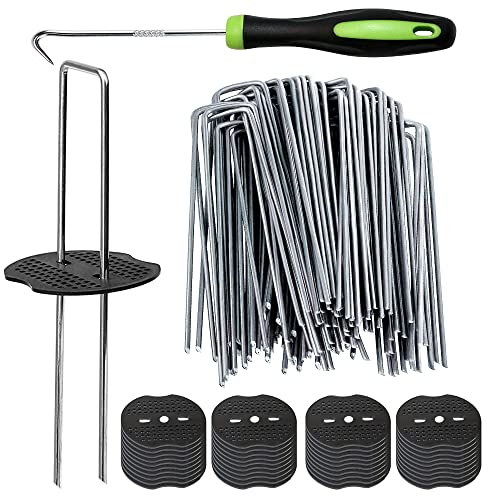
Bakulyor’s set solves a specific annoyance: a bare staple driven hard through thin fabric can chew a slot in the material, and wind works the fabric against the wire until the hole grows. This pack includes 50 plastic gaskets — one washer per staple — that sit under the top bridge and spread the clamping pressure over a wider disc of fabric. The staples themselves are 6-inch, 11-gauge (3 mm) galvanized steel with a 1-13/32-inch top width, a middle ground between the 1-inch and 1.5-inch pins above. For lightweight weed barrier, row cover edges and netting that you do not want torn, the gasket system is a thoughtful touch the plain packs do not offer.
Specs
- Length: 6 inches
- Gauge: 11 gauge (3 mm)
- Material/coating: galvanized steel with anti-rust treatment
- Top width: 1-13/32 inches
- Ends: pointed U-pin ends
- Count per pack: 50 staples plus 50 gaskets
- ASIN: B096SW5TQ1
- Source: https://www.amazon.com/dp/B096SW5TQ1
Installing staples so they stay installed
Soil decides the technique. In soft or freshly watered ground, most 6-inch staples push in by hand or with a palm press. In firm soil, use a rubber mallet and strike the top bridge squarely; a glancing blow is what bends legs. In rocky ground, expect losses — some pins will hit stone and fold no matter whose name is on the box — so work with a mallet, a spare handful of staples, and a little patience: if a pin refuses at one spot, move it two inches rather than forcing it, because a half-driven bent staple holds worse than a fully driven one next to it.
A few habits make any of these packs perform better. Drive staples fully home so the top sits snug on the material without sawing into it. Overlap fabric seams by several inches and pin through both layers. On slopes, halve the spacing and angle pins slightly uphill. For drip lines, pin on alternating sides of the tubing rather than straddling it every time, which keeps the line from being pinched at every point. And when you pull staples for reuse, a flat screwdriver levered under the bridge pops them cleanly; straightened pins go back in the box, bent ones go in the bin.
Frequently asked questions
Are landscape staples reusable? Galvanized 11-gauge pins usually are, as long as they come out straight. Pull them with a lever rather than twisting, and expect the coating to be scuffed where the mallet struck — those spots rust first in storage, so dry pulled pins before boxing them.
Will 6-inch staples hold in sandy soil? They hold fabric adequately if you tighten the spacing, because sand offers little grip at any practical length. Pin edges closer together, bury fabric edges in a shallow trench where you can, and accept that wind-exposed corners may need re-pinning after storms.
Can staples damage drip lines? A pin driven carelessly can nick tubing. Straddle lines loosely rather than clamping them hard, or pin beside the line and let the fabric hold it. Wider-top staples give more clearance over fat emitter lines.
How long do galvanized staples last in the ground? It depends on soil moisture and coating thickness. Hot-dip galvanized pins in permanently damp soil typically serve for years before rust weakens them; thin finishes in the same soil give up sooner. For a one-season job, any galvanized pin here is more than durable enough.
The bottom line
There is no mysterious technology in a bent piece of wire, and that is the honest truth of this category. Buy 11-gauge wire, buy 6-inch legs, buy a galvanized coating — hot-dip if the pins will live in wet ground — and buy a pack count matched to your linear feet rather than to optimism. The Sandbaggy and Ashman 200-packs fit whole-yard fabric and drip projects, the HOOPLE 100-pack covers a single roll or a few beds, and the FEED GARDEN and Bakulyor 50-packs handle small jobs with, respectively, the widest top and a fabric-friendly gasket system. Pin densely, drive them square, and the fabric stays where you put it.
More from Amazon
Programs that pair well with the guide above. Offers and eligibility are set by Amazon and may change.
Free shipping on eligible items, Prime Video and more. Eligible new members can start with a free trial.
Start a Prime free trialA Prime membership for ages 18-24 with a trial period. Eligibility is set by Amazon.
See Prime for Young AdultsAudiobooks and podcasts to listen to on the go. Eligible new members can start with a free trial.
Try Audible freeAd-free music streaming. Eligible new subscribers can start with a free trial.
Try Music Unlimited freeAs an Amazon Associate we earn from qualifying purchases.










Write Your Review
No reviews yet. Be the first to share your experience!