

Key takeaways
- Five lawn sprinklers compared for gardens, yards and camp lawns: oscillating, impact, spinning and gear-drive picks with honest notes on water pressure.
As an Amazon Associate we earn from qualifying purchases.
A hose-end sprinkler is the simplest irrigation a lawn can get: one faucet, one hose, one head you move by hand. The catch is that almost every number printed on the box assumes strong municipal water pressure behind a short hose. Run the same sprinkler at the end of a long hose, on a well pump, or in a rural camp setup where pressure sags, and the pattern shrinks badly — a circle rated at eighty feet across can land closer to fifty, and an oscillating bar that should sweep a full rectangle starts leaving dry corners. Before comparing models, it is worth knowing roughly what pressure your outdoor faucet delivers, because that figure decides which of these five picks will actually perform as described.
Type matters as much as size. Oscillating sprinklers lay water in a rectangle, which suits most suburban lawns and garden plots. Impact sprinklers throw a heavy stream in a big circle and shrug off dirty water, which suits large, open ground. Gear-drive rotors turn slowly and quietly, but the gears need a minimum pressure to rotate at all — starve them and they stall in one spot and flood it. Spinning sprinklers are the gentle option: a fine, rain-like spray for smaller patches and beds, and the design most forgiving of weak pressure. Construction decides lifespan. A metal head on a metal base survives being dragged, dropped and left outside; a plastic gear drive is quieter and lighter, but its gears and seals are the wear points that decide how many seasons it lasts.
Affiliate Disclosure: This article contains affiliate links. If you buy through a link on this page, the site may earn a commission at no extra cost to you. Product details are taken from manufacturer and retailer listings at the time of writing.
1. Melnor 65154AMZ XT Turbo Oscillating Sprinkler — the adjustable rectangle for most lawns

The XT Turbo is Melnor’s full-size oscillating model on a metal base, and it is the straightforward recommendation for a rectangular lawn or a set of garden beds. The maker rates it for up to 4,500 square feet, and the controls are genuinely three-way: sliding tabs set the oscillation width, a second adjustment sets the range, and a flow control on the body throttles the volume without moving the sprinkler. That combination lets you water a narrow side strip one day and open the pattern up for the whole back lawn the next, which is where cheaper oscillators with a single range dial fall short.
The metal base is the detail that matters outdoors. It keeps the unit planted when the hose tugs, and it survives the casual abuse — mower bumps, being stepped around in the dark, storage in a shed corner — that cracks lightweight plastic sleds. The turbo-drive motor is sealed, so the oscillation does not depend on a stream of clean water to keep a paddle wheel turning. The honest limits are the usual ones for this type: the stated coverage assumes healthy household pressure, the spray is wind-sensitive because the water leaves in a high fan, and the body above the base is polymer, so the base will outlast the fittings if the unit is left baking in sun season after season. The Amazon bundle listing includes Melnor’s QuickConnect adapter set for fast hose swaps.
Specs
- Type: Oscillating (turbo drive)
- Stated coverage: up to 4,500 sq. ft.
- Base: Metal sled base
- Material: Metal base with polymer body and spray tube
- Pattern adjustments: 3-way — width, range and flow control
- Extras: QuickConnect product adapter set included in the bundle listing
- ASIN: B0B9FC123W
- Source: https://www.amazon.com/dp/B0B9FC123W
2. Gardena 1975-U AquaZoom — precise edges for smaller, tidier plots
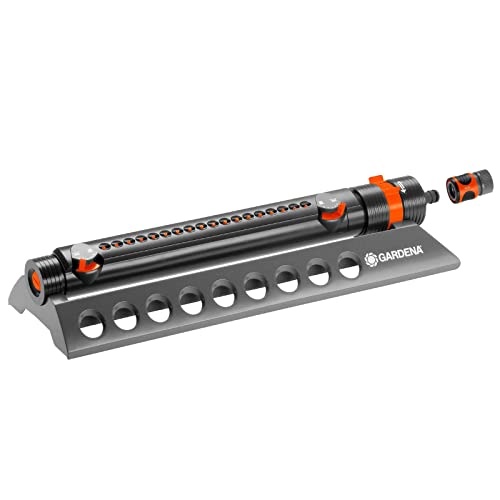
The AquaZoom is the precision option in this group. Gardena lists it at up to 3,900 square feet, but the real reason to choose it is control: the range, the spray width and the flow are each adjusted independently, so the rectangle can be trimmed to stop at a path, a fence line or the edge of a vegetable bed instead of soaking all three. For camp lawns and small garden yards where the grass sits in defined panels between hard surfaces, that edge control saves more water than a bigger headline coverage figure ever will.
The trade-offs are construction and appetite for pressure. The housing and spray tube are plastic — well-finished, German-made plastic with a weighted sled base that sits flat and stays put, but plastic all the same, and it will not shrug off being driven over the way the Melnor’s metal base might. Like every oscillator, it also wants a reasonable pressure behind it; on a weak supply the fan narrows and the far corners of the rectangle go dry first. Within its limits it is the neatest waterer here, and the adjustment dials are large enough to work with wet hands. Buyers who need to cover one big open area should look at the impact and gear-drive models below instead.
Specs
- Type: Oscillating
- Stated coverage: up to 3,900 sq. ft. (listing figure)
- Base: Weighted sled base
- Material: Plastic housing and spray tube
- Pattern adjustments: Range, spray width and flow, each independently adjustable
- Origin: Made in Germany
- ASIN: B002VED42O
- Source: https://www.amazon.com/dp/B002VED42O
3. Orbit 56667Z Zinc Impact Sprinkler on Tripod — big circles, raised above the grass

Impact sprinklers are the old farm answer to large ground, and the 56667Z packages that mechanism properly: a zinc impact head on a telescoping metal tripod that lifts the stream above lawn grass, low shrubs and garden rows. Orbit rates the pattern at up to ninety feet in diameter, and the head adjusts from a full circle down to a partial arc, with a diffuser to break the stream up for shorter throws. Raised on the tripod, the stream clears obstacles that would chop up the pattern of a ground-level head, which makes this the pick for big camp lawns, rough pasture-style ground and oversized yards.
Two honest caveats come with the type. First, the click-clack of an impact head is not quiet — it is part of how the mechanism works, and near a tent or a bedroom window it will be noticed. Second, that ninety-foot circle is a strong-pressure figure; impact heads keep rotating at pressures where gear drives stall, which is a genuine advantage, but the diameter still shrinks as pressure falls. The zinc head itself is the durability story: metal internals tolerate gritty or reclaimed water that would wear a plastic rotor, and there are no fine gear teeth to jam. The tripod legs need reasonably firm ground to stay planted under hose drag.
Specs
- Type: Impact (pulsating)
- Stated coverage: up to 90 ft diameter circle
- Base: Telescoping metal tripod
- Material: Zinc impact head
- Pattern adjustments: Full circle or partial arc; diffuser for distance control
- ASIN: B004VUA82K
- Source: https://www.amazon.com/dp/B004VUA82K
4. Orbit H2O-Six Gear Drive on Tripod — quiet rotation with six patterns

The H2O-Six is the flexible rotor of the group. Its gear-drive head offers six selectable spray patterns — small, medium, large, shower, vertical and flat — chosen by rotating the top of the head, plus collar tabs that set the arc anywhere from a narrow wedge to a full 360 degrees, and a four-position diffuser that changes the droplet size. On its telescoping tripod, which adjusts from 25 to 48 inches, Orbit rates it at up to eighty feet in diameter, covering 5,026 square feet on a full circle. A flow-through outlet lets a second sprinkler be chained behind it on the same hose run.
The gear drive is also the honest weakness, in two ways. It runs whisper-quiet compared with an impact head, but it needs pressure to work: Orbit states an operating range of 15 to 65 PSI, and at the bottom of that range rotation gets lazy and the diameter falls well short of the headline figure. The head is plastic and zinc rather than all metal, so the gear train is a wear item in a way the Orbit impact head above is not — gritty water shortens its life, and the maker’s own instructions assume a reasonably clean supply. Treat it as the quiet, versatile option for clean municipal water, not the tool for a silty well.
Specs
- Type: Gear-drive rotor
- Stated coverage: up to 80 ft diameter (5,026 sq. ft. at full circle)
- Base: Telescoping metal tripod, adjusts 25 to 48 in
- Material: Plastic and zinc head
- Pattern adjustments: 6 spray patterns; arc from partial to 360 degrees; 4-position diffuser
- Stated pressure range: 15 to 65 PSI
- Extras: Flow-through outlet for chaining a second sprinkler
- ASIN: B0013I475M
- Source: https://www.amazon.com/dp/B0013I475M
5. Dramm ColorStorm Spinning Sprinkler (15074) — gentle rain for small patches and beds

The spinning sprinkler is the oldest simple design here: water pressure spins a head on a bearing and throws a fine, even rain in a circle of up to about thirty-eight feet across. Dramm’s ColorStorm version builds that mechanism the way the type deserves — a zinc and aluminum body, a brass pin riding on a ball bearing, and a heavy stationary metal base that does not walk or tip when the hose is pulled. There is nothing to adjust and almost nothing to break, which is precisely the point for a small lawn patch, a bed of seedlings or a camp garden corner that needs a gentle soak rather than a soaking at range.
Its virtues and limits are the same fact viewed from two sides. The spray is fine and soft, so it suits new seed and delicate plantings, and the simple spinning action keeps working at pressures where a gear drive would stall — retailer specifications put the working range at roughly 20 to 80 PSI. But a fixed circle of modest diameter is all it will ever water, there is no arc or pattern control, and on a large lawn it would need constant moving. The listing is sold in several colors, which sounds trivial until the sprinkler has to be spotted in tall grass before the mower finds it.
Specs
- Type: Rotating (spinning)
- Stated coverage: up to 38 ft spray diameter
- Base: Heavy-duty stationary metal base
- Material: Zinc and aluminum body; brass pin on ball bearing
- Pattern adjustments: Fixed spinning pattern; coverage set by pressure and placement
- Stated pressure range: 20 to 80 PSI (retailer specification)
- ASIN: B006L90F72
- Source: https://www.amazon.com/dp/B006L90F72
How to choose: match the mechanism to the ground
Start with shape. Rectangles — most lawns, most garden plots — belong to oscillating models, and the choice between the Melnor and the Gardena is really about whether you value the metal base or the finer edge control. Circles and big open ground belong to the impact head and the gear drive; between those two, decide by water quality and noise. Dirty or gritty water, or a don’t-care attitude to a clicking head, points to the zinc impact sprinkler. Clean water and a premium on quiet point to the H2O-Six. Small patches, beds and new seed belong to the spinning sprinkler, whose fine spray will not blast soil away from roots.
Then be honest about pressure, because it overrides everything above. Every coverage figure in this article is a maximum at healthy household pressure. A long hose run, an elevated tank or a tired well pump can cut the real pattern by a third or more, and rotors suffer first because their gears need pressure simply to turn. If your supply is weak, the impact and spinning designs degrade most gracefully; if your supply is strong, all five will reach close to their stated patterns.
Finally, think about the base. Sled bases drag easily and store flat, but a light sled can be pulled sideways by a stiff hose — weight, whether from metal or a weighted base, is a feature. Tripods lift the stream over grass and shrubs and are the only way to water uneven or planted ground evenly, at the cost of setup time and a need for firm footing. Spikes, common on smaller heads, sit between the two and fail mainly in hard, dry soil where they will not push in.
Care that decides how long a sprinkler lasts
Three habits matter more than brand. Use the filter washer at the hose connection and rinse it when flow drops — most “dead” gear drives are simply starved by a clogged screen. Drain any sprinkler before the first hard freeze and store it under cover; water left in a sealed turbo or gear housing is what splits bodies over winter. And clean the jets: oscillating tubes and the Dramm’s brass nozzles both include or accept a cleaning pin, and a single grit-blocked jet leaves a dry stripe that looks like a coverage fault. Do those three things and the metal models here should run for many seasons; skip them and even the zinc impact head will eventually seize.
More from Amazon
Programs that pair well with the guide above. Offers and eligibility are set by Amazon and may change.
Free shipping on eligible items, Prime Video and more. Eligible new members can start with a free trial.
Start a Prime free trialA Prime membership for ages 18-24 with a trial period. Eligibility is set by Amazon.
See Prime for Young AdultsAudiobooks and podcasts to listen to on the go. Eligible new members can start with a free trial.
Try Audible freeAd-free music streaming. Eligible new subscribers can start with a free trial.
Try Music Unlimited freeAs an Amazon Associate we earn from qualifying purchases.

Write Your Review
No reviews yet. Be the first to share your experience!