

Key takeaways
- Compare five soil scoops for potting, planting and beds by capacity, material and sieve options, with verified specs and sources for every pick.
As an Amazon Associate we earn from qualifying purchases.
Affiliate Disclosure: This article contains affiliate links. If you buy through a link on this page, the site may earn a commission at no extra cost to you. Products are chosen on specifications and availability, not on commission rates.
A soil scoop looks like the simplest tool in the shed, and in one sense it is: a soil scoop is a volume tool, not a digging tool. Its job is to move a repeatable amount of potting mix, compost or granular amendment from a bag or bin into a pot, a planting hole or a bed, over and over, without spilling half of it on the path. Because the basic shape barely changes between brands, the real differences are easy to miss until the tool is in your hand. They are capacity, whether the end carries a sieve mesh for sifting, and whether the neck where bowl meets handle survives prying into a compacted bag of mix.
That last point deserves to be stated plainly. Almost every broken soil scoop fails at the neck. A bag of potting mix that has sat in a damp shed settles into a solid block, and the natural move is to lever the scoop against it. A one-piece metal scoop shrugs that off. A thin plastic scoop, or a stamped bowl spot-welded to a separate handle, may not. Material matters for a second reason too: gritty mixes full of perlite, bark and sand are abrasive. Stainless steel comes out of a season of that work looking much the same; plastic bowls get scored and rough, which makes mix cling instead of sliding out cleanly.
This guide compares five soil scoops that cover the useful range: an oversized potting scoop for filling large containers, a classic stainless scoop for general bed and pot work, a wide ergonomic scoop for gardeners who work by the hour, a sieve set with a bonsai scoop for grading your own mix, and a mini plastic pair for seedlings and small pots. Each entry lists the specifications the maker actually publishes, including where a maker does not publish a figure at all.
What Actually Differs Between Soil Scoops
Capacity and bowl shape. Makers are inconsistent here: some state a volume, most state only dimensions. A deep, high-sided bowl carries loose, dry mix without shedding it on the way to the pot, but it is clumsy inside small pots. A wide, shallow bowl loads fast from a flat bag and levels off neatly, yet spills more on the move. Match the bowl to your biggest routine job, not your biggest imaginable one.
Sieve ends and sifting. Bonsai and succulent growers often need fines removed from gritty mix so drainage stays open. Scoops with a mesh back, and sieve pans sold with a scoop, shake out the dust while you portion. For general potting mix straight from a bag, a sieve does nothing except slow you down.
Neck construction. One-piece cast or forged scoops have no joint to fail. Two-piece tools rely on a tang, rivets or a weld. A full-length tang inside the handle is the strongest two-piece arrangement; a short stub tang is the weakest.
Material. Stainless steel resists rust and abrasion and can be pried with, within reason. Aluminum alloys are lighter and rust-proof but dent if used as a lever against rock or frozen ground. Plastic is light, gentle on glazed pots and fine for loose mix, but it flexes, scores under grit, and its neck is the first thing to crack in compacted material.
Handle. Potting sessions are repetitive. A shaped, non-slip grip matters more than the last half inch of bowl length, especially with wet hands and gloves.
The Five Soil Scoops Compared
Garden Weasel Potting Scoop (91362)

The Garden Weasel is the bulk mover of this group. Its bowl is oversized with tall sides and an extra-deep profile, shaped to carry a heaped load of loose mix from bag to planter without dribbling a trail across the patio. The tip is serrated, which earns its keep opening bag seams and breaking up surface clumps before loading. Construction is one-piece AluminIron, the maker’s aluminum alloy, so there is no neck joint to fail, and the full-length tang runs through a six-inch ergonomic grip.
Two honest caveats. First, at 13 inches long with a 4-inch-wide bowl, it is bulky inside small pots and tight containers; this is a filling tool, not a detail tool. Second, Garden Weasel does not publish a bowl volume, so capacity comparisons rest on the stated dimensions and bowl depth rather than a measured figure. Aluminum also dents if it is used to pry rocks or frozen soil, so it should move mix, not lever ground.
Specs
- Capacity: Not published by the maker; bowl depth 1.25 in with tall sides
- Material: AluminIron (aluminum alloy), one-piece construction
- Sieve: None, plain bowl with serrated cutting tip
- Dimensions: 13 x 4 x 3 in
- Handle: 6 in ergonomic non-slip rubberized grip over full-length tang
- Weight: 0.33 kg
- ASIN: B08C253V48
- Source: https://www.amazon.com/dp/B08C253V48
Garden Works The Original Soil Scoop

The Original Soil Scoop is the traditional pattern done properly: an 18-gauge stainless steel blade with serrated edges, made in the USA, on a cushioned Comfort Grip handle produced with over 50 percent recycled material. The serrations are functional, not decorative; they saw through fine roots and matted mix while you load, and the pointed profile doubles for furrowing seed rows and lifting soil out of planting holes. At 6 ounces it is the lightest full-size metal scoop here, which adds up over a long potting session.
Stainless steel is the right call for gritty work: perlite and bark-heavy mixes score plastic quickly, while this blade rinses clean and does not rust when it is put away damp. The listing’s stated length is 11.5 inches, a touch shorter than the oversized Garden Weasel, which makes it handier in medium pots and raised beds. Garden Works does not publish a bowl volume, so treat it as a general-purpose scoop sized by its dimensions rather than by a measured capacity.
Specs
- Capacity: Not published by the maker
- Material: Stainless steel blade, 18 gauge
- Sieve: None, plain bowl with serrated edges
- Dimensions: 11.5 x 3 in (listing product dimensions)
- Handle: Comfort Grip, made with over 50% recycled material
- Weight: 6 oz
- ASIN: B000EIR5UQ
- Source: https://www.amazon.com/dp/B000EIR5UQ
Radius Garden 106 Ergonomic Aluminum Hand Scooper

The Radius Garden 106 is built around the hand rather than the bowl. Its curved Natural Radius Grip holds the wrist in a neutral position instead of cocked back, which is the posture that makes repetitive scooping ache. The blade is die-cast aluminum and noticeably wide, with a shallower dish than a deep potting scoop: it loads quickly from a bag or bin, maneuvers well when planting out, and the wide face carries a generous layer of mix per pass. The listing puts the tool at 0.53 lb, light for its size.
The trade-offs follow from the design. A shallow, wide bowl spills more than a deep one when carried over distance, so this scoop suits working at a bench or bed edge rather than trekking mix across the garden. Die-cast aluminum is strong in compression but should not be used as a pry bar against compacted or stony ground. Gardeners with arthritis, carpal tunnel symptoms or reduced grip strength are the clear audience; everyone else should choose it for the handle geometry, not the bowl.
Specs
- Capacity: Not published by the maker; wide, shallow bowl profile
- Material: Die-cast aluminum blade
- Sieve: None, plain bowl
- Dimensions: 15 x 4 x 3.75 in (listing item dimensions)
- Handle: Ergonomic curved grip, thermoplastic elastomer over polypropylene core
- Weight: 0.53 lb
- ASIN: B00ABNZNEO
- Source: https://www.amazon.com/dp/B00ABNZNEO
CDOKY Soil Sieve Set with Bonsai Soil Scoop

This is the pick for anyone who grades their own mix. The set pairs a stainless steel sifting pan with five interchangeable mesh screens running from 0.04 in up to 0.48 in, plus a bonsai soil scoop for portioning. Shake a load of gritty substrate over the coarse screen and the stones stay behind; swap to a fine screen and the dust that clogs drainage falls through. For bonsai, succulents and seed-starting mixes, that control over particle size is the difference between a mix that drains freely and one that stays soggy.
The honest framing: this is a sieve kit with a scoop, not a scoop with a token sieve. If you buy bagged potting mix and use it as it comes, the screens will sit unused and a plain scoop from this list is the better buy. The scoop itself is a small bonsai-pattern tool for measured amounts, not a bulk filler. The full kit weighs 0.75 kg, most of it the steel pan and screens, and stainless mesh edges deserve care in handling and storage.
Specs
- Capacity: Small bonsai-pattern scoop; sized for portioning, not bulk filling
- Material: Stainless steel pan, screens and scoop
- Sieve: Yes, 5 interchangeable mesh screens, 0.04 in to 0.48 in
- Dimensions: Sifting pan set; see listing for pan diameter by variant
- Handle: Scoop handle per bonsai pattern; pan is two-handled for shaking
- Weight: 0.75 kg (full set)
- ASIN: B0DLKXKRLL
- Source: https://www.amazon.com/dp/B0DLKXKRLL
Home-X Set of 2 Soil Scoops
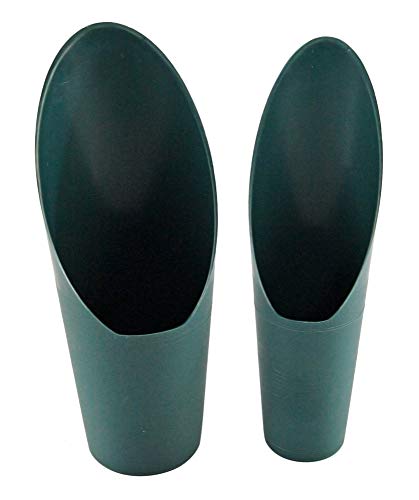
The Home-X pair covers the small end of the work: two plastic scoops, one 6.5 x 2.5 in and one 6.25 x 1.75 in, for seed trays, small pots, bonsai benches and measured amounts of granular fertilizer or grit. Together they weigh 1.76 ounces, so they live happily in an apron pocket or a bench drawer, and plastic will not scratch glazed or painted pots the way a metal edge can.
The limits are the usual plastic limits, stated plainly. These are measuring and portioning tools for loose material. The necks will flex under load, and levering into a compacted bag or a dry, root-bound pot is exactly how a scoop like this cracks. Used within their design brief — loose mix, small containers, repeatable small volumes — they are the right tool, and having two sizes means the small one actually fits the seed tray instead of making do.
Specs
- Capacity: Not published by the maker; mini format for small, measured amounts
- Material: Plastic
- Sieve: None, plain bowls
- Dimensions: 6.5 x 2.5 in and 6.25 x 1.75 in (one of each)
- Handle: Molded plastic grip, integral with bowl
- Weight: 1.76 oz (set of 2)
- ASIN: B08674Q9NC
- Source: https://www.amazon.com/dp/B08674Q9NC
Which Soil Scoop Should You Buy?
Buy the Garden Weasel if your routine is filling large pots and planters from bags: the deep, tall-sided bowl and one-piece alloy body are built for volume, and the serrated tip opens the next bag. Buy the Garden Works Original if you want one durable stainless scoop for general potting, beds and furrowing, and prefer a lighter tool with cutting edges. Buy the Radius Garden 106 if your hands or wrists limit your sessions; the handle geometry is the product. Buy the CDOKY set if you mix or grade your own substrate and need fines out of it. Buy the Home-X pair if your work is seedlings, small pots and measured amendments, and keep them away from compacted bags.
Whichever you choose, rinse grit off the bowl before it dries on, and store metal scoops dry. A scoop has no moving parts and nothing to adjust; looked after, the metal ones on this list should outlast several seasons of bags.
FAQ
What size soil scoop do I need?
Match the bowl to the pots you fill most. Mini scoops around 6 inches suit seed trays and small pots. Full-size scoops around 11 to 13 inches fill medium and large containers efficiently. An oversized bowl in a small pot spills more than it saves.
Is stainless steel better than plastic for a soil scoop?
For gritty, abrasive mixes and any prying at all, yes: stainless resists scoring and rust and its neck tolerates leverage. Plastic wins on weight, on cost, and around glazed pots it cannot scratch. The failure mode to avoid is using a plastic scoop as a lever in compacted mix.
What does a sieve-end scoop or sieve set actually do?
It separates mix by particle size. Screens remove dust and fines that block drainage in bonsai and succulent mixes, and hold back stones and bark chunks from seed mixes. If you use bagged mix as it comes, you do not need one.
Can a soil scoop replace a trowel?
Only partly. A scoop moves loose material far faster than a trowel, and serrated models can furrow and lift soil from holes. For digging into firm ground, cutting roots or levering out plants, a trowel’s narrower, stronger blade is still the right tool. Most gardeners end up with one of each.
More from Amazon
Programs that pair well with the guide above. Offers and eligibility are set by Amazon and may change.
Free shipping on eligible items, Prime Video and more. Eligible new members can start with a free trial.
Start a Prime free trialA Prime membership for ages 18-24 with a trial period. Eligibility is set by Amazon.
See Prime for Young AdultsAudiobooks and podcasts to listen to on the go. Eligible new members can start with a free trial.
Try Audible freeAd-free music streaming. Eligible new subscribers can start with a free trial.
Try Music Unlimited freeAs an Amazon Associate we earn from qualifying purchases.










Write Your Review
No reviews yet. Be the first to share your experience!