

Key takeaways
- Compare five trailer brake controllers, from proportional Tekonsha and REDARC units to a Bluetooth CURT Echo and a time-delayed pick, by axles and install.
As an Amazon Associate we earn from qualifying purchases.
Affiliate Disclosure: This article contains affiliate links. If you buy through them, we may earn a commission at no extra cost to you.
A travel trailer, boat trailer, or loaded utility trailer with electric brakes needs one thing from the tow vehicle: a signal that tells those brakes how hard to work, and when. That signal comes from an in-cab electric brake controller. Without one, the trailer brakes do nothing at all, and the tow vehicle’s brakes carry the whole combined weight — longer stopping distances, hotter brakes, and a trailer that can push the vehicle around on descents. Many states also require a working controller once a trailer passes a set weight threshold, so for a lot of camping rigs this is not an optional accessory.
One honest note before the picks. Many newer trucks leave the factory with an integrated trailer brake controller built into the dash, and if yours has one that works well, you may not need anything on this page. The controllers below are for vehicles without a factory unit, for older trucks whose integrated controller has failed or feels vague, and for drivers who want trailer profiles and braking modes a basic factory setup does not offer. Check your dash and owner’s manual first.
Proportional vs Time-Delayed: The Distinction That Matters Most
Every controller here works in one of two ways, and the difference shapes how the rig feels in every stop.
A proportional controller uses an internal accelerometer or inertia sensor to measure how hard the tow vehicle itself is slowing down. It then applies the trailer brakes in direct proportion: a gentle slowdown for a traffic light gets gentle trailer braking, and a hard stop gets full trailer braking almost immediately. The result is braking that feels like one vehicle instead of two, with less jerking, less trailer-brake wear in town, and full power available in an emergency without any adjustment.
A time-delayed controller works on a timer. When the brake pedal is pressed, it ramps trailer braking power up to a preset level over a preset delay, the same way every time, regardless of how hard the vehicle is actually stopping. That means a light pedal tap in a parking lot eventually gets the same trailer braking as a firm stop, which can feel grabby at low speed, and a panic stop waits for the ramp before full power arrives. Time-delayed units are simpler, cheaper to build, and mount in any position because they have no leveling sensor. For light, occasional towing they do the job. For regular towing, heavier trailers, or mountain driving, proportional control is the safer and more comfortable choice, and four of the five picks below are proportional.
Whichever type you choose, three other factors decide fit. First, axle count: controllers are rated for one to four axles (two to eight brake assemblies), and the rating must cover your trailer. Second, installation: many vehicles have a factory tow-package port under the dash, and a vehicle-specific plug-and-play harness connects the controller in minutes; without that port, the controller hardwires with four leads. Third, the manual override lever or button, which applies the trailer brakes alone from the cab — the control used to settle trailer sway and to test the brakes before rolling.
1. Tekonsha Prodigy P3 90195 — Proportional, 1 to 4 Axles

The Prodigy P3 is the long-running benchmark among dash-mounted proportional controllers, and it earns that position with diagnostics as much as braking feel. Its internal accelerometer delivers true proportional braking, and a boost feature lets the driver add extra initial trailer braking for heavier loads or slick conditions, in selectable steps. The front-facing LCD shows output voltage, battery and brake circuit status, and plain-language diagnostic messages, and it stores settings for multiple trailers, so moving between a camper and a utility trailer does not mean starting the setup over.
The P3 mounts under or on the dash with a clip and a conventional wiring connection. On vehicles with a tow-package port, a Tekonsha two-plug harness (sold separately) makes it plug-and-play; otherwise it hardwires. A manual override lever sits on the front of the unit, within easy reach. It is the pick for drivers who tow varied trailers often and want the controller to tell them what is happening electrically, not just apply power.
Specs
- Brand: Tekonsha
- Model: 90195 (Prodigy P3)
- Control type: Proportional (internal accelerometer)
- Axles supported: 1 to 4 axles
- Display: LCD with voltage readout and diagnostics
- Features: Boost settings, multiple-trailer memory, manual override lever
- Installation: Dash mount; plug-and-play with vehicle-specific harness (sold separately) or hardwire
2. Tekonsha Primus IQ 90160 — Proportional, 1 to 3 Axles

The Primus IQ takes the same proportional principle and trims it to the essentials for single- and tandem-axle trailers, plus the occasional three-axle rig. Its inertia sensor is self-leveling, so the mounting angle is forgiving, and it applies trailer braking in proportion to vehicle deceleration just like its bigger sibling. A boost button adds extra initial braking when a loaded trailer needs it, and a digital display shows the output level and connection status.
Where the P3 is a diagnostic instrument, the Primus IQ is a set-and-go controller: a power knob, a boost button, and a manual override lever on the underside. It uses the same Tekonsha two-plug harness system, so installation on a tow-package vehicle is quick, and the compact housing with a snap-in mounting clip can be removed and stored when not towing. For the very common case of a travel trailer or boat trailer with one or two axles, it covers the need without paying for four-axle capacity and multi-trailer memory.
Specs
- Brand: Tekonsha
- Model: 90160 (Primus IQ)
- Control type: Proportional (self-leveling inertia sensor)
- Axles supported: 1 to 3 axles
- Display: Digital output and status display
- Features: Boost button, manual override lever, removable snap-in mount
- Installation: Dash mount; plug-and-play with vehicle-specific harness (sold separately) or hardwire
3. CURT Echo 51180 — Proportional, Bluetooth, No Dash Unit at All

The Echo takes a completely different approach to installation: there is no dash unit. The controller plugs in line between the vehicle’s 7-way RV blade socket and the trailer’s 7-way plug, at the back of the vehicle, and its triple-axis accelerometer measures deceleration from there. All control happens through a smartphone app over Bluetooth — output level, sensitivity, trailer profiles, and the manual override are on the phone screen. If the phone connection drops while driving, the controller keeps applying the last settings, so braking never depends on the phone staying connected.
This design solves real problems. Nothing is mounted in the cab, nothing is hardwired, and the same controller moves between tow vehicles in seconds, which makes it the natural pick for households with two tow vehicles or for a borrowed or rented truck. The trade-offs are equally real: adjustments mean interacting with a phone app rather than reaching for a knob, and the unit lives outside at the socket, so it should be secured and removed when not towing. CURT also offers a separate wireless manual override button for drivers who want a physical control. Proportional braking for one to two axles covers most travel trailers and campers.
Specs
- Brand: CURT
- Model: 51180 (Echo Mobile)
- Control type: Proportional (triple-axis accelerometer)
- Axles supported: 1 to 2 axles
- Display: None on unit; smartphone app over Bluetooth
- Features: Multiple trailer profiles in app, phone-based manual override, no wiring or dash mount
- Installation: Plugs in line at the 7-way RV blade socket
4. REDARC Tow-Pro Elite — Dual-Mode Proportional, 1 to 3 Axles
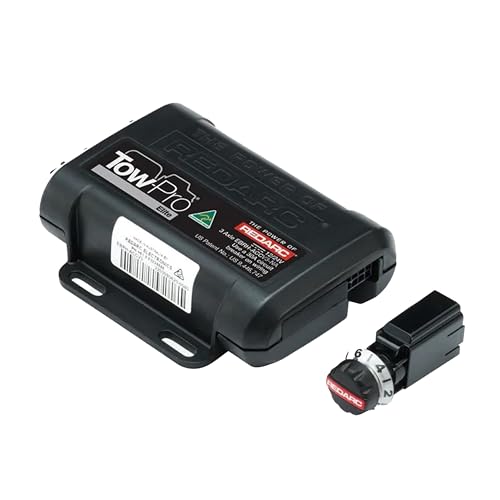
The Tow-Pro Elite hides its main module behind the dash and leaves only a small rotary control knob visible, which suits modern interiors where a bulky controller looks out of place and knee room is tight. It offers two braking modes selected from that knob. The everyday mode is proportional, using an accelerometer to match trailer braking to vehicle braking. The second is a user-controlled mode in which the driver sets a fixed braking level the controller applies regardless of deceleration — intended for off-road towing, steep loose descents, and sand or mud, where proportional systems can over- or under-react to the surface.
The Elite works on both 12-volt and 24-volt vehicles, calibrates itself actively as it is driven, and supports electric brakes as well as electric-over-hydraulic systems. The knob also serves as the manual override: push it to apply the trailer brakes alone. Installation uses a vehicle-specific harness on many trucks (sold separately) or a universal wiring kit. For campers who tow a trailer down forest roads and boat ramps as well as highways, the dual-mode design is the differentiator; the clean, almost factory look is the bonus.
Specs
- Brand: REDARC
- Model: Tow-Pro Elite (EBRH-ACCV3-NA)
- Control type: Proportional plus user-controlled mode (dual mode)
- Axles supported: 1 to 3 axles
- Display: LED indication on the control knob
- Features: Active calibration, 12V and 24V compatible, electric-over-hydraulic capable, push-knob manual override
- Installation: Hidden main module with dash knob; plug-and-play harness on many vehicles (sold separately) or universal hardwire
5. Tekonsha Brakeman IV 8507120 — Time-Delayed, 1 to 4 Axles

The Brakeman IV is the time-delayed entry in this lineup, included deliberately so the simpler technology has a fair representative. When the brake pedal is pressed, it ramps output up to the level set on its digital controls over a short delay. There is no inertia sensor, which means it can be mounted at any angle and in tight spots where a proportional unit’s leveling would be awkward, and its behavior is completely predictable because it does the same thing every stop.
Digital push-button controls set the output and the ramp, an LED display shows the settings and circuit diagnostics, and a manual override lever applies the trailer brakes on demand. It handles up to four axles, so capacity is not the compromise — braking finesse is. In stop-and-go traffic the fixed ramp can feel grabby at low speed, and in a sudden stop the trailer brakes reach full power on the timer rather than instantly. For a light utility trailer towed occasionally on flat ground, that trade is reasonable and the unit is simple and dependable. For a heavy travel trailer or mountain routes, choose one of the proportional picks above instead.
Specs
- Brand: Tekonsha
- Model: 8507120 (Brakeman IV)
- Control type: Time-delayed (digital ramp)
- Axles supported: 1 to 4 axles
- Display: Digital display with diagnostics
- Features: Push-button output and ramp settings, manual override lever, mounts at any angle
- Installation: Dash mount; plug-and-play with vehicle-specific harness (sold separately) or hardwire
How to Choose
Start with the braking type. Proportional control is the right default for almost everyone towing a camper or travel trailer regularly: it matches trailer braking to the stop, which is easier on equipment and calmer for passengers. Reserve time-delayed units for light, infrequent towing where simplicity and mounting freedom matter more than finesse.
Then match the axle rating to the trailer, with headroom if a bigger trailer is in your future. Check your vehicle for a tow-package port before buying — if it has one, add the matching vehicle-specific harness to the order and any of the dash-mounted picks becomes a short plug-and-play job; if it does not, budget time for a four-wire hardwire install or have a shop do it.
Finally, think about where the controls will live. Drivers who adjust settings often tend to prefer a physical knob or lever they can reach without looking: the P3, Primus IQ, and Brakeman IV put everything on the unit, and the REDARC reduces it to one knob. Drivers who tow with several vehicles, or who refuse to add hardware to a modern dash, are better served by the Echo at the socket. Whichever you install, do the low-speed setup routine in an empty lot — set the output so the trailer brakes engage firmly without locking, test the manual override, and re-check after the first loaded trip. A controller that is installed but never dialed in delivers only half of what it was bought for.
More from Amazon
Programs that pair well with the guide above. Offers and eligibility are set by Amazon and may change.
Free shipping on eligible items, Prime Video and more. Eligible new members can start with a free trial.
Start a Prime free trialA Prime membership for ages 18-24 with a trial period. Eligibility is set by Amazon.
See Prime for Young AdultsAudiobooks and podcasts to listen to on the go. Eligible new members can start with a free trial.
Try Audible freeAd-free music streaming. Eligible new subscribers can start with a free trial.
Try Music Unlimited freeAs an Amazon Associate we earn from qualifying purchases.







Write Your Review
No reviews yet. Be the first to share your experience!