

Key takeaways
- Compare A-frame, swivel and electric tongue jacks by lift capacity and travel to match your camper or utility trailer tongue weight and mount style.
As an Amazon Associate we earn from qualifying purchases.
A tongue jack lifts the trailer coupler clear of the hitch ball, holds the tongue level while parked, and lowers everything back down for the next trip. When the jack is too weak, too short, or the wrong shape for the tongue, every hookup turns into extra blocks, extra cranking, and a coupler that will not quite line up.
This guide compares five tongue jacks for the main trailer families found at campgrounds and on job sites: a manual A-frame jack for campers and cargo trailers, an electric A-frame jack for push-button hitching, a weld-on pipe-mount swivel jack for straight-tongue utility trailers, a bolt-on marine swivel jack for light boat trailers, and a fixed-mount drop-leg jack for taller trailers that need extra lift. Each pick lists capacity and travel figures so you can match it to your loaded tongue weight and coupler height.
Affiliate Disclosure: This article contains affiliate links. If you buy through a link on this page, the site may earn a commission at no additional cost to you.
How to Choose a Tongue Jack
Start with the mount, because the mount decides which trailers a jack can fit at all. A-frame jacks bolt or weld to the flat plate where the two tongue rails meet on a camper or enclosed cargo trailer. Swivel jacks clamp or weld to the side of a straight tongue and pivot up out of the way for towing, which is why boat and utility trailers use them most. Fixed-mount jacks stay vertical and suit taller frames where ground clearance matters less.
Next, compare lift capacity with tongue weight, not with the weight of the whole trailer, because the jack only carries the tongue. Take the tongue weight from the trailer maker or weigh it fully loaded, then choose a jack with a clear margin above that figure. Some makers list two numbers: a lift figure for what the screw can raise, and a higher support figure for what it holds once stopped. When both appear, size by the lift figure.
Travel matters just as much. Compare retracted and extended heights with your coupler height on and off the ball, allowing extra range for uneven sites. A jack that runs out of travel before the coupler clears the ball forces you onto blocks, while generous travel and a drop leg reach the ground with far less cranking.
Finally, decide between manual and electric operation. A manual jack never needs a battery and has fewer parts to fail, suiting trailers moved a few times a season. An electric jack trades that simplicity for push-button lifting, suiting campers that hitch often. Electric models need a healthy battery and a manual crank override for the day it goes flat.
Safety Basics That Apply to Every Pick
A tongue jack lifts the tongue only. It is not a stand for working under the trailer, and nobody should work under a tongue held up by the jack alone. Chock the wheels before unhitching, use level ground where possible, and lower the tongue onto the tow vehicle or proper supports before reaching under the coupler. Keep hands clear of the latch while the tongue moves, and lock a swivel jack fully in its travel position before towing.
1. CURT 28250 A-Frame Top-Wind Jack — Manual Standard for Campers

The CURT 28250 is a manual top-wind jack built for the A-frame tongue found on most travel trailers, pop-up campers, and many enclosed cargo trailers. CURT lists two figures for this model: a support capacity of 5,000 lb and a lift capacity of 3,000 lb. The lift figure is what the screw can raise under load, while the support figure is what the jack holds once the coupler is parked, so a camper with a loaded tongue weight comfortably under the lift figure is the right match.
Vertical travel is 14-1/8 inches, from 10-3/8 inches retracted to 24-1/2 inches extended, and the jack retracts fully for towing clearance. The top-wind handle has a built-in grip, so you crank standing over the tongue rather than crouching beside it. The outer tube carries a black powder coat finish over zinc plating for outdoor protection.
Mounting is bolt-on or weld-on to the A-frame plate, a direct replacement pattern for many factory crank jacks. No mounting hardware is included, so match bolts to your plate before installation day. There is no wheel and no drop leg, so pair it with a foot pad or stable block on soft ground. Choose it for a simple, battery-free replacement for a worn camper jack. It is the wrong shape for a straight-tongue boat or utility trailer, which needs a side-mount swivel design instead.
Specs
- Type: A-frame tongue jack, manual top-wind
- Lift capacity: 3,000 lb
- Support capacity: 5,000 lb
- Vertical travel: 14-1/8 in
- Retracted height: 10-3/8 in
- Extended height: 24-1/2 in
- Mount: Bolt-on or weld-on A-frame plate
- Finish: Black powder coat over zinc plating
- Handle: Top-wind with built-in grip
2. Lippert 285318 Power Tongue Jack — Electric Lifting for A-Frame Campers
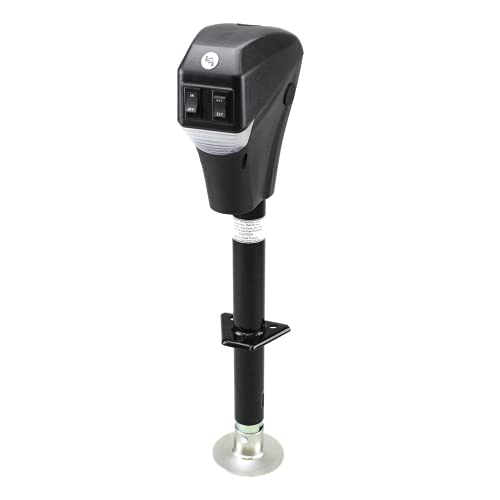
The Lippert 285318, sold as the Lippert Power Tongue Jack model 285318, replaces hand cranking with a 12V motor and push-button control. Lippert gives it a lift capacity of 3,500 lb, covering the tongue weight of many mid-size travel trailers and cargo trailers with an A-frame tongue. Power draw is listed at 30 amps, delivered through helical-cut gears the maker describes as quiet and efficient compared with straight-cut gear sets.
Stroke is 18 inches, from 10.75 inches retracted to 28.75 inches extended, giving useful range for levelling on an uneven site without stacking blocks under the foot. Four LED lights shine on the coupler area for night hookups, and the head carries a textured casing. A foot pad about 5.4 inches across is included, with mounting hardware, pins, and a hand crank for manual override if the battery goes flat.
Installation uses the standard A-frame bolt pattern, so it commonly replaces a factory crank jack in the same holes, with one power lead to the battery. Confirm your loaded tongue weight sits under the lift capacity with margin, and plan fuse protection for the 30-amp draw. It suits campers that hitch often, and is a poor match for a boat trailer with no battery on board.
Specs
- Type: A-frame tongue jack, electric
- Model: Lippert 285318
- Lift capacity: 3,500 lb
- Stroke: 18 in
- Retracted height: 10.75 in
- Extended height: 28.75 in
- Power: 12V DC, 30 amps
- Gears: Helical-cut
- Foot pad: 5.4 in diameter
- Extras: Four LED coupler lights, manual crank override, mounting hardware and pins included
3. CURT 28354 Pipe-Mount Swivel Jack — Weld-On Strength for Utility Trailers

The CURT 28354 is a side-wind swivel jack for straight-tongue trailers such as utility, landscape, and equipment trailers. Like the A-frame CURT above, it carries a support capacity of 5,000 lb and a lift capacity of 3,000 lb, so the working sizing figure is again the lift number against your loaded tongue weight. The difference is the mount: a pipe-mount bracket lets the jack swing up parallel with the tongue for towing, then swing back down and lock with a pull pin for parking and hookups.
Travel is 10 inches, from 10-1/4 inches retracted to 20-1/4 inches extended. The side-wind handle has an integrated grip, and the finish is the same black powder coat over zinc used across this CURT family. Swinging the jack up buys ground clearance a fixed jack cannot offer, helping on rutted driveways and steep approaches.
This model is weld-on only. It ships with a raw steel pipe bracket that must be welded to the frame, so fitting it calls for welding skill or a fabrication shop, and the weld becomes part of the load path every time you lift the tongue. There is no wheel and no drop leg, so carry a foot pad or solid block for soft ground, and confirm the pin is fully seated in both positions before moving the trailer. Choose it for a straight-tongue work trailer that needs a strong jack which disappears out of the way on the road.
Specs
- Type: Pipe-mount swivel tongue jack, manual side-wind
- Lift capacity: 3,000 lb
- Support capacity: 5,000 lb
- Vertical travel: 10 in
- Retracted height: 10-1/4 in
- Extended height: 20-1/4 in
- Mount: Weld-on pipe bracket, pull-pin swivel lock
- Finish: Black powder coat over zinc plating
- Handle: Side-wind with integrated grip
4. Fulton XP15 0101 Swivel Jack — Bolt-On Marine Jack for Light Trailers

The Fulton XP15 0101 is a sidewind marine jack built for boat trailers and other light trailers with a straight tongue. Fulton gives it a capacity of 1,500 lb, covering the tongue load of many small fishing boat and personal watercraft trailers. That figure should be compared with tongue weight, not with the combined weight of boat, motor, fuel, and trailer, and it rules this jack out for heavier cruisers and loaded campers, where the higher-capacity picks in this guide belong.
Travel is 10 inches, from 13 inches retracted to 23 inches extended, measured from the mounting plate center to the wheel bottom. Clearance above the plate is 12.4 inches, worth checking against a winch post before ordering. The steel body carries a Z-MAX 600 zinc finish for corrosion resistance on a trailer that backs into water most weekends.
The mount bolts to the side of the tongue with no welding, and the jack swivels up alongside the tongue for towing. An 8-inch wheel lets you roll a light trailer around a driveway by hand once it is off the ball. Keep the pivot pin rinsed and lubricated in salt use, and always swing and lock the jack before towing.
Specs
- Type: Swivel tongue jack, manual sidewind, wheeled marine style
- Model: Fulton XP15 0101
- Capacity: 1,500 lb
- Travel: 10 in
- Length retracted: 13 in, measured from mounting plate center to wheel bottom
- Length extended: 23 in, measured from mounting plate center to wheel bottom
- Mount: Bolt-on side mount for straight tongues
- Finish: Z-MAX 600 zinc
- Wheel: 8 in
5. Seachoice 50-52051 Fixed-Mount Jack — Drop Leg Reach for Taller Trailers

The Seachoice 50-52051, part number 50-52051, is a fixed-mount jack with a drop leg, aimed at trailers whose tongue sits higher than a short swivel jack can reach. Seachoice lists a maximum load of 2,500 lb and a lift figure of 28.6 inches. The drop leg explains that tall number: you pin the inner leg down near the ground first, so the screw only covers the working part of the lift instead of winding down through empty air from a high tongue.
Mounting is bolt-on with hardware included per the listing, and the bracket fits frames up to 3 by 5 inches, so measure your tongue tube first. The fixed mount stays vertical at all times, keeping the load path straight, but it hangs lower than a swivel unit while towing, so confirm ground clearance on your driveway approach and ramp first.
This jack suits a taller utility, boat, or car trailer where a 10-inch jack runs out of stroke before the coupler clears the ball. It is not the pick for a low trailer, and the 2,500 lb figure rules out heavier campers. Set the drop leg pin fully through the tube, chock the wheels, and keep the load vertical.
Specs
- Type: Fixed-mount tongue jack with drop leg, manual
- Part number: Seachoice 50-52051
- Maximum load: 2,500 lb
- Lift: 28.6 in with drop leg adjustment
- Mount: Bolt-on, fits trailer frames up to 3 x 5 in
- Hardware: Mounting hardware included per listing
- Leg: Drop leg for quick height setting before cranking
Which Tongue Jack Fits Your Trailer?
For a camper or cargo trailer with an A-frame tongue, the choice is between cranking and pushing a button. The CURT 28250 keeps things simple and battery-free with a 3,000 lb lift figure and 14-1/8 inches of travel, while the Lippert 285318 offers 3,500 lb of electric lift and an 18-inch stroke for owners who hitch often and level on uneven ground. Both share the same A-frame mounting pattern, so the decision comes down to tongue weight, travel, and whether the trailer carries a healthy battery.
For a straight-tongue utility trailer, the CURT 28354 brings the same lift and support figures in a weld-on swivel package that swings clear for towing. For a light boat trailer, the Fulton XP15 0101 bolts on without welding, resists corrosion, and rolls on its wheel for hand positioning, within its 1,500 lb limit. For a taller trailer, the Seachoice 50-52051 uses a drop leg to reach the ground quickly, within its 2,500 lb limit.
Measure the tongue, look up the loaded tongue weight, confirm the mount and frame size, and check retracted clearance. A jack matched on those points makes every hookup short and predictable.
More from Amazon
Programs that pair well with the guide above. Offers and eligibility are set by Amazon and may change.
Free shipping on eligible items, Prime Video and more. Eligible new members can start with a free trial.
Start a Prime free trialA Prime membership for ages 18-24 with a trial period. Eligibility is set by Amazon.
See Prime for Young AdultsAudiobooks and podcasts to listen to on the go. Eligible new members can start with a free trial.
Try Audible freeAd-free music streaming. Eligible new subscribers can start with a free trial.
Try Music Unlimited freeAs an Amazon Associate we earn from qualifying purchases.







Write Your Review
No reviews yet. Be the first to share your experience!