

Key takeaways
- Compare five steering wheel pullers for cars, trucks and classics, from simple bolt pullers to kits with lock plate compressors, with specs for each pick.
As an Amazon Associate we earn from qualifying purchases.
A steering wheel sits on a splined, tapered shaft, and after years of heat cycles, corrosion and one very tight retaining nut, it rarely slides off by hand. Rocking the wheel, prying behind the spokes or striking the shaft end can bend the wheel, mushroom the shaft threads or damage the column bearings. A steering wheel puller solves the problem the controlled way: two bolts thread into the tapped holes in the wheel hub, a yoke bridges across them, and a center forcing screw presses on the shaft end so the wheel walks straight off its splines with even pressure.
The five tools below cover the main shapes this job takes. Two are simple, dedicated bolt pullers built around a yoke and a handful of threaded fasteners. One is a professional pattern with a wider fastener spread for mixed fleets of domestic and import vehicles. Two are combination sets that bundle a lock plate compressor alongside the puller, which matters when the job continues past the wheel into the column itself, for a turn signal switch, an ignition lock cylinder or a cancelling cam. Each entry lists what is actually in the kit, because with pullers the fastener assortment is the product: a puller whose bolts do not match the threads in a given hub is a paperweight.
Safety first: the airbag decides the procedure
On any vehicle with an airbag in the steering wheel, the puller is the last tool that touches the column, not the first. The battery must be disconnected and the maker’s waiting period observed before the airbag module is handled, and the module must be removed, stored and reinstalled exactly as the vehicle’s service manual describes. An airbag that deploys during wheel removal can cause serious injury, and the wiring, clockspring and connectors behind the wheel are easy to damage with improvised methods. If the service manual procedure for a given vehicle is not available, or the airbag steps are unclear, the correct move is to stop and have the wheel removed by a shop that has the manual. On older cars and classics without an airbag the job is simpler, but the same discipline applies to the horn wiring and any column-mounted switches.
Two habits protect the hardware on every vehicle. Leave the retaining nut threaded loosely on the shaft while pulling, so the wheel cannot jump free when it breaks loose. And mark the wheel and shaft alignment before removal, so the wheel goes back on centered rather than one spline off.
Bolt pullers, leg pullers and lock plate tools
Most steering wheels carry two threaded holes in the hub, cast there at the factory specifically for a bolt-style puller. A bolt puller threads a matched pair of bolts into those holes, and the forcing screw does the rest. The catch is thread variety: domestic wheels from different decades use different SAE threads, imports add metric sizes, and the five sets of cap screws in a professional kit exist because no single pair covers the field.
Some later-model wheels have no threaded holes at all. Those need a leg-style puller, whose hooked legs reach behind the hub and pull on the wheel body instead. Where a kit is bolts-only, that limit is stated in its entry below, because discovering it mid-job means a second purchase.
The lock plate is a separate part with a separate tool. On tilt and telescoping columns, a spring-loaded lock plate sits under the wheel, held by a snap ring. Compressing that plate to free the ring takes a U-shaped compressor that threads onto the column, not the puller. Kits that bundle one are labelled as combination sets in this guide; a puller alone does not do that job.
1. Lisle 45000 Steering Wheel Puller

Lisle’s 45000 is the classic dedicated bolt puller, built in heavy-duty steel and sized for the way most steering wheel jobs actually go: one wheel, one column, no extra services planned. The kit is a puller frame, a forcing screw and a screw pad, plus three pairs of bolts covering the common SAE hub threads. The screw pad is the detail that earns its place. It sits between the forcing screw and the end of the steering shaft, spreading the load so the screw tip cannot chew up the shaft end or its threads while the wheel is under full pulling tension.
The bolt assortment is the working heart of the set: pairs in 3/8-16, 5/16-18 and 5/16-24 cover the threaded hub holes found across a wide span of domestic cars, trucks and older imports. Because the frame is a simple two-bolt yoke, setup is fast, and there are no legs or adapters to sort. The trade-off is scope. This is a bolts-only puller with no answer for wheels that lack threaded hub holes, and no lock plate tool for deeper column work. For a threaded-hub wheel on a car, truck or classic, it is the straightforward, durable choice, and its compact clam shell package stores flat in a tool drawer.
Specs
- Brand: Lisle
- Model: 45000
- Type: Bolt-style steering wheel puller
- Construction: Heavy-duty steel
- Includes: Puller frame, forcing screw, screw pad
- Bolts included: 2 each 3/8 in. 16T, 5/16 in. 18T, 5/16 in. 24T
- Shaft protection: Screw pad protects the end of the steering shaft
- Fitment: Most makes and models with threaded hub holes
- Packaging: Clam shell
2. OTC 7245 Steering Wheel Puller

The OTC 7245 is the professional pattern of the same idea, widened where working mechanics feel the difference: the fastener spread. Five sets of cap screws, in both standard and metric threads, ride with the cross bar and forcing screw, so the kit answers far more hub thread combinations without a trip back to the tool truck. That breadth is what separates a shop puller from a single-car tool, and it is why this pattern shows up in fleet and restoration work where the next vehicle through the door is unknown.
The forcing screw ends in a swivel tip, which serves the same protective purpose as a screw pad: the tip stays planted on the shaft end instead of rotating against it, so the shaft threads survive the pull. OTC also rates the tool for columns with or without telescoping sections, a real distinction on the tilt and telescoping columns fitted to many trucks and larger cars. Like the Lisle, this is a dedicated puller only. There is no lock plate compressor in the set, so column work beyond the wheel needs a second tool, and wheels without threaded holes are outside its design. Within its brief, it is the most complete bolt puller here.
Specs
- Brand: OTC
- Model: 7245
- Type: Bolt-style steering wheel puller
- Includes: Cross bar, forcing screw, five sets of cap screws
- Cap screws: Standard and metric thread sets
- Forcing screw: Swivel end, protects the steering shaft
- Columns: Works with or without telescoping steering columns
- Fitment: Most domestic and imported vehicles with threaded hub holes
3. OEMTOOLS 25200 Steering Wheel Puller

The OEMTOOLS 25200 is the value end of the dedicated pullers: a steel yoke, a pressure screw and three sets of pulling fasteners with washers and swivels, covering the threaded hubs of most makes and models. The layout mirrors the Lisle pattern, with the swivel hardware doing the shaft-protection work as the screw is turned down. For an owner who pulls a wheel occasionally, a wheel swap on a project truck, a horn or switch repair on a daily driver, the three fastener sets handle the common thread sizes and the steel construction shrugs off the occasional seized hub.
The limits are the same as any compact bolt puller, stated plainly. Three fastener sets cover less ground than the OTC’s five, so an unusual hub thread may fall outside the box. There are no puller legs for unthreaded wheels and no lock plate compressor. Judged as a single-purpose tool for threaded-hub wheels, it covers the job honestly and simply.
Specs
- Brand: OEMTOOLS
- Model: 25200
- Type: Bolt-style steering wheel puller
- Construction: Steel
- Includes: Yoke, pressure screw, three sets of pulling fasteners with washers and swivels
- Fitment: Most makes and models with threaded hub holes
- Lock plate tool: Not included
4. 8MILELAKE Steering Wheel Remover and Lock Plate Compressor Set
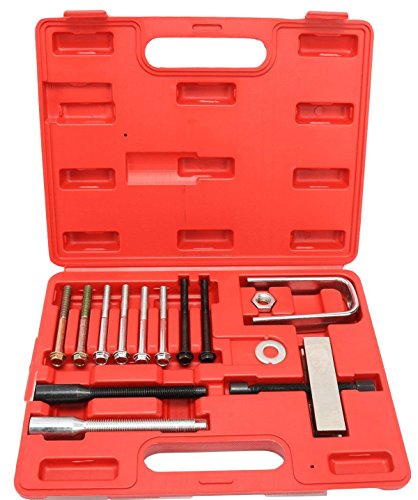
This 8MILELAKE set is a combination kit: a steering wheel puller and a lock plate compressor in one box, which makes it the pick for jobs that continue into the column. The puller side works on domestic and imported vehicles, including columns with telescoping tilt, and the bolt assortment spans SAE and metric threads so the same kit moves between an older domestic truck and a newer import car. When the wheel is off, the bundled compressor handles the next step, pressing the spring-loaded lock plate down so its snap ring can be removed for turn signal switch or lock cylinder service.
Bundling is the whole argument here, and it is a good one for classic and truck work, where a wheel pull so often turns into column service on vehicles whose switches and cylinders are decades old. The set ships in a blow-molded carrying case, which keeps the puller, compressor and loose bolts together between jobs. Buyers who only ever pull wheels pay for a compressor they may not use; buyers who service columns get both tools in one purchase and one case.
Specs
- Brand: 8MILELAKE
- Type: Steering wheel puller and lock plate compressor combination set
- Includes: Steering wheel puller with forcing screw, lock plate compressor, cap screw sets
- Bolts: SAE and metric threaded bolts included
- Columns: Includes telescoping tilt column applications
- Fitment: Domestic and imported vehicles
- Storage: Blow-molded carrying case
- Lock plate compressor: Included, bundled in the kit
5. Acymner Car Steering Wheel Puller Compressor Remover Set

The Acymner set takes the same combination approach, a steering wheel puller paired with a lock plate compressor, aimed squarely at home workshops working across a household fleet. The listing frames the kit for most cars, SUVs and light trucks, which matches where combination sets earn their keep: one tool that covers the family vehicles and the project car, including the lock plate step when a switch or bearing needs attention under the wheel. Steel construction throughout suits the loads involved, since a compressor works against a stiff plate spring and a puller against a hub that may not have moved in thirty years.
As with the 8MILELAKE, the honest framing is scope. This is a two-function kit, and its value rises with every column job beyond simple wheel removal; for a single threaded-hub wheel pull, one of the dedicated pullers above is the leaner purchase. Before ordering, the standard check applies: confirm the hub thread arrangement the target vehicle needs against the kit contents, and confirm whether the planned repair actually reaches the lock plate.
Specs
- Brand: Acymner
- Type: Steering wheel puller and lock plate compressor combination set
- Includes: Steering wheel puller, lock plate compressor remover tools
- Construction: Steel
- Fitment: Most cars, SUVs and light trucks
- Lock plate compressor: Included, bundled in the kit
How to choose among the five
Start with the vehicle, not the tool. Check the service information for the exact year and model: does the wheel hub have threaded puller holes, and which thread? A threaded hub and a wheel-only job point to a dedicated bolt puller, the Lisle 45000 for the classic three-thread spread, the OTC 7245 when metric threads or a telescoping column enter the picture, and the OEMTOOLS 25200 as the simple, steel, occasional-use version of the same pattern. An unthreaded hub rules all three out and calls for a leg-style puller instead.
Then decide how deep the job goes. If the repair continues to the turn signal switch, ignition lock cylinder or column bearings, the lock plate has to come off, and a combination set, the 8MILELAKE or the Acymner, saves a second order and a second wait. If the wheel is the whole job, a compressor in the box is dead weight. Finally, weigh storage: a fitted case keeps a many-piece kit complete over years of occasional use, while a compact clam shell puller disappears into a drawer with nothing to lose.
Whichever set is chosen, the working rules stay the same: battery disconnected and airbag handled per the service manual on equipped vehicles, retaining nut left loosely threaded while pulling, alignment marked before removal, and steady screw pressure rather than shock. A wheel that will not move under firm, even tension is giving information, usually a wrong thread, a missed retaining clip or corrosion that wants penetrating oil and patience, not a longer wrench.
Affiliate Disclosure: This article contains affiliate links. If you buy through a link on this page, the site may earn a commission at no additional cost to you.
More from Amazon
Programs that pair well with the guide above. Offers and eligibility are set by Amazon and may change.
Free shipping on eligible items, Prime Video and more. Eligible new members can start with a free trial.
Start a Prime free trialA Prime membership for ages 18-24 with a trial period. Eligibility is set by Amazon.
See Prime for Young AdultsAudiobooks and podcasts to listen to on the go. Eligible new members can start with a free trial.
Try Audible freeAd-free music streaming. Eligible new subscribers can start with a free trial.
Try Music Unlimited freeAs an Amazon Associate we earn from qualifying purchases.



Write Your Review
No reviews yet. Be the first to share your experience!