

Key takeaways
- Compare receiver pin locks and coupler locks for camping trailers, with fit by receiver class, pin size and coupler size, plus honest deterrence limits.
As an Amazon Associate we earn from qualifying purchases.
A trailer parked at a trailhead, a storage lot or the side of a house is only as secure as the two connection points a thief has to defeat: the pin that holds the ball mount inside the receiver, and the coupler that drops over the tow ball. Hitch locks address one or both points. This guide compares five locks across both jobs, with the fit details that decide whether a lock works on a given rig: receiver class and pin diameter for receiver locks, and coupler size or latch span for coupler locks.
One point needs to be stated plainly before any product is named. No hitch lock makes a trailer theft-proof. A lock delays a thief, forces noise and tools into the attempt, and makes one trailer a less attractive target than the unprotected trailer parked next to it. Given enough time and privacy, any lock in this class can be cut, drilled or pried off. The honest goal is deterrence and delay, layered with parking choices and a wheel lock where the risk justifies it. Any guide that promises more than that is overselling a piece of hardened steel.
Affiliate Disclosure: This article contains affiliate links. If a purchase is made through one of those links, the site may earn a commission at no additional cost to the reader. Product selection here is based on published manufacturer specifications and fit data, not on commissions.
The Two Jobs a Hitch Lock Does
A receiver pin lock replaces the plain pin and clip that hold a ball mount or hitch accessory inside the receiver tube. With the mount locked in, the mount cannot be slid out of the receiver, and the trailer cannot be separated from the tow vehicle at that joint without the key. Receiver locks are sized by pin diameter, which follows receiver class: smaller 1-1/4 inch receivers in Class I and Class II use a 1/2 inch pin, while 2 inch and larger receivers in Class III, Class IV and Class V use a 5/8 inch pin. Usable pin length matters on wide or heavy-duty receivers, where a standard pin may not leave enough length for the lock head to seat.
A coupler lock protects the trailer itself, in two different ways. A latch-style lock passes a small pin, usually 1/4 inch, through the hole in the coupler latch and locks it shut. Fitted while hitched, it stops the latch from being opened at a stop; fitted while parked, it keeps the latch closed but does not block the coupler socket. A ball-style lock does the opposite job: a shield seats up into the coupler socket of an unhitched trailer and locks in place, so another tow ball cannot be coupled to it. Ball-style locks are sized by coupler size, most commonly 1-7/8 inch, 2 inch or 2-5/16 inch, and they only protect a trailer parked unhitched.
Because the two jobs differ, many owners end up with one lock of each type, or a combination set. The five picks below include two dedicated receiver locks, one ball-style coupler lock, one latch-style coupler lock, and one three-piece set covering both jobs.
1. Master Lock 1469DAT Receiver Lock

The 1469DAT is a barbell-style receiver lock built around an extended-length stainless steel pin. It does the receiver job only: it locks a ball mount or accessory into the receiver so the pin cannot be pulled. The extended pin length is the detail that separates it from standard receiver locks, because heavy-duty tow packages on full-size trucks use wider receiver assemblies where a standard-length pin can leave the lock head short of seating fully. Master Lock lists fit for the heavy-duty tow packages on common full-size pickups, and the stainless construction suits a lock that lives outdoors through winter road salt and summer rain. The Push to Lock mechanism seats the lock body onto the pin with a firm push, with the key used for removal.
Specs
- Job: receiver pin lock (locks the ball mount to the receiver)
- Model: Master Lock 1469DAT
- Pin diameter: 5/8 in (16 mm)
- Receiver fit: Class III and Class IV receivers, extended length for heavy-duty tow packages
- Material: stainless steel
- Locking mechanism: Push to Lock, keyed
- Weather protection: weather-resistant design
- Warranty: limited lifetime, per the manufacturer
2. CURT 23518 Black Trailer Hitch Lock
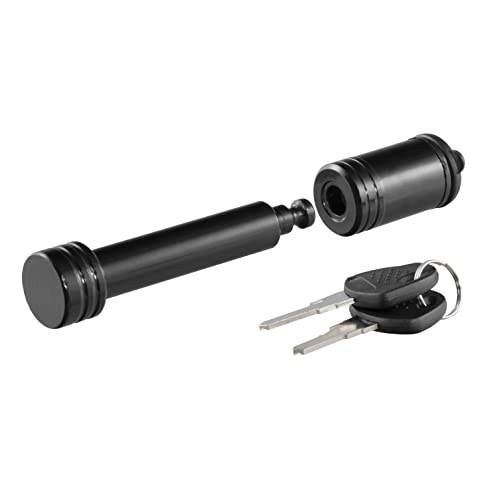
The CURT 23518 covers the same receiver job, sized for the most common towing setup on the road: a 2 inch receiver with a 5/8 inch pin hole, the standard pairing for Class III and Class IV hitches under most campers, boat trailers and utility trailers. It uses a barbell design, with the lock head on one end of the pin and a fixed head on the other, and a quarter-turn key operation. The usable pin length suits a standard 2 inch receiver tube without the extra span of an extended lock, so owners of heavy-duty 2-1/2 inch receivers should check the longer-pin options instead. A weather-tight cap over the keyway helps keep road grit and water out of the cylinder between trips.
Specs
- Job: receiver pin lock (locks the ball mount to the receiver)
- Model: CURT 23518
- Pin diameter: 5/8 in
- Receiver fit: 2 in receiver, Class III and Class IV
- Usable pin length: 2.85 in
- Design: barbell style, quarter-turn key activation
- Finish: black
- Keyway protection: weather-tight cap
3. Master Lock 379DAT Universal Coupler Lock

The 379DAT does the parked-trailer job. It is a ball-style coupler lock: the body seats into the coupler socket of an unhitched trailer and the locking shield closes over the coupler, so a tow ball cannot be inserted and the trailer cannot be coupled to a waiting vehicle. One lock adjusts to fit 1-7/8 inch and 2 inch couplers, and most 2-5/16 inch couplers, which covers the large majority of campers, boat trailers and utility trailers. The word most in the 2-5/16 inch fit matters: coupler castings vary, and fit should be confirmed on the specific coupler before relying on it. The zinc construction resists rust and corrosion, and the maker specifies a locking mechanism intended to resist picking and prying. Two keys are included. This lock does nothing for a hitched trailer; it protects the trailer while parked and unhitched, which is when trailers are most often taken.
Specs
- Job: coupler lock, ball style (blocks the coupler socket of an unhitched trailer)
- Model: Master Lock 379DAT
- Coupler fit: 1-7/8 in, 2 in, and most 2-5/16 in couplers
- Material: zinc, rust and corrosion resistant
- Locking mechanism: keyed, designed to resist picking and prying
- Keys included: 2
- Use case: parked, unhitched trailers, campers and boat trailers
4. CURT 23523 Chrome Trailer Tongue Coupler Lock

The 23523 is the latch-style entry in this guide. Its 1/4 inch pin passes through the latch hole of a latch-type coupler and the padlock-style body locks the latch closed. Fitted while towing, it guards against the latch being opened at a stop; fitted while parked, it keeps the latch shut, although it does not block the coupler socket the way a ball-style lock does. The distinguishing specification is span: this chrome version accommodates latch spans up to 3-3/8 inches, wider than the short-span latch locks in the same line, making it the version to check for couplers with broad latch castings. Owners should measure the latch span before ordering, because a latch lock with too little span will not close over the latch. Construction is high-strength steel with a chrome finish, in a compact padlock form that stores easily in a glove box or tongue box.
Specs
- Job: coupler latch lock (locks the coupler latch closed)
- Model: CURT 23523
- Pin diameter: 1/4 in
- Maximum latch span: 3-3/8 in
- Coupler type: latch-type couplers
- Material: high-strength steel
- Finish: chrome
- Locking mechanism: keyed, padlock style
5. REESE Towpower 7014700 Tow ‘N Store Lock Kit

The REESE 7014700 takes the combination approach, bundling three locks in one keyed set so a single purchase covers both jobs. The set includes a universal coupler lock for the parked trailer, a brass coupler latch lock for locking the latch while hitched or stored, and a dual bent pin receiver lock for the ball mount. The receiver pin is the flexible piece: a dual-diameter bent pin that works in both 1/2 inch and 5/8 inch pin holes, so the set fits 1-1/4 inch Class I and Class II receivers as well as 2 inch Class III and Class IV receivers. That breadth suits a household with two tow vehicles, or a small trailer and a larger camper, where receiver classes differ between rigs. The trade-off is that each lock in a bundled set is a generalist rather than the heaviest option in its category, and the universal coupler lock carries the usual caveat that fit on 2-5/16 inch couplers should be confirmed on the actual coupler. For an owner who currently has no locks at all, it closes both gaps at once.
Specs
- Job: both jobs (receiver pin lock, coupler latch lock, and universal coupler lock in one set)
- Model: REESE Towpower 7014700
- Set contents: universal coupler lock, brass coupler latch lock, dual bent pin receiver lock
- Receiver fit: 1-1/4 in and 2 in receivers
- Pin diameters: 1/2 in and 5/8 in (dual bent pin)
- Locking mechanism: keyed set
- Use case: hitched and unhitched security for mixed trailer fleets
How to Choose the Right Hitch Lock
Start by identifying which job needs doing, because a receiver lock and a coupler lock are not interchangeable. A stolen trailer is usually taken while parked and unhitched, which makes the coupler lock the first purchase for stored trailers. A receiver lock protects the hitched connection and the ball mount itself, which matters at trailheads and rest stops.
For a receiver lock, confirm the pin diameter against the receiver class: 1/2 inch for 1-1/4 inch Class I and Class II receivers, 5/8 inch for 2 inch and larger Class III, Class IV and Class V receivers. Then confirm usable pin length, especially on 2-1/2 inch and 3 inch heavy-duty receivers, where an extended pin such as the Master Lock 1469DAT above may be required for the lock head to seat. A pin that is too short is not a minor inconvenience; a lock head that cannot seat fully is a lock that is not locked.
For a coupler lock, confirm the coupler size stamped on the coupler itself, not the size of the ball on the mount. Ball-style universal locks cover 1-7/8 inch and 2 inch couplers reliably, while 2-5/16 inch fit varies by casting and should be checked. For a latch lock, measure the latch span and match it to the lock’s maximum span. Material and weather protection decide how long these locks stay usable outdoors: stainless steel and zinc constructions with capped keyways survive seasons that seize an unprotected cylinder, and a seized lock that has to be cut off protects nothing.
Finally, keep the honest framing from the top of this guide in view. A hitch lock is a deterrent layer, not a guarantee. It works best combined with parking in visible, lit places, adding a wheel lock for long-term storage, and keeping photographs and the trailer’s identification numbers on file. Against a casual thief looking for the easiest trailer in the lot, a visible coupler lock and a locked receiver pin change the calculation. Against a determined thief with power tools and privacy, they buy time and noise, and that is all any lock in this category honestly offers.
Frequently Asked Questions
Does a receiver lock replace a coupler lock?
No. A receiver lock secures the ball mount inside the receiver of the tow vehicle. A coupler lock secures the trailer’s coupler. A parked, unhitched trailer gets no protection from a receiver lock, and a hitched trailer’s mount gets no protection from a coupler lock. Many owners use both.
What pin size fits a 2 inch receiver?
A 2 inch Class III or Class IV receiver uses a 5/8 inch pin. A 1-1/4 inch Class I or Class II receiver uses a 1/2 inch pin. Heavy-duty 2-1/2 inch and 3 inch receivers also use 5/8 inch pins but need a longer usable pin length.
Will a universal coupler lock fit a 2-5/16 inch coupler?
Usually, with a caveat. Universal locks such as the Master Lock 379DAT are specified for 1-7/8 inch, 2 inch and most 2-5/16 inch couplers. Because coupler castings differ between manufacturers, the fit on a specific 2-5/16 inch coupler should be confirmed before the lock is relied on.
Can a hitch lock be cut off?
Yes. Any lock in this category can be defeated given time, privacy and cutting tools. Its purpose is to deter opportunistic theft and delay a determined attempt, not to make theft impossible.
More from Amazon
Programs that pair well with the guide above. Offers and eligibility are set by Amazon and may change.
Free shipping on eligible items, Prime Video and more. Eligible new members can start with a free trial.
Start a Prime free trialA Prime membership for ages 18-24 with a trial period. Eligibility is set by Amazon.
See Prime for Young AdultsAudiobooks and podcasts to listen to on the go. Eligible new members can start with a free trial.
Try Audible freeAd-free music streaming. Eligible new subscribers can start with a free trial.
Try Music Unlimited freeAs an Amazon Associate we earn from qualifying purchases.

Write Your Review
No reviews yet. Be the first to share your experience!