

Key takeaways
- Compare five weight distribution hitches by tongue weight, bar style and sway control type, with honest sizing guidance for level, safer towing.
As an Amazon Associate we earn from qualifying purchases.
Affiliate Disclosure: This article contains affiliate links. If you buy through a link on this page, the site may earn a commission at no additional cost to you.
A trailer that pushes the back of the tow vehicle down does more than look wrong. It unloads the front axle, which lightens steering feel, lengthens braking distances, and leaves the rig more vulnerable to sway when a truck passes or a crosswind hits. Weight distribution hitches exist to fix the geometry: spring bars lever tongue weight forward onto the front axle of the tow vehicle and back onto the trailer axles, restoring a level stance and the steering and braking control that came with it.
The five systems below cover the most common travel trailer weight bands. They differ in the ways that actually matter: the tongue weight range the bars are built for, whether the bars are round or trunnion style, and how each one handles sway — built into the head and brackets, generated by bar tension and geometry, or limited to two friction points. Read the sizing section before the product sections, because with this class of equipment the correct bar rating matters more than the badge on the head.
How to Size a Weight Distribution Hitch
Start with tongue weight, not trailer weight. Weigh the trailer loaded for a trip — water, gear, batteries, propane — and measure the tongue weight as it actually sits. The spring bars must be rated for that loaded tongue weight. Bars rated far above the real tongue weight are too stiff: they ride harshly, can stress the trailer frame, and may not transfer weight smoothly. Bars rated below it cannot restore the front axle load no matter how many chain links or bracket notches are added.
Gross trailer weight is the second check. Every system below states both figures exactly as its maker states them, and both must cover the loaded trailer. Then confirm the receiver and shank: most of these kits fit a 2-inch receiver, the shank must offer enough drop or rise to set the trailer level, and the ball size must match the coupler.
One limit deserves to be stated plainly: a weight distribution hitch does not raise the tow vehicle’s rated towing capacity, its payload rating, or the receiver’s own rating. It redistributes weight the vehicle is already rated to carry. The lowest-rated component in the chain — vehicle, receiver, hitch, ball, or coupler — remains the ceiling.
The 5 Weight Distribution Hitches
1. Equal-i-zer 4-Point Sway Control Hitch 90-00-1000

The Equal-i-zer is the reference design for integrated sway control. Its spring bars rest on L-brackets mounted to the trailer frame, and sway resistance comes from friction at four points: where the bars meet the brackets and where the bar sockets rotate in the head. Because the friction points are part of the weight distribution hardware itself, there is no separate friction bar to install, remove before reversing, or forget in the rain. Sway control on this model is built in, not an add-on.
The 90-00-1000 is the 10,000 lb tier of the line. The bars are trunnion style, which keeps the bar ends higher for better ground clearance on uneven campsite approaches than a round bar of the same rating. The kit includes the standard hitch shank; the hitch ball is not included with this part number, so the ball must be sourced to match the coupler and torqued to the maker’s specification during setup.
Specs
- Maker and model: Progress Mfg. (Equal-i-zer) 90-00-1000
- Maximum tongue weight: 1,000 lb
- Maximum gross trailer weight: 10,000 lb
- Bar style: Trunnion spring bars
- Sway control: Built in, 4-point friction at the head and frame brackets
- Shank: Standard hitch shank included, 2-inch receiver fit
- Hitch ball: Not included
2. Blue Ox SwayPro BXW1000

The SwayPro takes a different approach to sway: prevention through geometry and bar tension rather than friction alone. Its spring bars load into a head with built-in caster, so the bars constantly work to hold the trailer centred behind the tow vehicle instead of only resisting sway after it starts. Rotating latches clamp the bar chains under tension, which makes hookup repeatable — the same latch position gives the same bar load every time, with no counting of chain links.
The BXW1000 carries the line’s 1,000 lb tongue weight bars, and the listing states 10,000 lb maximum towing for this configuration. The head is built for a standard coupler mounted on top of the trailer frame, and the 7-hole shank gives a useful range of height adjustment for levelling. Spring bars are identified by a dot system stamped on the bar end, which makes it easy to confirm the fitted bars match the rating ordered. This listing is for the hitch with a standard coupler head; confirm ball fitment for the coupler before ordering, as ball configuration varies across SwayPro listings.
Specs
- Maker and model: Blue Ox SwayPro BXW1000
- Maximum tongue weight: 1,000 lb
- Maximum gross trailer weight: 10,000 lb as stated in the listing title
- Bar style: Spring bars with rotating-latch tensioning
- Sway control: Built in, caster head geometry and bar tension
- Shank: 7-hole shank, 2-inch receiver fit
- Coupler fit: Standard coupler welded on top of the frame
3. CURT TruTrack 4P Weight Distribution Hitch 17500
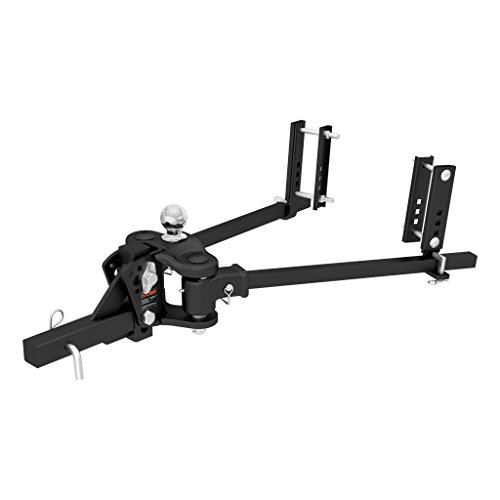
CURT’s TruTrack 4P pairs trunnion spring bars with an integrated four-point sway control system: friction at the head and at the trailer brackets, in the same layout philosophy as the Equal-i-zer, with CURT’s own head casting and a spring-loaded adjustment mechanism that keeps bar tension consistent as conditions change. Like the Equal-i-zer, sway control here is fully built in, with nothing extra to attach or remove when backing into a site.
The 17500 is rated up to 10,000 lb gross trailer weight with up to 1,000 lb of tongue weight. Trunnion bars keep the working hardware tucked higher than round bars, and the kit arrives more complete than most: the 2-5/16-inch ball is included and the 2-inch shank is in the box, so setup can begin without a second order. The head offers tilt adjustment for dialling in the amount of weight transfer during the initial setup measurements.
Specs
- Maker and model: CURT TruTrack 4P, model 17500
- Maximum tongue weight: 1,000 lb
- Maximum gross trailer weight: 10,000 lb
- Bar style: Trunnion spring bars
- Sway control: Built in, 4-point friction system
- Shank: 2-inch shank included
- Hitch ball: 2-5/16-inch ball included
4. Husky Center Line TS 32217

The Center Line TS is the lighter-trailer option in this group, and its rating band is its defining feature: the 32217 is built for tongue weights from 600 to 800 lb and trailers up to 8,000 lb. That narrower band is a virtue when the trailer genuinely sits in it, because the bars are sized closer to the load instead of being a heavier bar detuned. Owners of mid-size travel trailers are the audience; heavier trailers belong on the 1,000 lb class systems above.
Sway control is built in and friction-based: the trunnion bars bear against the head and the frame brackets, generating resistance at the contact points whenever the trailer tries to pivot. There is no separate sway bar. The kit includes the 2-5/16-inch ball, and the whole assembly is noticeably more compact than the older Center Line HD design it descends from, which helps on trailers with limited frame space around the coupler.
Specs
- Maker and model: Husky Center Line TS, model 32217
- Tongue weight range: 600 to 800 lb
- Maximum gross trailer weight: 8,000 lb
- Bar style: Trunnion spring bars
- Sway control: Built in, friction at the head and brackets
- Hitch ball: 2-5/16-inch ball included
5. Fastway e2 2-Point Sway Control Round Bar Hitch 94-00-1061
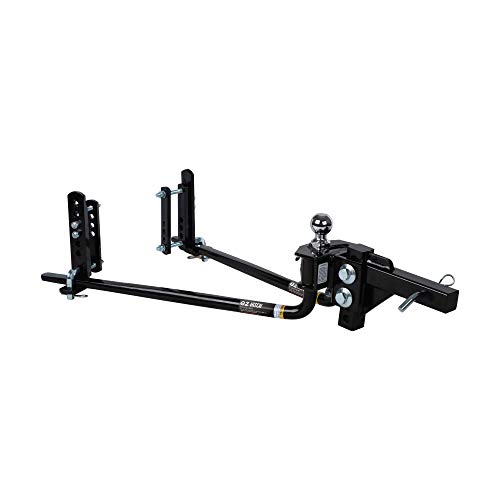
The e2 is built by Progress Mfg., the same company behind the Equal-i-zer, and it simplifies the formula. Sway control comes from friction at two points — where the spring bars rest on their frame brackets — rather than four. That is less sway resistance than the 4-point systems above, stated plainly, but it is still built into the hardware full time, with no separate friction bar to manage. For trailers that are well balanced and towed by a vehicle with capacity in reserve, two-point control is a reasonable trade for a simpler, lighter setup.
This is the round bar version, rated at 1,000 lb tongue weight and 10,000 lb trailer weight. Round bars hang lower than trunnion bars, which is worth remembering for steep driveway aprons and rough access tracks; in exchange, the round bar e2 is straightforward to set up, with L-brackets that do not require drilling the frame. The 94-00-1061 kit includes the standard hitch shank and a pre-installed 2-5/16-inch ball, so it is complete out of the box.
Specs
- Maker and model: Fastway (Progress Mfg.) e2, model 94-00-1061
- Maximum tongue weight: 1,000 lb
- Maximum gross trailer weight: 10,000 lb
- Bar style: Round spring bars
- Sway control: Built in, 2-point friction at the frame brackets
- Shank: Standard hitch shank included
- Hitch ball: 2-5/16-inch ball pre-installed
Round Bars vs Trunnion Bars
Round bars curve down from the head and are held up by chains; trunnion bars slide into the head from below and sit flatter. In practice the differences are clearance and hardware style. Trunnion bars keep more ground clearance under the head and are the default on the integrated 4-point systems. Round bars are simple, widely understood, and work well where clearance is not tight — but the bar ends and chains hang lower, which matters on rutted approaches to campsites. Neither style distributes weight better by itself; the bar rating and the setup determine that.
Setup Honesty: What Actually Makes Towing Safer
Every maker of the systems above publishes a setup procedure built around measurements: front fender height uncoupled, coupled without bars, and coupled with bars engaged. The target is to return a defined share of the lost front-axle height, not to crank the bars until the rig looks level by eye. A trailer can sit visually level with the front axle still underloaded, and an over-tensioned hitch can make the combination nervous in crosswinds. Measure, adjust, and re-measure after the first loaded trip, because springs and brackets settle.
Bar sizing is the decision that matters most. A 1,000 lb bar set on a trailer with 650 lb of loaded tongue weight will ride harshly and transfer weight abruptly; a 600 lb bar set under 900 lb of tongue weight will never restore the front axle. Match the bars to the measured tongue weight first, then choose among the systems that offer that rating based on sway control type and clearance.
Finally, the safety note on recalls: each model in this article was checked against the federal SaferProducts.gov recall database by model and product name before inclusion, and none of the five systems appears in a recall record. That check is worth repeating for any used hitch bought second-hand, where an older production run — not the current model — is what changes hands.
More from Amazon
Programs that pair well with the guide above. Offers and eligibility are set by Amazon and may change.
Free shipping on eligible items, Prime Video and more. Eligible new members can start with a free trial.
Start a Prime free trialA Prime membership for ages 18-24 with a trial period. Eligibility is set by Amazon.
See Prime for Young AdultsAudiobooks and podcasts to listen to on the go. Eligible new members can start with a free trial.
Try Audible freeAd-free music streaming. Eligible new subscribers can start with a free trial.
Try Music Unlimited freeAs an Amazon Associate we earn from qualifying purchases.







Write Your Review
No reviews yet. Be the first to share your experience!