

Our Short List of 3

- Material: Rubber, from 100 percent recycled material
- Foot size: 1 x 1 inch
- Height of lift: 1/2 inch
- Pack count: 32 feet (elevates up to 8 planters)

- Material: Rubber, from 100 percent recycled material
- Foot size: 2 x 2 inches
- Height of lift: 3/4 inch
- Pack count: 6 risers (elevates up to 2 large planters)

- Material: Plastic, terra-cotta color
- Shape: Slide-under toes with interlocking stacking grooves
- Height of lift: Low-profile toe (maker does not state a figure)
- Pack count: 12
All 4 Picks at a Glance
| Product | Specs | Action |
|---|---|---|
| 1. POTRISERS Standard Size Pot Feet, 32 Pack |
| Check price on Amazon |
| 2. POTRISERS Large Pot Feet, 6 Pack (PR2-6) |
| Check price on Amazon |
| 3. Bosmere Pot Toes, Terra Cotta, Pack of 12 |
| Check price on Amazon |
 4. The Garden Gecko Invisible Pot Feet, 24 Pack |
| Check price on Amazon |
Key takeaways
- Lift planters off decks and patios with the best pot feet and risers: rubber, plastic and resin picks for drainage, airflow and stain-free surfaces.
As an Amazon Associate we earn from qualifying purchases.
A pot that sits flat on a deck or patio is quietly doing damage in both directions. Water that drains out of the base has nowhere to go, so it pools under the pot, keeps the mix at the bottom permanently wet, and leaves a dark ring on wood, a white mineral stain on stone, and a rust mark on metal stands. In winter the same trapped moisture is what splits clay pots: water held against the base freezes, expands, and cracks the pot from the bottom up. Pot feet solve this with the simplest possible mechanism — they lift the pot a fraction of an inch so air can move underneath, drainage water can escape, and the surface below can dry between waterings.
Two honest limits need stating before any product list. First, pot feet only help if the pot’s drainage hole stays clear; a foot lifts the base, but a hole blocked by compacted mix, roots or a shard of crock still holds water inside the pot, and no riser fixes overwatering from above. Feet prevent deck staining and reduce frost-crack risk — they do not rescue a plant that is being watered too often. Second, every load figure quoted below assumes the pot’s weight is spread evenly across the feet on hard, level ground. A heavy planter resting on three feet on soft soil or gravel will not behave like the same planter on a concrete patio.
This guide covers feet and risers only: the small blocks, toes and pads that slip under a pot’s base. It does not cover plant caddies on wheels, which move pots rather than simply lifting them, and it does not cover saucers, which catch water instead of letting it drain away. The five picks below span recycled rubber, EPDM rubber, plastic and decorative resin, from invisible low-profile pads to feet that are meant to be seen.
Affiliate Disclosure: This article contains affiliate links. If you buy through them, we may earn a commission at no extra cost to you. We only list products with verifiable manufacturer specifications.
How Many Feet Does a Pot Need?
Three feet support most round pots, and a three-point arrangement has a real advantage: it is self-leveling on slightly uneven ground, so the pot does not rock. Four feet suit square planters, long troughs and window boxes, where a three-point layout can leave a long base flexing or a corner unsupported. Very large planters may need five or six feet spread around the rim.
Placement matters as much as count. Feet belong near the outer edge of the base, under the wall of the pot where the structure is strongest — not clustered near the drainage hole, where they can partly block it and where the base of a cheap plastic pot may bow under load. Space them evenly, check the pot sits level, and re-check after the first heavy watering, when wet mix can double the load and settle the pot slightly.
1. POTRISERS Standard Size Pot Feet, 32 Pack
- Material: Rubber, from 100 percent recycled material
- Foot size: 1 x 1 inch
- Height of lift: 1/2 inch
- Pack count: 32 feet (elevates up to 8 planters)
POTRISERS is the name most associated with this category, and the Standard 32-pack is the bulk workhorse: thirty-two small square feet, enough for eight planters at four feet per pot. Each foot measures 1 inch square and lifts the pot 1/2 inch, which is enough clearance for drainage water to run out and air to circulate, while staying effectively invisible under the base. The feet are cut from 100 percent recycled rubberized material, made in the USA and Canada, and the rubber grips the surface below instead of skating on it, which also makes them useful inside a saucer to keep a pot base up out of standing water.
The maker’s strength figure is stated precisely: four Standard risers support up to 1,600 lb, and the maker notes the design was strength-tested in a university engineering laboratory. Treat that the way all such figures should be treated — as an even-load number on hard ground — but for ordinary small and medium pots it leaves a wide margin. The honest trade-offs are size and lift: a 1 inch foot is fiddly to position under an already heavy planted pot, and 1/2 inch of clearance is the minimum end of the range, so pots on rough stone may need the feet stacked or a taller riser instead.
2. POTRISERS Large Pot Feet, 6 Pack (PR2-6)
- Material: Rubber, from 100 percent recycled material
- Foot size: 2 x 2 inches
- Height of lift: 3/4 inch
- Pack count: 6 risers (elevates up to 2 large planters)
The Large POTRISERS are the same recycled-rubber idea scaled up for the planters that actually threaten a deck: big glazed pots, half-barrel planters and garden statuary. Each riser measures 2 x 2 inches and lifts 3/4 inch, and the pack of six covers up to two large planters at three risers each. The maker’s stated figure is that three Large risers support up to 9,000 lb — again an even-load laboratory number, but it underlines that these are built for genuinely heavy containers.
The extra 1/4 inch of lift over the Standard size matters more than it sounds. On decking, a 3/4 inch gap lets a hose or brush pass underneath for cleaning, and keeps the pot base clear of shallow puddles after rain. The limitation is the pack size: six pieces disappear fast if you own several large planters, and the low profile means these remain a purely functional choice — they are designed to disappear, not to decorate.
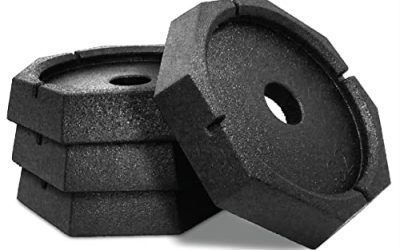
3. Bosmere Pot Toes, Terra Cotta, Pack of 12
- Material: Plastic, terra-cotta color
- Shape: Slide-under toes with interlocking stacking grooves
- Height of lift: Low-profile toe (maker does not state a figure)
- Pack count: 12
Bosmere’s Pot Toes take a different approach to the hardest part of fitting pot feet: getting them under a pot that is already planted and heavy. Instead of flat pads that need the pot lifted or tilted, each toe is a shaped plastic wedge that slides under the edge of the base from the side. The interlocking grooves let toes stack, so the same pack can level a pot sitting on uneven paving, and the terra-cotta color is chosen to blend with clay pots rather than disappear entirely. The maker rates the toes for pots and planters of any shape up to 500 lb, and the toes can be trimmed to tuck further under smaller bases.
Plastic is the honest compromise here. It will not grip a smooth floor the way rubber does, and it carries a specific cold-weather warning: owners in cold climates report the plastic can crack in extreme cold, so in regions with hard winters the toes are best lifted out and stored with the pots rather than left loaded under a frozen planter. Terracotta-colored plastic also does not age like clay — expect the color to fade in strong sun over a few seasons. In mild climates, on patios where pots are already in place, the slide-under design is the easiest of the five to fit.
4. The Garden Gecko Invisible Pot Feet, 24 Pack
- Material: Solid EPDM rubber
- Foot size: About 1.9 inches diameter
- Height of lift: About 0.55 inch
- Pack count: 24 feet, plus 24 self-adhesive pads
The Garden Gecko’s feet are solid EPDM rubber discs, about 1.9 inches across and roughly 0.55 inch thick, sold as a 24 pack with 24 strong self-adhesive pads included. The adhesive pads are the distinguishing feature: stuck to the top of each foot, they stop the foot from being left behind or kicked out of position when a pot is nudged or dragged slightly, which is the common failure of loose pads on smooth patios. The textured EPDM surface grips the ground, the maker states the feet were tested with 100 kg, and the listed maximum weight recommendation is 200 kg.
EPDM is a sound material choice for this job — it is the rubber family used for outdoor seals, so it resists compression and weather better than foam pads, which flatten permanently under a heavy pot. Two honest caveats apply. New rubber feet often carry a noticeable rubber smell for the first days outdoors, and black rubber can leave marks on pale, porous stone such as quartzite or light marble indoors; on light indoor surfaces, test one foot in an inconspicuous spot or place a pad underneath.
5. DTSFHTDAL Animal-Shaped Resin Pot Feet, Turtle, 3 Pack
Every other pick in this guide tries to hide. This one does the opposite: three turtle-shaped resin feet that hold a pot visibly off the ground and are meant to be part of the display. Resin is a sensible decorative material — it does not rot, rust or absorb water the way unglazed clay does, and the seller describes the feet as weather-resistant for indoor and outdoor use. A set of three is exactly one pot’s worth, arranged in the stable tripod layout described above.
The honesty notes for this pick are about what is not published. The seller does not state a load rating or a precise lift height for these feet, so they should be treated as feet for ordinary decorative pots, not for the heaviest planters in the garden — if a container needs two people to move it, choose the rubber risers above instead. The hand-finished painted surface can also wear or chip over time outdoors, which matters more on a foot bought for its looks than on one bought to disappear. As a gift-style accent for a favorite pot by a door or on a porch, though, it does a job none of the invisible pads attempt.
Specs
- Material: Resin
- Design: Turtle-shaped decorative feet
- Height of lift: Not published by the seller
- Pack count: 3 feet (one pot)
- Stated load rating: Not published by the seller
- Best for: Decorative pots where the feet are part of the display
- Use: Indoor and outdoor
How to Choose: Material, Load and Winter
Material decides how a foot ages. Solid rubber and EPDM resist compression, grip smooth floors and shrug off weather, but can smell when new and can mark pale stone. Recycled rubber adds a sustainability argument and, in the POTRISERS case, published laboratory strength testing. Plastic toes are the easiest to fit under planted pots and the easiest to trim, but plastic embrittles with cold and UV. Resin feet are decorative first and functional second. Real clay and terracotta feet exist too, and they match clay pots beautifully — but remember the framing from the introduction: terracotta feet can crack in freeze-thaw cycles exactly like the pots they lift, because the same porous clay drinks the same water. In cold-winter regions, glazed, resin or rubber feet are the safer year-round choice, and any pot valuable enough to protect deserves to be checked before the first hard freeze.
Load ratings deserve a skeptical read across the whole category. The numbers are real but conditional: they assume the weight is shared evenly by the stated number of feet, on a hard, flat surface, with the feet placed under the strong outer wall of the base. Halve your confidence on gravel, soil or decking with wide gaps, and never judge by the weight of the dry pot — a large planter full of wet mix after rain is the load the feet actually carry.
Finally, fit the lift to the job. Half an inch is enough for drainage and stain prevention on a smooth patio. On rough stone, sloped ground or anywhere you want to sweep or hose underneath, 3/4 inch or stackable feet earn their keep. Count your pots before choosing a pack size — three feet per round pot, four per trough — and keep a few spares, because the one thing every type of pot foot has in common is that they are small, dark, and remarkably easy to lose in a garden bed.
More from Amazon
Programs that pair well with the guide above. Offers and eligibility are set by Amazon and may change.
Free shipping on eligible items, Prime Video and more. Eligible new members can start with a free trial.
Start a Prime free trialA Prime membership for ages 18-24 with a trial period. Eligibility is set by Amazon.
See Prime for Young AdultsAudiobooks and podcasts to listen to on the go. Eligible new members can start with a free trial.
Try Audible freeAd-free music streaming. Eligible new subscribers can start with a free trial.
Try Music Unlimited freeAs an Amazon Associate we earn from qualifying purchases.
Write Your Review
No reviews yet. Be the first to share your experience!