

Our Short List of 3

- Plate: 8 × 8 in
- Total weight: 14 lb
- Handle: steel, 48 in
- Plate material: steel, welded construction
- Plate: 8 × 8 in
- Total weight: about 13 lb
- Handle: steel, 48 in
- Plate material: steel

- Plate: 8 × 8 in
- Total weight: about 10.5 lb
- Handle: steel; 43.5 in overall tool length
- Plate material: steel
All 4 Picks at a Glance
| Product | Specs | Action |
|---|---|---|
| 1. Truper Tru Pro 48 in. Steel Tamper — Best All-Round 8 × 8 |
| Check price on Amazon |
| 3. Bon Tool 22-801 Dirt Tamper — Pro Masonry Pick |
| Check price on Amazon |
| 4. Razor-Back 30004 All-Steel Tamper — Best for Tight Spots and Post Holes |
| Check price on Amazon |
 5. Kraft Tool CC929 Cast Iron Dirt Tamper — Heaviest Hitter |
| Check price on Amazon |
Key takeaways
- Compare five hand tampers on plate size, total weight and handle material, plus lift-by-lift technique for compacting soil, gravel and paver bases.
As an Amazon Associate we earn from qualifying purchases.
A hand tamper is the simplest compaction tool there is: a heavy flat plate on a long handle, lifted and dropped until loose material locks together. It is also the most misused. Spread a thick layer of gravel, bounce a tamper across the top, and the surface looks finished while the bottom stays loose — the pavers laid over it will rock and settle within a season. Used properly, in thin layers, a hand tamper builds a base that stays put for years, and it reaches the corners, edges and post holes that no machine can. The five tampers below are all manual steel or cast iron models. What separates them is plate size, total weight, and handle material — the three things that decide how much force each blow delivers and how punished your hands and shoulders feel by the end of the job.
Affiliate Disclosure: This article contains affiliate links. If you buy through them, we may earn a commission at no extra cost to you. Products were chosen on plate size, weight and handle construction, not on commission.
How to Choose a Hand Tamper
Work in thin lifts — that rule matters more than the tool. A hand tamper only compacts the top few inches of material. Fill and tamp in lifts of about 2 to 3 inches of gravel or soil at a time, then add the next layer. A 6-inch paver base is three passes, not one. Slightly damp material compacts far better than dust-dry or muddy material, because the moisture lets particles slide against each other and lock. Overlap each blow by roughly half a plate width and work in a grid, edges first, so no loose strip survives along a foundation or form board where settling always starts.
Plate size trades force against coverage. The same arm strength drives every blow; a smaller 8 × 8 inch plate concentrates that force onto less area and bites deeper into dense gravel and clay, while a 10 × 10 inch plate spreads it out, covers open ground faster, and is better for levelling softer soil without punching holes in it. Match the plate to the material: small plate for hard, stubborn base; large plate for broad, softer work.
Weight is the engine — and the workload. A hand tamper has no motor. Its compaction force is its mass plus whatever you add on the downstroke, which is why these tools run from about 10 to 20 pounds. Heavier genuinely compacts better per blow. It also means you lift that full weight hundreds of times in a session, so the heaviest tamper is only the right choice if your arms can keep its blows consistent to the last corner. A lighter tool swung all afternoon beats a heavy one that gets sloppy after twenty minutes.
Handle material decides how the day feels. Steel handles are the strongest and transmit the most shock straight into your hands and elbows; a rubber grip softens that noticeably. Hardwood flexes slightly and absorbs vibration better than steel, at the cost of a handle that can eventually split or loosen in its socket. Fiberglass sits between the two. Handle length matters too: around 48 inches lets most people work standing upright, while a shorter handle gives more control in trenches and around posts but asks more of your back.
Know when to rent the machine instead. Honesty about scope: a hand tamper is the right tool for paver patios, walkways, shed pads, fence post backfill, trench lines and patch repairs. For a full driveway base, a large slab pad, or any area much beyond a hundred square feet of deep base, a rented plate compactor does in an hour what would take days by hand and compacts deeper than arms can. Buy the hand tamper for the detail work either way — even machine-compacted jobs need one along walls and corners.
The 5 Best Hand Tampers for Soil, Gravel and Paver Bases
1. Truper Tru Pro 48 in. Steel Tamper — Best All-Round 8 × 8
- Plate: 8 × 8 in
- Total weight: 14 lb
- Handle: steel, 48 in
- Plate material: steel, welded construction
The Tru Pro (model 34387) is the tamper that shows up on professional crews and in rental fleets, and it is built like it expects that life: an 8 × 8 inch steel plate welded to a 48-inch steel handle, with no wood to split and no socket to work loose. At 14 pounds it sits at the heavy end of the 8 × 8 class, so each blow lands with real authority on crushed gravel base, yet it is still manageable for a full session of lift-by-lift work. The all-steel build is the point — this is the tamper to leave in a truck bed or barn corner without worrying about the handle. The trade-off is shock: a steel handle sends more of every impact back into your hands than wood does, so gloves with padded palms are close to mandatory on long jobs.
2. Walensee Steel Tamper 10 × 10 — Best for Coverage and Levelling
Walensee’s tamper takes the opposite approach to the Truper: a wider 10 × 10 inch steel plate on a 48-inch steel handle, at a lighter 12.4 pounds total. The bigger footprint bridges over soft spots instead of punching into them, which makes it the best leveller here for topsoil, sand bedding layers and finished-grade work, and the maker also rates it for tamping blacktop patch repairs. The rubber grip on the handle is a genuine comfort upgrade over bare steel during repetitive work. What the wide plate cannot do is match an 8 × 8 for force per blow on hard, dense base — on stubborn crusher-run gravel you will feel the difference and need more passes. For patios, walkways and garden paths in ordinary soil, though, the coverage and the lighter swing win.
Specs
- Plate: 10 × 10 in
- Total weight: 12.4 lb
- Handle: steel, 48 in, with rubber grip
- Plate material: steel
- Best use: levelling soil and sand bedding, paver fields, blacktop patch repair
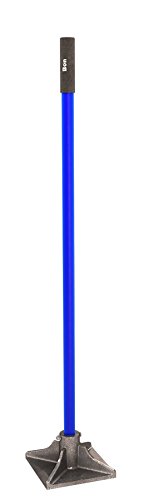
3. Bon Tool 22-801 Dirt Tamper — Pro Masonry Pick
- Plate: 8 × 8 in
- Total weight: about 13 lb
- Handle: steel, 48 in
- Plate material: steel
Bon Tool sells to the masonry and concrete trades, and the 22-801 is its standard dirt tamper: an 8 × 8 inch steel plate on a 48-inch steel handle, built for daily site work rather than occasional weekends. It is a plain tool in the best sense — thick plate, clean welds, nothing decorative — and that plainness is why it survives being thrown in a gang box for years. At roughly 13 pounds it lands a fraction lighter than the Truper, which some users will prefer across a long day of base prep, and the 8 × 8 footprint concentrates force well for compacting around forms, footings and slab edges where a plate compactor cannot reach. There is no grip cushioning, so it shares the all-steel shock trade-off: bring gloves.
4. Razor-Back 30004 All-Steel Tamper — Best for Tight Spots and Post Holes
- Plate: 8 × 8 in
- Total weight: about 10.5 lb
- Handle: steel; 43.5 in overall tool length
- Plate material: steel
The Razor-Back 30004 shrinks the formula: the same 8 × 8 inch steel plate, but an all-steel build only 43.5 inches long overall and around 10.5 pounds. That shorter, lighter package is noticeably easier to control in a trench, between fence posts, or inside a form where a 48-inch handle keeps hitting things — and tamping backfill around a post is exactly the job where control matters more than coverage. It is also the friendliest pick here for smaller users or anyone whose shoulders object to a heavier tool. The limits are honest ones: less mass means less compaction per blow, so on deep gravel base you will work more lifts and more passes, and the shorter handle means more bending on open ground. As a detail and utility tamper, though, it earns its place next to a bigger tool rather than instead of one.
5. Kraft Tool CC929 Cast Iron Dirt Tamper — Heaviest Hitter
- Plate: 10 × 10 in
- Total weight: about 20 lb (17 lb head)
- Handle: hardwood, 48 in
- Plate material: cast iron
The CC929 is the heavyweight of this group: a 10 × 10 inch cast iron head that alone weighs 17 pounds, mounted on a 48-inch hardwood handle, for roughly 20 pounds all in. Cast iron puts more mass in the plate than a fabricated steel plate of the same size, and the result is the hardest-hitting hand tamper here — the one to reach for on stubborn clay, compacted fill, and the strip right against a foundation where settling does the most damage. Kraft, another trade supplier, builds it as a finishing and detail tool for exactly those tight, high-force spots. The hardwood handle is the comfort choice, absorbing shock that the steel-handled picks pass on, though wood needs a dry storage spot and an occasional check of the head fixing. Twenty pounds is real work: this is a tool for short, deliberate sessions, not all-day swinging.
Technique Notes That Save a Base
Test as you go. A properly compacted lift sounds and feels different — the plate lands with a dull, solid thud instead of a hollow bounce, and a boot heel twisted on the surface leaves barely a mark. Check every lift, not just the last one, because a soft layer buried under good ones will still settle later.
Mind the edges. Bases fail at borders first. Spend extra passes along walls, edging and forms, and tamp the strip where a machine-compacted field meets a hand-tamped corner especially carefully — that seam is where pavers tip.
Protect yourself, not just the work. Steel-toe boots are not optional around a 14-to-20-pound plate, and padded gloves make the difference between finishing the job and quitting with numb hands. Lift the tamper with your legs, keep blows vertical rather than swung, and stop when your form gets sloppy — tired blows compact unevenly, which is worse than a shorter session.
Store it dry and check the head. Wipe soil off the plate before it hardens on, keep wood handles out of the weather, and check welds and head fixings at the start of each season. A hand tamper has almost nothing to go wrong with it, which is exactly why the ones above last for decades when they are put away clean.
More from Amazon
Programs that pair well with the guide above. Offers and eligibility are set by Amazon and may change.
Free shipping on eligible items, Prime Video and more. Eligible new members can start with a free trial.
Start a Prime free trialA Prime membership for ages 18-24 with a trial period. Eligibility is set by Amazon.
See Prime for Young AdultsAudiobooks and podcasts to listen to on the go. Eligible new members can start with a free trial.
Try Audible freeAd-free music streaming. Eligible new subscribers can start with a free trial.
Try Music Unlimited freeAs an Amazon Associate we earn from qualifying purchases.

Write Your Review
No reviews yet. Be the first to share your experience!