

Key takeaways
- Compare the best boning knives for deer, fish and meat processing, from stiff blades for joints to flexible blades for silver skin and poultry.
As an Amazon Associate we earn from qualifying purchases.
A boning knife earns its place at the processing table by doing the work a fillet knife cannot. Around a deer shoulder, a knee joint, or the rib cage of a hog, the blade has to push through cartilage, lever against bone, and hold its line when the cut gets heavy. A fillet knife is built for the opposite job: long, thin, and whippy, sliding along a fish’s spine and under skin where there is nothing hard to push against. Swap the two and both jobs go badly. The fillet blade folds and skates on a joint; the boning blade tears a fillet instead of gliding through it. This guide covers boning profiles only — stiff, semi-stiff, and flexible — for hunters breaking down deer, anglers who also trim red meat and poultry, and anyone processing whole animals or large cuts at home.
Affiliate Disclosure: This article contains affiliate links. If you buy through a link on this page, we may earn a commission at no extra cost to you. That is how the site is funded, and it does not change which products are listed here.
Flex Class Decides the Task
The single most important choice in a boning knife is how much the blade bends, because flex decides what the knife can actually do.
A stiff blade barely bends. That rigidity is what you want for deer joints, beef work, and separating large primals: the blade goes where your hand points it, it can lever through connective tissue at a joint, and it will not deflect off a bone and wander into good meat. The trade-off is that a stiff blade cannot follow a curved bone closely, so it leaves more meat behind on ribs and shanks.
A flexible blade bends along its whole length. It is the right tool for poultry, for trimming silver skin off a loin or a fish, and for working around small, curved bones where the blade has to wrap the contour. Push a flexible blade into a deer knee joint, though, and it will flex away from the cut instead of driving through it.
Semi-stiff and semi-flexible blades sit between the two and are the honest all-rounders: enough backbone to quarter a deer, enough give to trim a tenderloin cleanly. Most home processors who own one boning knife should start in this middle band, then add a stiff or flexible specialist later if a specific job keeps coming up short.
Blade shape matters second. A curved blade keeps more edge in contact when you draw the knife along a bone, which is why curved profiles dominate in commercial plants. A straight blade is easier to control for joint work and simpler to sharpen evenly. Neither is wrong; they suit different hands and different habits.
Steel, Edges, and the Mid-Animal Steel
Boning knives live a hard life. The edge hits bone, cartilage, cutting boards, and frozen spots, sometimes all in the same animal. Two things follow from that. First, edge retention on budget steel is limited: expect to stop and steel the blade partway through a deer, not as a sign of failure but as normal maintenance for this class of knife. A few passes on a honing steel realigns the edge and takes seconds; a knife that needs a full resharpening mid-animal is the wrong knife or a neglected one. Second, steel that is slightly softer and easier to steel back is often more practical at a processing table than a very hard blade that chips on bone and takes an hour on stones to restore.
Grip is the last deciding factor, and it outranks appearance every time. Processing work is wet work — hands and handles end up slick with water, fat, and blood. A textured synthetic handle that locks into a wet palm is a safety feature, not a cosmetic choice. Smooth polished wood and glossy handles look better on a counter and behave worse on a cold garage table at the end of a long evening. Every knife below was picked with that order of priorities: flex class first, steel second, wet grip third.
The Five Boning Knives Compared
1. Victorinox Fibrox Pro 6-Inch Curved Boning Knife, Semi-Stiff

The Fibrox Pro is the default recommendation in this class, and the semi-stiff curved version is the one to buy for mixed game work. The curved blade follows a rib cage or a leg bone in long drawing strokes, and the semi-stiff flex gives it enough spine to work through a shoulder without the blade folding away. The Fibrox handle is the real reason this knife shows up in so many processing kits: the textured thermoplastic grip stays put in a wet, greasy hand, it rinses clean, and it does not absorb anything. For a hunter who quarters two or three deer a season and trims store-bought primals the rest of the year, this is the balanced middle of the lineup.
Specs
- Blade length: 6 inches
- Blade shape: Curved, narrow profile
- Flex class: Semi-stiff
- Steel: High-carbon stainless steel
- Hardness: Not stated in the listing data
- Handle: Fibrox Pro thermoplastic elastomer, textured for wet grip
- Sheath: Not included
- Certification: NSF certified; made in Switzerland
2. Mercer Culinary Millennia 6-Inch Stiff Boning Knife

This is the stiff end of the lineup, built for the cuts the flexible knives cannot make. The Millennia’s rigid 6-inch blade drives straight through the connective tissue at a deer knee or hock joint and holds its line when you separate a beef primal, where a bendy blade would deflect and scallop the meat. The blade is a wider boning profile than the curved knives here, which adds control on flat, heavy cuts. The handle blends Santoprene over polypropylene with textured finger points, a commercial-kitchen design meant to stay grippy with wet hands through a full shift. If your processing is mostly deer, hogs, and beef — and poultry rarely — this is the class of blade to start with.
Specs
- Blade length: 6 inches
- Blade shape: Straight, wide boning profile
- Flex class: Stiff
- Steel: High-carbon, stain-free Japanese steel
- Hardness: Not stated in the listing data
- Handle: Santoprene and polypropylene, black, textured finger points
- Sheath: Not included
- Certification: NSF certified
3. Dexter-Russell Sani-Safe 6-Inch Curved Boning Knife

Dexter-Russell has supplied commercial meat plants for generations, and the Sani-Safe line is that world in a single knife: a curved 6-inch blade in the company’s proprietary DEXSTEEL high-carbon steel, with a plain white polypropylene handle that can be scrubbed, sanitized, and put straight back to work. The flex sits in the semi-flexible band — it bends enough to run along ribs and peel meat off a bone in long strokes, and it is firm enough to stay honest on pork shoulders and deer quarters. The white handle is not a style choice; in a plant it shows contamination at a glance, and at home it shows you exactly where the knife needs cleaning. A fully flexible sibling exists in the same line for buyers who want more bend.
Specs
- Blade length: 6 inches
- Blade shape: Curved
- Flex class: Semi-flexible
- Steel: DEXSTEEL proprietary high-carbon steel
- Hardness: Not stated in the listing data
- Handle: Polypropylene, white, textured Sani-Safe grip
- Sheath: Not included
- Certification: NSF certified; made in the USA
4. Mercer Culinary Renaissance 6-Inch Flexible Boning Knife
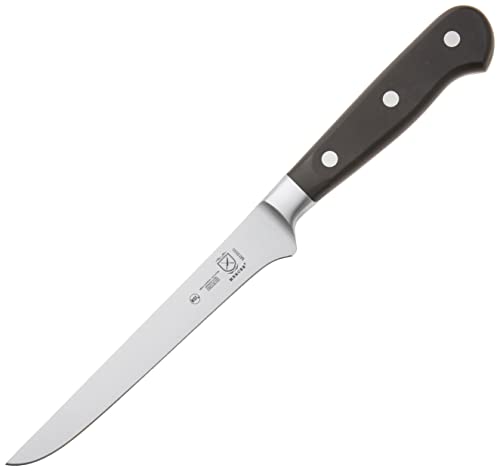
The Renaissance is the flexible specialist at the working end of the lineup. Its forged blade bends along its length, which is exactly what poultry work, silver-skin trimming, and fish trimming ask for: the edge wraps the contour of a breastbone or slides under a membrane and lifts it in one sheet instead of sawing it into strips. Forging gives it a full tang and a more finished feel than stamped blades in this class, and the riveted handle has a soft-touch inlay that helps it stay planted in the hand. Know its limit before you buy: this is not the knife for popping deer joints, and forcing it through one is how flexible blades get bent permanently.
Specs
- Blade length: 6 inches
- Blade shape: Narrow, tapered profile
- Flex class: Flexible
- Steel: High-carbon German steel, forged, full tang
- Hardness: Not stated in the listing data
- Handle: Delrin with Santoprene inlay, riveted
- Sheath: Not included
- Certification: NSF certified
5. Wüsthof Classic 6-Inch Flexible Boning Knife
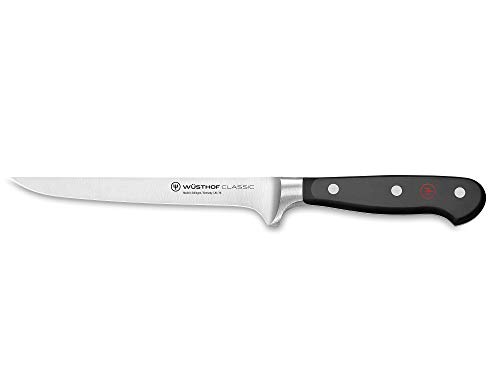
The Classic is the premium flexible option: a precision-forged blade from Solingen in X50CrMoV15 high-carbon stainless, the steel Wüsthof uses across the Classic line, with a full tang running through a triple-riveted POM handle. In hand it is the most refined knife here — the balance point sits right at the bolster, so the tip feels easy to place when you are working blind around a joint or trimming fat to a consistent thickness. The flexible blade suits poultry, fish, and trimming work, and the harder forged steel holds its edge longer between steeling sessions than the budget blades above. It asks more care in return: hand washing, and no levering against bone, because a hard, thin, flexible edge is the wrong thing to pry with.
Specs
- Blade length: 6 inches
- Blade shape: Straight, narrow profile
- Flex class: Flexible
- Steel: X50CrMoV15 high-carbon stainless steel, precision forged, full tang
- Hardness: Not stated in the listing data
- Handle: Polyoxymethylene (POM), triple-riveted
- Sheath: Not included
- Origin: Solingen, Germany
How to Choose, and How to Keep the Edge
Match the flex to your main animal and the choice makes itself. Mostly deer, hogs, or beef quarters: start stiff or semi-stiff — the Millennia for pure joint work, the Victorinox if the same knife also has to trim. Mostly poultry, fish trimming, and silver skin: go flexible, with the Renaissance as the workhorse pick and the Wüsthof as the long-term upgrade. Mixed work on one knife: the semi-flexible Dexter or the semi-stiff Victorinox, and accept that each gives up a little at both extremes.
Whichever you choose, plan on maintaining the edge during the work, not just after it. Keep a honing steel at the table and use it the moment the blade starts to drag on skin or skate on fat — a few light passes restore a working edge, while a neglected edge needs stones and real time. Wash and dry the knife as soon as processing ends; high-carbon and stain-free steels alike will spot if they sit wet in a sink. Store the blade covered or on a magnetic strip rather than loose in a drawer, because the thin boning profile chips and rolls faster than a chef’s knife edge. Do that, and any of the five knives above will handle seasons of deer, fish, and meat processing without drama.
More from Amazon
Programs that pair well with the guide above. Offers and eligibility are set by Amazon and may change.
Free shipping on eligible items, Prime Video and more. Eligible new members can start with a free trial.
Start a Prime free trialA Prime membership for ages 18-24 with a trial period. Eligibility is set by Amazon.
See Prime for Young AdultsAudiobooks and podcasts to listen to on the go. Eligible new members can start with a free trial.
Try Audible freeAd-free music streaming. Eligible new subscribers can start with a free trial.
Try Music Unlimited freeAs an Amazon Associate we earn from qualifying purchases.







Write Your Review
No reviews yet. Be the first to share your experience!