

Key takeaways
- Five meat grinders for processing deer and elk at home, compared on head size, motor power, plates and duty cycle, from a #22 workhorse to a compact #8.
As an Amazon Associate we earn from qualifying purchases.
Affiliate Disclosure: This article contains affiliate links. If you buy a grinder through a link on this page, we may earn a commission at no additional cost to you. That support helps us keep publishing camping and outdoor gear guides.
Processing your own deer or elk at home comes down to one bottleneck: the grinder. Boning, trimming, and wrapping are slow, patient work, but grinding is where an undersized machine makes itself known — the auger slows, the meat warms up, the motor strains, and what should have been clean ground venison turns into a smeared, grey paste. The five grinders below cover the realistic range for home wild game processing, from a #22 stainless workhorse that can chew through an elk in batches to a compact #8-class unit meant for a single deer broken into weekend sessions.
Two ideas run through every section. First, head size matters more than advertised wattage: the number (#8, #12, #22, #32) describes the diameter of the grinding plate and throat, and a bigger head moves more meat per minute with less effort. Second, duty cycle is real. Small grinders are built for short runs with rest breaks, and feeding one a whole elk without pause is how motors die. Match the machine to the animal and the volume, and any of these will do honest work.
1. LEM BigBite #8 – Stainless Hunter’s Grinder With Metal Gears

LEM builds equipment specifically for hunters who process game at home, and the BigBite #8 is the size most deer hunters actually need. The #8 head is the smallest of the traditional sizing classes, but the BigBite auger design pulls meat into the knife faster than a standard auger, which is why LEM rates this half-horsepower unit at roughly seven pounds of meat per minute. For one or two deer a season, ground in sensible batches, that pace is plenty.
The construction is the real argument for this grinder. The head, auger, and knife are stainless steel, the gears are all metal rather than plastic, and the motor is a permanently lubricated induction type rather than a universal motor that screams and wears brushes. It ships with two stainless grinding plates — a fine 4.5 mm plate for finished burger grind and a coarse 10 mm plate for a first pass or chili grind — plus three stuffing tubes and a meat stomper.
The honest limits: a #8 throat means meat must be cut into smaller strips than a #12 or #22 accepts, and while the BigBite is tougher than most grinders its size, it is still a #8. An elk’s worth of trim ground in one sitting should be broken into batches with short rests, both for the motor and to keep the meat cold. LEM sells a deep line of plates, knives, and attachments in this size, so the grinder can grow with you.
Specs
- Head size: #8 stainless steel head, auger, and knife
- Motor: 0.5 HP induction motor, permanently lubricated
- Gears: All-metal gear train
- Throughput: Approximately 7 lb per minute per the manufacturer
- Plates included: 4.5 mm fine and 10 mm coarse stainless plates
- Attachments: 3 stuffing tubes, meat stomper
- Brand: LEM Products (model 1779)
2. Weston Pro Series #22 – The Big Stainless Workhorse

At the other end of the home scale sits the Weston Pro Series #22. A #22 head has a plate roughly three and a half inches across, and paired with a 1.5 horsepower motor it is rated by Weston at up to fourteen pounds of meat per minute. That is whole-elk, multi-deer, add-a-pig territory: the class of machine a household buys when processing day involves several animals and nobody wants to be the one still grinding at midnight.
Everything about the build matches the throughput. The body and head are stainless steel, the gears are metal, and the motor is air-cooled and permanently lubricated for long runs. Weston includes two stainless plates — a fine 4.5 mm and a coarse 12 mm — along with three stuffing funnels and a snack stick funnel, so sausage work does not require a separate stuffer for most home batches. The large tray and wide throat accept big chunks, which cuts down on pre-trimming time.
Be honest with yourself about the trade-offs. This is a heavy, counter-dominating machine that needs storage space and two hands to move comfortably, and its capacity is wasted on a hunter who grinds one small deer a year. It also rewards cold meat: even a #22 will smear fat if you feed it warm, soft trim for an hour straight. Work in batches, keep a tray of cubed meat in the freezer between runs, and it will grind all day.
Specs
- Head size: #22 stainless steel
- Motor: 1.5 HP, 1120 W, air-cooled
- Gears: All-metal gear train
- Throughput: Up to 14 lb per minute per the manufacturer
- Plates included: 4.5 mm fine and 12 mm coarse stainless plates
- Attachments: 3 stuffing funnels, snack stick funnel, stomper
- Brand: Weston (model 10-2201-W)
3. STX Turboforce II Platinum – #12 Grinder With a Full Accessory Kit

The STX Turboforce II Platinum takes a different approach: a #12 head in a lighter housing, sold as a complete kit. Inside the box are six grinding plates in a spread of hole sizes, three stainless steel cutting blades, three sausage stuffing tubes, a kubbe attachment, a burger and slider patty press, and a pair of meat claws. For a first-time game processor who owns no accessories at all, that bundle covers burger, sausage, and snack-stick work from day one.
The #12 head size is the sweet spot for many households — big enough to accept generous strips of venison and grind a deer in a reasonable session, small enough to store in a cabinet. STX’s quad air-cooled housing is designed to keep the motor cooler during longer runs than a sealed budget housing would, and having spare blades in the box matters more than it sounds: a dull knife is the number one cause of smeared grind, and swapping in a fresh blade mid-season is cheaper than fighting a bad texture.
One caution applies to this whole class of grinder. The large wattage figures used to advertise compact grinders describe a locked-rotor peak the motor can hit for an instant, not the power it sustains while grinding. Judge this machine by its #12 head, its plate and blade package, and sensible batch sizes — an honest deer at a time with the meat kept near freezing — rather than by the biggest number printed on the box. The housing and gears in this class are also not the all-stainless, all-metal construction of the LEM and Weston above, which is the real difference you are trading for the accessory bundle.
Specs
- Head size: #12
- Motor: Electric, quad air-cooled housing design
- Plates included: 6 grinding plates in assorted sizes
- Blades: 3 stainless steel cutting blades
- Attachments: 3 sausage tubes, kubbe attachment, burger-slider patty press, 2 meat claws
- Brand: STX International (model STX-4000-TB2)
4. Kitchener Commercial Grade – #12 Stainless Grinder Built for Volume

Kitchener’s commercial grade grinder is the quiet middle option: a #12 head in a stainless steel body, rated by the maker at up to 330 pounds of meat per hour. That works out to about five and a half pounds per minute — slower on paper than the big Weston, but the rating reflects a machine intended to run steadily rather than sprint, which suits processing days built around a couple of deer and a lot of sausage.
The stainless construction is the draw here. Stainless bodies wipe down fast, do not hold odors the way painted or plastic housings can, and shrug off the wet, bloody reality of a garage processing table. The package includes coarse and fine grinding plates and a sausage stuffing tube, covering the standard two-pass venison burger workflow: a coarse first grind, a chill, then a fine second grind mixed with whatever ratio of pork or beef fat you prefer.
Where does it sit honestly? It lacks the deep accessory ecosystem and hunter-specific support of LEM, and its #12 head still asks you to cut elk trim into strips rather than chunks. What it offers instead is simple, sturdy construction in the size class most home processors should buy, from a design that has been sold for years. For a household that processes a few animals a season and wants stainless without stepping up to a #22, it is a sensible fit.
Specs
- Head size: #12
- Body: Stainless steel
- Throughput: Rated up to 330 lb per hour per the manufacturer
- Plates included: Coarse and fine grinding plates
- Attachments: Sausage stuffing tube, meat pusher
- Brand: Kitchener
5. Sunmile SM-G31 – Compact Grinder for Small Batches
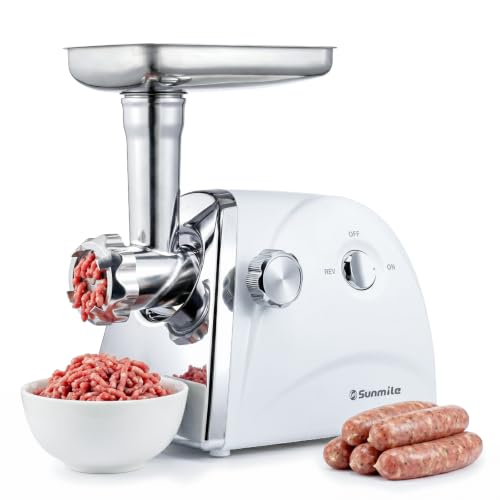
Not every hunter needs a countertop monument. The Sunmile SM-G31 is a small electric grinder built for modest jobs: a few pounds of venison trim turned into burger, a single deer’s grind split across two evenings, or small batches of fresh sausage. Its motor is rated at 250 watts of working output, and it comes with three stainless cutting plates and three sausage attachments, which is a complete little kit for occasional use.
This is also where honesty matters most. A grinder in this class has a short duty cycle: run it in small batches, let it rest, and keep the meat partially frozen so the knife cuts instead of smears. Feed it an entire elk in one continuous session and you will overheat it — that is not a defect, it is physics, and the same warning applies to every compact grinder regardless of the peak wattage printed on the box. Silver skin and heavy tendons should be trimmed away more carefully than with a #12 or #22, because a small head has less torque to pull tough pieces through.
Within those limits, the SM-G31 makes sense as a first grinder or a camp-and-cabin second machine. It stores in a fraction of the space the big stainless units need, the parts are simple to wash, and for the household that grinds a few times a year rather than a few times a month, it covers the job without dedicating a shelf to it.
Specs
- Head size: Compact #8-class head
- Motor: 250 W rated output
- Plates included: 3 stainless steel cutting plates (fine, medium, coarse)
- Attachments: 3 sausage attachments, meat pusher
- Certification: ETL listed
- Brand: Sunmile (model SM-G31)
How to Choose the Right Grinder for Wild Game
Start with volume, because volume decides head size. One deer a year, ground in a couple of relaxed sessions, is #8 territory. Two or three deer, or regular sausage projects, point to a #12. Elk, moose, multiple animals in a weekend, or grinding for an extended family justifies a #22. A #32 is commercial equipment and overkill for nearly every home.
Next, look past advertised wattage. Peak or locked-rotor wattage figures are marketing numbers; what predicts real grinding is head size, motor type, and gear material. Induction motors with all-metal gears, like the LEM and Weston above, run quieter and survive hard use better than small universal motors with plastic gear trains. Stainless heads, knives, and plates resist corrosion and are easier to sanitize than aluminum or plated parts.
Plates decide texture. A coarse plate around 10–12 mm handles the first pass and chili grind; a fine plate around 4.5 mm produces finished burger. Two-pass grinding — coarse, chill, then fine — gives the best texture and keeps fat from smearing. For sausage, confirm the grinder includes stuffing tubes in the sizes you need, though a dedicated vertical stuffer still does cleaner work than any grinder-mounted tube.
Finally, respect duty cycle and temperature. Grind meat that is nearly frozen, work in batches a small machine can handle, and stop to rechill when the grind starts looking soft or pale. Clean and dry every part the day you grind: ground meat has enormous surface area, and sanitation, not horsepower, is what keeps home-processed game safe.
FAQ
Can a #8 grinder handle an elk?
It can, but only with patience: cut the trim into small strips, grind in batches, and give the motor rest breaks while the meat stays cold. Hunters who process elk every year are usually happier with a #12 or #22.
Should venison be ground once or twice?
Twice gives the best result for burger. A coarse first pass breaks down the trim, then a chill and a fine second pass — after mixing in any added fat — produces an even texture that cooks like quality ground meat.
Do I need to add fat to ground venison?
Venison is very lean, so most home processors blend in pork or beef fat for burgers that hold together and stay moist. Straight venison works for chili, tacos, and sauces where added moisture comes from the dish itself.
Can these grinders handle bones?
No. Home meat grinders are built for boneless meat. Small soft bones and gristle strain the knife and motor, and hard bone can damage the plate. Bone everything out and trim heavy silver skin before grinding.
How should a grinder be cleaned after processing game?
Disassemble the head, knife, and plate, wash in hot soapy water, dry every part completely before storage, and run a piece of bread through the assembled grinder at the start of a session to clear out old residue. Never put wet parts away sealed — that is how plates rust.
Conclusion
The right grinder is the one sized for your season. The Weston Pro Series #22 is the buy-once answer for elk and multi-deer households, the LEM BigBite #8 delivers stainless, all-metal construction in a compact hunter-focused package, and the Kitchener splits the difference with a stainless #12. The STX Turboforce II Platinum suits first-timers who want every accessory in one box, and the Sunmile SM-G31 covers small, occasional batches honestly. Pick by head size and duty cycle, keep the meat cold, and home processing stops being a chore and starts being part of the hunt.
More from Amazon
Programs that pair well with the guide above. Offers and eligibility are set by Amazon and may change.
Free shipping on eligible items, Prime Video and more. Eligible new members can start with a free trial.
Start a Prime free trialA Prime membership for ages 18-24 with a trial period. Eligibility is set by Amazon.
See Prime for Young AdultsAudiobooks and podcasts to listen to on the go. Eligible new members can start with a free trial.
Try Audible freeAd-free music streaming. Eligible new subscribers can start with a free trial.
Try Music Unlimited freeAs an Amazon Associate we earn from qualifying purchases.

Write Your Review
No reviews yet. Be the first to share your experience!