

Key takeaways
- Compare the best deer fencing for gardens and orchards: tall poly mesh rolls and a complete kit, with honest notes on height, posts and gaps.
As an Amazon Associate we earn from qualifying purchases.
A deer fence succeeds or fails on one number: height. A whitetail that browses your beans at ankle level can also clear a six-foot barrier from a near standstill when it is motivated, which is why serious deer fencing starts at about 7.5 feet and why so many disappointed gardeners own a five-foot fence. Everything else in this guide — mesh size, material, breaking strength — matters only after the height is right, and even the right roll of mesh is only half a system. Posts, a tensioned top line, a bottom edge pinned to the ground and a gate that closes flush decide whether the perimeter actually holds. Read the picks below with that in mind: these are garden-scale mesh rolls and one complete kit, compared on the specs their listings actually state.
Affiliate Disclosure: This article contains affiliate links. If you buy through a link on this page, we may earn a commission at no extra cost to you. That is how this site stays running, and it does not change which products we include or what we say about them.
What actually keeps deer out
Height first. Seven feet is the floor for a garden fence and 7.5 to 8 feet is the safer target where deer pressure is heavy or the ground slopes down toward the fence on the deer’s side, which effectively shortens it. Several rolls below are 7 feet: treat those as light-to-moderate pressure tools, best on flat ground and better still when the top edge is hard to judge against trees or a hedge behind it, because deer dislike jumping what they cannot size up.
Material. Almost every garden deer fence sold in rolls is black polypropylene mesh. It is light, cheap per foot, nearly invisible from twenty feet away and it will not rust. Its weakness is strength: light netting in the 1 to 2 pound per roll class is a visual and physical suggestion, not a wall, and a deer that leans or blunders into it can tear through. Heavier polypropylene rolls publish a certified breaking load — several hundred pounds per square foot on the heavy grades — and metal hex or welded wire removes the chew and tear question entirely, at far more weight and money. None of the five listings below publishes a certified breaking load in its listing data, which tells you honestly where this group sits: seasonal to moderate-duty garden protection, not orchard-perimeter armor.
Mesh size. Openings run from about 3/4 inch on fine netting to roughly 2 inches on heavy fence mesh. Fine mesh doubles as bird and rabbit discouragement and is harder for a deer to get a nose or hoof into; wide mesh is stronger per strand and easier to see. There is no wrong answer here for deer alone — they are stopped by the barrier, not the grid — but fine mesh sags more and needs closer post spacing.
The invisible half of the job. A roll of mesh includes no way to stand up. Posts every 8 to 10 feet (closer for fine netting), something to tension the top — a monofilament line or wire — ground stakes or a buried skirt along the bottom so deer cannot nose underneath, and flagging tape tied along a new fence for the first weeks, because deer run into mesh they cannot see and a frightened deer hits harder than a browsing one. One gap at a gate, one corner left sagging, and the fence is a decoration: deer patrol perimeters and find the weak point within days.
Pressure honesty. In deep winter, when food is scarce and a garden holds the only green or stored feed around, determined deer test any fence — pushing, leaning and probing. A fence that held all summer can be breached in February. That is not a reason to skip fencing; it is a reason to build the full system and to walk the line after storms.
The five picks
1. Tenax 084060 Deer Fence Kit, 7 ft x 100 ft — the complete kit

Most deer fence listings sell you mesh and wish you luck. This Tenax kit is the exception in this group: the box carries the 7 by 100 foot polypropylene net plus 10 adjustable poles, 50 self-locking ties and 10 sod staples, so a small garden can go from roll to standing fence in one purchase. The mesh is Tenax’s tight Deer Net Folded grid at 0.63 by 0.75 inches — fine enough to double as bird netting over fruit — and the adjustable poles cope with the gentle slopes that defeat fixed-height stakes. Tenax positions this net as seasonal protection for areas with light deer pressure, and that framing is honest: the mesh is a light net, not a heavy C-Flex grade roll. Buy it for a summer vegetable garden near the house, where the fence comes down or gets checked often, not as a permanent orchard perimeter.
Specs
- Material: Polypropylene mesh
- Roll size: 7 ft high x 100 ft long
- Mesh size: 0.63 x 0.75 in
- Kit contents: 10 adjustable poles, 50 self-locking ties, 10 sod staples
- Breaking strength: Not stated in the listing data reviewed
- Intended use (maker): Seasonal protection, light deer pressure
- Posts included: Yes — adjustable poles
2. Mklsit Deer Netting Fence, 8 ft x 100 ft — the tall roll
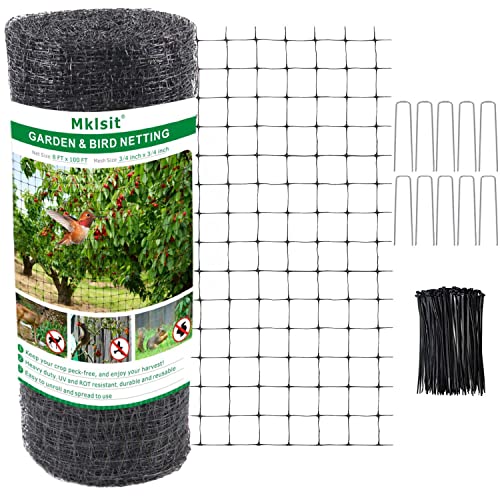
Height is the product, and this is the only roll in the group that reaches a full 8 feet, which makes it the default pick where deer pressure is real and the ground is flat enough to use the height. The 3/4 inch polypropylene mesh is UV resistant per the listing, and the roll ships with 10 ground stakes and 50 zip ties — enough to pin the bottom edge and fasten the mesh to posts you supply. Note the division of labor: stakes and ties are in the box, posts and a top tension line are not, and at 8 feet tall this net wants posts set firmly, because a tall, fine mesh catches wind like a sail. Set posts at the closer end of the usual spacing and tension the top line before hanging the mesh.
Specs
- Material: Polypropylene, UV resistant
- Roll size: 8 ft high x 100 ft long
- Mesh size: 3/4 in
- Included: 10 stakes, 50 zip ties
- Breaking strength: Not stated in the listing data reviewed
- Posts included: No — stakes and ties only
3. Jobe’s LG400171 Deer Barrier Fencing, 7 ft x 100 ft — the long-running standard
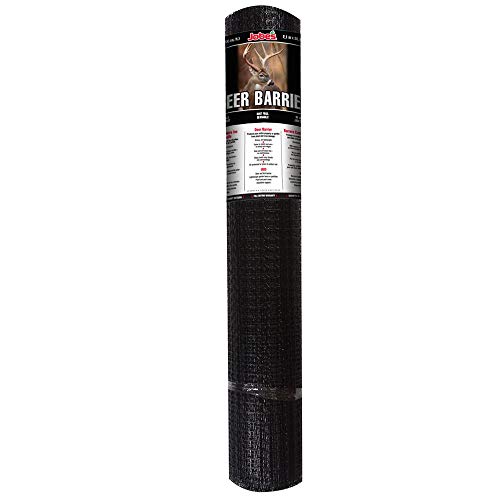
The Jobe’s Deer Barrier (the Deer Block family, from Easy Gardener) is one of the oldest names in garden deer mesh, and its listing is admirably plain about what it is: a flexible, UV-treated polypropylene roll with a grid of approximately 1 inch, sold folded in half so it unrolls from a 3.5 foot bundle to its full 7 feet. At 6.2 pounds it is light enough for one person to carry around a perimeter and staple to trees and existing posts, which is exactly how it is most often used — as a quick seasonal barrier around an orchard block or a new planting rather than a built fence line. The maker suggests post spacing of 6 to 8 feet. Nothing else is in the box: no posts, no ties, no stakes. It will not stop a deer that decides to push through, and the maker does not claim otherwise; it stops the casual browser, which is most deer damage in most gardens.
Specs
- Material: UV-treated polypropylene
- Roll size: 7 ft high x 100 ft long
- Mesh size: Approximately 1 in grid
- Item weight: 6.2 lb
- UV treatment: Yes, per maker
- Posts/ties included: No — mesh roll only
4. FEED GARDEN Deer Fence Netting, 7 ft x 100 ft — roll with fasteners

This roll splits the difference between the bare netting above and the full Tenax kit: the 7 by 100 foot UV-protected polypropylene mesh comes with 10 stakes and 50 zip ties in the box, so the bottom edge can be pinned and the mesh fastened the day it arrives, as long as posts or trees already stand where the fence will run. The 3/4 inch fine mesh is the garden-friendly grid — small enough to discourage birds and rabbits at the same time, at the cost of more sag between posts and more wind load than an open grid. Treat the included stakes as ground pins for the bottom hem, not as fence posts; a 7 foot net hung on stakes alone will lean within a week. On existing posts, a chain-link top rail or a tension line, it is a tidy one-box refresh for a tired fence line.
Specs
- Material: Polypropylene, UV-protected
- Roll size: 7 ft high x 100 ft long
- Mesh size: 3/4 in
- Included: 10 stakes, 50 zip ties
- Breaking strength: Not stated in the listing data reviewed
- Posts included: No — stakes and ties only
5. Dalen Deer-X Protective Netting DX-7, 7 ft x 100 ft — the lightest cover

Deer-X is the featherweight of the group at 1.6 pounds for the full 7 by 100 foot roll, and that weight tells you its job: this is protective netting first and a fence second. The 3/4 inch polypropylene mesh with UV inhibitors drapes over shrubs, fruit bushes and young trees as readily as it hangs on posts, and for individual high-value plants — a new orchard row’s first two springs, a hosta bed, berry canes — draped and staked netting often beats a perimeter fence on effort. Hung as a fence it needs close post spacing and a top line, and it is the first of these five a determined deer would tear. Dalen has sold this roll for years as the disposable-season option; buy it expecting to protect plants through a season or two, not to build infrastructure.
Specs
- Material: Polypropylene with UV inhibitors
- Roll size: 7 ft high x 100 ft long
- Mesh size: 3/4 in
- Item weight: 1.6 lb
- Model: DX-7
- Posts/ties included: No — netting roll only
Putting it up so it works
Whichever roll you choose, the installation decides the outcome. Walk the perimeter first and clear the line, because mesh stapled around brush has gaps built in. Set corner posts to be braced, not just planted — corners carry the tension of two runs. Hang the mesh from a tensioned top line rather than from the posts alone, pin the bottom edge to the ground with stakes every few feet or flare a few inches of mesh outward flat on the ground and weight it, since deer push under a floating hem more often than they jump a tall fence. Tie flagging tape or survey ribbon along the top and middle for the first month: a new black mesh fence is effectively invisible at dusk, and the deer you want to educate should meet it at a walk, not at a run. Build the gate as carefully as the fence — a gate opening is where perimeters fail, so overlap the mesh at the closure or frame the gate to the full height. Then walk the line monthly and after every storm, re-tensioning sags and closing gaps before the deer find them.
The bottom line
For a first garden fence with nothing on hand, the Tenax kit is the only box here that stands up on its own. Where deer pressure is the real thing and posts are already planned, the 8 foot Mklsit roll buys the height that matters most. The Jobe’s barrier remains the quick seasonal standard for wrapping blocks of planting, the FEED GARDEN roll suits a re-mesh of an existing post line, and Dalen’s Deer-X is plant cover that can pinch-hit as fencing. And if your pressure is heavy and year-round — an orchard that feeds you, in deer country — take the honest hint in these spec tables: step up to a heavy polypropylene roll with a published breaking load or to metal mesh, on braced posts, because no light net in this group pretends to be that fence.
More from Amazon
Programs that pair well with the guide above. Offers and eligibility are set by Amazon and may change.
Free shipping on eligible items, Prime Video and more. Eligible new members can start with a free trial.
Start a Prime free trialA Prime membership for ages 18-24 with a trial period. Eligibility is set by Amazon.
See Prime for Young AdultsAudiobooks and podcasts to listen to on the go. Eligible new members can start with a free trial.
Try Audible freeAd-free music streaming. Eligible new subscribers can start with a free trial.
Try Music Unlimited freeAs an Amazon Associate we earn from qualifying purchases.










Write Your Review
No reviews yet. Be the first to share your experience!