

Key takeaways
- Box, pincher, cinch and snare gopher traps compared, plus how to probe a mound system and find the active main tunnel that decides if any trap works.
As an Amazon Associate we earn from qualifying purchases.
Affiliate Disclosure: This article contains affiliate links. If you buy through a link on this page, the site may earn a commission at no additional cost to you.
A gopher trap is decided before it is ever set. The trap itself is a simple machine — a spring, a loop, a pair of jaws — and every design on this page has caught gophers for years. What separates a trap that fires within a day from one that sits buried and ignored for a month is whether it is sitting in a tunnel the gopher is still using. Correct placement in an active tunnel decides everything, and a trap in an abandoned run catches nothing, no matter how well it is built. Probing and reading mound signs come before hardware, every time.
Two more honest points up front. First, one gopher makes many mounds: a single pocket gopher can push up a dozen or more fresh mounds in a week, so a yard full of dirt piles is usually one or two animals working a large tunnel system, not an invasion. Second, trapping is an ongoing program, not a one-weekend fix. While the habitat and food supply remain — roots, bulbs, irrigated lawn — new gophers eventually move into emptied tunnel systems, and the traps come back out.
Reading the Mounds and Finding the Main Tunnel
Pocket gophers announce themselves with fan-shaped or crescent-shaped mounds of loose soil, each with a plugged hole off to one side. That plug is the door to a short lateral tunnel, and the lateral is not where traps belong. A few inches to a couple of feet beyond the plug, the lateral joins the main tunnel — a deeper, permanent runway, typically 6 to 18 inches below the surface, that the gopher travels daily between feeding areas. Traps belong in the main tunnel.
A probe finds it. A gopher probe, a long screwdriver, or a stiff rod pushed into the soil between two fresh mounds will suddenly drop an inch or two when it breaks through the tunnel roof into the void. Work the probe in a rough circle a foot or so from a fresh mound until you feel that drop, then open the tunnel with a trowel. Test activity before you set: open a short section of tunnel, leave it exposed, and check back within a day. A gopher using that run will plug the opening with soil to seal out light and air. A plugged test hole means an active tunnel; one that stays open means the animal has moved on, and so should you.
Direction matters too. A main-tunnel set works best when the gopher can arrive from either direction, which is why experienced trappers set two traps back to back in one excavation, facing opposite ways. However you arrange it, cover the excavation so the tunnel stays dark — a board, a bucket, or soil mounded over cardboard — because gophers plug light leaks, and a trap buried behind a wall of pushed soil never gets its chance.
The Four Mechanisms, Briefly
Box traps are set into an excavated section of the main tunnel. The gopher enters following its own runway, trips a trigger, and spring-loaded bars close. They are forgiving to place and a common first trap.
Pincher traps are compact jaw traps that sit inside the tunnel itself, in a runway or at a mound opening. Their narrow body suits smaller tunnels, and every moving part sits below ground once set — a tidy option in lawns crossed by people and pets.
Cinch traps place a wire loop across the tunnel opening. The gopher passes through the loop on its normal rounds and the loop draws tight. They are light, cheap to run in numbers, and a professional standard for covering large systems.
Snare tube traps work from above. You probe to find the tunnel, open a small hole, and seat the trap so its straps sit in the gopher’s path — no full excavation. The better designs add an above-ground indicator so a fired trap can be spotted from across the yard.
Victor 0626 Black Box Gopher Trap

The Black Box is the box trap most home trappers start with, and its design explains why. You dig down to the main tunnel, open a section wide enough to seat the box flush with the tunnel floor, and set the box so the gopher’s runway continues straight through it. The animal enters following its own tunnel, pushes against the trigger, and the twin spring-loaded bars on top of the housing snap down. Set in pairs back to back, a single excavation covers traffic from both directions.
The housing is molded plastic with steel springs, which keeps it light and rust-free in wet soil, and it is fully reusable — rinse it, reset it, and move it to the next active run. The trade-offs are the digging itself and the lack of any above-ground signal: the whole set is buried and covered, so checking means opening the excavation. In an active main tunnel, though, this remains one of the most dependable designs sold, and its simplicity is the point.
Specs
- Mechanism: Box trap with spring-loaded kill bars and entrance trigger
- Placement: Excavated main tunnel, set flush with the tunnel floor; often paired back to back
- Kill action: Twin spring bars close as the gopher trips the trigger inside the box
- Material: Molded plastic housing, steel springs
- Set indicator: None — the set is buried and checked by hand
- Reusable: Yes
- Pack count: 1 trap
Victor 0611 Easy Set Gopher Trap 2-Pack
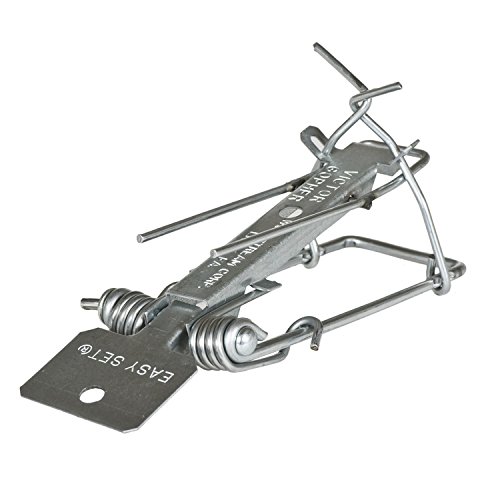
The Easy Set is Victor’s pincher design, built for a different placement than the Black Box. Instead of excavating a chamber for a box, you open the tunnel just enough to slide this narrow trap into the runway itself, or set it at a mound opening where the lateral meets the surface. Its short base and slim profile fit tunnels that a box cannot, and when it is set, all of its moving parts sit below ground, out of the way of feet, paws, and mower wheels.
The body is galvanized steel, and Victor rates the design for all soil types — sandy, silty, clay, and loamy — which matters because pincher traps set in loose sand can be undermined, while heavy clay defeats weak springs. This listing is the twin pack, which suits the standard practice of setting two traps facing opposite directions in one run.
Specs
- Mechanism: Pincher-style jaw trap
- Placement: Inside the runway or at a mound opening; all moving parts below ground when set
- Kill action: Spring jaws close on the gopher as it passes through the set trap in its tunnel
- Material: Galvanized steel
- Set indicator: None above ground
- Reusable: Yes
- Pack count: 2 traps
GopherHawk Single Trap (GH-TRP)

The GopherHawk takes the opposite approach to excavation: almost none. You probe near a fresh mound to find the habitat tunnel, open a hole just wide enough for the trap, and seat the tube so its stainless steel straps sit in the gopher’s path. When the gopher pushes through, the spring drives the straps closed. Because the set needs only a probe hole instead of a dug-out chamber, a GopherHawk can be placed in minutes and moved just as fast when a run goes quiet.
Its signature feature is the above-ground catch indicator: when the trap fires, the sprung mechanism shows visibly at the top of the tube, so a walk around the yard tells you which sets need attention. The straps are stainless steel and replaceable, and the trap is made in the USA. The honest limitation of this listing is what it excludes — it is the trap only. The wedge and probe tool is sold separately or bundled in the GopherHawk trapping set, and first-time users should budget for a probe one way or another, because the whole system depends on finding the tunnel accurately.
Specs
- Mechanism: Snare-style tube trap with spring-driven stainless steel straps
- Placement: Seated from above into the habitat tunnel through a probed hole near a fresh mound
- Kill action: Straps close around the gopher as it pushes through the set trap
- Material: Stainless steel straps, molded tube body
- Set indicator: Yes — above-ground indicator shows when the trap has fired
- Reusable: Yes; straps are replaceable
- Pack count: 1 trap (wedge and probe tool not included)
Cinch Gopher Trap Kit (3 Medium)

Cinch traps are the working standard of professional gopher trappers, and the design is the oldest on this page: a galvanized steel wire trap whose loop is set across the tunnel opening at the mound or in an opened section of run. The gopher, following its runway, passes into the loop, and its own forward motion draws the cinch tight. There is no spring to fight and almost nothing to break, which is why trappers who run dozens of sets a day still carry them.
This kit is the medium size — the correct size class for pocket gophers — with three traps in the box, enough to work a typical home tunnel system with sets in two directions and a spare for the next fresh mound. Cinch traps do have a learning curve: the loop must be sized and staked correctly in the tunnel opening, and a sloppy set gets plugged with soil like any other trap. But they are light, weatherproof, and made in the USA by CINCH Traps.
Specs
- Mechanism: Wire cinch trap — loop set across the tunnel opening
- Placement: Tunnel openings in the mound system or an opened section of the main run
- Kill action: The loop draws tight around the gopher as it passes through on its rounds
- Material: Galvanized steel wire
- Set indicator: None on the trap itself
- Reusable: Yes
- Pack count: 3 traps, medium size
Blackhole Trap — The Original Blackhole Gopher Trap

The Blackhole is built around how a gopher reads its world. The trap is a dark tube, open at both ends, with a spring-loaded snare inside. You excavate a section of the main tunnel and lay the tube into the run so the tunnel line continues straight through it. To the gopher, the tube reads as more tunnel — dark, enclosed, unremarkable — and it walks in on its normal patrol. Partway through, it trips the trigger and the snare closes.
That camouflage principle is the Blackhole’s real advantage: many traps fail because the gopher detects an obstruction or a light leak and buries the set in pushed soil, and a tube that continues the tunnel gives it less to detect. The trap is reusable, the mechanism rinses clean, and the one-piece tube has no adjustments to drift out of tune. Like the box trap, it asks for a proper excavation and gives no above-ground signal, so it rewards trappers who check sets on a daily round.
Specs
- Mechanism: Spring-loaded snare inside a dark tube that mimics a tunnel section
- Placement: Laid into an excavated main tunnel so the run continues through the tube
- Kill action: Snare loop closes when the gopher trips the trigger inside the tube
- Material: Black molded tube, steel spring and snare wire
- Set indicator: None — checked on a daily round
- Reusable: Yes
- Pack count: 1 trap
Gopher Traps Are Not Mole Traps
These two animals are constantly confused, and their traps are not interchangeable. A mole is a small insect hunter that pushes up volcano-shaped mounds and shallow surface ridges; a pocket gopher is a larger, plant-eating rodent that builds fan-shaped mounds with a plugged side hole and runs a deeper, wider tunnel system. A mole trap set in a gopher run is undersized hardware in the wrong tunnel. Fan-shaped mounds with an offset plug, plus plants pulled down from below or clipped at the root, mean gophers — and the traps on this page. Shallow ridges and round, volcano-like mounds mean moles, and mole traps instead.
Rules, Safety, and Checking
Every trap here is a lethal device, and it should be handled with the respect that implies. Keep sets away from children: flag each excavation, cover it as the design requires, and never leave a set where a child or a visiting pet can dig into it. Keep non-target animals in mind as well — set traps inside the tunnel system as directed rather than at open surface holes. And check local rules before you start: some states, counties, and municipalities regulate which traps may be used and how often they must be checked, and requirements genuinely vary by jurisdiction.
Check traps daily. A daily round lets you confirm a catch and reset or relocate a plugged set while the sign is fresh. When a run goes quiet and the test holes stay open, pull the traps, fill the excavations, and store the traps clean and dry — they will be needed again when the next gopher finds the empty system.
Frequently Asked Questions
How many traps do I need for one yard?
Start with two to four. One gopher works one tunnel system, and a pair of traps set in opposite directions in the main run, plus a set at a second active mound, covers most home situations. Large properties and heavy infestations are where multi-trap kits like the Cinch earn their keep.
How long before a trap catches?
In a correctly identified active tunnel, often within a day or two. If a set sits untouched for several days, the tunnel is probably inactive or the set has been detected and plugged — re-probe, test the run again, and move the trap rather than waiting longer.
Do I need bait?
No. Every trap here works on the gopher’s own travel through its tunnel, not on attraction. Placement replaces bait entirely, which is why finding the main run matters more than anything sold in a bottle.
What do I do when the mounds stop?
Confirm with a test hole: open the tunnel and see whether it gets plugged. If it stays open for a couple of days, the system is empty. Pull the traps, level the mounds, and keep the traps handy — an empty, intact tunnel system is an invitation to the next gopher in the neighborhood.
The Bottom Line
Buy the mechanism that matches how you want to work. The Victor Black Box is the forgiving starter box trap, the Victor Easy Set pincher fits tight tunnels with everything below ground, the GopherHawk minimizes digging and reports its own catches, the Cinch kit covers a whole system the way professionals do, and the Blackhole hides in the tunnel line itself. Whichever you choose, spend more effort on the probe than on the purchase: find the main tunnel, confirm it is active, keep the set dark, and check it daily. That routine — not any single trap — is what ends gopher damage.
More from Amazon
Programs that pair well with the guide above. Offers and eligibility are set by Amazon and may change.
Free shipping on eligible items, Prime Video and more. Eligible new members can start with a free trial.
Start a Prime free trialA Prime membership for ages 18-24 with a trial period. Eligibility is set by Amazon.
See Prime for Young AdultsAudiobooks and podcasts to listen to on the go. Eligible new members can start with a free trial.
Try Audible freeAd-free music streaming. Eligible new subscribers can start with a free trial.
Try Music Unlimited freeAs an Amazon Associate we earn from qualifying purchases.










Write Your Review
No reviews yet. Be the first to share your experience!