

Key takeaways
- Five real battery load testers compared, from fixed 100-amp analog units to a variable 1000-amp carbon pile, with load ratings and CCA ranges for each.
As an Amazon Associate we earn from qualifying purchases.
A battery can show a healthy voltage on a meter and still collapse the moment a starter motor asks it to work. Resting voltage only proves the battery is charged; it says almost nothing about whether the plates inside can still deliver heavy current. A load tester answers the harder question. It clamps onto the terminals, draws a real electrical load for ten to fifteen seconds, and shows how far the voltage sags while the battery is under genuine stress. A strong battery holds its voltage inside the pass band. A tired one dives, and no amount of surface charge can hide it.
That makes a load tester a different instrument from a conductance tester. Conductance units send a small signal through the battery, measure its internal response and calculate an estimated cranking figure without ever drawing serious current. The estimate is quick and gentle, but it is still an estimate. A carbon-pile or resistive load tester makes the battery prove itself with real amps, which is why the method remains the deciding check when a conductance reading and the symptoms disagree. A load tester is also not a charger: a charger restores energy to the battery, while the load tester judges how much usable capacity is actually there once the battery is charged. The five testers below are all true load testers, spanning fixed 100-amp handheld units for home garages up to a variable 1000-amp carbon pile built for shop and fleet work.
Affiliate Disclosure: This article contains affiliate links. If you buy through these links, we may earn a commission at no extra cost to you.
How to Choose a Battery Load Tester
Start with the load rating and how it is applied. Fixed-load handheld testers draw a set current, most commonly 100 amps on a 12V battery and 50 amps on a 6V battery, through a resistive element or carbon pile. That is a meaningful stress for small and mid-size batteries, and it is the format of four of the five picks here. A variable carbon-pile tester lets the operator dial the load up or down, which matters for a textbook test: the classic procedure applies a load equal to half the battery’s rated cold cranking amps for fifteen seconds and checks that voltage stays at or above roughly 9.6 volts at room temperature. Only a variable unit can match half the CCA of a big truck battery, so heavy-duty work points to the Clore SOLAR 1876 below.
Next, match the tester’s stated capacity to the batteries in the fleet. The handheld units here are rated for batteries up to 1000 CCA, which covers most cars, light trucks, motorcycles, boats and lawn equipment. The variable carbon pile extends that to 2000 CCA and adds 24V coverage for series-wired truck and equipment systems. Voltage support is the other filter: every pick handles 6V and 12V, which keeps older vehicles and powersport batteries in scope, while only the shop unit adds 24V. Finally, consider the readout. All five use analog meters or gauges rather than screens, so the verdict is a needle position against printed bands for battery condition, charging output and starter draw. There are no menus and no internal batteries to manage, but there is also no stored result, so readings that need comparing over time have to be written down.
Safety Before Any Load Test
A load test is a controlled short burst of very heavy current, and it deserves respect. The resistive element or carbon pile inside the tester converts that energy into heat, so the housing gets hot enough to burn skin during and shortly after a test. Hold the load switch only for the time the maker specifies, usually ten to fifteen seconds, and let the unit cool between tests instead of running batteries back to back. Work in a ventilated space, because lead-acid batteries can vent hydrogen gas, and a spark near the terminals is a genuine ignition risk. Wear eye protection, remove rings and watches, and keep flames and cigarettes away from the battery. Never load test a battery with a cracked case, a frozen electrolyte bulge, a loose or damaged terminal, or one that is hissing or smells strongly of rotten eggs; a damaged battery under load can vent acid or rupture. The battery also needs to be fully charged before testing, since a discharged good battery and a charged bad one can produce the same ugly needle swing.
1. OTC 3180 100 Amp Battery Load Tester

The OTC 3180 is the shop-grade version of the classic handheld load tester. It applies a fixed 100-amp load through a heavy-duty load switch and reads the result on a wide analog meter with printed bands for battery condition, so the verdict is visible at a glance without interpreting a bare number. The same hookup supports charging system and starter draw checks, which makes it a three-job tool: clamp it on to judge the battery under load, then use the meter to watch charging voltage and cranking behavior before condemning any single part.
OTC builds this tester for repeated professional use, with a housing and switch rated for the heat cycles that come with testing battery after battery. It covers 6V and 12V batteries up to 1000 CCA, which spans passenger cars, light trucks, marine starting batteries and powersport equipment. It is larger and heavier than the budget handhelds in this list, and that bulk is the trade for durability. For a small shop, a fleet corner or a serious home garage that tests batteries every week, it is the fixed-load pick most likely to still be working in a decade.
Specs
- Load type: Fixed resistive load, heavy-duty load switch
- Load rating: 100 amps
- Battery voltage: 6V and 12V
- Testing capacity: Batteries up to 1000 CCA
- Display: Analog meter with condition bands
- Additional checks: Charging system output and starter draw
- Power source: None required, powered by the battery under test
2. NEIKO 40510A Battery Load Tester

The NEIKO 40510A follows the same fixed-load formula in an all-metal housing built to live on a pegboard rather than in a drawer. Its carbon-pile load draws 100 amps from a 12V battery and 50 amps from a 6V battery, and the analog gauge reports voltage under load against the pass and weak zones printed on the dial. Like the OTC, it is rated for batteries up to 1000 CCA and doubles as a quick check of charging voltage and starter draw, so a slow crank can be separated into a battery problem or a starter problem with the same two clamps.
Because the load is fixed, the test is simple and repeatable: charge the battery, clamp on with correct polarity, hold the load for the specified seconds and read the needle. The honest limits are the ones shared by every fixed 100-amp unit. On a large high-CCA truck battery, 100 amps is well under the half-CCA load of the textbook procedure, so the reading is a useful screening result rather than a full certification. The tester also makes real heat, and its maker-specified cooldown between tests slows down back-to-back work. For home mechanics who think in voltage under load and want a good-or-bad answer without menus, it fits the brief exactly.
Specs
- Load type: Fixed carbon-pile load
- Load rating: 100 amps on 12V, 50 amps on 6V
- Battery voltage: 6V and 12V
- Testing capacity: Batteries up to 1000 CCA
- Display: Analog gauge with condition zones
- Additional checks: Charging system and starter draw
- Construction: All-metal housing
3. Clore SOLAR 1876 Carbon Pile Battery Load Tester
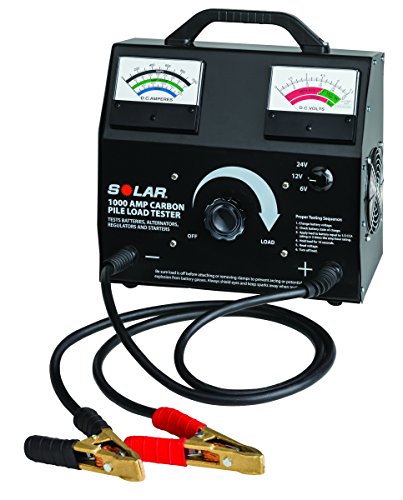
The SOLAR 1876 is the variable carbon pile, and it is in a different class from the handhelds. Instead of a fixed draw, its carbon pile can be adjusted up to 1000 amps, so the operator can set the load to half the rated CCA of the battery on the bench, which is the classic load test procedure done properly. It tests 6V, 12V and 24V batteries up to 2000 CCA, covering the dual-battery diesel trucks and heavy equipment that a 100-amp handheld can only screen. Dual gauges show load current and voltage at the same time, so the sag is watched against the exact load being applied rather than assumed.
The 56-inch cable reach and heavy-duty clamps are made for shop bays, letting the tester sit on a cart while the battery stays in the vehicle. The same hookup supports starter and alternator assessment. The trade-offs are size and commitment: at roughly 25 pounds it is a bench and bay tool, the carbon pile gets seriously hot in use, and the analog gauges give a reading to interpret rather than a printed verdict. There are no chemistry profiles to select, because a carbon pile has no algorithm. For warranty decisions, fleet maintenance and any garage that needs a load test result that settles arguments, this is the pick.
Specs
- Load type: Variable carbon pile
- Load rating: Adjustable up to 1000 amps
- Battery voltage: 6V, 12V and 24V
- Testing capacity: Batteries up to 2000 CCA
- Display: Dual analog gauges for load current and voltage
- Cable reach: 56 inches
- Additional checks: Starter and alternator assessment
- Weight: About 25.6 pounds
- Warranty: 1 year limited
4. KAIHENG 6V/12V Battery Load Tester

The KAIHENG tester keeps the fixed-load format and trims everything else away. It draws the same 100 amps on a 12V battery and 50 amps on a 6V battery as the other handhelds, reads the result on an analog gauge, and adds a plain voltmeter function so resting and charging voltage can be checked with the same clamps before the load is applied. Copper clips with insulated grips seat firmly on standard terminals, which matters more than it sounds: a slipping clamp during a 100-amp draw is a spark and a ruined reading at the same time.
There is no digital readout, no memory and no chemistry menu, and the gauge’s stated voltage accuracy of plus or minus 0.2 volts is fine for a pass-or-fail decision but not for fine diagnosis. Results on AGM and gel batteries should be read with the same caution that applies to every resistive tester, since the printed bands are calibrated around conventional flooded batteries. What the KAIHENG offers is the honest core of the method at the simplest level: clamp, load, read. For a single car, a mower and an annual before-winter check, that is the whole job.
Specs
- Load type: Fixed resistive load
- Load rating: 100 amps on 12V, 50 amps on 6V
- Battery voltage: 6V and 12V
- Display: Analog gauge
- Additional function: Voltmeter for resting and charging voltage checks
- Voltage accuracy: Plus or minus 0.2 volts
- Clamps: Copper clips with insulated grips
5. VCT Battery Load Tester 100A/50A
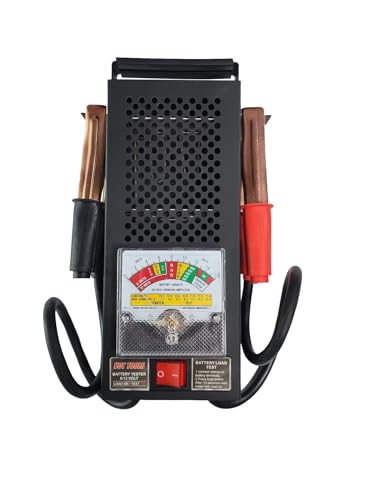
The VCT tester runs the same 100-amp and 50-amp fixed loads for 12V and 6V batteries up to 1000 CCA, and its distinguishing detail is aimed at first-time users: the clamps are color-coded red and black with rubber grips, which makes a reversed-polarity hookup harder to commit at the exact moment a nervous beginner is most likely to make one. The analog meter carries the usual condition bands, and the tester covers the standard spread of cars, light trucks, motorcycles, ATVs, boats and lawn tractors.
That accessibility is the whole design brief. There is no internal resistance reading and no digital record, so comparing two batteries side by side means noting needle positions by hand. Charging system checks are basic, limited to watching the meter with the engine running. Heat buildup limits back-to-back testing just as it does on the other fixed-load units. As a first load tester for a household that wants a forgiving analog tool and a clear visual answer, it covers the ground without asking the owner to learn a menu system first.
Specs
- Load type: Fixed resistive load
- Load rating: 100 amps on 12V, 50 amps on 6V
- Battery voltage: 6V and 12V
- Testing capacity: Batteries up to 1000 CCA
- Display: Analog meter with condition bands
- Clamps: Color-coded red and black with rubber grips
- Additional checks: Basic charging system voltage check
How a Load Test Should Be Run
Whatever tester is chosen, the procedure decides whether the result means anything. Charge the battery fully first, then let it rest for several hours, or switch on the headlights briefly to strip the surface charge that makes a weak battery read strong. Connect the clamps directly to clean terminal posts, positive first. Apply the load for the time the maker specifies, ten to fifteen seconds on the fixed-load handhelds, while watching the needle: a healthy 12V battery holds at or above about 9.6 volts under a half-CCA load at room temperature, and the needle steadies rather than continuing to fall. Release the load, let the tester cool, and only then repeat if a second reading is needed to confirm the first. A battery that fails under load after a full charge has given its answer, and retesting it weekly will not change it.
More from Amazon
Programs that pair well with the guide above. Offers and eligibility are set by Amazon and may change.
Free shipping on eligible items, Prime Video and more. Eligible new members can start with a free trial.
Start a Prime free trialA Prime membership for ages 18-24 with a trial period. Eligibility is set by Amazon.
See Prime for Young AdultsAudiobooks and podcasts to listen to on the go. Eligible new members can start with a free trial.
Try Audible freeAd-free music streaming. Eligible new subscribers can start with a free trial.
Try Music Unlimited freeAs an Amazon Associate we earn from qualifying purchases.

Write Your Review
No reviews yet. Be the first to share your experience!