

Key takeaways
- Jackery sells so many power stations that choosing one for a camping trip can feel harder than choosing the campsite.
Jackery sells so many power stations that choosing one for a camping trip can feel harder than choosing the campsite. The lineup runs from a pocketable 292Wh box that charges phones and a lantern, to HomePower units with more than 3,000Wh that are really meant for a cabin or RV pad. The right answer depends on three things you can answer before you shop: how many nights you stay, whether the car can recharge the station along the way, and how far you carry it from the vehicle to the tent.
This comparison is written for weekend car campers, overlanders, and RV owners who already like the Jackery brand and want to pick the correct model rather than the biggest one. Six distinct stations are covered, and duplicate listings that only swap in a solar panel bundle are folded into their base model. Every claim comes from the product titles, so check the manufacturer’s spec sheet for weight, ports, and solar input limits before you commit in 2026.
Quick Picks
Our top picks



As an Amazon Associate we earn from qualifying purchases at no extra cost to you.
| Product | Best for | Key spec from the title |
|---|---|---|
| Jackery Explorer 300 | Phones, lights, and a weekend tent trip | 292Wh, LiFePO4 battery |
| Jackery Explorer 1000 v2 | Car camping with a cooler and gadgets | 1070Wh, 1500W, 1-hour fast charge |
| Jackery Explorer 2000 v2 | Extended trips and RV hookup-free stays | 2042Wh, 2200W AC, 20ms UPS |
| Jackery HomePower 3600 Plus | Basecamp or cabin that stays in one place | 3584Wh, 3600W AC |
| Jackery Explorer 500 v2 | Lightweight carry to a remote site | 512Wh, 500W AC, 1000W peak, 14lbs |
| Jackery HomePower 3000 | Large group camps and RV power | 3072Wh, 3600W AC, 7200W surge |
How to Choose
Match capacity to nights away
Start with a short list of what you plug in: phones, a headlamp, a small fan, a 12-volt cooler, maybe a laptop. Estimate the watt-hours each uses per day and add them up. A phone needs only a modest slice of a charge, while a powered cooler or an electric blanket can eat through hundreds of watt-hours overnight. For a one-night trip with phones and lights, about 300Wh is plenty; for a long weekend with a cooler, aim for the 1,000Wh class; beyond that, you are powering a camp kitchen or an RV, and the 2,000Wh-plus models earn their place.
Weigh carry distance against output
Output in watts decides what you can run at once, but weight decides whether you will actually bring the unit. The Explorer 500 v2 lists a 14lbs weight, a useful anchor for gauging the others. Models in the 1,000 to 2,000Wh range are heavier and are best loaded straight from trunk to campsite. The HomePower units are meant to stay put. If you hike more than a short distance from the car, drop down a size and bring a backup power bank for small electronics.
Plan the recharge before you go
Solar panels turn a power station into a self-sufficient system, but only if the sun cooperates and the panel wattage is high enough. Bundle listings here include a 40W panel with the Explorer 300 and two 200W panels with the larger units. Panels shrink recharge time compared with nothing at all, yet shade, tree cover, and short winter days can cut output sharply. A car charging cable gives a reliable top-up while you drive, and the 1-hour fast-charge listing on the Explorer 1000 v2 helps if you have wall power at a trailhead or motel the night before.
Chemistry, ports, and safe use
Most of these listings call out LiFePO4 or LFP batteries, which handle repeated cycling well. Check the outlet mix: AC for a small coffee maker or camp lights, USB-C power delivery for phones and laptops, and a 12-volt output for a cooler. Do not run a power station inside a closed tent near heat sources, and keep it dry and shaded when possible. Unlike a gas generator, a battery unit does not release carbon monoxide, but a gas generator parked near a tent door is a serious hazard and should always stay well away from sleeping areas.
The 6 Best Options
Jackery Explorer 300
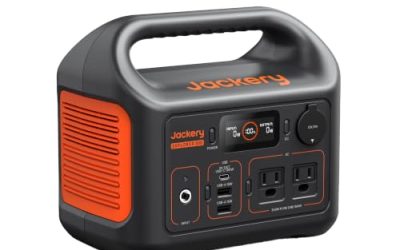
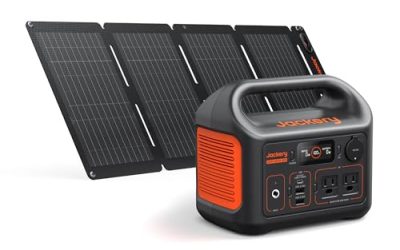
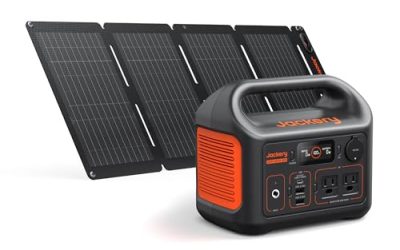
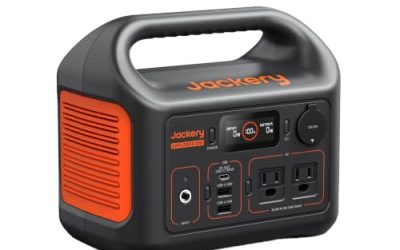
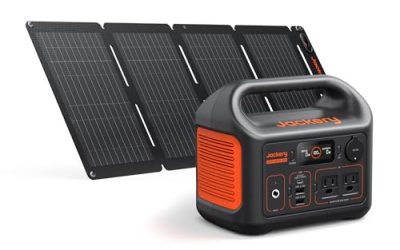
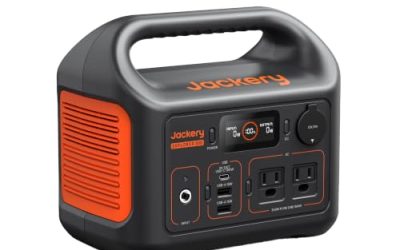
The Explorer 300 lists 292Wh, a LiFePO4 battery, and is aimed at outdoors, camping, travel, hunting, and blackouts. A separate listing bundles it with a 40W solar panel and lists a 300W AC output with a pure sine wave outlet. It is the entry point for people who simply want power for devices and a light or two on a short trip.
- Strength: the 292Wh class is compact enough for a daypack-adjacent camp setup.
- Strength: pure sine wave AC is listed on the solar bundle for sensitive electronics.
- Trade-off: it will not run a cooler or heater for long, and a 40W panel recharges slowly.
Skip it if you plan to power a mini fridge, a CPAP plus other gear, or more than two people’s devices for several nights.
Jackery Explorer 1000 v2
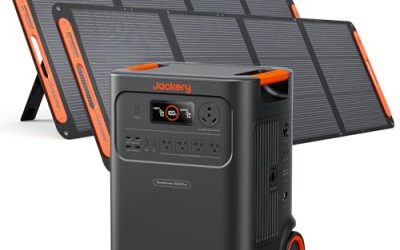
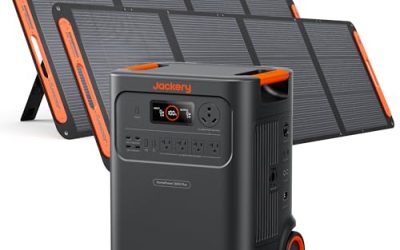
This one lists 1070Wh, 1500W of output, a one-hour fast charge, a LiFePO4 battery, and a 100W USB-C output. It is the sweet spot for car campers who want a cooler, a few chargers, and a camp light running all weekend, with a bundle option that adds two 200W panels. The fast-charge claim means a quick top-up before you head out is realistic.
- Strength: 1500W handles small appliances like a kettle on short bursts.
- Strength: fast charging cuts downtime between trips.
- Trade-off: it is bulkier than the smaller models, so it stays near the car.
Skip it if you hike in with your gear or only need to charge phones and lanterns. Campers who sleep far from the parking area will also find it awkward to move, so think about where the station will actually sit once camp is set up.
Jackery Explorer 2000 v2
Listed at 2042Wh with 2200W of AC output, LiFePO4 cells, a 20ms UPS function, and 100W USB-C power delivery, it is offered alone or with two 200W panels. This is the pick for multi-day trips, group campsites, or RV stays without hookups, where a larger battery spares you from constant recharging.
- Strength: 2042Wh supports a cooler, lights, and a laptop for several days.
- Strength: 2200W AC output leaves room for several small appliances at the same time.
- Trade-off: it is heavy for a tent camper who parks far from camp.
Skip it if your trips are short or your loads are limited to phones and a light. The UPS function is a bonus for home use during an outage, so this model also rewards owners who want one station that does double duty at the campsite and in the house.
Jackery HomePower 3600 Plus
The HomePower 3600 Plus lists 3584Wh and 3600W AC output. It is the largest battery in the camping-adjacent Jackery range and suits fixed basecamps, hunting cabins, and RV pads. Treat it as a power source you drive to a site and leave in place, not one you carry on a trail.
- Strength: 3584Wh is plenty for multiple days of normal camp loads.
- Strength: 3600W AC output opens the door to larger appliances.
- Trade-off: it is a premium, heavy, stay-in-one-spot purchase.
Skip it for weekend tent camping, where the capacity and weight go to waste. Its listing is also the sparsest of the group, naming only the capacity and AC output, so read the manufacturer sheet for solar input, ports, and expansion options before you decide it fits your rig.
Jackery Explorer 500 v2
This model lists 512Wh with 500W AC and a 1000W peak, uses LiFePO4, and is described as 14lbs light. A second listing notes that an AC cable is included. It is the middle step for campers who find 300Wh too tight but do not want to haul a heavy 1,000Wh unit from the car.
- Strength: the 14lbs listed weight is easy to carry from the vehicle.
- Strength: 1000W peak helps with small devices that spike briefly.
- Trade-off: 500W continuous limits you from running big heating appliances.
Skip it if your plan includes a powered cooler for more than a night, or if you want to run higher-wattage kitchen gear. Anyone who already owns the 300Wh model for solo trips may find this one a natural upgrade for the whole family.
Jackery HomePower 3000
Listed at 3072Wh, 3600W AC output, 7200W surge, and an LFP battery, the HomePower 3000 sits just below the 3600 Plus. It makes sense for group camps, RV living, and long off-grid stays where one station must power a refrigerator, lights, and a few tools. It is not a backpacking tool.
- Strength: 7200W surge covers startup spikes from motors and compressors.
- Strength: 3072Wh gives room for extended stays.
- Trade-off: it is built for home backup first, so camping convenience is secondary.
Skip it if you are loading the car for a weekend trip and cannot afford the trunk space or the weight. For campers who also want the same station to cover a house during a storm, it is a more sensible purchase than a camping-only model.
Which One Fits Your Situation
Solo or couple tent weekend
The Jackery Explorer 300 keeps phones, a headlamp, and a small fan going for a night or two without taking up space in the trunk.
Family car camping with a cooler
Go with the Jackery Explorer 1000 v2. Its 1070Wh and fast-charge listing suit a cooler plus several chargers, and the bundle with two panels helps on longer trips.
Light carry to a remote site
The Jackery Explorer 500 v2 is the best fit when weight matters: the listing shows 14lbs, and 512Wh covers phones, cameras, and lighting.
RV or cabin basecamp
The Jackery HomePower 3000 or the HomePower 3600 Plus suit fixed sites with large loads, and the Explorer 2000 v2 is the middle ground when you want more portability.
Common Mistakes
- Buying the largest Jackery by default and then leaving it home because it is too heavy to carry to the campsite.
- Counting on a small solar panel to recharge a large battery in a single afternoon.
- Forgetting that a cooler or heater consumes far more energy than phones and lights.
- Storing the station in a hot car or in direct sun, which stresses any lithium battery.
- Placing a gas generator beside the tent to charge a station, which risks carbon monoxide exposure.
Specs and Terms Explained
Wh versus mAh
Phone chargers and power banks quote milliamp-hours, while power stations quote watt-hours. To compare them, multiply mAh by the cell voltage (usually around 3.7V) and divide by 1,000. A 10,000mAh pack therefore holds roughly 37Wh. Against that yardstick, even the smallest unit in this guide holds many times more energy than a typical power bank.
Explorer versus HomePower
Jackery uses these names for different jobs. Explorer models, such as the Explorer 300, Explorer 500 v2, Explorer 1000 v2, and Explorer 2000 v2, are the portable-sized line built for trips. HomePower models, including the HomePower 3000 and HomePower 3600 Plus, are larger systems aimed at cabins, RV pads, and backup power. Treat the name as a rough size tier before you read any numbers.
Car port charging
Plugging a station into a vehicle’s 12V socket works, but it is slow compared with a wall charger. It is best used to top off during a drive, not to refill a large battery from empty. Plan on wall charging before you leave home.
Reserve capacity
To estimate how many days a charge lasts, divide the battery’s watt-hours by the daily draw of the devices you carry. Then keep a reserve instead of running it to zero, because a battery near empty leaves no room for a cold night or a forgotten light.
Which One Should You Buy?
| If you… | Choose… |
|---|---|
| carry gear on foot from a parked car and only need phones and lights | Jackery Explorer 300 |
| camp with a partner and add a fan or a camera battery | Jackery Explorer 500 v2 |
| bring a cooler, a fan, and several devices for a family | Jackery Explorer 1000 v2 |
| stay several nights and run bigger loads at the site | Jackery Explorer 2000 v2 |
| park an RV or stay at a cabin and want whole-site power | Jackery HomePower 3000 or Jackery HomePower 3600 Plus |
Setup and Care Tips
Keep the station out of direct sun and off wet ground at camp. A dry, shaded spot such as a cooler lid, a picnic table, or a cargo bin keeps it from overheating and protects the ports from drips. Never place it in a closed tent beside a stove or heater, and give the vents several inches of clearance. Lithium batteries lose usable capacity in the cold, so on a freezing night keep the unit in the car cabin or inside your sleeping area rather than outside. Before you leave, charge it fully, pack the cables you need, and check each port once at home. After the trip, wipe off dust and store it in a cool, dry place with a partial charge, topping it up every few months.
Related guides
- Battery Powered Generator For Refrigerator
- Portable Power Station For Refrigerator
- Portable Power Station For Camping
Frequently Asked Questions
Which Jackery is best for a weekend of camping?
For phones and lights, the Explorer 300 is enough. For a cooler and more gear, the Explorer 1000 v2 is the safer choice because of its larger battery and 1500W output.
Can I use a Jackery in a tent?
Battery stations make no exhaust, but keep them off the sleeping bag, away from heaters, and out of rain. Never bring a gas generator into or beside a tent because of carbon monoxide risk.
Do I need the solar panel bundle?
If you camp more than a night or two without a vehicle charge, panels extend your trip. Weekend campers who can charge at home beforehand may not need them.
Are the HomePower models good for camping?
They have large batteries and high output, but they are built for home backup and are heavy. They suit RV pads and cabins better than a tent site.
Write Your Review
No reviews yet. Be the first to share your experience!