

Key takeaways
- Five antifreeze hydrometer testers compared for coolant freeze protection: disc and dial types, ethylene glycol scales, and honest temperature notes.
As an Amazon Associate we earn from qualifying purchases.
Coolant does not stay at full strength forever. Water gets added at a roadside top-up, a slow leak gets diluted refill after refill, and the mix that once protected an engine through a hard winter can quietly drift until a cold night at a campsite or in outdoor storage is enough to freeze it. Frozen coolant expands, and the damage it leaves behind — a cracked block, a split radiator, a burst hose — is far more serious than the two minutes it takes to check the mix. An antifreeze tester is the small tool that gives that warning early.
The five testers in this guide are all hydrometers: squeeze-bulb instruments that draw a coolant sample into a clear chamber and read its density, by counting floating discs or by a pointer moving across a printed scale. One boundary is worth stating up front. These are not optical refractometers, the eyepiece instruments that read a drop of coolant by how it bends light; refractometers are a different tool family, covered in a separate guide. Test strips are also a different method and are not included here. All five picks are calibrated for ethylene glycol coolant, which covers the great majority of cars, trucks and RVs — but that calibration matters, and the propylene glycol section below explains why the two scales must never be treated as interchangeable.
Affiliate Disclosure: This article contains affiliate links. If you buy through these links, we may earn a commission at no additional cost to you. This helps support our work and allows us to continue providing detailed tool guides.
How a Hydrometer Antifreeze Tester Works
Every tester here works on the same principle: antifreeze concentration changes coolant density, and density is what a hydrometer measures. Squeeze the bulb, dip the intake tube into the radiator neck or overflow reservoir, and release to draw a sample into the chamber. In a disc tester, calibrated plastic discs sit in the sample; the denser the coolant, the more discs float, and the count is matched against the chart printed on the body. A dial tester moves a pointer instead. Either way, the reading converts density into a freeze protection temperature.
The clear chamber does a second job for free: the drawn sample is visible, so rust particles, sediment and oil contamination show up alongside the strength reading. Weak coolant and dirty coolant are different problems with different fixes, and a hydrometer sample shows both.
Two honest limits apply to the whole class. First, the scales are printed for one coolant chemistry: ethylene glycol and propylene glycol reach the same freeze point at different densities, so an ethylene glycol scale read against a propylene glycol mix gives a wrong number in a plausible-looking way. Second, density changes with temperature, so a hot sample reads differently from the same coolant cold. Some makers address this with temperature-compensating designs or a hot-or-cold accuracy claim; others assume a sample near room temperature and say nothing. Each pick below states which applies.
What to Look for in an Antifreeze Tester
Match the scale to the coolant. Confirm what is actually in the vehicle before choosing a tester. All five picks here read ethylene glycol, including GM Dex-Cool, which is an ethylene glycol formula despite its different color and additive package. Propylene glycol coolant needs a tester scaled for it.
Look for an overprotection indicator. More antifreeze is not always better: past roughly a seventy percent concentration, freeze protection gets worse again and heat transfer suffers. Two picks below carry a sixth disc that floats only when the mix is overconcentrated — the one reading a basic tester cannot give.
Prefer dual scales. Workshop manuals mix Fahrenheit and Celsius; a tester printed in both saves conversion errors at the radiator cap.
Check the temperature claim. If the maker states the tester is temperature compensating or accurate hot and cold, a warm sample is acceptable. If the maker says nothing, let the sample cool toward room temperature before trusting the reading, and treat it as a band rather than an exact figure.
The 5 Best Antifreeze Testers
1. Prestone AF-1420 Antifreeze/Coolant Tester
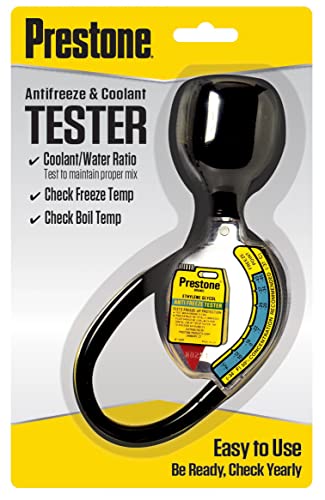
The Prestone AF-1420 is the household-name option, built by the company whose coolant sits on the same shelf. Prestone positions it as a tester for antifreeze and anti-boil protection: it measures coolant concentration and reads the protection level of the mix, covering both ends of the thermometer — the freeze point that matters in winter storage and the boil-over margin that matters on a summer grade.
Its second function is the one owners use most between winter checks. The clear chamber lets the drawn sample be inspected visually for rust and sediment, so a single squeeze answers two questions: is the mix strong enough, and is it clean enough to leave in place. For a vehicle that sits at a rural property or a trailhead between trips, that combined check is the realistic maintenance habit — strength and condition in one draw.
On temperature, honesty is required: Prestone publishes no temperature-compensation claim for the AF-1420, so its scale assumes a sample near the reference temperature its chart was printed for. Draw from a cool engine, or let a warm sample settle before reading it, and treat the result as a sound estimate rather than a laboratory figure.
Specs
- Model: AF-1420
- Type: Squeeze-bulb hydrometer tester
- Coolant: Ethylene glycol based coolants
- Checks: Freeze protection, boil-over protection, visual rust and sediment inspection of the sample
- Dimensions: 17.78 x 12.7 x 2.54 cm
- Weight: 86.18 g
2. OEMTOOLS 24507 Professional Series Ethylene Glycol Antifreeze Tester
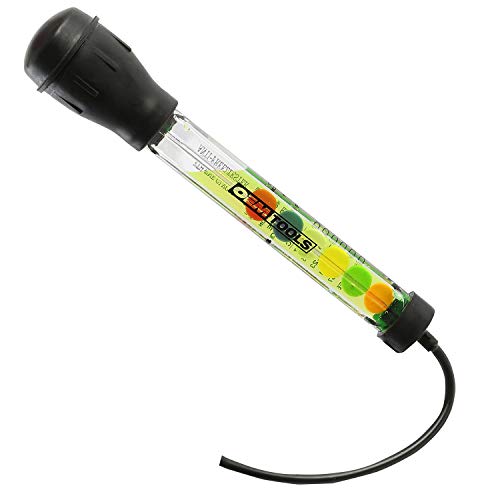
The OEMTOOLS 24507 is the clearest disc-counting design in this group. Five floating discs do the measuring: draw the sample, count how many discs rise, and match the count to the protection chart on the body. A sixth disc floats only when the coolant is overconcentrated, flagging the overprotection condition that reduces cooling efficiency and, pushed far enough, raises the freeze point again. That extra disc separates a shop-grade tester from a glovebox novelty.
OEMTOOLS states the tester reads accurately whether the coolant is hot or cold, removing the cool-down wait that reference-temperature testers impose; the claim is the maker’s, and it is stated here as such. The clear body also exposes the sample, so rust and debris are visible during the same draw.
The boundary on this pick is firm: it is an ethylene glycol tester only. OEMTOOLS names it for that chemistry, and its disc calibration should not be trusted against a propylene glycol mix.
Specs
- Model: 24507 (Professional Series)
- Type: Floating-disc hydrometer
- Discs: 5 measuring discs plus a 6th overprotection indicator disc
- Coolant: Ethylene glycol only
- Temperature: Maker states accurate readings hot or cold
- Sample check: Clear body shows rust and debris in the drawn coolant
3. Thexton THE106 Anti-Freeze Tester

Thexton is a US maker of specialty automotive service tools, and the THE106 is its disc-type ethylene glycol tester. It is temperature compensating — Thexton states it reads accurately with the coolant hot or cold — and it prints readings in both Fahrenheit and Celsius. It is specified for all ethylene glycol coolants, including Dex-Cool.
Two construction details stand out. The barrel is convex SAN plastic, shaped so the barrel itself magnifies the floating discs — on a small disc tester, that magnification is the difference between a confident count and a squint. And at 16-1/4 inches long, the THE106 reaches deeper into large filler necks and reservoirs than the short glovebox testers here. Like the OEMTOOLS above, it carries a sixth disc that shows overprotection, so a too-strong mix is flagged rather than mistaken for extra safety.
Specs
- Model: THE106
- Type: Floating-disc hydrometer, temperature compensating
- Coolant: All ethylene glycol coolants, including Dex-Cool
- Scales: Fahrenheit and Celsius
- Length: 16-1/4 in
- Barrel: Convex SAN plastic, magnifies the discs
- Discs: Measuring set plus a sixth overprotection disc
- UPC: 008721001061
4. EZRED SP102 Anti-Freeze Hydrometer
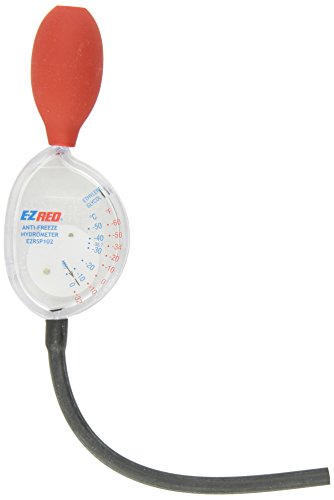
The EZRED SP102 — also listed under its shorter S102 name — is the durability pick, built with a heavy-duty, thick plastic casing for a tester that lives loose in a toolbox or door pocket rather than in a drawer insert. Antifreeze testers fail in mundane ways: a cracked chamber, a bulb that no longer seals, a nozzle too small to draw a clean sample. The SP102’s listed details address exactly those points, with the thick casing, a tight bulb seal and a larger intake nozzle.
Its scale is printed in both Fahrenheit and Celsius, so the reading needs no conversion. EZRED publishes no temperature-compensation claim for the SP102, so the honest working rule is the reference-temperature one: draw the sample from a cool system, or let a warm sample settle, and read it as a close estimate.
Specs
- Model: SP102 (also listed as S102)
- Type: Squeeze-bulb hydrometer
- Housing: Heavy-duty thick plastic casing
- Scale: Dual Fahrenheit and Celsius
- Intake: Larger intake nozzle; tight bulb seal
- Coolant: Ethylene glycol
- UPC: 971473128815
5. Aramox Dial Type Coolant Tester

The Aramox tester is the dial-type representative in this group. Instead of discs to count, a pointer moves across the printed scale as the sample is drawn in: fill to the marked line with the red float held perpendicular to the center line, and the pointer gives the reading directly — a format many users read faster than a disc count, particularly in poor light under a hood.
The scale carries dual calibration in Celsius and Fahrenheit and covers both seasonal questions: the freezing point that matters in winter and the boiling point that matters in summer. The body is ABS, and the tester is specified for ethylene glycol coolant. On temperature, the listing claims no automatic compensation: the pointer reads the sample as drawn, so hot and cold samples of the same coolant will not read identically, and the cool-sample rule applies.
Specs
- Type: Dial (pointer) hydrometer
- Scales: Dual Celsius and Fahrenheit calibration
- Coolant: Ethylene glycol
- Material: ABS
- Weight: 74 g
- Part number: Aramoxkxzv18dh7y
- UPC: 739551601014
How to Use a Hydrometer Tester
Work on a cool engine. A pressurized cooling system at operating temperature can spray scalding coolant when the cap is opened, so let the system cool until the upper hose is no longer hot to a careful touch. Open the radiator cap slowly, or draw from the overflow reservoir if the radiator has no accessible cap — reservoir coolant is the same mix, though it may lag behind a recent top-up.
Squeeze the bulb, insert the tube below the coolant surface, and release slowly so the chamber fills without foam. Hold the tester vertical, let the discs or pointer settle, then read the freeze protection temperature from the chart or scale. Rinse the tester with clean water afterward; dried residue is the main cause of sticky discs and drifting readings later. If the reading sits close to the coldest temperature the vehicle will face, treat that as a fail rather than a pass and adjust the mix — a hydrometer reading is an estimate with a margin, not a guarantee to the last degree.
Ethylene Glycol vs Propylene Glycol: Why the Scale Matters
The two glycols do the same job at different densities. A fifty percent ethylene glycol mix and a fifty percent propylene glycol mix protect to roughly similar temperatures, but their specific gravities differ enough that an ethylene glycol disc set floats the wrong number of discs in propylene glycol coolant. The reading still looks confident; it is simply wrong. Every tester in this guide is an ethylene glycol instrument, which covers most vehicles — but propylene glycol appears in low-toxicity formulas and in some RV and marine contexts, exactly where a camping household is likely to meet it. Check the coolant container or vehicle documentation before testing. If the system runs propylene glycol, use a tester scaled for it, or a refractometer with a dedicated propylene glycol scale. Never assume color settles the question: dye colors are maker conventions, not chemistry labels.
A Note on Recalls
These are unpowered hand tools, and a search of the federal SaferProducts recall database for antifreeze and coolant testers returns no recalls for any tester in this guide. The one antifreeze recall on record — a 2022 recall of a mislabeled RV and marine antifreeze — covers a bottled coolant fluid, not a testing tool, and no pick above is affected.
Verdict
For most owners, the OEMTOOLS 24507 and the Thexton THE106 are the strongest picks: both count floating discs, both flag overprotection with a sixth disc, and both carry maker claims for hot-or-cold accuracy — the Thexton adding a magnifying barrel and dual scales. The Prestone AF-1420 remains the simple default, pairing a protection reading with a rust and sediment check in the same draw. The EZRED SP102 suits a tester that will be knocked around in a toolbox, and the Aramox suits anyone who reads a pointer faster than a disc count. Whichever ends up in the glovebox, the habit matters more than the instrument: check the mix before the cold does.
More from Amazon
Programs that pair well with the guide above. Offers and eligibility are set by Amazon and may change.
Free shipping on eligible items, Prime Video and more. Eligible new members can start with a free trial.
Start a Prime free trialA Prime membership for ages 18-24 with a trial period. Eligibility is set by Amazon.
See Prime for Young AdultsAudiobooks and podcasts to listen to on the go. Eligible new members can start with a free trial.
Try Audible freeAd-free music streaming. Eligible new subscribers can start with a free trial.
Try Music Unlimited freeAs an Amazon Associate we earn from qualifying purchases.
Write Your Review
No reviews yet. Be the first to share your experience!