

Key takeaways
- Five manual tortilla presses in cast iron, aluminum and wood compared on plate size, weight, leverage and liners for flat, even homemade tortillas.
As an Amazon Associate we earn from qualifying purchases.
A manual tortilla press does one simple job: it takes a ball of masa or dough and flattens it between two plates into a round, even disc in a single pull of the handle. No electricity, no heating element, no moving parts beyond a hinge and a lever. That simplicity is exactly why the differences between presses matter. Plate diameter decides the largest tortilla the tool can physically produce. Plate material and weight decide how much of the flattening work the press does for you and how much your arm has to supply. Handle length and hinge geometry decide whether the disc comes out evenly thick or wedge-shaped, thin on the hinge side and fat at the edge.
Two limits deserve to be stated plainly before any product names. First, plate diameter is a hard cap on tortilla size: an 8-inch press cannot make a 10-inch tortilla, no matter how small the dough ball starts. Buy the plate that matches the tortillas you actually eat, not the other way around. Second, a press is at its best with corn masa. Corn tortillas flatten cleanly and hold their shape when the plate lifts. Flour tortilla dough contains gluten, and it springs back after pressing, so flour tortillas usually still need a quick rolling pin finish to reach full size and thinness. Every press below handles corn dough well; expect the rolling pin step for flour regardless of which one you choose.
The five presses in this guide cover the three plate materials worth considering — cast iron, cast aluminum, and wood — and the three common plate sizes: 6, 8, and 10 inches. All are manual press-only tools. Electric press-and-bake tortilla makers are a different format and are not included, and none of these presses cooks the tortilla; a hot comal or skillet still does that job.
Affiliate Disclosure: This article contains affiliate links. If you buy through a link on this page, we may earn a commission at no additional cost to you. Product details are taken from manufacturer and retailer listings at the time of writing.
1. Victoria Cast Iron Tortilla Press, 8 Inch
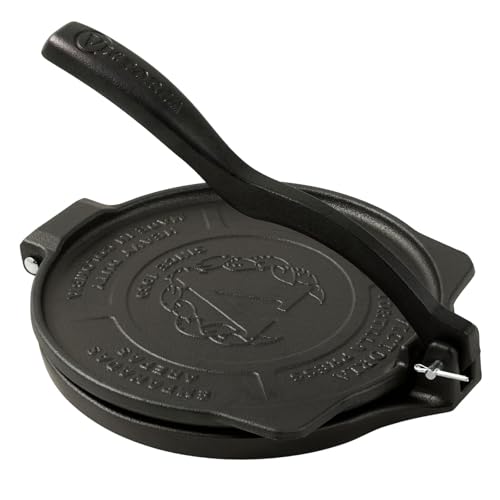
The Victoria is the reference point for cast iron presses, made in Colombia by a foundry that has cast cookware since 1939. The plates are cast iron with an engineered flat surface and a textured finish that holds seasoning, and the press arrives pre-seasoned with three layers of flaxseed oil rather than a synthetic coating. That seasoning matters because masa is wet: a seasoned plate releases a lined tortilla cleanly and resists rust between uses, as long as the press is dried after washing and never left soaking.
At roughly 8.4 pounds, this is the heaviest press in the guide, and the weight is functional. The top plate’s mass does most of the flattening, so a firm pull on the reinforced lever handle produces a thin, even disc without leaning body weight into it. The hinge uses stainless steel pins, and the handle is curved for a better grip angle through the stroke. The footprint is the trade-off: at about 11 inches deep with the handle geometry included, it needs real counter or cupboard space, and nobody will call it light to move.
Specs
- Plate diameter: 8 inches
- Material: Cast iron, pre-seasoned with flaxseed oil
- Weight: Approximately 8.4 lb
- Handle: Reinforced cast iron lever with ergonomic curve
- Hinge: Stainless steel pins
- Footprint: Approximately 10.4 x 11.3 inches
- Liners included: None — use parchment or a cut plastic liner
- Model: TOR-003, made in Colombia
2. Uno Casa Cast Iron Tortilla Press, 8 Inch

The Uno Casa takes the same cast iron formula and packages it as a ready-to-start kit. The press itself is a pre-seasoned cast iron unit with 8-inch plates and a level pressing surface, weighing about 7.2 pounds — noticeably easier to lift in and out of a cupboard than the Victoria, while still heavy enough that the plate does most of the work on a standard masa ball.
What separates it is the box contents. One hundred parchment paper rounds come included, sized to the plates, so the press can be used the day it arrives without cutting liners from a plastic bag or a parchment roll. An extra screw set is also in the box, which is a small but practical touch: the hinge and handle hardware on any lever press takes repeated stress, and having the spare fasteners on hand turns a loose handle from a dead tool into a five-minute fix. The plates are flat with no raised rim, so thickness is governed by how far the handle travels — consistent pressure gives consistent discs, and pressing a second time after rotating the tortilla a quarter turn evens out any hinge-side bias.
Specs
- Plate diameter: 8 inches
- Material: Cast iron, pre-seasoned
- Weight: Approximately 7.2 lb
- Handle: Cast iron lever
- Footprint: Approximately 9.8 x 8 x 2 inches
- Liners included: Yes — 100 parchment paper rounds
- Extras: Spare screw set included
- Care: Hand wash only
3. IMUSA Aluminum Tortilla Press, 8 Inch (MEXI-86008)

The IMUSA MEXI-86008 is the traditional Mexican-style press in cast aluminum, and its defining number is 1.8 pounds. That is roughly a quarter of the weight of the cast iron presses above, which changes how the tool gets used: it hangs on a hook, travels to a camp kitchen or a relative’s house without a second thought, and stores in a drawer-adjacent cupboard where an 8-pound iron press would be a nuisance.
The trade-off is pressing force. Aluminum plates do not carry the mass to flatten a stiff masa ball on gravity and leverage alone, so the long curved handle matters more here — it provides the leverage, and the user supplies more of the downward effort, especially for larger or drier dough balls. For standard hydrated corn masa, the press produces even 8-inch rounds without drama. The bare aluminum finish needs a liner every time, since masa sticks to unseasoned metal, and no liners are included. Aluminum also cannot be seasoned like iron; the liner is not optional equipment, it is part of the system.
Specs
- Plate diameter: 8 inches
- Material: Cast aluminum, silver finish
- Weight: Approximately 1.8 lb
- Handle: Curved aluminum lever for leverage
- Footprint: Approximately 10.4 x 7.9 x 5.1 inches
- Liners included: None — a liner is required to prevent sticking
- Model: MEXI-86008
- Best for: Corn tortillas, tostones, arepas, empanada discs
4. panan Wooden Tortilla Press, 6 Inch Square (Bamboo)

Wooden presses work differently from metal ones: instead of a round plate, the panan uses two flat square bamboo boards joined by a hinge, with a lever handle that folds the top board down onto the dough. This 6-inch version is the small-format pick, sized for street-taco corn tortillas, dumpling wrappers, and mini flatbreads rather than full-size wraps. The square plates are a genuine advantage at this size — the corners give the liner something to grip, and small rounds release without tearing.
Bamboo is light, at about 2.9 pounds for the whole press, and it does not rust, need seasoning, or require oiling. What it cannot do is match cast iron for sheer flattening force on stiff dough, so this press suits soft, well-hydrated masa and small dough balls best. Thickness consistency depends on even handle pressure, and like every wooden press it must be lined: wet masa bonds to wood grain and will tear on release if pressed bare. No parchment rounds are listed in the box; a recipes eBook is included instead, so plan on cutting liners from parchment or a plastic produce bag before the first use.
Specs
- Plate size: 6 inches, square plates
- Material: Bamboo wood
- Weight: Approximately 2.9 lb
- Handle: Wooden lever with hinged top board
- Footprint: Approximately 9.2 x 6.5 x 3.9 inches (packaged dimensions)
- Liners included: None listed — liner required for masa
- Extras: Recipes eBook included
- Model: S23
5. Uprony Wooden Tortilla Press, 10 Inch

The Uprony is the large-format option: 10-inch wooden plates that can produce the big rounds quesadillas, burrito-size wraps, and enchiladas call for — the sizes an 8-inch press physically cannot reach. The construction is solid wood with a hinged top plate and lever handle, and at about 3.1 pounds it delivers that larger plate in a tool that still hangs up or slides into a cupboard easily.
Ten inches of plate also exposes the wooden format’s limits honestly. A wood press this size flexes more than iron under hard pressure, and even thickness across a full 10-inch span takes a deliberate, centered pull on the handle; pressing, rotating the lined tortilla, and pressing again is the reliable technique. The kit contents help from day one: 50 parchment paper sheets and a small rolling pin are included, and the rolling pin is not filler — it is exactly the tool needed for the flour-tortilla finish described at the top of this guide, since flour dough springs back after pressing at any plate size. For corn masa, the liners keep the release clean and protect the wood from moisture.
Specs
- Plate diameter: 10 inches
- Material: Wood
- Weight: Approximately 3.1 lb
- Handle: Wooden lever with hinged top plate
- Footprint: Approximately 10.9 x 10.8 x 2.7 inches (packaged dimensions)
- Liners included: Yes — 50 parchment paper sheets
- Extras: Rolling pin included
- Best for: Quesadillas, burrito-size wraps, enchiladas, roti
How to Choose a Tortilla Press
Start with plate size, because it cannot be changed later. Six-inch plates suit street tacos and dumpling wrappers. Eight inches is the standard for everyday corn tortillas and the size most recipes assume. Ten inches is for burrito wraps and quesadillas. Remember the hard rule: the plate caps the tortilla, so an 8-inch press will never produce a 10-inch round.
Match the material to how you cook. Cast iron presses itself, in effect — the plate weight does the work, the seasoning protects the surface, and the tool will outlast its owner with basic drying and oiling care. The cost is literal weight and storage space. Cast aluminum gives up pressing force for portability; it suits occasional tortilla nights and small kitchens. Wood sits between them on effort, never rusts, and brings the traditional tortillero feel, but it demands a liner every time and rewards softer dough.
Think about thickness honestly. No manual press has a thickness gauge. Final thickness comes from dough ball size, hydration, and how hard the handle is pulled, and every hinged press leaves the hinge side marginally thinner than the handle side. The fix is technique, not money: press once, rotate the lined tortilla a quarter turn, and press again. Consistent dough ball weight matters more than press brand for consistent tortillas.
Plan the liner before the first press. Masa sticks to bare aluminum and bare wood, and it can grab seasoned iron too. Parchment rounds are the tidy option — the Uno Casa and Uprony include a starter supply — while a cut-open plastic produce bag is the traditional reusable alternative. Either way, the dough ball goes between two layers of liner, slightly toward the hinge, so it spreads toward the handle side as it flattens.
Know what a press does not do. It does not cook. Pressed tortillas still go onto a dry, hot comal or skillet until they puff and spot. And for flour tortillas, keep expectations straight: the press gives a head start on shape and thickness, but gluten spring-back means a rolling pin finish is the normal last step, not a sign of a bad press.
More from Amazon
Programs that pair well with the guide above. Offers and eligibility are set by Amazon and may change.
Free shipping on eligible items, Prime Video and more. Eligible new members can start with a free trial.
Start a Prime free trialA Prime membership for ages 18-24 with a trial period. Eligibility is set by Amazon.
See Prime for Young AdultsAudiobooks and podcasts to listen to on the go. Eligible new members can start with a free trial.
Try Audible freeAd-free music streaming. Eligible new subscribers can start with a free trial.
Try Music Unlimited freeAs an Amazon Associate we earn from qualifying purchases.


Write Your Review
No reviews yet. Be the first to share your experience!