

Key takeaways
- Compare five vacuum storage bags for clothes, bedding and travel, from jumbo valve bags and mixed-size combo packs to a roll-up set for suitcases.
As an Amazon Associate we earn from qualifying purchases.
Vacuum storage bags solve a problem every household and every camper knows: soft, bulky textiles take up far more room than their weight justifies. A spare duvet fills a closet shelf, off-season sleeping bags crowd the gear bin, and a suitcase packed with sweaters closes only with effort. A vacuum bag replaces the air trapped in those fibers with a flat, stackable slab. This guide compares five sets — four valve bags that work with a household vacuum or a hand pump, plus one roll-up travel set that needs no vacuum at all — with each maker’s own material wording, seal design, and compression claim quoted in the Specs, because the headline percentages in this category are marketing figures and the construction details are what actually differ.
How to Choose Vacuum Storage Bags
Valve bags versus roll-up bags. Valve bags are the home-storage standard: fill the bag, run the sealing clip across the double zip, then pull the air out through a one-way valve with a vacuum cleaner hose or a hand pump. They reach the deepest compression and suit bedding, duvets, and seasonal clothing. Roll-up bags skip the valve entirely; you seal the zip and roll the bag by hand so air escapes through a one-way vent. They compress less, but they work anywhere — a tent, a cruise cabin, a hostel — with no equipment at all.
Size the bag to the load. Jumbo bags around 40 by 30 inches swallow a queen bedding set or several pillows. Large and medium bags suit sweaters, jackets, and towels, while small bags handle a handful of garments. A mixed-size combo pack is the flexible choice for a whole wardrobe rotation; a single-size jumbo pack is better when the job is bedding only.
Read the material line. Most valve bags are a PA+PE film — polyamide for puncture resistance over polyethylene for the air barrier — though some makers list polypropylene or simply “plastic.” Thicker film survives repeated use and sharp zipper teeth on stored garments better than thin film. Whatever the blend, keep bags away from sharp edges, belt buckles, and exposed bed-frame hardware.
Respect the fill line. Every maker prints a maximum fill line and warns against overstuffing. A bag packed past the line strains the zip and the seams, and it is the most common cause of a bag that slowly re-inflates. Leave the stated margin, smooth the contents flat before sealing, and run the clip across the zip more than once.
1. Spacesaver Premium Vacuum Storage Bags, 6-Pack Jumbo

Spacesaver is the name most shoppers meet first in this category, and its Premium line is the straightforward bedding pick: six bags, all in the same jumbo size, with no assortment decisions to make. Each bag measures 40 by 30 inches, and the maker rates one bag for four pillows or a complete queen-size bedding set, which makes the pack a clean fit for households rotating duvets, comforters, and guest bedding between seasons or packing bulky linens for a move.
The sealing system is the brand’s signature pairing of a double-zip seal with a triple-seal turbo valve: the zip closes the mouth of the bag, and the capped valve lets a vacuum hose or the included hand pump pull air out without letting it creep back in. A travel hand pump is in the box, which matters for campers and anyone sealing bags in a storage unit or cabin where no vacuum cleaner is available. Spacesaver’s headline claim for the line is “80% more space,” quoted here as the maker’s own figure rather than a measured result.
Specs
- Bag count and sizes: 6 bags, all Jumbo at 40 x 30 in each
- Capacity guide: Maker rates one bag for 4 pillows or 1 queen-size bedding set
- Material: PA+PE plastic film; the maker describes it as thick, durable, and reusable
- Seal: Double-zip seal closed with a sealing clip
- Valve: Triple-seal turbo valve with cap; works with a standard vacuum hose
- Hand pump: Included (travel hand pump)
- Maker’s compression claim: “80% more space” (maker’s figure)
2. Amazon Basics Vacuum Compression Storage Bags, 6-Pack

The Amazon Basics 6-pack is the mixed-size alternative to a single-size box: two jumbo, two large, and two medium bags cover a bedding set and a shelf of sweaters in one purchase. The jumbo bags measure 40 by 30 inches (100 x 76 cm), the large bags 80 x 60 cm, and the medium bags 70 x 50 cm, so the set maps neatly onto a seasonal wardrobe swap — duvet in a jumbo, coats in the larges, knitwear in the mediums.
Construction follows the same proven pattern as the Spacesaver set: a PA+PE film, a heavy-duty double-zip seal, and a triple-seal turbo valve that accepts either a standard vacuum cleaner hose or the included hand pump. Amazon’s own instructions are worth following literally — leave about four inches of space at the closing side, slide the zipper clip along the edge several times, then vacuum. The maker’s stated figure is compression of bulky textiles by up to 80 percent, again a best-case number for soft, lofty loads rather than a promise for every fabric.
Specs
- Bag count and sizes: 6 bags — 2 Jumbo (40 x 30 in / 100 x 76 cm), 2 Large (80 x 60 cm), 2 Medium (70 x 50 cm)
- Material: PA+PE film, transparent
- Seal: Heavy-duty double-zip seal with zipper clip
- Valve: Triple-seal turbo valve; fits standard vacuum hoses
- Hand pump: Included
- Maker’s compression claim: Compresses textiles by up to 80% (maker’s figure)
3. HIBAG Vacuum Storage Bags, 30-Pack Combo

Where the first two sets are sized for one closet job, the HIBAG 30-pack is the whole-house option. Thirty bags in the brand’s combo assortment span small, medium, large, and jumbo valve bags plus hand roll-up travel bags, so a single box covers the linen closet, the kids’ outgrown clothes, the camping bedding bin, and a couple of suitcases. HIBAG’s own size guide rates the small bag for six to eight sweaters, the medium for eight to ten sweaters or one to two winter coats, the large for ten to twelve sweaters or pillows and curtains, and the jumbo for a double duvet or a queen bedding set.
The valve bags use screw-on ports that accept any standard vacuum hose, and a hand pump is included for sealing away from home; the roll-up bags in the assortment need neither, which is handy for travel. One honest difference to note before buying: the listing gives the material as polypropylene (PP) rather than the PA+PE film of the sets above, so shoppers who specifically want the nylon-layer film should weigh that. The maker’s headline for the set is the promise to “save 80% closet and suitcase space” — a claim, not a measurement, and real results depend on how lofty the load is.
Specs
- Bag count and sizes: 30 bags in the 30-COMBO assortment — small, medium, large, and jumbo valve bags plus hand roll-up travel bags
- Capacity guide (maker’s size chart): Small fits 6–8 sweaters; Medium 8–10 sweaters; Large 10–12 sweaters; Jumbo fits a double duvet or queen bedding set
- Material: Listed by the maker as polypropylene (PP)
- Seal: Zipper closure with sealing clip
- Valve: Screw-on valve port; works with any standard vacuum hose or the hand pump
- Hand pump: Included (1 hand pump)
- Maker’s compression claim: “Save 80% closet and suitcase space” (maker’s figure)
4. GONGSHI Vacuum Storage Bags, 12-Pack Combo

The GONGSHI 12-pack splits the difference between the six-bag sets and the HIBAG box: twelve bags, three each of jumbo, large, medium, and small, which is enough range for a bedding refresh plus a wardrobe rotation without committing to thirty bags. The jumbos measure 40 by 30 inches, the larges 32 by 24, the mediums 28 by 20, and the smalls 24 by 16 — the same four-step ladder most brands use, so replacement bags from other makers pair predictably with these.
The hardware is familiar and well chosen: a double-seal zipper closed by a sliding clip, and a triple-seal turbo valve that the maker says is designed to get air out and let none back in. The bags work with any standard vacuum cleaner, and a travel hand pump is included for sealing at a destination. GONGSHI describes the film as industrial-grade thick plastic, and the listing’s load guidance is a modest 11 pounds per bag — a useful reminder that these bags are for bulky but light textiles, not for dense loads. Compression claims for this set are stated as a general size reduction rather than a percentage, which is refreshingly restrained for the category.
Specs
- Bag count and sizes: 12 bags — 3 Jumbo (40 x 30 in), 3 Large (32 x 24 in), 3 Medium (28 x 20 in), 3 Small (24 x 16 in)
- Material: Thick plastic film; the maker describes it as industrial-grade PA+PE
- Seal: Double-seal zipper with sliding clip
- Valve: Triple-seal turbo valve; works with any standard vacuum cleaner
- Hand pump: Included (travel hand pump)
- Load guidance: 11 lb per bag as listed
- Maker’s compression claim: Stated as a size reduction without a percentage figure
5. HIBAG Travel Compression Bags, 12-Pack (Roll-Up)
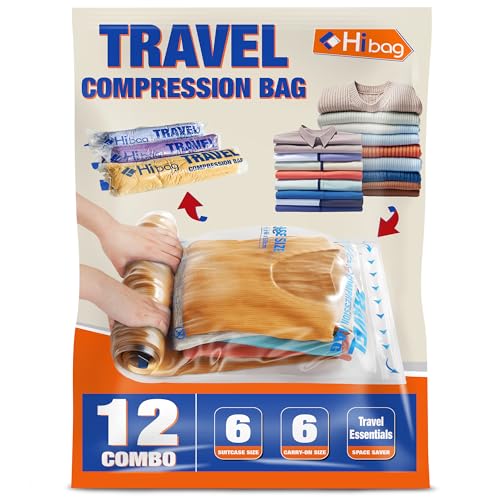
This is the roll-up pick in the guide, included deliberately and labelled as such: the HIBAG 12-Travel set has no vacuum valve and needs no pump. Twelve bags — six medium and six large, in the maker’s carry-on and luggage sizes — are sealed with a double zip and then rolled by hand, which pushes the air out through a one-way vent at the end of the bag. That makes the set the natural choice for cruises, camping trips, and return legs of journeys where the clothes are bulkier than they were on the way out and no vacuum exists.
The detail that sets this set apart is the zip itself: the two zip lines are color-coded, one yellow and one blue, so a fully closed seal is easy to confirm at a glance — a small thing that prevents the classic roll-up failure of a bag slowly re-inflating inside a suitcase because one inch of zip was left open. HIBAG states the bags reduce contents by up to 75 percent of their original volume, and elsewhere describes the set as providing up to three times the packing space; treat both as maker figures for soft clothing, not bedding. Roll-up compression is gentler than a vacuum’s, which some travelers prefer for garments they will wear straight out of the bag.
Specs
- Bag count and sizes: 12 roll-up bags — 6 medium and 6 large (maker’s carry-on and luggage sizes)
- Compression method: Roll-up by hand; no vacuum and no pump required or supplied
- Material: Polyethylene (PE) film; the maker describes it as extra thick
- Seal: Double zip with color-coded yellow and blue lines to confirm closure
- Valve: No vacuum valve; one-way air vent releases air while rolling
- Hand pump: Not included (not needed)
- Maker’s compression claim: Reduces contents by up to 75% of original volume (maker’s figure)
Which Set Fits Your Storage Job?
For bedding only, the Spacesaver 6-pack of identical jumbo bags is the simplest buy, and its included hand pump suits storage units and cabins. For a mixed wardrobe rotation, the Amazon Basics 6-pack and the GONGSHI 12-pack ladder their sizes from jumbo down to small, with the GONGSHI box doubling the count. The HIBAG 30-pack is the bulk option for a whole household, keeping in mind its polypropylene film differs from the PA+PE used by the others. And for travel without access to a vacuum, the HIBAG roll-up set trades some compression for total independence from equipment.
Whichever set you choose, the habits matter more than the brand: fill only to the printed line, smooth contents flat, run the sealing clip twice, and store the flattened bags somewhere they will not be punctured or baked by heat.
An Honest Word on Compression Claims
Every percentage in this guide is a maker’s figure, measured — if measured at all — on the loftiest possible load, such as a puffy duvet that is mostly trapped air. Dense or already-flat items compress far less, and no bag creates space from nothing; it only removes air. Expect strong results on comforters, pillows, sleeping bags, and fleece, and modest results on jeans, books-adjacent packing, or anything rigid.
Compression also has a cost over time. Months spent fully compressed can leave deep creases in structured garments, and down and feather fills can lose loft permanently if they are stored crushed for long periods — several makers advise against long-term compressed storage of down, and against storing leather or fur in vacuum bags at all. A sensible routine is to store down gear compressed only for transport or a single season, then let it loft in a breathable cotton sack for the rest of the year. Finally, a bag that has slowly softened after some months is not necessarily defective: tiny amounts of air migration through film and seals are normal in this category, and a quick re-vacuum restores the slab.
Safety and Recall Check
We searched the U.S. Consumer Product Safety Commission’s SaferProducts.gov recall database on November 21, 2026, using the product names “vacuum storage bag,” “storage bag,” and “vacuum bag.” The searches returned no recalls for vacuum storage bags, and none of the five products in this guide is the subject of a CPSC recall we could find. That is a statement about the recall database only, not a general safety certification.
The standing safety rules for this product type still apply. Thin plastic bags are a suffocation hazard: keep them away from babies and children, never use them in cribs, beds, carriages, or playpens, and do not let children treat them as toys. Keep filled bags away from radiators, heaters, and sharp objects, respect each maker’s fill line so seams are not stressed, and use these bags for textiles only — they are not food-storage products and are not a substitute for dry, climate-controlled storage of delicate items.
Affiliate Disclosure
This article contains affiliate links. If you buy through a link on this page, we may earn a commission at no additional cost to you. Product details and specifications are taken from the manufacturers’ own listings at the time of writing.
More from Amazon
Programs that pair well with the guide above. Offers and eligibility are set by Amazon and may change.
Free shipping on eligible items, Prime Video and more. Eligible new members can start with a free trial.
Start a Prime free trialA Prime membership for ages 18-24 with a trial period. Eligibility is set by Amazon.
See Prime for Young AdultsAudiobooks and podcasts to listen to on the go. Eligible new members can start with a free trial.
Try Audible freeAd-free music streaming. Eligible new subscribers can start with a free trial.
Try Music Unlimited freeAs an Amazon Associate we earn from qualifying purchases.










Write Your Review
No reviews yet. Be the first to share your experience!