

Key takeaways
- The best WAG bags for Leave No Trace camping and hiking compared: gelling waste kits from Cleanwaste, Restop, PACT, Reliance and Biffy Bag, with specs.
As an Amazon Associate we earn from qualifying purchases.
A WAG bag — short for Waste Alleviation and Gelling bag — is a portable human waste disposal kit built around a simple idea: you do your business into an inner bag that already contains a gelling and deodorizing powder, seal that bag inside a second, puncture-resistant outer bag, and carry the whole package out with you. Nothing gets buried, nothing gets left behind, and the sealed kit goes into the regular trash once you reach the trailhead in most areas where these systems are used.
Packing out human waste used to be a niche practice for river runners and mountaineers. It is now routine on heavily used trails, in alpine zones where soil is too thin for a cathole to work, in desert country where waste barely decomposes, and anywhere land managers have decided that burial is no longer acceptable. If a permit, a ranger, or a trailhead sign tells you to carry a WAG bag, one of the five kits below will do the job. They differ in pack size, powder type, what extras are included, and whether they are built for a backpack or for a bucket toilet at a base camp.
Affiliate Disclosure: This article contains affiliate links. If you buy through a link on this page, we may earn a commission at no additional charge to you. Product information comes from manufacturer and retailer listings, and we do not accept payment for placement in these roundups.
When a WAG Bag Is Required, Not Optional
Leave No Trace guidance treats the cathole as the default for backcountry waste, but land managers override that default in a growing list of places. On Mt Whitney, rangers issue a WAG bag with every permit because the rocky alpine terrain above treeline cannot absorb waste. River corridors such as the Grand Canyon require all human waste to be carried out, and backpackers hiking in and out of the canyon are expected to pack out as well. Desert canyon country in Utah, high alpine basins in the Rockies and the Sierra, narrow slot canyons, and snow-covered routes all share the same problem: waste buried there either does not break down or ends up in a water source.
Even where a WAG bag is not legally required, it is often the most responsible option. If the ground is frozen, saturated, within 200 feet of water, or so rocky that a proper cathole cannot be dug, a waste kit solves the problem completely. Carrying one also removes the guesswork for new backpackers, scout groups, and families who are still learning backcountry skills.
How the Double-Bag and Gelling System Works
Every kit in this roundup follows the same basic architecture. The inner bag is the one you use. It is pre-loaded with a treatment powder — a blend built around super-absorbent polymers, the same family of materials used in diapers, often combined with enzymes or odor-neutralizing agents. Liquid hitting the powder turns to gel within minutes, which locks in moisture, suppresses smell, and starts breaking waste down. Most kits add a small supply of toilet paper and a hand wipe so the system is self-contained.
When you are finished, the inner bag is tied or folded closed and dropped into the outer bag. The outer bag is the serious piece of engineering: thicker plastic, a zip closure, and enough puncture resistance to survive being lashed to the outside of a pack or tossed into a bear canister alongside food. That double containment is what makes land managers comfortable with the system, and it is what separates a real WAG bag from a plain plastic sack.
Disposal is the part people get wrong, so it is worth stating plainly. A used WAG bag goes in the regular trash — these kits are designed and approved for landfill disposal in most jurisdictions, because the gelled, double-sealed waste is treated as ordinary solid waste. Never bury a WAG bag. The plastic does not break down in soil, animals dig buried bags up, and burial defeats the entire purpose of carrying the kit. Always check local rules before a trip, because a small number of municipalities restrict trash disposal of waste bags, and some trailheads provide dedicated WAG bag collection bins that should be used instead.
The 5 Best WAG Bags Compared
1. Cleanwaste Original WAG Bag — GO Anywhere Toilet Kit, 12 Pack

Cleanwaste is the company that defined this product category, and its Original WAG Bag is the kit most commonly handed out with backcountry permits in the United States. Each of the twelve kits in the box is individually complete: an inner waste bag pre-loaded with Poo Powder, an outer puncture-resistant disposal bag with a zip closure, toilet paper, and a hand wipe. There is nothing else to buy and nothing to assemble, which is exactly what you want when a ranger hands you a permit and points at the trail.
The Poo Powder is the heart of the system. The gelling formula — a technology Cleanwaste traces to absorbent development work done for the space program — gels liquid waste on contact, neutralizes odor, and begins breaking down solids. The inner bag can be used on the ground, over a rock or log, or with Cleanwaste’s folding GO Anywhere toilet seat. For most backpackers, hikers, and climbers, this is the benchmark kit: proven, widely stocked, and accepted everywhere WAG bags are required.
Specs
- Bags per pack: 12 individual kits
- Treatment: Poo Powder gelling and deodorizing powder, pre-loaded in the inner bag
- Includes: inner waste bag, outer puncture-resistant zip-close disposal bag, toilet paper, hand wipe in each kit
- Capacity: 2 lb per kit (manufacturer listing)
- Use: ground use or with the GO Anywhere portable toilet seat
- ASIN: B001P6ZFG2
- Source: https://www.amazon.com/dp/B001P6ZFG2
2. RESTOP 2 Disposable Waste Bag — 24 Pack

The RESTOP 2, model RS2, comes out of the portable sanitation industry rather than the outdoor retail world, and it shows in the engineering. The bag uses a patented triple-layer barrier design — effectively a bag within a bag — with gelling polymers and enzymes sealed inside the inner bag. Waste is funneled down into the treatment zone, the inner bag is closed off, and the outer barrier layer handles containment for the carry out. Each bag handles both liquid and solid waste, which not every kit on the market can claim.
Every RS2 includes toilet tissue and an antimicrobial wet wipe, and the 24-count pack suits groups, guide services, and anyone stocking a base camp or an emergency kit. The rated capacity of 32 fluid ounces per bag is generous for a single use. RESTOP bags are used by outdoor programs, event organizers, and agencies that need a sanitation system with no moving parts. One honest note: the parent company has been transitioning the RESTOP brand under the Cleanwaste name, so packaging may carry either label while the RS2 product itself remains the same design.
Specs
- Bags per pack: 24 bags
- Treatment: gelling polymers and enzymes in the inner bag; triple-layer barrier bag-within-bag design
- Includes: toilet tissue and antimicrobial wet wipe with each bag
- Capacity: 32 fl oz of liquid or solid waste per bag
- Use: ground use or with a commode system
- ASIN: B07X7KRNNH
- Source: https://www.amazon.com/dp/B07X7KRNNH
3. PACT Pack Out Kit — 6 Pack
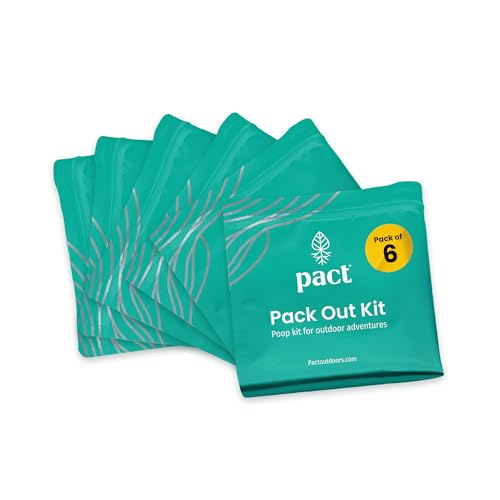
PACT Outdoors designed its Pack Out Kit specifically for backpackers, and it is the lightest and most thoughtfully packaged option in this roundup. Each kit weighs about 2.1 ounces and is color-coded so you can tell the inner bag from the outer disposal bag at a glance in dim light. The treatment is a dehydrating and deodorizing poop powder rather than a pure gelling agent, which keeps the used kit compact instead of swelling it into a gel pillow.
Instead of a token square of toilet paper, PACT includes two compressed wipes that expand into full-size towels with a squirt of water, plus a separate hand wipe. Clear instructions are printed right on the kit, which makes it a smart choice for groups handing bags to first-time backpackers. The one limitation to know before you buy: the PACT kit is designed for solid waste only, so liquid waste needs to be handled separately, ideally on soil or gravel away from water where regulations allow. For ounce-counting hikers on routes where pack-out is required, that trade-off is usually worth it.
Specs
- Bags per pack: 6 kits
- Treatment: dehydrating and deodorizing poop powder (solid waste only)
- Includes: inner bag, outer smell-proof zip disposal bag, 2 compressed wipes, hand wipe in each kit
- Weight: about 2.1 oz per kit
- Use: backpacking and hiking pack-out routes
- ASIN: B0DF8RVB2B
- Source: https://www.amazon.com/dp/B0DF8RVB2B
4. Reliance Double Doodie Plus with BIO-Gel — 6 Pack

The Reliance Double Doodie Plus serves a different job than the backpacking kits above. These are large-format waste bags built to line a portable toilet — a Reliance Luggable Loo, a folding camp toilet, or a plain five-gallon bucket with a snap-on seat. The inner bag comes pre-charged with BIO-Gel, Reliance’s waste gelation powder, which solidifies liquid waste and controls odor. After use, the inner bag is sealed inside the outer zip-lock bag, which has a carry handle and a double-zip closure.
For car camping, base camps, hunting camps, ice-fishing shelters, and group sites where a bucket toilet is the sanitation plan, this is the practical pick. One bag can serve a small group for a day of toilet use rather than a single person once, which makes the six-bag box go further than the count suggests. The honest limitation: these bags do not include toilet paper or hand wipes, and at their size they are not what you would stuff into a backpack for a Whitney attempt. Buy them for the bucket, not the trail.
Specs
- Bags per pack: 6 bags
- Treatment: BIO-Gel waste gelation powder, pre-loaded in the inner bag
- Includes: inner waste bag and outer zip-lock carry bag with handle (no toilet paper or wipe included)
- Capacity: family-size bags sized for 5-gallon bucket toilets and Reliance portable toilets
- Use: car camping, base camps, and bucket toilet systems
- ASIN: B001123ATE
- Source: https://www.amazon.com/dp/B001123ATE
5. Biffy Bag Pocket Size Disposable Toilet — Pack of 25
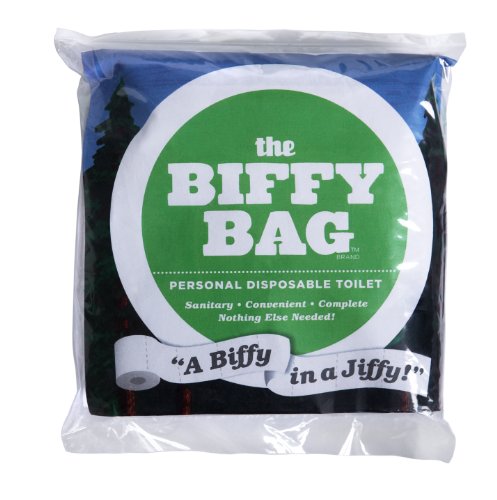
The Biffy Bag takes the most unusual approach in this roundup: the waste bag itself is wearable. Two straps tie around your waist, the bag hangs in position between your legs, and you squat slightly and let gravity work. It sounds odd, but the design solves a real problem — no balancing over a bag spread on the ground, and no separate toilet seat to carry. The used bag then seals into a heavy-duty mylar zip-top transport bag for the carry out.
Inside the bag, Biffy Powder gels and neutralizes waste, and each single-use kit includes an ample supply of toilet paper and an oversized wet wipe. The whole kit folds down to pocket size, small enough for a glove box, a daypack hip belt pocket, or a tackle box, and the 25-count pack is the bulk option for people who use them all season — van travelers, anglers, pilots of small aircraft, and anyone whose work or play keeps them far from facilities. The triple-layer odor protection means a used Biffy Bag rides in a pack without announcing itself.
Specs
- Bags per pack: 25 single-use kits
- Treatment: Biffy Powder gelling and neutralizing powder in the waste bag
- Includes: wearable waste bag with waist straps, mylar zip-top transport bag, toilet paper, oversized wet wipe in each kit
- Design: pocket-size folded kit; triple-layer odor protection
- Use: hiking, travel, boating, and emergency kits
- ASIN: B00A33JV6I
- Source: https://www.amazon.com/dp/B00A33JV6I
How to Choose the Right WAG Bag
Start with where the bag will be used. For backpacking and hiking on pack-out routes, the Cleanwaste Original, RESTOP 2, PACT, and Biffy Bag are all built to be carried in or on a pack; the Reliance Double Doodie belongs with a bucket toilet at a camp you drive to. Choosing between the trail kits comes down to three questions.
First, does the kit handle liquid waste? Cleanwaste, RESTOP 2, Reliance, and Biffy Bag gel both liquid and solid waste in one bag. The PACT kit is solid-waste only, which is fine where regulations allow urinating on durable surfaces, but a poor fit for river trips and snow camps where everything must be contained. Second, what is included? A kit with toilet paper and a hand wipe is a complete system; a bag without them means packing supplies separately and remembering them at the worst moment. Third, how many days are you covering? Count one bag per person per day as a working rule on required pack-out routes, and buy the pack size that covers the trip with a spare or two — a 12-pack or 24-pack usually works out better for groups than single kits.
Weight matters at the margins. A traditional gelling kit adds a few ounces before use and more after; the PACT kit is the lightest option here because it dehydrates rather than gels. Whatever you carry, store used bags in an opaque stuff sack or a dedicated hard-sided container, well away from food, and never inside a sleeping bag stuff sack or clothing layer.
Using and Disposing of a WAG Bag Correctly
Technique is simple but worth rehearsing before the trail. Set up on a flat, durable surface at least 200 feet from water, trails, and camp. Open the inner bag wide and roll the top edge down so it stays open. When finished, add the toilet paper and wipe to the inner bag — everything goes in, nothing is left on the ground. Close the inner bag, expel excess air, and seal it inside the outer bag. Use the hand wipe last, and put it in the bag too.
At the trailhead or back home, the sealed kit goes into regular household trash or a designated collection bin where one is provided. Landfill disposal is the intended endpoint for these systems in most states and counties, since the waste is gelled, sealed, and treated. What you must never do is bury the bag, burn it in a campfire, or drop it in a vault toilet or portable toilet tank — the plastic and gel foul those systems. If local rules differ where you live or travel, the local rule wins; a quick check of the land manager’s website before the trip settles it.
Final Thoughts
A WAG bag is not glamorous gear, but in the places that require one, it is as essential as a bear canister. The Cleanwaste Original WAG Bag is the safest all-around choice and the one most likely to match what a ranger hands you. The RESTOP 2 brings sanitation-industry engineering and a big 24-count pack. The PACT Pack Out Kit is the lightest and best explained for backpackers. The Reliance Double Doodie Plus runs a bucket toilet at base camp, and the Biffy Bag folds small enough to live in a glove box. Match the kit to the trip, pack out everything, and the places that need protecting stay worth visiting.
More from Amazon
Programs that pair well with the guide above. Offers and eligibility are set by Amazon and may change.
Free shipping on eligible items, Prime Video and more. Eligible new members can start with a free trial.
Start a Prime free trialA Prime membership for ages 18-24 with a trial period. Eligibility is set by Amazon.
See Prime for Young AdultsAudiobooks and podcasts to listen to on the go. Eligible new members can start with a free trial.
Try Audible freeAd-free music streaming. Eligible new subscribers can start with a free trial.
Try Music Unlimited freeAs an Amazon Associate we earn from qualifying purchases.










Write Your Review
No reviews yet. Be the first to share your experience!