

Key takeaways
- Five bookends compared on weight per end, base design and grip: tall steel for binders, cast iron pairs near three pounds each, and compact steel picks.
As an Amazon Associate we earn from qualifying purchases.
A bookend is a physics problem wearing a decorative costume. A row of books leans because gravity pulls the unsupported end of the row sideways, and the only things resisting that push are friction, mass, and leverage. Bookends solve it in two fundamentally different ways. The first is the flat base plate: a thin steel flange that slides underneath the first few books in the row, so the books’ own weight pins the end down and the upright plate simply gives them something to lean against. The second is the free-standing heavy end: a solid block of cast iron or stone whose own mass and a grippy bottom do all the work, with nothing tucked under the books at all.
That distinction matters more than style, because each design fails differently. A base-plate end holds almost any row as long as enough books sit on the plate — take too many books off the shelf and the same end skates around uselessly. A free-standing end works with a row of three books or thirty, but only up to the limit of its own weight: a three-pound end will hold a leaning row of novels all day, yet a shelf of tall, heavy art books and oversized cookbooks can walk it slowly across the shelf or tip the whole row over it. Height matters too. An end that reaches only halfway up a tall cookbook braces it below its centre of gravity, which is exactly how big books fold over the top of short bookends.
The five picks below cover both designs honestly: a tall steel library end for binders and big reference books, two cast iron pairs at roughly three pounds per end, a compact bent-steel end for everyday shelves, and one light decorative steel end included with its limits stated plainly. Every Specs block pins the weight per bookend where the maker publishes it — and says so where the maker does not.
Affiliate Disclosure: This article contains affiliate links. If you buy through them, we may earn a commission at no extra cost to you. Product details and specifications are taken from the makers’ own published listings.
How to Choose Bookends for Heavy Books
Start with the heaviest row you own, not the average one. Cookbooks, atlases, binders and art books are the loads that defeat bookends. Weigh the decision by the tallest, heaviest shelf you need to tame: that row wants either a tall base-plate end with several books parked on the flange, or a free-standing end of at least a few pounds per side.
Match the height to the books. As a working rule, the upright should reach at least two-thirds of the height of the tallest book it braces. A 6-inch end against an 11-inch cookbook is a hinge, not a brace. Tall steel ends in the 9 to 10 inch range exist precisely for binders and oversized volumes.
Check the shelf depth before the style. A base-plate end needs its flange fully under the books, which means the shelf must be deeper than the plate is long, with the upright sitting where the row actually ends. A free-standing end needs only its own footprint, but that footprint — often just 3 inches deep on cast iron designs — is also all that resists tipping, so narrow-based heavy ends belong against a full row, not a half-empty one.
Protect the shelf. Bare metal on finished wood or painted shelving will scratch eventually, and heavy cast iron dragged sideways scratches fastest. Full anti-slip bases and foam or rubber pads are not cosmetic extras; they add the friction the design depends on and keep the finish intact. If a pick has no pads, budget a minute to stick on felt pads yourself.
Be sceptical of the words “heavy duty.” The phrase appears on bookends weighing a few ounces. The honest figures are the published weight per end, the height, and the base design — which is why each pick below leads with those numbers rather than the marketing label.
1. Officemate Heavy Weighted Bookends, 10-Inch Steel (93182)
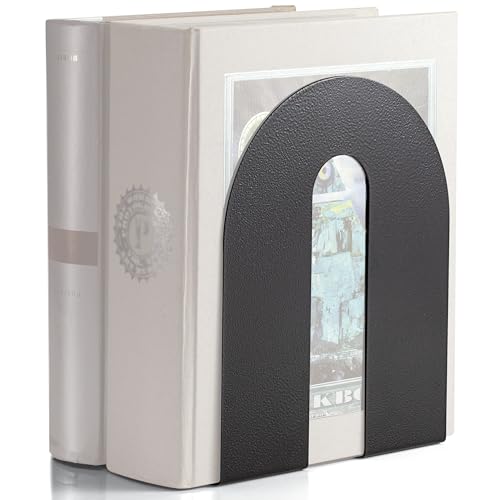
Officemate’s 93182 is the library pattern done at full size: a ribbed steel upright a full 10 inches tall, on a wide flat base flange, finished in black enamel. This is the pick for the rows that break lesser bookends — three-ring binders, directories, atlases and the big hardcover cookbooks that fold over shorter ends. The height is the point: at 10 inches, the plate braces tall volumes well above their midpoint, and the ribbed pressing keeps the tall plate from flexing under a leaning load.
The base is a flat steel flange designed to sit under the first books of the row, with a padded non-skid base underneath that both grips the shelf and protects the finish. Used that way — flange loaded with books — the holding power comes from the row itself, and this end will manage a heavy shelf confidently. Used free-standing at the end of a short row with nothing on the flange, it is just a light steel plate and will slide like one; the design assumes you load the base.
One transparency point: Officemate sells this model under a “heavy weighted” name but does not publish a per-bookend weight, and the weight field in the listing data is unreliable. Judge it on its dimensions and design rather than on a number the maker does not stand behind.
Specs
- Sold as: 1 pair (2 bookends)
- Dimensions: 10 in tall; base flange approx. 8 x 6.5 in
- Weight per bookend: not published by the maker
- Material: steel with black enamel finish, ribbed upright
- Base design: flat plate that slides under the first books of the row
- Non-slip protection: padded non-skid base
- Shelf depth needed: at least 6.5 in for the flange, plus the row itself
2. CRAFTSMAN ROAD Cast Iron Brick Arch Bookends

The Brick Arch set is the free-standing answer: two solid cast iron ends, each weighing approximately 3 pounds, with a layered brick-arch relief and an antique brass lacquered finish. There is no flange and nothing goes under the books — the ends simply sit at either side of the row and resist by mass, helped by a rubbery anti-skid bottom surface that keeps them from creeping on smooth shelves.
Three pounds per end is a meaningful figure. It is enough to hold a solid row of hardcover novels, cookbooks and reference books upright indefinitely, and the 6-inch height suits standard bookcase shelving where most books live. The honest limit is leverage: at 6 inches tall with a 3-inch-deep base, these ends brace books below the midpoint of genuinely tall volumes, so a row of oversized art books leaning hard can still fold over the top or walk the ends. For the kitchen shelf of standard cookbooks and the living-room bookcase, though, this is the strongest decorative option here — real iron, real weight, and a finish that looks like a vintage find rather than office equipment.
Specs
- Sold as: 1 pair (2 bookends)
- Dimensions: 5 in wide x 6 in tall x 3 in deep, each
- Weight per bookend: approx. 3 lb, as published by the maker
- Material: solid cast iron, antique brass lacquered finish
- Base design: free-standing block; no under-book plate
- Non-slip protection: rubbery anti-skid bottom surface
- Shelf depth needed: 3 in footprint per end
3. Sungmor Cast Iron Dog Bookends

Sungmor’s dog bookends take the same free-standing cast iron formula and give it a sense of humour: two seated dog statues, hand-polished and painted, that happen to weigh about 3.1 pounds each. The pair’s published item weight is 6.16 pounds, which puts each end in the same working class as the Brick Arch set above — heavy enough that a leaning row of hardcovers pushes against something that does not want to move.
At 5.7 inches tall, these are sized for paperbacks, standard hardcovers and the mid-height cookbook shelf rather than for atlases. The footprint is compact at roughly 4.9 x 3.1 inches, so they suit narrower shelves and desks where a wide steel flange would eat into book space. The trade-off for the sculptural shape is contact area: a statue braces a row at the points where its body meets the books, not along a flat vertical plate, so very tall or top-heavy volumes are better served by the flat-faced picks in this guide.
One practical note the listing leaves open: Sungmor does not specify anti-slip pads for this model. Cast iron on polished wood will scratch if the end gets dragged, so stick felt pads under each base before they go on a finished shelf.
Specs
- Sold as: 1 pair (2 bookends)
- Dimensions: approx. 4.9 x 3.1 in footprint, 5.7 in tall, each
- Weight per bookend: approx. 3.1 lb (pair listed at 6.16 lb total)
- Material: cast iron, painted finish
- Base design: free-standing statue base; no under-book plate
- Non-slip protection: not specified by the maker — add felt pads on finished wood
- Shelf depth needed: about 3.1 in footprint per end
4. Acrimet Steel Bookends, 6 7/8-Inch

Acrimet’s bookend is the minimalist’s base-plate design: a single piece of steel, bent once into an L, finished with an electrostatic powder coating. There is nothing to assemble and nothing decorative to dust around — just a 6 7/8-inch upright and a 4 1/2-inch base plate that slides under the row. The full-coverage anti-slip base is the detail that earns its place here: the entire underside grips, which keeps the end planted when you pull a book out one-handed and protects the shelf finish at the same time.
This is the everyday pick for standard shelves — novels, paperbacks, workbooks, magazines and mid-size hardcovers — in home offices, classrooms and kids’ rooms where a plain black end that disappears behind the books is a feature. Its limits are the flip side of its size: at under 7 inches tall it braces tall cookbooks below their midpoint, and like every base-plate end it needs books resting on the plate to do its best work. Acrimet does not publish a per-bookend weight, so judge it as what it is — a well-made light steel end whose holding power comes from the row on its flange, not from its own mass.
Specs
- Sold as: 1 pair (2 bookends)
- Dimensions: 6 7/8 in tall x 4 in wide x 4 1/2 in deep
- Weight per bookend: not published by the maker
- Material: single-piece steel, electrostatic powder-coated finish
- Base design: flat plate that slides under the first books of the row
- Non-slip protection: full-coverage anti-slip base
- Shelf depth needed: at least 4.5 in for the base plate, plus the row itself
5. MaxGear Tree Design Bookends

The MaxGear Tree Design pair is included as the decorative option — with its limits stated up front, because the numbers demand it. The listing’s published item weight is 10.8 ounces for the pair, which is about 5.4 ounces per bookend. That is a light steel end, and no amount of “heavy duty” wording in a product title changes what a leaning row of oversized cookbooks will do to it: on its own mass alone, it loses.
What saves the design is its base. Each end is an L of heavy-gauge powder-coated steel, 7 inches tall with a 4.7 x 3.5 inch flat base that slides under the first books of the row, plus four anti-slip foam pads underneath. Loaded correctly — plate pinned under several books — it holds novels, paperbacks, journals and DVDs neatly, and the cut-out tree silhouette lets the end book’s cover show through, which is the entire point of a decorative end on a visible shelf. Treat it as a paperback-and-novel end for living-room shelving, keep the heavy cookbook row for the cast iron and tall steel picks above, and it does its job well.
Specs
- Sold as: 1 pair (2 bookends)
- Dimensions: 7 in tall; base 4.7 x 3.5 in
- Weight per bookend: approx. 5.4 oz (pair listed at 10.8 oz total)
- Material: heavy-gauge steel, powder-coated black finish
- Base design: flat plate that slides under the first books of the row
- Non-slip protection: 4 anti-slip foam pads under each bookend
- Shelf depth needed: at least 4.7 in for the base plate, plus the row itself
Putting the Right End on the Right Shelf
The pattern across these five picks is simple. Rows fail bookends in two ways — sliding them or folding over them — and each design here answers one failure better than the other. Free-standing cast iron, at roughly three pounds per end, answers sliding and works with any row length, but its modest height caps the size of book it can honestly brace. Base-plate steel answers folding and heavy rows by borrowing the books’ own weight, but only while the plate stays loaded.
So the practical split is this: give the tall steel Officemate pair to the binder and atlas shelf, give the cast iron pairs to the cookbook and hardcover shelves where they will be seen, keep the Acrimet pair for tidy everyday shelving, and let the MaxGear pair decorate the paperback shelf it is actually built for. Whichever you choose, do the two-minute jobs that make any bookend work better: load base plates fully under the row, add felt where pads are missing, and stand the tallest books where the tallest ends are.
More from Amazon
Programs that pair well with the guide above. Offers and eligibility are set by Amazon and may change.
Free shipping on eligible items, Prime Video and more. Eligible new members can start with a free trial.
Start a Prime free trialA Prime membership for ages 18-24 with a trial period. Eligibility is set by Amazon.
See Prime for Young AdultsAudiobooks and podcasts to listen to on the go. Eligible new members can start with a free trial.
Try Audible freeAd-free music streaming. Eligible new subscribers can start with a free trial.
Try Music Unlimited freeAs an Amazon Associate we earn from qualifying purchases.










Write Your Review
No reviews yet. Be the first to share your experience!