

Key takeaways
- Two steam mops, two canister steamers and one handheld compared for sealed floors, grout and upholstery, with tank, heat-up and pressure specs.
As an Amazon Associate we earn from qualifying purchases.
Steam cleaners all do the same basic trick — boil water, push the steam through a pad, pad head or nozzle, and let heat loosen dirt so a cloth can lift it away — but the three shapes in this guide do genuinely different jobs. A steam mop is a floor tool and little else: fast to start, light to push, and done when the floor is. A handheld steamer is the opposite, a short-burst detail tool for grout lines, stovetops, taps and sink rims that runs out of water in minutes. A canister steamer sits between them, trading a long heat-up wait for a big boiler, real pressure and a box of attachments that can move from floor tiles to grout to upholstery in one session. Choosing well means matching the shape to the work before comparing numbers.

One honesty note before the picks. Makers advertise steam as eliminating up to 99.9 percent of common household germs, and that figure comes from controlled tests where steam is held on one spot for a sustained period. A quick mop pass across a kitchen floor does not hold that contact time, so treat sanitising claims as a best-case ceiling rather than a promise for every pass. What steam reliably does — at any setting — is loosen dried-on grime without detergents, which is the reason most people buy one.
The five machines below cover all three shapes: two steam mops, two canister steamers and one handheld, each labelled by type so the trade-offs stay visible.
Affiliate Disclosure: This article contains affiliate links. If you buy through a link on this page, we may earn a commission at no extra cost to you.
What to Look For in a Steam Cleaner
Type decides the job list. Steam mops clean sealed hard floors and nothing else. Handhelds clean small, awkward targets for a few minutes at a time. Canisters are the only shape here that honestly covers floors, grout and upholstery in a single machine, because they carry the water, pressure and attachments to do all three.
Tank size is really session length. A mop’s 15–16 ounce tank covers a room or two. A canister boiler of 40–64 ounces runs from forty minutes to two hours per fill. Handhelds hold a cup or so and are empty before a whole shower is done — fine for a grout line, frustrating for a floor.
Heat-up time splits the classes. Mops are ready in about thirty seconds because they heat a small flow of water on demand. Pressurised boilers take three to twelve minutes, and a sealed boiler cannot be opened and refilled until it cools, so a mid-job refill costs real waiting time.
Pressure matters off the floor. On a flat floor, heat and a pad do most of the work and mop makers often do not publish pressure at all. In grout lines and around taps, a published pressure figure — and a narrow nozzle to deliver it — is what pushes softened grime out of the recess instead of across it.
Respect the floor limits. Steam mops and floor heads belong on sealed tile, stone, sealed hardwood and similar hard surfaces. Unsealed wood, unglazed tile and some laminates can be damaged by heat and moisture, and no steam cleaner here is a carpet extractor: a carpet glider can refresh a carpet’s surface, but it does not pull soil out of the pile the way an extraction machine does.
Check the safety basics. Any pressurised boiler should have a locking safety cap that cannot be opened while the tank is hot and pressurised. Before buying any steam appliance, it is worth a minute on the CPSC recall database to confirm the exact model has no open recall — steam products have been recalled for burn hazards before now.
Bissell PowerFresh Steam Mop 1940A
The PowerFresh is the straightforward steam mop in this lineup: plug it in, wait roughly half a minute, and push it across sealed hard floors. Its removable 16-ounce tank is the largest in the mop class here, and it lifts out for filling at the sink instead of asking you to carry the whole mop to the tap. Three steam settings — low, medium and high — let you match output to the surface, using less steam on sealed hardwood and more on tile. A flip-down scrub brush at the back of the head drops onto dried spills and tracked-in grit that the pad alone would skate over, which makes it the more versatile of the two mops for kitchen floors.
The 23-foot cord is longer than most steam mop cords and covers a large open-plan space without an outlet change. The trade-offs are the class trade-offs: the 12-inch head cleans floors only, there are no detail attachments, and Bissell does not publish a steam pressure figure because a mop’s pad work does not depend on one.
Specs
- Type: Steam mop
- Water tank: 16 fl oz, removable
- Heat-up time: About 30 seconds
- Steam control: 3 settings (low, medium, high)
- Steam pressure: Not published
- Cord length: 23 ft
- Cleaning path: 12 in
- Weight: 6.2 lb
- Included: 2 washable microfiber pads, flip-down Easy Scrubber brush
- Best for: Sealed hard floors, everyday kitchen and bathroom mopping
Shark Steam Pocket Mop S3501
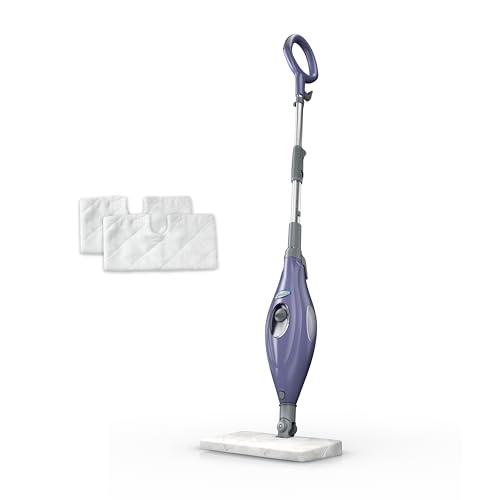
The Shark takes a different route to the same job. Instead of electronic steam settings, it uses a pump-action handle: push the mop and the pumping motion releases steam on demand, so the floor gets steam while you are moving and not while you are standing still. Its pocket pads are the other half of the idea — each microfiber pad is a two-sided pocket that slips over the rectangular head, and when one side is dirty you flip the head and keep going with the clean side. Two washable pads are included, along with a filling flask for the 450 ml tank.
At under five pounds it is the lightest machine in this guide, and the 30-second heat-up matches the Bissell. What you give up is control and reach: there is a single steam level with no adjustment, and the 18-foot cord covers small to medium rooms rather than big open floors. It is a mop for quick, frequent passes over sealed floors, not a detail tool.
Specs
- Type: Steam mop
- Water tank: 450 ml (15 oz)
- Heat-up time: About 30 seconds
- Steam control: Pump-action, on demand; single setting
- Steam pressure: Not published
- Cord length: 18 ft
- Weight: About 4.9 lb
- Included: 2 double-sided washable pocket pads, filling flask, rectangle mop head
- Best for: Sealed hard floors, light and quick mopping
McCulloch MC1385 Deluxe Canister Steam Cleaner

The MC1385 is the whole-house machine here, built around a 64-ounce boiler — the biggest tank in this guide — that the maker rates for up to two hours of steam per fill. That capacity is paid for in patience: the boiler needs about twelve minutes to come up to pressure, and because it is a sealed, pressurised tank, running it dry mid-job means a cool-down before you can refill. Plan the session and it is a strength; grab it for one small spill and it is overkill.
Where it earns its place is pressure and control. Steam is rated up to 58 psi, output is adjusted with a variable control dial, a pressure gauge shows the boiler’s state, and an optional steam lock holds the trigger open for long passes. The 23 included accessories — mop head, extension wands, round and brass brushes, jet nozzles, a squeegee and a fabric tool among them — are what let one machine move from floor tiles to grout lines to upholstery without improvising. This is the pick for a full bathroom-and-kitchen day rather than a single room.
Specs
- Type: Canister steam cleaner
- Water tank: 64 fl oz boiler
- Heat-up time: About 12 minutes
- Steam time: Up to 120 minutes per fill (maker figure)
- Steam pressure: Up to 58 psi (4 bar)
- Power: 1,500 W
- Steam control: Variable dial with pressure gauge and steam lock
- Included: 23 accessories, including mop head, brushes, nozzles and squeegee
- Best for: Whole-house sessions, grout, tile and upholstery
Wagner Spraytech 915e On-Demand Steam Cleaner
The Wagner 915e is the smaller, quicker canister of the two. Its 40-ounce tank heats in about nine minutes and delivers up to forty minutes of steam per fill — enough for a bathroom, a kitchen floor and the grout between them, without committing to the McCulloch’s two-hour session size. Steam pressure is rated at 3.5 bar, and the 8-foot hose puts the jet nozzle into shower corners, around taps and along cooker edges while the canister stays parked on the floor.
Eighteen attachments are included, among them a floor brush with extension tubes, large and small brushes, a jet nozzle and a steam plate that also strips wallpaper — a second job this machine is genuinely built for. Two practical notes: Wagner specifies distilled water for the tank, which is worth following in hard-water areas, and the 6-foot power cord is short, so the hose does most of the reaching and an outlet near the work area matters.
Specs
- Type: Canister steam cleaner
- Water tank: 40 fl oz (1.2 L)
- Heat-up time: About 9 minutes
- Steam time: Up to 40 minutes per fill
- Steam pressure: 3.5 bar (maker figure)
- Power: 1,500 W
- Hose length: 8 ft
- Cord length: 6 ft
- Included: 18 attachments, including floor brush, jet nozzle and wallpaper steam plate
- Best for: Floors plus detail work, bathrooms, wallpaper removal
Comforday Handheld Pressurized Steam Cleaner

The Comforday is the detail specialist: a pressurised handheld that exists for the jobs a mop head cannot reach. It heats its small boiler in roughly three to five minutes and delivers steam at a maker-stated pressure of 3 bar through a set of nine attachments — extension hose, angled nozzle, round brushes, a fabric tool and a window tool among them. That combination is aimed squarely at grout lines, hob burners, taps, sink rims, shower doors and car seats, where a concentrated jet and a small brush do what a pad cannot.
The limits are printed in its own manual and worth taking seriously. The tank holds 350 ml, but the recommended fill is 250 ml so the boiler can build pressure safely, and a fill lasts about fifteen to twenty minutes of steam. Refilling means switching off, letting the unit cool and releasing pressure before the safety cap will open — the correct routine for any pressurised handheld, and the reason this shape is a spot tool rather than a room tool. The 9.8-foot cord keeps it tethered, so it suits one fixture at a time within reach of an outlet.
Specs
- Type: Handheld steam cleaner
- Water tank: 350 ml (recommended fill 250 ml)
- Heat-up time: About 3–5 minutes
- Steam time: About 15–20 minutes per fill
- Steam pressure: 3 bar (maker figure)
- Power: 1,050 W
- Cord length: 9.8 ft
- Included: 9-piece accessory kit, safety lock and safety cap
- Best for: Grout, stovetops, taps, sinks and spot jobs
How to Choose Among These Five
Start with the surface list, not the spec sheet. If the job is sealed hard floors and nothing else, a steam mop is the honest answer: the Bissell PowerFresh if you want steam settings, a scrub brush and the longest cord, or the Shark Pocket Mop if you want the lightest push and pads that flip instead of being swapped. If grout and upholstery are genuinely on the list, skip the mops entirely — no mop attachment kit turns a floor tool into a detail tool — and choose between the canisters: the McCulloch MC1385 for long sessions and the highest published pressure, the Wagner 915e for a smaller tank, faster heat-up and wallpaper duty as a bonus. Add the Comforday handheld only if your real problem list is grout lines, cooker tops and bathroom fixtures; it complements a mop rather than replacing one.
Whichever shape you pick, a few habits protect both the machine and the floors. Sweep or vacuum first, because steam turns loose grit into mud that the pad then spreads. Use distilled water in boilers where the maker asks for it, and descale on the maker’s schedule in hard-water homes. Let pressurised tanks cool before opening them, every time. And keep steam off unsealed wood and delicate laminates — heat plus moisture is exactly what those finishes cannot take.
More from Amazon
Programs that pair well with the guide above. Offers and eligibility are set by Amazon and may change.
Free shipping on eligible items, Prime Video and more. Eligible new members can start with a free trial.
Start a Prime free trialA Prime membership for ages 18-24 with a trial period. Eligibility is set by Amazon.
See Prime for Young AdultsAudiobooks and podcasts to listen to on the go. Eligible new members can start with a free trial.
Try Audible freeAd-free music streaming. Eligible new subscribers can start with a free trial.
Try Music Unlimited freeAs an Amazon Associate we earn from qualifying purchases.
Write Your Review
No reviews yet. Be the first to share your experience!