

Key takeaways
- Compare five wet tile saws for bathroom, kitchen and flooring jobs, from a 10-inch sliding-table saw to compact tabletop and handheld models.
As an Amazon Associate we earn from qualifying purchases.
A wet tile saw does one job that no other saw in the shop can do: it pushes a water-cooled diamond blade through ceramic, porcelain, and stone without cracking the glaze or filling the room with silica dust. The catch is that “tile saw” covers three very different machines. A sliding-table bridge saw feeds the tile into the blade on a rolling cart and can rip a two-foot plank tile in one pass. A tabletop tray saw parks the blade over a water reservoir and asks you to push the tile through by hand, which works well until the tile gets bigger than the table. A handheld wet saw has no table at all, so capacity is unlimited but every cut depends on your grip and a guide.
Matching the format to your tile matters more than motor size. A compact 7-inch tabletop that rips 12 inches cannot finish a 24-inch floor tile no matter how carefully you feed it, and a 69-pound bridge saw is wasted on a single backsplash. The five saws below cover the realistic range for bathroom, kitchen, and flooring work, and each one is labelled by format so you can see exactly what kind of cutting you are buying.
Affiliate Disclosure
This article contains affiliate links. If you buy a product through one of these links, we may earn a commission at no additional cost to you. This helps support our work and allows us to continue providing free content.
1. DEWALT D24000S 10-Inch Wet Tile Saw with Stand
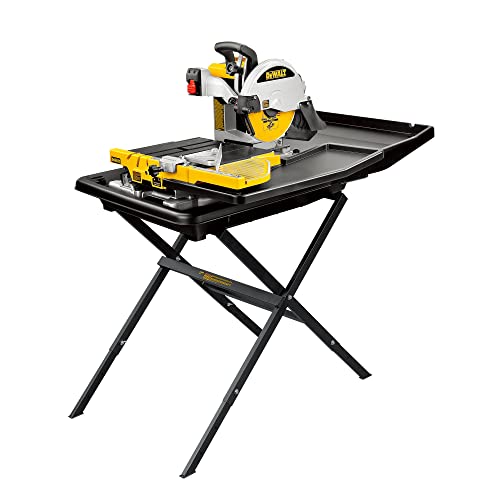
The D24000S is the sliding-table bridge saw that tile setters measure other saws against. The cutting cart rolls on stainless steel rails, so the tile moves and the blade stays put, which is the arrangement that produces the straightest long rips. With 25 inches of rip capacity and 28 inches available when you use the plunge feature, it swallows 24-inch floor tiles and long plank formats that defeat every tabletop in this roundup. The diagonal capacity of 18 by 18 inches covers standard large-format squares turned corner to corner.
Water control is the other reason this saw earns its footprint. A submersible pump feeds dual nozzles at the blade, and the water pan plus the side and rear trays catch runoff before it reaches the floor, so the saw can work indoors over finished surfaces with reasonable care. The head tilts for 22.5-degree and 45-degree cuts, the plunge action handles cutouts for outlets and pipes, and the folding stand is in the box rather than sold separately. At 69 pounds it is a one-person carry in two pieces, though nobody would call it light.
Specs
- Format: Sliding-table bridge (rail) saw, stand included
- Blade diameter: 10 inches
- Motor: 1.5 HP, 4,200 RPM
- Max rip capacity: 25 inches (28 inches with plunge cut)
- Max diagonal capacity: 18 x 18 inches
- Max depth of cut: 3-1/8 inches
- Bevel capacity: 22.5 and 45 degrees
- Water system: Submersible pump, dual blade nozzles, water pan with side and rear trays
- Stand: Included
- Weight: 69 pounds
2. PORTER-CABLE PCE980 7-Inch Table Top Wet Tile Saw
The PCE980 takes the sliding-cart idea and shrinks it to benchtop size. Half of its stainless steel deck slides, which steadies the tile through the cut and gives cleaner edges than a fixed tray at this size, and the on-table rip capacity reaches 17 inches. That is enough for 12-inch floor tile, most backsplash work, and shower walls, but it is a hard ceiling: a 24-inch tile will not fit, and no technique changes that.
Instead of a pump, the blade runs through an enclosed water reservoir under the deck, with a splash guard to keep spray off the operator and a drain plug for cleanup. The trade-off is that reservoir-fed cooling is less consistent than a pumped stream on long porcelain cuts, so feed slowly and check the water level on big jobs. The head does not tilt, so bevels are off the menu; miter cuts come from the included miter square instead. A roll cage with a carry handle wraps the whole saw, which makes it genuinely easy to move between rooms at 27 pounds.
Specs
- Format: Tabletop tray saw with sliding cutting cart
- Blade diameter: 7 inches
- Motor: 1 HP, 6.5 amps, 2,850 RPM
- Max rip capacity: 17 inches
- Max diagonal capacity: 12 inches
- Max depth of cut: 1-1/4 inches
- Bevel capacity: None (fixed head; miter square included for angled cuts)
- Water system: Enclosed reservoir under stainless steel deck, splash guard, drain plug
- Stand: Not included (benchtop, roll cage with carry handle)
- Weight: 27 pounds
3. SKIL 3550-02 7-Inch Wet Tile Saw with HydroLock
The 3550-02 solves the tabletop saw’s oldest problem: the mess. Its HydroLock water containment system keeps water sealed around the blade instead of letting it sheet across the table and onto the floor, so you can set the saw up in the bathroom you are tiling instead of making forty trips to the garage. For apartment remodels and finished homes, that containment is worth more than extra power.
Capacity is honest mid-size territory. The saw handles tile up to 18 by 18 inches on rip cuts and 12 by 12 inches on diagonals, and the table tilts for bevel cuts at 22.5 and 45 degrees on tile up to 12 by 12 inches. The 5-amp motor spinning at 3,600 RPM is adequate for ceramic and standard porcelain fed at a sensible pace, but it is not a production machine, and thick stone will remind you of that. The published maximum depth of cut is 3/4 inch, which covers the tile this saw is sized for.
Specs
- Format: Tabletop tray saw with water containment system
- Blade diameter: 7 inches
- Motor: 5.0 amps, 3,600 RPM
- Max rip capacity: Tile up to 18 x 18 inches
- Max diagonal capacity: Tile up to 12 x 12 inches
- Max depth of cut: 3/4 inch
- Bevel capacity: 22.5 and 45 degrees (tile up to 12 x 12 inches)
- Water system: HydroLock containment keeps water at the blade; reservoir below deck
- Stand: Not included (benchtop)
- Weight: 24 pounds
4. QEP 22400Q Torque Master 4-Inch Tile Saw
The Torque Master is the smallest saw here, an 8-pound tabletop built for the jobs that do not justify dragging out a full-size machine: a kitchen backsplash, a mosaic sheet, a handful of cuts around a toilet flange. Because the tile is pushed straight through with no fence-limited throat, rip and diagonal capacity are effectively unlimited for the small, thin material this saw is meant for, and the dual extension tables fold out to support wider pieces.
Its 3/5 HP high-torque motor turns a 4-inch continuous-rim diamond blade at 4,600 RPM, and the maximum depth of cut is 3/4 inch, so standard ceramic and thin porcelain are in, thick pavers are out. The table tilts for 22.5-degree and 45-degree miter cuts, which is unusual at this size. The deep water tray catches runoff and recycles it back to the reservoir, cutting down on refills during a session. Think of it as a trim saw for tile: limited, but exactly right inside those limits.
Specs
- Format: Compact tabletop tray saw
- Blade diameter: 4 inches
- Motor: 3/5 HP, 4 amps, 4,600 RPM
- Max rip capacity: Unlimited (push-through design)
- Max diagonal capacity: Unlimited (push-through design)
- Max depth of cut: 3/4 inch
- Bevel capacity: Tilting table for 22.5 and 45 degree miter cuts
- Water system: Deep water tray that catches and recycles water to the reservoir
- Stand: Not included (benchtop, dual extension tables included)
- Weight: 8 pounds
5. DEWALT DWC860W 4-3/8-Inch Wet/Dry Handheld Tile Cutter
The DWC860W abandons the table entirely. It is a 6.6-pound handheld saw that you guide along the tile, which makes it the only tool here that can trim tile already on the wall, cut curves and notches freehand, or work on pavers and stone that would never fit a tabletop. Rip and diagonal capacity are unlimited in the literal sense, bounded only by how steadily you can steer.
A 12-foot water line in the kit connects to a faucet or hose and feeds water to the blade for wet cutting, and the saw can also run dry where water is impractical, with the dust that dry cutting always brings. The 10.8-amp motor spins the 4-3/8-inch blade at 13,000 RPM and cuts 1-3/8 inches deep at 90 degrees, with bevels up to 45 degrees. Precision is the honest trade: without a fence or cart, long straight rips wander unless you clamp down a straightedge, so treat this as the specialist that complements a table saw rather than replacing one.
Specs
- Format: Handheld wet/dry tile cutter
- Blade diameter: 4-3/8 inches
- Motor: 10.8 amps, 13,000 RPM
- Max rip capacity: Unlimited (freehand)
- Max diagonal capacity: Unlimited (freehand)
- Max depth of cut: 1-3/8 inches
- Bevel capacity: Up to 45 degrees
- Water system: 12-foot water line kit feeds the blade; dry cutting also possible
- Stand: Not applicable (handheld)
- Weight: 6.6 pounds
How to Choose the Right Tile Saw
Start with your largest tile, not your average one. Rip capacity is a hard physical limit set by the distance from the blade to the fence or the travel of the cart. Measure the longest cut your project needs, including diagonals, and buy for that number. A saw that rips 12 or 17 inches is a backsplash and small-floor tool; 24-inch and plank tiles demand a sliding-table saw with 24-plus inches of travel, or a handheld saw and a steady hand.
Blade size sets depth and stamina. A 10-inch blade cuts deeper, runs cooler, and lasts longer between changes than a 7-inch blade, and it shrugs off thick porcelain and stone that stall small saws. Seven-inch tabletop blades handle standard ceramic and porcelain tile thickness without complaint. Four-inch blades, on the QEP and the DEWALT handheld, are for thin material and detail work.
Water systems decide where you can work. Pump-fed saws like the D24000S deliver a constant stream to both sides of the blade and manage runoff with trays, which suits long sessions. Reservoir saws cool the blade by dipping it, which is simple and reliable but needs level checks. Containment designs like the SKIL HydroLock trade some capacity for the ability to cut indoors over finished floors, and handhelds put the water supply on a hose line so the mess stays where you point it.
Bevels and miters are not standard. Some heads tilt, some tables tilt, and some saws, like the PCE980, do neither and rely on a miter square for angled cuts. If your design calls for mitered corners or bullnose edges, confirm the bevel capacity before ordering.
Plan for the stand and the weight. Bridge saws earn a stand; the DEWALT includes one. Tabletops assume a bench, a tailgate, or a pair of sawhorses, and at 8 to 27 pounds they store on a shelf. The handheld needs nothing but stores its usefulness in your toolbox full time.
The Bottom Line
For whole-room floors and large-format tile, the DEWALT D24000S is the saw that removes capacity from the list of things to worry about, and its water management lets it work indoors. For the classic one-bathroom remodel, the PORTER-CABLE PCE980 and the SKIL 3550-02 cover the same tile sizes two ways: the Porter-Cable with a sliding cart and more power, the SKIL with containment that keeps a finished room clean. The QEP Torque Master handles backsplashes and small repairs for very little shelf space, and the DEWALT DWC860W covers the installed-tile trims, curves, and odd cuts that no table saw can reach. Pick by your biggest tile and your mess tolerance, in that order, and any of the five will do its job well.
More from Amazon
Programs that pair well with the guide above. Offers and eligibility are set by Amazon and may change.
Free shipping on eligible items, Prime Video and more. Eligible new members can start with a free trial.
Start a Prime free trialA Prime membership for ages 18-24 with a trial period. Eligibility is set by Amazon.
See Prime for Young AdultsAudiobooks and podcasts to listen to on the go. Eligible new members can start with a free trial.
Try Audible freeAd-free music streaming. Eligible new subscribers can start with a free trial.
Try Music Unlimited freeAs an Amazon Associate we earn from qualifying purchases.


Write Your Review
No reviews yet. Be the first to share your experience!