

Key takeaways
- Choose a padded single sleeve for low-cost storage and occasional driving, a double-ski roller for regular trips, and a fully padded wheeled bag with reinforced handles and replaceable wheels for frequent flights. Choose a hard case such as the Sportube Series 3 when crush protection…
The best ski bags for travel are padded wheeled roller bags with enough length for your skis, a separate boot compartment, and reinforced handles and zippers; for storage at home, a lighter padded sleeve may be the better-value choice.
Your decision mainly comes down to four questions: are you checking skis on flights, do you need to pack boots in the same bag, how often will the bag be moved through airports, and where will you store it between trips? A slim ski sleeve costs less and takes less space, while a wheeled travel bag offers much better protection and convenience but is heavier and bulkier.
Our top picks


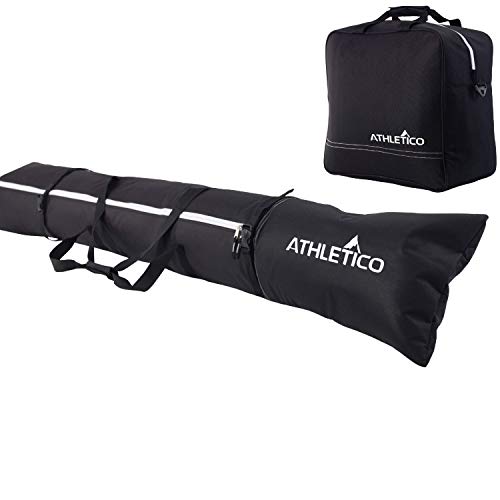
As an Amazon Associate we earn from qualifying purchases at no extra cost to you. Ratings are shown as listed on Amazon.
Best ski bags by situation
| Situation | Best bag type | Useful specification | Typical market range |
|---|---|---|---|
| Occasional local trips | Padded single-ski sleeve | 170–190 cm length, 5–10 mm padding | $50–$120 |
| Regular road trips | Padded double-ski bag | 175–195 cm length, room for 2 pairs and poles | $100–$220 |
| Frequent air travel | Wheeled, fully padded ski roller | 185–200 cm length, 10–15 mm padding, replaceable wheels preferred | $180–$400 |
| Skis plus boots and clothing | Large roller with boot compartments | 2 boot compartments, 90–140 L total capacity | $220–$500 |
| Limited storage space | Compressible sleeve or foldable roller | Folds to roughly 35–50 cm when empty | $80–$250 |
Best ski bags for travel
Best all-around wheeled option: Dakine Fall Line Ski Roller
The Dakine Fall Line Ski Roller is a strong choice for skiers who want padded protection, wheels, and practical organization without moving into the largest expedition-style bags. It is designed around ski-length fit and is available in multiple lengths, so check the specific version rather than assuming every model has the same capacity.
Its main advantage is balance: it can carry skis and poles while remaining easier to handle than an oversized double-ski case. Look for the version that gives at least 5 cm of spare internal length beyond your fully assembled ski-and-binding measurement. The padded construction is useful against knocks and abrasion, but it is still wise to wrap bindings and sharp ski edges so they do not damage the lining.
Best for organized airline travel: Thule RoundTrip Ski Roller
The Thule RoundTrip Ski Roller suits travelers who value structured packing and smooth movement through airports. Depending on the configuration, the design provides substantial padding, exterior compression, and wheels that make a long loaded bag less awkward to pull.
This type of bag is particularly useful when one person must manage skis, poles, and a separate boot bag. Its relatively structured shape helps prevent skis from shifting, but that also means it takes more room in a closet or vehicle. Measure your car’s cargo opening before buying a long roller; the bag’s stated length does not tell you whether it will bend enough to fit through a narrow hatch.
Best for maximum packing flexibility: Db Snow Roller
The Db Snow Roller is aimed at travelers who want to carry more than one pair of skis and compress the bag when it is not full. Its length-adjustable, foldable design can be helpful when different ski lengths are used by the same household.
Choose it when versatility matters more than minimum weight. A large roller can absorb clothing and protective layers around the skis, but packing soft goods into every empty space can push the total bag weight beyond airline limits. Weigh the complete bag at home rather than estimating from the empty-bag specification.
Best hard-sided protection: Sportube Series 3
The Sportube Series 3 is a hard-sided ski case rather than a conventional fabric bag. It is worth considering when skis face repeated abuse in vehicle cargo areas, shared equipment transport, or frequent checked travel. Hard plastic resists crushing better than most soft cases, and the case can accommodate multiple pairs depending on ski dimensions and bindings.
The trade-off is weight, storage space, and less flexible packing. A hard case will not compress around a small load, and its wheels and shell add bulk. It also needs careful internal packing: skis should not rattle, and poles or loose accessories should be secured so they cannot strike the shell from inside.
What to look for in the best ski bags
1. Padded protection
Padding is most valuable on the base, ends, binding area, and side panels that contact luggage belts or vehicle walls. A bag with 10–15 mm of foam padding and a dense outer fabric generally offers a more useful protection upgrade than decorative extra pockets.
Check whether padding is continuous. Some lightweight sleeves have padding only on the top and bottom, leaving the binding area exposed. For checked travel, favor full-length padding, reinforced corners, and a water-resistant exterior. Water resistance helps with snow and wet platforms, but it is not the same as waterproof construction.
2. Ski-length fit
Measure from the ski tip to the end of the tail, then add at least 5 cm for easy loading. If the bag will contain skis with large freeride bindings, allow additional room for width and binding height. A bag that is technically long enough but tight around the bindings can stress its zipper and distort the padding.
For two pairs, measure the combined binding width and compare it with the bag’s internal width. Do not rely only on an advertised “double” label: some double bags fit two narrow piste skis comfortably but become difficult to close with wide skis and bulky bindings.
3. Boot compartments
A dedicated boot compartment keeps hard boot shells away from ski bases and creates a place for wet gear to dry separately. Two independent compartments are more convenient than one large compartment because they balance the load and reduce boot movement.
Boot compartments are not always included in ski-only rollers. If you want one-bag travel, look for at least 90 L of total capacity and ventilation or a wipe-clean lining. Remember that boots, helmet, clothing, and accessories can add more weight than the skis themselves.
4. Wheels and carrying options
Two larger wheels usually roll better over uneven pavement, while smaller recessed wheels save space but can catch on door thresholds. A telescoping handle should lock at more than one height and feel stable when the bag is fully loaded. Reinforced end handles are important because airport staff and car loaders often lift the bag from the end rather than using the shoulder strap.
A removable shoulder strap is useful for stairs, but it should not be the primary carrying method for a heavy double-ski bag. Look for padded grab handles on the top and bottom, plus compression straps that keep the contents from sliding toward one end.
5. Airline-friendly durability
Airlines set their own size and weight rules, and ski equipment policies can change, so verify the current policy before departure. A bag that fits the skis may still exceed a carrier’s weight limit after boots and clothing are added.
For frequent checked travel, prioritize a robust zipper with large pulls, bartacked handle attachments, abrasion-resistant fabric such as 600-denier polyester or stronger, and replaceable wheels. Zippers and wheels usually wear before the main fabric. A long warranty and available replacement parts can matter more than a slightly lower purchase price.
Fabric roller versus hard case
| Feature | Fabric ski roller | Hard ski case |
|---|---|---|
| Typical empty weight | 3–6 kg | 6–10 kg |
| Protection from crushing | Good with full padding; limited against heavy compression | Very good |
| Storage when empty | Often folds or compresses | Requires full case length |
| Flexible packing | Excellent for clothing and accessories | Limited but stable |
| Best use | Mixed travel, road trips, and manageable airline loads | Repeated checked travel and maximum impact protection |
A simple cost-per-use calculation
Suppose a $240 wheeled roller lasts six seasons and is used for four ski trips per season. That is 24 trips, or about $10 per trip before considering repairs. A $90 padded sleeve used twice per season for six seasons costs $7.50 per trip, but it may require a separate boot bag and more carrying effort.
The roller becomes the better value when its wheels, boot storage, or padding replace another piece of luggage. Conversely, if you fly only once every several years, a sturdy sleeve and a separate boot bag may make more sense than paying for features that remain unused.
How to pack and maintain a ski bag
- Dry everything first. Snow and road moisture trapped inside the bag encourage odor, mildew, and corrosion on metal hardware.
- Protect the bindings and edges. Place a towel, ski jacket, or purpose-made divider around bindings and sharp edges.
- Secure loose items. Put poles in their sleeve or strap them together so they cannot puncture the lining.
- Balance the load. Put boots and dense items near the center, not at the wheel end. This reduces tipping and strain on the handle.
- Weigh the packed bag. Leave a margin below the airline limit because scales can differ.
- Clean before storage. Empty the bag, wipe dirt with mild soap and water, air-dry it fully, and store it unzipped in a dry place.
Bottom line
Choose a padded single sleeve for low-cost storage and occasional driving, a double-ski roller for regular trips, and a fully padded wheeled bag with reinforced handles and replaceable wheels for frequent flights. Choose a hard case such as the Sportube Series 3 when crush protection outweighs weight and storage convenience. The best ski bags are not necessarily the largest: the right one is long enough for your skis, organized around your boots and poles, and light enough to stay within your airline’s baggage limit.






Write Your Review
No reviews yet. Be the first to share your experience!