

Key takeaways
- For most RV owners, the SHURflo Revolution 4008 is the safest starting point because its 3.0 GPM output and 55 PSI rating match a broad range of standard systems. Choose a compact 1.2–2.0 GPM pump for a small single-fixture camper, a Flojet Triplex 03526 when…
The best RV water pumps for most campers are the SHURflo Revolution 4008 for a balanced 3.0 GPM/55 PSI setup, the SEAFLO 42-Series for a quieter higher-flow upgrade, and a compact 12-volt diaphragm pump in the 1.2–2.0 GPM range for small trailers with one faucet and limited battery capacity.
Our top picks

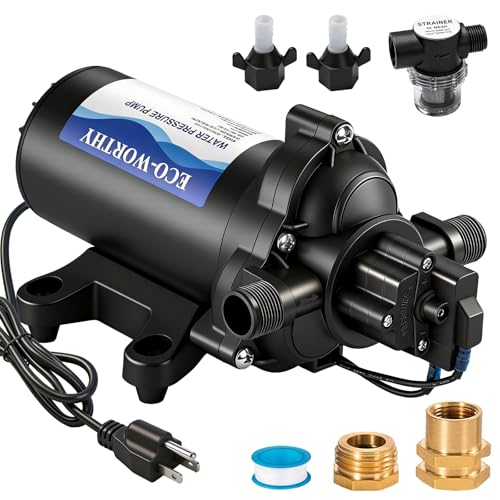


As an Amazon Associate we earn from qualifying purchases at no extra cost to you. Ratings are shown as listed on Amazon.
Quick comparison: best RV water pumps by use case
| Pump type or model | Rated flow | Pressure rating | Typical current draw | Self-priming | Best fit |
|---|---|---|---|---|---|
| SHURflo Revolution 4008 | 3.0 GPM | 55 PSI shutoff | About 7.5 amps at maximum load | Yes, approximately 6 feet | Most small and medium RVs |
| SEAFLO 42-Series | About 3.0–5.5 GPM, depending on version | 45–60 PSI, depending on version | About 8–17 amps, depending on version | Yes, commonly 6 feet | Large RVs or multiple fixtures |
| Flojet Triplex 03526 | About 2.9 GPM | 50 PSI shutoff | About 7 amps | Yes, approximately 9 feet | Replacement installations and moderate demand |
| Compact 12-volt diaphragm pump | 1.2–2.0 GPM | 40–55 PSI | About 3–6 amps | Usually 3–6 feet | Teardrop trailers and one-fixture use |
| High-flow 12-volt RV pump | 4.0–5.5 GPM | 45–60 PSI | About 10–17 amps | Usually 6 feet | Class A motorhomes and several simultaneous outlets |
Published specifications vary by exact revision and pressure-switch setting, so confirm the label and installation manual before replacing a pump. Flow figures are maximum ratings; actual flow falls as hose length, filters, fittings, elevation, and faucet restrictions increase.
Our picks by RV size and plumbing demand
Best all-around choice: SHURflo Revolution 4008
The SHURflo Revolution 4008 is a sensible default for many travel trailers, fifth wheels, and camper vans. Its 3.0 GPM rating supplies one shower or faucet comfortably, while its 55 PSI shutoff pressure is compatible with the plumbing used in many modern RVs. The three-chamber diaphragm design is self-priming and includes an internal bypass intended to reduce rapid cycling at low flow.
Choose it when your RV has one bathroom, a conventional water heater, and no expectation of running a shower, kitchen faucet, and exterior sprayer at the same time. It is also a practical replacement when the original pump was near 3 GPM and 45–55 PSI. Its main limitation is electrical demand: a pump drawing roughly 7.5 amps at full load needs sound wiring and a properly sized fuse.
Best for larger plumbing systems: a high-flow SEAFLO 42-Series pump
SEAFLO 42-Series pumps are available in several flow and pressure configurations, including versions around 3.0, 4.0, and 5.5 GPM. The larger versions make sense in a Class A motorhome, large fifth wheel, or RV with multiple bathrooms and long water runs. More flow can reduce the pressure drop caused by several open fixtures, but it does not create more hot water or solve undersized plumbing.
Do not automatically buy the highest-flow version. A 5.5 GPM pump can draw roughly 10–17 amps, depending on configuration, and may expose weak wiring, small water lines, restrictive filters, or a marginal battery. It can also cycle more noticeably if the system has a tiny accumulator or a low-flow faucet.
Best for a straightforward replacement: Flojet Triplex 03526
The Flojet Triplex 03526 is a useful option when its inlet, outlet, voltage, pressure, and mounting footprint match the pump already installed. Its approximately 2.9 GPM output and 50 PSI shutoff rating suit many standard RV water systems. Replacement compatibility matters more than a small difference in advertised flow: moving hose connections, rewiring the circuit, or drilling new mounting holes can turn a simple repair into a plumbing project.
Best for a small trailer: a 1.2–2.0 GPM compact diaphragm pump
A compact pump is adequate for a teardrop trailer, pop-up camper, or small van with a single faucet and a short plumbing run. Lower flow reduces battery demand, often to roughly 3–6 amps, and can be easier to quiet inside a small cabin. The tradeoff is weaker shower performance and a greater chance of pressure loss if the pump must push water through a filter, long hose, or restrictive fixture.
How to match pump capacity to your RV
Use the number of fixtures you expect to operate, not the number installed. A typical faucet may consume 1.0–2.0 GPM, while an RV showerhead commonly uses about 1.5–2.5 GPM. Two fixtures therefore do not necessarily require a 5.5 GPM pump, because users usually mix hot and cold water and rarely operate both at full flow. However, a large RV with long 1/2-inch water lines benefits from additional capacity.
| RV situation | Recommended pump range | Why |
|---|---|---|
| Teardrop or compact camper, one faucet | 1.2–2.0 GPM, 40–50 PSI | Lower electrical demand and adequate single-fixture flow |
| Small travel trailer, one bathroom | 2.5–3.0 GPM, 45–55 PSI | Good shower performance without excessive battery use |
| Large travel trailer or fifth wheel | 3.0–4.0 GPM, 50–60 PSI | Compensates for longer runs and occasional simultaneous use |
| Class A with multiple bathrooms or exterior outlets | 4.0–5.5 GPM, 45–60 PSI | Maintains usable flow across several branches |
Pressure, flow, and plumbing compatibility
GPM describes volume, while PSI describes pressure at a blocked outlet or pressure-switch cutoff. A pump advertised at 3.0 GPM does not deliver 3.0 GPM at 55 PSI; its flow curve determines the actual output at a particular pressure. Look for a performance chart when available, especially if you have a long run, a high-mounted tank, or several filters.
Pressure must also suit the RV. Many RV plumbing systems are designed around a pump cutoff near 45–55 PSI, but the weakest component sets the safe limit. Check the water heater, filter housing, accumulator, hose fittings, and manufacturer specifications before selecting a 60 PSI pump. When connected to campground water, use an RV pressure regulator even if the onboard pump has a lower pressure rating.
Noise, mounting, and electrical demand
Diaphragm pumps make a clicking or pulsing sound as their motor and pressure switch operate. The pump itself may be acceptable while the installation is loud because vibration travels through a thin cabinet wall. Use the supplied rubber feet, leave clearance around the housing, and avoid rigidly clamping the pump to a resonant panel. Flexible inlet and outlet hoses can reduce transmitted vibration better than hard tubing.
Electrical current rises with pressure and restriction. As a rough example, a 7.5-amp pump used for 10 minutes consumes about 1.25 amp-hours:
7.5 amps × 10 minutes ÷ 60 = 1.25 amp-hours.
If the pump runs 30 minutes over a long day, the theoretical use is 3.75 amp-hours, before accounting for inverter losses, battery condition, and cycling. A high-flow pump drawing 15 amps for the same 30 minutes would use about 7.5 amp-hours. Follow the pump manual for fuse size and wire gauge; a longer wire run generally requires heavier cable to limit voltage drop.
Self-priming and installation details that matter
Self-priming means the pump can pull water from a tank below the pump after the line is initially filled with air. It does not mean the pump can run dry indefinitely or overcome a blocked strainer. Install the pump close to the tank, use an inlet hose at least as large as the specified inlet, and place a cleanable strainer before the pump.
- Turn off 12-volt power and release water pressure by opening a faucet.
- Confirm the replacement pump’s voltage, port size, flow, pressure cutoff, and polarity.
- Install or clean the inlet strainer; debris can damage valves and reduce priming.
- Use flexible hose for the final connection where possible, and support the pump without crushing its rubber feet.
- Reconnect wiring with weather-resistant terminals and the manufacturer-specified fuse.
- Fill the tank, open a faucet, and let the pump run until air is purged.
- Inspect every connection for leaks, then check whether the pump stops cleanly when the faucet closes.
Ownership realities and common mistakes
The parts most likely to cause trouble are the inlet strainer, diaphragm valves, pressure-switch contacts, and hose connections. Sediment, tank debris, freezing water, and running the pump dry for extended periods shorten service life. Drain the system before freezing weather, clean the strainer periodically, and sanitize the fresh-water system according to the RV manufacturer’s procedure rather than relying on the pump to remove contamination.
Frequent cycling usually indicates a leak, a clogged strainer, a partially closed valve, an air leak on the inlet side, or an accumulator problem. A small accumulator tank can smooth pulsation and reduce starts, but it cannot compensate for an incorrectly sized pump or blocked plumbing. If the pump runs continuously with all fixtures closed, switch it off and find the leak before the motor overheats.
Bottom line
For most RV owners, the SHURflo Revolution 4008 is the safest starting point because its 3.0 GPM output and 55 PSI rating match a broad range of standard systems. Choose a compact 1.2–2.0 GPM pump for a small single-fixture camper, a Flojet Triplex 03526 when replacement compatibility is the priority, and a properly wired 4.0–5.5 GPM SEAFLO 42-Series model only when the RV’s plumbing and electrical system can use the extra capacity.





Write Your Review
No reviews yet. Be the first to share your experience!