

Key takeaways
- 0°: simplest setup and a natural choice for beginners, casual paddling and anglers who frequently change sides.
- 10–30°: a versatile range for touring, fitness paddling and many adjustable paddles.
- 45° or more: traditional for some paddlers, but less forgiving if your wrists, grip or technique are inconsistent.
The best kayak paddles are lightweight, correctly sized for your kayak and stroke, and matched to the water you paddle: a low-angle touring paddle for relaxed distance, a shorter high-angle paddle for powerful maneuvering, or a compact, durable paddle for recreation and fishing.
Our top picks
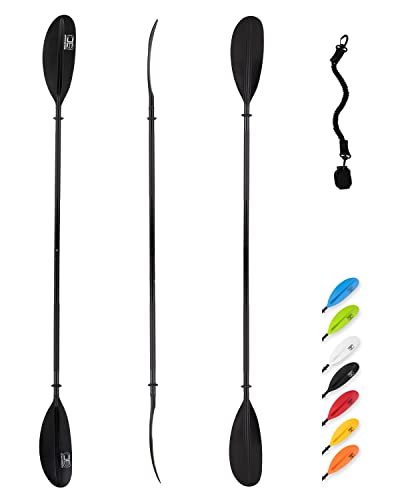


As an Amazon Associate we earn from qualifying purchases at no extra cost to you. Ratings are shown as listed on Amazon.
Quick picks by paddling situation
| Situation | Best paddle type | Useful specifications | Why it works |
|---|---|---|---|
| Relaxed lake touring | Low-angle touring paddle | 230–250 cm; 550–750 g; 10–15° feather | Longer reach and moderate blades reduce fatigue during an efficient, low-angle stroke. |
| Wide recreational kayak | Recreational paddle | 230–250 cm; 750–1,050 g; 0–30° feather | Extra length reaches the water comfortably from a broad seat, while a robust construction tolerates occasional impacts. |
| Fitness or fast touring | High-angle touring paddle | 210–230 cm; 500–700 g; 15–30° feather | Shorter length and larger blades support a more vertical, forceful stroke. |
| Sea kayak and loaded touring | Light carbon or fiberglass touring paddle | 215–240 cm; 500–750 g; adjustable ferrule | Low swing weight saves energy over many hours, and adjustable length helps accommodate conditions and technique. |
| Fishing, rocky rivers, or shared use | Durable fiberglass or reinforced nylon paddle | 220–250 cm; 800–1,150 g; 0–30° feather | Heavier construction is less costly to replace when the blade hits rocks, docks, or a tackle box. |
These figures are starting points rather than universal rules. Your torso height, kayak width, seat position, blade design and stroke style can shift the ideal choice by 10 cm or more.
Blade shape: the biggest effect on stroke feel
Blade area and shape determine how much water the paddle moves per stroke. A narrow, elongated blade is usually associated with a low-angle stroke. It enters the water smoothly and loads the muscles gradually, making it efficient for cruising at a comfortable pace. This is a good match for many sea kayaks and touring kayaks.
A shorter, wider blade is designed for a high-angle stroke. It catches more water quickly and produces strong acceleration, edging control and corrective power. The trade-off is higher resistance: if you use a large blade with a relaxed stroke, your shoulders and arms may fatigue before your kayak benefits from the extra surface area.
Asymmetrical blades are common on modern kayak paddles. Their longer outer edge and shorter inner edge help the blade maintain a stable orientation while submerged. Dihedral blades have a raised center ridge that divides water flow and can make the stroke feel smoother and less flutter-prone. Neither feature removes the need for proper technique, but both can make a paddle easier to control.
Match blade size to your engine
Large blades are not automatically more efficient. They are useful for short bursts, acceleration, current, surf and strong paddlers who can maintain good form. Smaller blades often produce better overall efficiency for long-distance recreational paddling because they allow a higher cadence with less force per stroke. When comparing two paddles, consider blade area alongside weight; a very light paddle with an overly large blade can still be tiring.
Shaft material and weight: efficiency beyond the blade
Aluminum shafts are inexpensive and reasonably durable, but they are heavier and can feel cold in low temperatures. Fiberglass shafts reduce weight and transmit less vibration while offering a useful balance of price and durability. Carbon-fiber shafts are typically the lightest and stiffest option. They make each stroke feel immediate and reduce the effort of repeatedly lifting the paddle clear of the water.
Common market ranges are approximately $40–$90 for basic aluminum or nylon paddles, $90–$220 for fiberglass or composite recreational and touring paddles, and $220–$600 or more for lightweight carbon touring paddles. A more expensive paddle makes the most financial sense when you paddle frequently, cover long distances, or are sensitive to swing weight—not simply because carbon sounds faster.
Pay attention to total weight and balance. A paddle that is 150 g lighter may not sound important, but every stroke involves lifting and rotating it. For example, at 50 strokes per minute over two hours, you make about 6,000 strokes. Reducing the lifted mass by 0.15 kg does not equal a simple 900 kg load because the paddle is not lifted its full length every time, but the repeated reduction in swing effort is noticeable over a long session.
Feather angle: choose control or comfort
The feather angle is the rotation between the two blades. At 0°, both blades have the same orientation. At 30° or more, the blades are offset, so the upper blade slices through the air as the lower blade pulls through the water. Feathering can reduce air resistance and may suit a strong, active stroke, but it requires more wrist rotation and consistent hand positioning.
- 0°: simplest setup and a natural choice for beginners, casual paddling and anglers who frequently change sides.
- 10–30°: a versatile range for touring, fitness paddling and many adjustable paddles.
- 45° or more: traditional for some paddlers, but less forgiving if your wrists, grip or technique are inconsistent.
An adjustable ferrule is valuable if more than one person uses the kayak or if you are still refining your technique. Start at 0° or 15°, then change only one variable at a time. If your lower wrist bends sharply or your upper hand repeatedly twists, the feather angle may be too aggressive—or the paddle may be too long or too large.
Paddle length: use kayak width and stroke angle together
Kayak width matters because a broad kayak requires the blade to travel farther outward before it reaches the water. A narrow sea kayak may suit a 210–230 cm paddle, while a wide recreational kayak may need 230–250 cm. A low-angle stroke generally favors a longer paddle; a high-angle stroke generally favors a shorter one.
| Kayak width | Low-angle touring | High-angle paddling |
|---|---|---|
| Under 60 cm | 215–230 cm | 205–220 cm |
| 60–70 cm | 225–240 cm | 210–225 cm |
| Over 70 cm | 235–250 cm | 220–235 cm |
Use the lower end of a range if you are tall, paddle with a high-angle stroke, or use a narrow kayak. Use the upper end if the kayak is wide, the seat is low, or you paddle with a relaxed low-angle stroke. If possible, hold the paddle horizontally above your head with your elbows near 90 degrees; this is only a rough check, but it can reveal an obviously unsuitable length.
Drip rings: small parts that affect comfort
Drip rings sit near the blade and intercept water that would otherwise run down the shaft into your lap. They do not improve propulsion, but they keep hands drier, reduce water entering a sit-in kayak, and make cold-weather paddling more comfortable.
Look for secure, flexible rings that stay in place without sliding toward the ferrule. Drip rings can trap grit, so rinse them after muddy or sandy trips. If water still streams down the shaft, inspect the ring position and check whether the blade is being lifted too vertically during the recovery phase. Technique and paddle angle affect dripping as much as the rings themselves.
A practical buying decision matrix
| Your priority | Recommended construction | Blade and length direction |
|---|---|---|
| Lowest purchase cost and occasional use | Aluminum shaft with fiberglass-reinforced nylon blades | Moderate blade, 230–240 cm for an average-width recreational kayak |
| Weekly touring and reduced fatigue | Fiberglass shaft and blades | Smaller or medium low-angle blade, 220–240 cm |
| Long-distance trips and minimum swing weight | Carbon shaft with carbon or composite blades | Light low-angle blade, 215–235 cm |
| Frequent rocks, docks, and transport abuse | Reinforced nylon or fiberglass blades with a protected edge | Moderate blade, adjustable 220–250 cm |
| Two paddlers or changing conditions | Two- or four-piece adjustable ferrule | Length adjustment of at least 10 cm and feather settings from 0° to 30° |
Ownership details that determine value
Rinse a paddle with fresh water after saltwater, sand or muddy trips, paying attention to the ferrule, seams and drip rings. Separate the shaft sections while rinsing so grit does not remain inside the connection. Dry the paddle out of direct intense heat; prolonged heat can damage finishes, adhesives or ferrule components.
The ferrule and blade edges usually show wear before the shaft does. Do not drag blades across concrete, use them as poles, or strike rocks with the blade tip. Inspect for cracks, soft spots, loose ferrule buttons and separation around the blade perimeter. A small edge chip may be cosmetic, but a crack that spreads into the blade or shaft is a reason to stop using the paddle.
For most buyers, the best kayak paddles are not the largest or lightest models available. Choose blade resistance that matches your cadence, length that matches kayak width and stroke angle, and the lightest construction your budget and impact risk justify. That combination improves efficiency far more than selecting a premium material without checking fit.






Write Your Review
No reviews yet. Be the first to share your experience!