

Key takeaways
- Compare the best fishing line for lakes, rivers and saltwater use: braid, fluorocarbon, mono and copolymer picks with diameters and honest trade-offs.
As an Amazon Associate we earn from qualifying purchases.
Fishing line is the cheapest part of a fishing setup and the part that decides whether a hooked fish reaches the net. It is also the most confusing aisle in the tackle shop, because three different materials — monofilament, fluorocarbon and braid — are sold side by side as if one of them were simply better. None of them is. Each trades stretch, visibility and abrasion resistance against the other two, and the right choice depends on the water in front of you: a clear trout stream, a weedy lake, a rocky river or a salt flat.
This guide compares five lines sold on Amazon that cover the main approaches: two braids, one fluorocarbon, one classic monofilament and one copolymer hybrid. Each entry names one specific spool — one pound test, one length, one color — because line is sold by the variant, and the diameter printed on that spool matters more than the pound test in the product name. Where a line has a genuine weakness, it is stated plainly.
Affiliate Disclosure: This article contains affiliate links. If you buy through a link on this page, the site may earn a commission at no extra cost to you. Products are chosen for their specifications and suitability for the use described, and each line’s limitations are stated as plainly as its strengths.
1. PowerPro Spectra Braided Line (Moss Green, 20 lb, 300 yd)

PowerPro is the line that introduced most freshwater anglers to braid, and it remains the reference point for the category. It is woven from Spectra fiber, an ultra-high-molecular-weight polyethylene, and treated with the maker’s Enhanced Body Technology, a resin process intended to keep the braid round so it packs onto the spool evenly and casts without digging in as readily as a flat braid.
The defining trait of any braid is the near-total absence of stretch, and PowerPro is no exception. A jig bite in thirty feet of water registers as a distinct tap instead of the vague pressure monofilament transmits, and hook sets happen with a lift of the rod rather than a sweeping swing. The 20 lb spool here measures 0.009 inches in diameter — roughly the thickness of a 6 lb monofilament — so a reel holds far more of it, and light lures cast noticeably farther.
The trade-offs are equally clear. Braid is visible underwater, so in clear water it is normally fished with a fluorocarbon or mono leader. It has poor abrasion resistance against sharp rock compared with fluorocarbon of similar strength, and under a hard drag load it can bite into the wraps beneath it on the spool. It also costs more per spool than mono, which is why most anglers load it over cheap monofilament backing. For lake and river fishing around weeds, docks and timber — and for inshore saltwater work where sensitivity matters — it is the benchmark the other braids are measured against.
Specs
- Type: Braided Spectra (UHMWPE) fiber with Enhanced Body Technology
- Variant: Moss Green, 20 lb test, 300 yd spool
- Diameter: 0.009 in (0.23 mm), about the diameter of 6 lb monofilament
- Stretch: Near zero
- Model: 21100200300E
2. Seaguar InvizX Fluorocarbon Line (Clear, 12 lb, 200 yd)

Seaguar invented fluorocarbon fishing line, and InvizX is its mainstream main-line version: a 100% fluorocarbon formulated to be softer and more castable than the stiff fluorocarbons that earned the material a difficult reputation on spinning reels. The 12 lb, 200 yd spool here is the size most bass and walleye anglers load as a full main line.
Fluorocarbon’s case rests on physics. Its refractive index is close to that of water, so it is harder for fish to see than mono of the same diameter. It is also denser than water, so it sinks — an advantage for jigs, soft plastics and deep crankbaits, because the line does not bow upward and mute the feel of the bottom. That same sinking quality makes it a poor choice for topwater lures and floating presentations, where a floating monofilament keeps the lure working on the surface.
InvizX is also the natural answer to the leader question. Many anglers who fish braid as a main line tie two to six feet of fluorocarbon to the end of it: the braid provides sensitivity and strength, the fluoro provides a low-visibility, abrasion-resistant section near the hook. As a full main line it suits baitcasting reels and clear-water work; on spinning reels, heavier tests can spring off the spool in coils if the spool is overfilled. Fluorocarbon knots also demand care — moisten them and seat them slowly, because the material is damaged by friction heat more easily than mono.
Specs
- Type: 100% fluorocarbon main line
- Variant: Clear, 12 lb test, 200 yd spool
- Diameter: 0.011 in (0.285 mm)
- Behavior: Sinks; low memory for a fluorocarbon; low stretch relative to monofilament
- Model: 12VZ200
3. Berkley Trilene XL Monofilament (Fluorescent Clear/Blue, 10 lb, 300 yd)
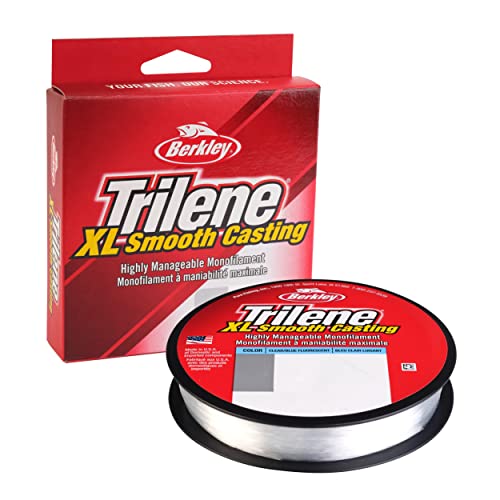
Trilene XL is the monofilament generations of campers learned to fish with, and it survives because monofilament’s weaknesses are also its strengths. Mono stretches — a great deal compared with braid — and that stretch forgives mistakes: a fish that surges at the bank, a drag set a touch too tight, a hook set that is half a second late. For beginners, kids and anyone fishing live bait, that forgiveness lands fish that a no-stretch line would tear free.
The XL formula is built for manageability rather than brute strength. It is limp, resists twists and kinks, and casts smoothly off both spinning and baitcasting reels, which is why it remains a default choice for all-purpose lake and river fishing with spinners, spoons and bait rigs. The Fluorescent Clear/Blue variant in this spool glows visibly above the surface so you can track your line, while appearing far less conspicuous below it.
The honest limitations are real. Mono absorbs water and is weakened by ultraviolet light, so a spool that lives on a rod in a sunny garage is not the line it was last season. It also has memory: after weeks on a small spinning spool it comes off in coils. The correct response is built into the category — monofilament is inexpensive, so treat it as a consumable and respool at the start of every season, or whenever the line feels wiry. Fresh budget mono outperforms old premium line of any material.
Specs
- Type: Nylon monofilament
- Variant: Fluorescent Clear/Blue, 10 lb test, 300 yd spool
- Diameter: 0.011 in (0.28 mm)
- Stretch: High — forgiving on hook sets and surging fish
- Model: XLFS10-26
4. KastKing SuperPower Braided Line (Low-Vis Gray, 20 lb, 327 yd)

KastKing’s SuperPower is the bulk-braid option: a four-strand UHMWPE braid sold in generous spool lengths, aimed at anglers who respool several reels or fish water where line gets cut back often. The variant here is the 20 lb, 327 yd spool in Low-Vis Gray, a muted color intended to be less conspicuous than hi-vis braid while remaining trackable above the surface.
In the water it behaves the way four-strand braid behaves. The zero-stretch sensitivity and thin diameter are the same advantages PowerPro offers, and knot strength is a genuine highlight — the slightly rougher texture of a four-carrier weave grips knots well. That texture is also the compromise: a four-strand braid is a little coarser and noisier through the guides than a finer eight-strand braid, and the maker-stated 0.010 in diameter should be read as approximate, because budget braids are commonly thicker in hand than the label suggests. Color also fades with use, which is cosmetic but worth knowing.
Read honestly, SuperPower is a workhorse rather than a refinement. It suits heavy-cover freshwater fishing, catfish and carp rigs, surf and pier fishing where abrasion and lost line are routine, and any setup where a long spool that invites regular respooling beats a short spool of premium braid fished until it frays. Pair it with a fluorocarbon leader in clear water, exactly as with any braid.
Specs
- Type: Braided UHMWPE, 4-strand weave
- Variant: Low-Vis Gray, 20 lb test, 327 yd spool
- Diameter: 0.010 in (0.25 mm) as stated by the maker
- Stretch: Near zero
- Model: NE-KKB-GY-300-20
5. Yo-Zuri Hybrid Copolymer Line (Clear, 8 lb, 275 yd)

Yo-Zuri Hybrid exists because some anglers want one line that behaves acceptably everywhere rather than excellently somewhere. It is a copolymer: nylon and fluorocarbon molecularly bonded during extrusion rather than coated afterward, so the fluorocarbon component cannot wear off. The 8 lb, 275 yd clear spool here is a finesse-oriented size for trout, panfish and light bass work in streams and clear lakes.
The blend lands where you would expect between its parents. It stretches less than straight monofilament but more than fluorocarbon, which makes it a reasonable compromise for crankbaits and other treble-hooked lures that benefit from some give. It is more abrasion resistant than plain nylon, handles with less memory than a full fluorocarbon, and Yo-Zuri emphasizes that the bonded construction is waterproof — unlike nylon, it does not absorb water and weaken or change character over a long day of casting.
It will not beat a specialist line at its own game: braid is thinner and more sensitive, pure fluorocarbon is less visible and sinks faster. What Hybrid offers a camping angler is simplicity — one spool that covers a spinning rod used for trout in the morning, bass in the evening and the occasional trip to a brackish creek, without a leader ritual or a second reel. Note that its 8 lb diameter of 0.011 in matches the 10 lb Trilene XL and 12 lb InvizX in this guide, a reminder that the number on the box is not a unit of thickness.
Specs
- Type: Copolymer — nylon and fluorocarbon molecularly bonded
- Variant: Clear, 8 lb test, 275 yd spool
- Diameter: 0.011 in (0.283 mm)
- Stretch: Moderate — between monofilament and fluorocarbon
- Model: 8 HB 275 CL
How to Choose Fishing Line for Lakes, Rivers and Saltwater
Start with the material, because the material decides the behavior. Monofilament floats, stretches and forgives; choose it for topwater lures, live bait, beginners and any fishing where a fish’s surge at short range is the main way fish are lost. Fluorocarbon sinks, is the least visible and resists abrasion best; choose it for bottom contact baits in clear water and as leader material in almost every other setup. Braid has essentially no stretch and the thinnest diameter per strength; choose it for weeds, timber, deep water and anywhere bite detection at distance matters, and add a leader when the water is clear or the bottom is sharp.
Compare diameters, not pound tests. There is no single enforced standard behind the number on a spool, and makers measure and label differently — some lines break well above their label, which is why a nominally weaker line can be the thicker one. This guide contains the proof: the 20 lb braids are 0.009–0.010 in across, while the 8 lb copolymer, 10 lb mono and 12 lb fluorocarbon are all about 0.011 in. Diameter is what determines how much line a reel holds, how deep a lure runs and how the line behaves in current, so shop by the decimal and treat pound test as a rough guide.
Match the line to the water. Lakes with heavy vegetation reward braid’s strength and cutting power through stems. Rivers add current and rock: braid with a fluorocarbon leader, or a full abrasion-resistant line, survives the rubbing that moving water causes. Saltwater adds corrosion-resistant tackle demands and hard-mouthed, fast fish; braid with a heavier fluorocarbon leader is the common answer, and every line should be rinsed and inspected after salt use because frayed sections fail without warning.
Finally, budget for replacement rather than for a single premium spool. Line is a consumable. Sunlight degrades monofilament, memory builds on small spools, and braid frays strand by strand around structure. Respooling mono and budget braid on a schedule — and stripping back the first several yards of any line regularly to check for nicks — prevents more lost fish than any upgrade in material.
Frequently Asked Questions
Is braid, fluorocarbon or monofilament best for a beginner?
Monofilament. It is the easiest to knot, the most forgiving of drag settings and hook sets, and the least expensive to replace while knots and casting are still being learned. Move to braid or fluorocarbon when a specific problem — missed bites in deep water, line-shy fish in clear water — asks for them.
Do I need a leader with braided line?
In clear water or around sharp rock, yes. Two to six feet of fluorocarbon adds low visibility and abrasion resistance where the line meets the fish and the bottom. In stained water or heavy vegetation, many anglers fish braid straight to the lure without issue.
Why does the same pound test come in different diameters?
Because pound-test labels are not produced to one shared standard across brands and materials. Breaking strengths are measured and rounded differently, and some lines are deliberately built stronger than their label. Diameter is the comparable figure, and it is printed on every spool in this guide.
How often should fishing line be replaced?
Monofilament at least once a season, and sooner if it feels wiry or shows coils that will not straighten. Fluorocarbon lasts longer but should be checked for nicks after every trip. Braid lasts the longest, yet its working end should be cut back regularly; when the color is gone and the weave looks fuzzy, respool.
Conclusion
There is no single best fishing line — there is a best match between a material and the water you fish. PowerPro remains the reference braid for sensitivity and strength at a thin diameter, and KastKing SuperPower covers the same ground in bulk spools for anglers who respool often. Seaguar InvizX is the clear-water and leader choice, sinking and nearly invisible. Trilene XL keeps monofilament’s case simple: forgiving, manageable and cheap enough to replace on schedule. Yo-Zuri Hybrid splits the difference for the one-rod camper. Pick by diameter and behavior first, and whatever you choose, replace it before it starts losing fish for you.
More from Amazon
Programs that pair well with the guide above. Offers and eligibility are set by Amazon and may change.
Free shipping on eligible items, Prime Video and more. Eligible new members can start with a free trial.
Start a Prime free trialA Prime membership for ages 18-24 with a trial period. Eligibility is set by Amazon.
See Prime for Young AdultsAudiobooks and podcasts to listen to on the go. Eligible new members can start with a free trial.
Try Audible freeAd-free music streaming. Eligible new subscribers can start with a free trial.
Try Music Unlimited freeAs an Amazon Associate we earn from qualifying purchases.










Write Your Review
No reviews yet. Be the first to share your experience!