

Key takeaways
- Compare five portable weather stations and handheld meters for camping and RV trips on sensors, wireless range, power, and honest forecast limits.
As an Amazon Associate we earn from qualifying purchases.
Weather decides more about a camping trip than any other piece of gear. It decides whether the tent goes up before dinner or during a downpour, whether a ridge walk is a pleasure or a lightning risk, and whether the RV awning stays out or gets rolled in before a gust tears it. A phone forecast helps, but it describes a town or a grid square miles wide, not the lakeshore, canyon, or exposed pass where you are actually sleeping. A portable weather station closes that gap: it measures the air where you are, right now, and shows you which way it is moving.
Be clear about what that does and does not mean. A weather station measures and trends. It does not forecast a mountain storm the way a meteorological service with radar, satellites, and models does. What it gives you is a barometric pressure trend, and that trend is a short-fuse local warning: pressure falling steadily over a few hours usually means deteriorating weather is close, while rising pressure usually means conditions are settling. It is a warning measured in hours, not a prediction measured in days, and it only works if someone is actually watching the trend instead of a single number.
The five products below split into two camps. The first four are wireless stations with a remote sensor and an indoor display, suited to RVs, basecamps, and drive-up campsites where you can mount a sensor, plug in or battery-power a console, and glance at readings from inside. The last is a handheld meter with no remote sensor at all, and it is the only one on this list that makes sense inside a backpack. Each has real limits, and those limits are stated plainly.
Affiliate Disclosure: This article contains affiliate links. If you buy a weather station through a link on this page, we may earn a commission at no additional cost to you. Commissions help keep this site running, and they never change which products we include or how we describe them.
Ambient Weather WS-2902 WiFi Smart Weather Station
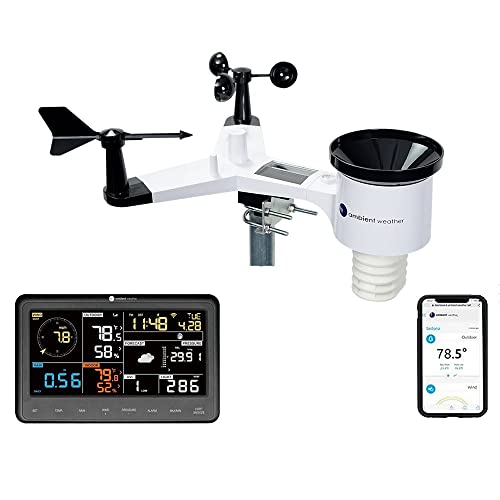
The WS-2902 is the full-instrument option: a single outdoor sensor array that measures wind speed and direction, rainfall, temperature, humidity, UV index, and solar radiation, and sends everything to a color console inside. For an RV or a basecamp that stays put for a week, that is a genuinely useful picture — you can watch a pressure trend, check whether the wind is building before you leave the awning out, and see how much rain actually fell overnight rather than guessing from the puddles.
The WiFi connection is the feature that cuts both ways. At home or at a campground with good WiFi, the station uploads to weather networks and can be checked from a phone anywhere. At a remote campsite with no network, the WiFi features simply do nothing, and you are left with the console — which is fine, but it means you are paying for connectivity you may rarely use outdoors. Setup is also the longest here: the array needs a pole or rail mount, leveling so the rain gauge reads honestly, and a clear view of the sky for its solar panel. The stated 330-foot sensor range is a line-of-sight figure; an RV wall, a truck, and a stand of trees between the array and the console will shorten it considerably.
Specs
- Sensors: Wind speed and direction, rainfall, temperature, humidity, barometric pressure, UV, solar radiation, dew point, wind chill, heat index
- Wireless range: Up to 330 ft (100 m) line of sight between sensor array and console
- Power: Sensor array solar panel with battery backup; console AC adapter with battery backup
- Display/app: Color console; WiFi upload to Ambient Weather Network and Weather Underground with app access
Sainlogic Wireless Weather Station (8-in-1, No WiFi)

The Sainlogic 8-in-1 station covers the same core ground as the Ambient Weather — an outdoor sensor unit measuring temperature, humidity, wind speed and direction, rainfall, and air pressure — but skips the internet entirely. Readings travel straight from the sensor to the display console, which also shows a pressure-based forecast icon, moon phase, and an alarm clock. For a campsite with no WiFi and no desire to create an account or configure an app, that simplicity is the point.
The trade-offs are the mirror image of the WS-2902’s. There is no phone access, no data upload, and no way to check conditions from town; if you are not standing in front of the console, you are not seeing the weather. The forecast icon is a simple pressure-trend graphic, useful as a rough heads-up and nothing more. The wireless range is again an open-field number, so the realistic setup is a sensor mounted on a pole or tree within a clear shot of the RV or tent, not on the far side of a metal trailer. Sensor placement matters as much as the hardware: a sensor baking in direct sun on a dark surface will report the temperature of that surface, not the air.
Specs
- Sensors: Temperature, humidity, wind speed and direction, rainfall, barometric pressure
- Wireless range: Up to 328 ft (100 m) open field between sensor and console
- Power: Sensor solar panel with battery backup; console adapter or batteries
- Display/app: LCD console with forecast icons, moon phase, and alarm clock; no WiFi, no app
La Crosse Technology C85845 Weather Station

The C85845 is the simplest station here, and it is honest about being a temperature-and-humidity instrument rather than a full observatory. A single wireless outdoor sensor reports temperature and humidity to a large color display, which adds indoor readings, forecast icons with trend arrows, heat index, dew point, daily high and low records, and customizable alerts that beep when temperature or humidity crosses a limit you set. Those alerts are the quietly practical feature for RV use: a freeze warning for water lines, or a heat warning for a pet inside a parked trailer, without anyone watching a screen.
What it does not do is measure wind or rain, so it cannot tell you whether the awning is in danger or how much water fell last night. La Crosse also notes that the forecast icons need a calibration period of about a week or more before they settle, which means the icons on a three-day trip are still learning and should be treated as decoration, not guidance. The display wants AC power for full-time backlight, with batteries as backup, which suits an RV on hookups better than a tent. The 300-foot transmission range is, as always, an open-air figure that walls and vehicles will cut down.
Specs
- Sensors: Indoor and outdoor temperature and humidity; heat index, dew point, barometric forecast icons
- Wireless range: Up to 300 ft (91 m) open air between sensor and display
- Power: Display 5V AC adapter with 3 AA battery backup (not included); sensor 2 AA batteries (not included)
- Display/app: Large color LCD with atomic clock, customizable alerts, and hi/lo records; no app
ThermoPro TP60S Wireless Thermometer Hygrometer

The TP60S is a remote temperature and humidity monitor rather than a weather station in the full sense, and judged on those terms it is a strong camping tool. This listing includes three remote sensors, so one station can watch the inside of the RV, the air outside under the awning, and a cooler, fridge, or storage bay at the same time. The display shows all channels with trend arrows and minimum/maximum records, runs entirely on AAA batteries, and needs no WiFi, no app, and no account — it works the same at a trailhead as it does at home.
Its limits are obvious and worth accepting with open eyes: no wind, no rain, no pressure, which means no pressure trend and therefore no short-fuse storm warning of any kind. It tells you what the temperature and humidity are and were, nothing about what is coming. The 500-foot range is the longest claim in this guide and the one to discount hardest — it is an unobstructed-area figure, and in a real campground with RVs, vehicles, and trees, expect a fraction of it. Within a single campsite, though, the signal has little distance to cover, and battery-only operation makes it the easiest station here to throw in a camp bin and forget until it is needed.
Specs
- Sensors: Temperature and humidity, indoor plus up to 3 remote sensors (3 transmitters included in this listing)
- Wireless range: Up to 500 ft (150 m) in open area, 433 MHz RF
- Power: AAA batteries for display and sensors (included)
- Display/app: LCD with trend arrows and min/max records for all channels; no WiFi, no app
Kestrel 3500FW Fire Weather Meter

The Kestrel 3500FW is a different kind of instrument entirely: a pocket-sized handheld meter with no remote sensor, no console, and nothing to mount. Hold it up and it reads wind speed (current, average, and maximum gust), temperature, wind chill, relative humidity, dew point, wet bulb temperature, heat stress index, altitude, and barometric pressure with a three-hour pressure trend indicator. That pressure trend arrow — rising, steady, or falling — is the single most useful storm cue any product in this guide offers a backpacker, because it works on a summit ridge as well as at a campsite.
The FW variant was built for fire-weather work, which is why it ships in safety orange with a probability-of-ignition reference card; campers can ignore the fire-specific extras and just use a rugged, waterproof meter that floats and runs for hundreds of hours on one coin cell. The honest limits: it only measures where you are standing, only while you are holding it, and it logs nothing for you to review later — there is no record of what the wind did at 3 a.m. unless you were awake to see it. Wind readings also depend on the user holding the impeller into the wind, clear of their own body. For backpacking, bikepacking, and paddling, where a sensor array is dead weight, this is the realistic choice.
Specs
- Sensors: Wind speed and gusts, temperature, wind chill, barometric pressure with 3-hour trend, altitude, relative humidity, dew point, wet bulb, heat stress index
- Wireless range: None — handheld, all sensors built in
- Power: 1 CR2032 coin cell, roughly 300 hours typical use
- Display/app: Backlit LCD with protective cover and lanyard; waterproof (IP67) and floats; no app
How to Choose
Start with the honest question of what decision the station will actually drive. If the decision is “do we hike, paddle, or drive over the pass today,” a barometric pressure trend is the reading that matters, and that rules out the TP60S, which has no pressure sensor at all. If the decision is “is the RV interior safe for the dog, the pipes, or the fridge,” temperature and humidity with alerts matter more, and the La Crosse or the multi-sensor ThermoPro answer it better than a full wind-and-rain array.
Match the hardware to the camping style. Multi-sensor stations earn their keep at RV sites and basecamps, where there is a pole or rail to mount an array, power for a console, and days in one place for readings to accumulate into a meaningful trend. They are poor backpacking tools: too bulky, too slow to set up, and pointless on a one-night stop. The Kestrel inverts every one of those traits — instant, pocketable, and self-contained, but blind to everything that happens while it sits in your pack.
Treat every wireless range figure as advertising’s best case. Those numbers are measured in open fields with nothing between sensor and console. RV walls, a metal truck bed, wet trees, and terrain all eat signal, so plan on mounting the sensor with a clear, short path to the display and be pleasantly surprised if you get more. Placement quality beats hardware quality: a temperature sensor belongs in shade, roughly head height, away from the campfire, the RV’s sun-baked wall, and the generator exhaust. A sensor in full sun on a dark surface is reporting that surface, not the weather.
Finally, learn to read the pressure trend, because it is the closest thing to a forecast these devices legitimately offer. Check it morning and evening. Steady or rising pressure generally means settled weather continues. A slow fall suggests a change in a day or so. A fast fall over two or three hours is the warning worth acting on — secure the awning, move the tent off the exposed spot, or get off the water. Even then, treat it as a prompt to check a real forecast when you have signal, not as a replacement for one.
FAQ
Can a portable weather station predict a thunderstorm at my campsite?
No. A station measures current conditions and shows a pressure trend. Rapidly falling pressure over a few hours is a reasonable warning that conditions are deteriorating, but no consumer station can tell you a storm will hit your exact campsite at a specific time. Use the trend as a cue to seek a proper forecast and to make camp defensible early.
Why do my temperature readings look wrong in the afternoon?
Most likely the sensor is in direct sun or mounted against a warm surface such as an RV wall or a dark vehicle. Sensors must sit in shade with airflow around them, away from fires and exhausts. Move the sensor before doubting the instrument — placement errors of several degrees are common and entirely self-inflicted.
How far will the wireless sensor really reach at a campground?
Far less than the box claims. Rated ranges assume open, unobstructed air. In practice, expect reliable connections over typical campsite distances — tens of feet to a couple of hundred — provided the path does not pass through a metal vehicle or RV wall. If the link drops, shortening the distance or raising the sensor fixes it more often than new batteries do.
Is a handheld meter or a full station better for backpacking?
The handheld, and it is not close. A sensor array needs mounting, setup time, and a fixed camp to produce useful trends, all of which fight against moving every day. A pocket meter like the Kestrel gives wind, temperature, and a pressure trend anywhere in seconds and weighs a few ounces. Stations belong to RVs, basecamps, and car camping.
Conclusion
There is no single best portable weather station here, because camping styles genuinely differ. The Ambient Weather WS-2902 is the most complete instrument for an RV or a long basecamp stay, provided its WiFi extras and setup time fit the trip. The Sainlogic delivers similar wind and rain data with less fuss and no internet. The La Crosse C85845 and ThermoPro TP60S narrow the job to temperature and humidity — the La Crosse with alerts and a big display, the ThermoPro with three battery-powered sensors and zero setup beyond batteries. And the Kestrel 3500FW is the one tool on this list a backpacker will actually carry. Whichever you choose, remember what it is: a measuring instrument with a useful trend arrow, not a crystal ball. Watch the pressure, place the sensor well, and act on the warning while it is still just a warning.
More from Amazon
Programs that pair well with the guide above. Offers and eligibility are set by Amazon and may change.
Free shipping on eligible items, Prime Video and more. Eligible new members can start with a free trial.
Start a Prime free trialA Prime membership for ages 18-24 with a trial period. Eligibility is set by Amazon.
See Prime for Young AdultsAudiobooks and podcasts to listen to on the go. Eligible new members can start with a free trial.
Try Audible freeAd-free music streaming. Eligible new subscribers can start with a free trial.
Try Music Unlimited freeAs an Amazon Associate we earn from qualifying purchases.










Write Your Review
No reviews yet. Be the first to share your experience!